Another place worthy of a tour around is the Palace of the Christian Kings. The current structure was built by King Alphonso XI El Justiciero (The Righteous) in 1327, but there are still a few remnants of the older Roman and Moorish buildings. It is an impressive palace, and there are some lovely gardens to walk around.
The 1469 marriage of King Ferdinand II of Aragon and Queen Isabella of Castile, united Spain, and in 1492 the monarchy left Cordoba and the palace was give to The Inquisition Court, where it would have been the site of some terrible acts of cruelty in the name of Christianity.
For anyone whose only knowledge of the Spanish Inquisition is that Monty Python sketch, I'll give you a brief run down. With the wars with the Moors having come to an end, and the Catholics in power, focus had been shifting towards religion, and a desire to make Spain a solely Catholic country.
Religious intolerance had been growing in Spain for some years, predominantly against the Jews. Many had been forced to convert to Catholicism, and were known as 'Conversos'. Some, however, had converted in public, but continued to practise Judaism in secret; they were known as 'Murranos', and were deemed as highly dangerous to the Catholic regime. In 1478, Pope Sixtus IV issued a Bull (an official papal letter) permitting Ferdinand and Isabella to establish The Inquisition, to seek out and put an end to heresy. In reality, of course, much of what occurred was more to do with strengthening the power of the unified monarchy, and with individuals using it to further their own interests.
In 1492, Jews were given a stark choice of Catholic Baptism or exile, and somewhere between 40,000-160,000 Jews left Spain. In 1526, Islam was banned in Spain. Whilst many Moslems accepted a forced conversion to Catholicism, these 'Moriscos' were still regarded as dangerous, and by 1614, some 300,000 of them had been driven out of the country. In the 16th and 17th centuries, The Reformation saw the rise of various Protestant religions spread across Northern Europe. In Spain, the spread was largely halted, as anyone associated with Protestantism was quickly arrested and dealt with. With Jews, Moslems and Protestants kept at bay, focus turned to Catholics who had adopted ideologies that differed from that of The Inquisition, and they too were persecuted.
The Spanish Inquisition lasted from 1478 to 1834, and was active in Spain and its colonies. As well as people being denounced for their actual religious beliefs and practises being outside of the accepted form of Catholicism, many people were turned in on that pretext, but in reality for other, purely selfish reasons. Once arrested, the victims would be tortured into confessions. If they survived the torture, they were required to denounce other heretics, and if guilty - which most were found to be - punished. The number of those said to have been executed varies widely depending on the source; the lowest suggest 3000-5000, while some others suggest up to ten times that amount. The most serious and unrepentant heretics were burned alive at the stake, especially in the early part.
This was not a good period in Spain's history, but let's not get too critical, as it certainly isn't the only country with skeletons in its past. We did visit the Museum of the Inquisition, which has a large, private collection of Inquisition period torture instruments. This also reminds us that other countries did their own share of terrible things, as the items here aren't all Spanish. There are some truly awful bits of equipment here, designed purely to inflict suffering. It is a fascinating place to visit, but I have to say that I left with renewed horror of the capacity that we humans have to do terrible things to one another.
Enough of that. I think it's time to move on swiftly to nicer subjects.
One of Cordoba's famous past inhabitants in Cervantes, who lived here as a child, and included reference to the Plaza del Potro in his famous tale of Don Quixote. It is a pretty little square, and the old Inn, that Cervantes may well have visited, is now home to the Centro Flamenco Fosforito, which turned out to be one of our favourite things to do here.
The centre is a great little museum about flamenco music, song and dance, with lots of information about its history and people. The bit that we really liked though, were all of the interactive music exhibits, where you could attempt to tap along in time to the flamenco rhythms. Nic and I spent ages trying to outdo each other. We were lucky to have the place mostly to ourselves, so try to go along when it is quieter, for the best experience.
Needless to say, we also found a few places to eat and drink here, and our favourite was definitely La Siesta, just down from Plaza del Potro, in Calle Enrique Romero Torres. The street is much quieter than the main square, and full of restaurants, but this one had excellent food at good prices. Top choices for us included the Berenjenas fritas con miel de cana, a kind of tempura aubergine with honey, and Natillas con canela y mousse de galleta, which it describes as cream custard with cinnamon and cookie mousse, but I just call delicious. We went back a few times.
In the main square, you really should try Bar Santos, a tiny tapas bar that is famous for its tortilla, which for anyone who hasn't tried it, is a sort of potato omelette. The ones they have here are huge great thick wheels of tortilla, and they are stacked up in the bar in huge numbers. Their popularity is justified, it is an excellent tortilla.
We certainly didn't want for good places to eat and drink here. There was a great little beer place, which I can't remember the name of, but I expect you'll come across if you wander around a bit. The final place I will mention is just slightly out of the main tourist area, but worth popping along to is you have time. The Mercado Victoria is a gourmet food market, which has a few stalls with raw ingredients, but is mostly prepared foods of various different cuisines. It is a nice place to go for some good and varied food, but it is busy.
Showing posts with label Andalucia. Show all posts
Showing posts with label Andalucia. Show all posts
Tuesday, August 30, 2016


Thursday, August 25, 2016
Cordoba, Spain - part one (Throwback post)
Our last main stop in Andalucia was Cordoba. It was a city that I was quite pleased to be going to, if for no other reason than to see the mosque-turned-cathedral that I had seen so many beautiful pictures of.
As it turned out, I ended up feeling a little disappointed, although to be fair, I recognise that my disappointment is probably unreasonable. Cordoba is actually quite a good place to visit, with some interesting sights and great food, and I have to say that overall, I enjoyed having been there, and would recommend it to others.
So why did I feel let down? Well, there were two aspects that caused it. The first was the tourists and the touristy nature of the place. Now I know that complaining about tourists might seem hypocritical, but for me there are different kinds, and places have different ways of dealing with them, some of which are better than others.
Unusually for us, we were staying in a little hotel, that was right on the square where the mosque is. From the moment that we arrived, we felt that kind of claustrophobia that you (or at least I) can get from being constantly amongst a crowd of people. Now bear in mind that I have lived and worked in London for years, so I am quite used to crowds, but some crowds are worse than others. Here, even in off season, we found ourselves constantly coming up against big coach groups of loud, selfie stick toting tourists, who were apparently blissfully ignorant of the concept of personal space.
This kind of tourist, that appears to have no regard for anyone else - locals or other visitors - irritates me. I know I should be more patient, but I'm not. So having multiple groups of them immediately around where we were staying, added to the number of tacky souvenir shops nearby, and I can't say that it put me in the best frame of mind for the city. In fairness, things improved greatly once you moved further from this main square, but you know what they say about first impressions.
The second thing, was the Grand Mosque itself. I think this was one of those cases where something has been hyped up, and the photos that we see of those lovely red and white striped arches, are so carefully set up and edited, that reality can't quite live up to the expectation. It isn't that the building wasn't remarkable, but rather that, without the perfect lighting and camera settings, it just doesn't normally look like those stunning photos.
But enough with the negative and on to the more positive now; the mosque - or Mezquita de Cordoba - is still beautiful. It was built in the 10th century, when Cordoba was at its peak, by Emir Abd ar-Rahman III. You enter through the elegant Patio de los Naranjos (Patio of Oranges), and inside are greeted by row upon row of the lovely arches. The red and white stripes are created by alternating the use of white stone and red brick, and they sit upon pillars of granite, jasper and marble.
After the Catholics took control in 1236, the mosque was consecrated as a cathedral, and over the next few hundred years, Catholic elements were added, which in my opinion, detract from the original.
If you are visiting on a tight budget, then you can get in for free and avoid the normal €8 entrance fee by going between 8:30-9:30am (Mon-Sat), but you must go around in strict silence.
Aside from the mosque, there are quite a few things to visit here in Cordoba, and we made it to a few of them. One was the Torre de la Calahorra, which is the fortified gate on the other side of the old Roman Bridge. It was originally built by the Moors, but was restored and added to by King Enrique II of Castille in 1369, in his efforts to defend the city against his brother, Pedro The Cruel.
The gate itself is OK, but the main reason to visit is the Vivo de Al-Andaluz museum, which gives an interesting look at life in Cordoba in the 10th century, when it was home to Christians, Moslems and Jews. It is only a small museum, and the exhibits are a little mixed in quality, but there are some really quite fascinating bits, which for us made it well worth while. And there are great views from the rooftop.
That's all for today, I'll continue our stroll through Cordoba in the next post.
As it turned out, I ended up feeling a little disappointed, although to be fair, I recognise that my disappointment is probably unreasonable. Cordoba is actually quite a good place to visit, with some interesting sights and great food, and I have to say that overall, I enjoyed having been there, and would recommend it to others.
So why did I feel let down? Well, there were two aspects that caused it. The first was the tourists and the touristy nature of the place. Now I know that complaining about tourists might seem hypocritical, but for me there are different kinds, and places have different ways of dealing with them, some of which are better than others.
Unusually for us, we were staying in a little hotel, that was right on the square where the mosque is. From the moment that we arrived, we felt that kind of claustrophobia that you (or at least I) can get from being constantly amongst a crowd of people. Now bear in mind that I have lived and worked in London for years, so I am quite used to crowds, but some crowds are worse than others. Here, even in off season, we found ourselves constantly coming up against big coach groups of loud, selfie stick toting tourists, who were apparently blissfully ignorant of the concept of personal space.
This kind of tourist, that appears to have no regard for anyone else - locals or other visitors - irritates me. I know I should be more patient, but I'm not. So having multiple groups of them immediately around where we were staying, added to the number of tacky souvenir shops nearby, and I can't say that it put me in the best frame of mind for the city. In fairness, things improved greatly once you moved further from this main square, but you know what they say about first impressions.
The second thing, was the Grand Mosque itself. I think this was one of those cases where something has been hyped up, and the photos that we see of those lovely red and white striped arches, are so carefully set up and edited, that reality can't quite live up to the expectation. It isn't that the building wasn't remarkable, but rather that, without the perfect lighting and camera settings, it just doesn't normally look like those stunning photos.
But enough with the negative and on to the more positive now; the mosque - or Mezquita de Cordoba - is still beautiful. It was built in the 10th century, when Cordoba was at its peak, by Emir Abd ar-Rahman III. You enter through the elegant Patio de los Naranjos (Patio of Oranges), and inside are greeted by row upon row of the lovely arches. The red and white stripes are created by alternating the use of white stone and red brick, and they sit upon pillars of granite, jasper and marble.
After the Catholics took control in 1236, the mosque was consecrated as a cathedral, and over the next few hundred years, Catholic elements were added, which in my opinion, detract from the original.
If you are visiting on a tight budget, then you can get in for free and avoid the normal €8 entrance fee by going between 8:30-9:30am (Mon-Sat), but you must go around in strict silence.
Aside from the mosque, there are quite a few things to visit here in Cordoba, and we made it to a few of them. One was the Torre de la Calahorra, which is the fortified gate on the other side of the old Roman Bridge. It was originally built by the Moors, but was restored and added to by King Enrique II of Castille in 1369, in his efforts to defend the city against his brother, Pedro The Cruel.
The gate itself is OK, but the main reason to visit is the Vivo de Al-Andaluz museum, which gives an interesting look at life in Cordoba in the 10th century, when it was home to Christians, Moslems and Jews. It is only a small museum, and the exhibits are a little mixed in quality, but there are some really quite fascinating bits, which for us made it well worth while. And there are great views from the rooftop.
That's all for today, I'll continue our stroll through Cordoba in the next post.
Tuesday, August 23, 2016
Seville - The New (Throwback post)
 |
| Metropol Parasol, Seville |
We were pretty impressed with the eating options here in Seville in general actually, including a few simple but good quality places (that I can't remember the names of,) around Plaza Hercules, and some great pinchos places.
 |
| Flamenco, Seville |
Whilst in Seville, it would almost seem wrong not to get along to a bit of flamenco. If you read our earlier post, you will know that we caught a bit of the music in the more natural setting of bars, or penas, in Cadiz and Jerez. Here, we decided to find a flamenco show.
 |
| Flamenco, Seville |
One thing we particularly liked in Seville was the Metropol Parasol. Built in March 2011, it is a modern building that houses the once open air market that used to be in the square, a restaurant and a concert space, as well as a small exhibition of the archaeological remains that were found during the development.
The real attraction though, is the fabulous walkway over the top. It looks great from the ground, but really comes into its own when you are on it. The structure flows organically, undulating and winding around to provide excellent views across Seville.
 |
| Flamenco, Seville |
The porcelain factory closed in the 1980s and the site is now the home of a modern art gallery, with some rather wacky installations. Honestly, I can't say that I especially enjoyed most of the artworks, but a few were interesting and it is a pleasant place to wander around on a nice day.
Sadly, my loss of photos problem hit badly from Seville onwards, so again there are some missing from this post, and I have none at all from here on in Spain.
Thursday, August 18, 2016
Seville - The Old (Throwback post)
 |
| Plaza de Espana, Seville |
 |
| Parque de Maria Luisa |
This huge semi circular building was created for the 1929 Exposicion Iberoamericana, and is impressive, if in a slightly kitschy way. It has little canals that you can actually hire a boat to row around, pretty bridges and lampposts, and tiled representations of all of the cities of Spain.
We spent a while looking at the tiles for the places that we had visited, to try to understand the relevance of the images to the town or city; some were easier than others.
 |
| Plaza de Espana, Seville |
 |
| Plaza de Espana, Seville |
 |
| Plaza de Espana, Seville |
 |
| Plaza de Espana, Seville |
 |
| Cathedral, Seville |
The Giralda is all that remains of the old 12th century mosque is the 104 metre tall minaret, which was converted into the bell tower. The tower is unusual in that there are no steps to climb up it, but instead they put in ramps, so that the guards could get up and down the tower on horseback.
 |
| Seville |
The cathedral is home to the tomb of Christopher Columbus, who died in 1506, although it is said that his body was moved so many times that they aren't absolutely sure it is him there.
 |
| Cathedral, Seville |
 |
| Cathedral, Seville |
 |
| Alcazar, Seville |
Overall, there is quite a mix of architectures, with Moorish, Mudejar, Gothic, and Renaissance. It isn't something that I've ever seen (I know, I am about the only one), but others may recognise some of it from Game of Thrones.
 |
| Alcazar, Seville |
Another building well worth going to see is the Casa de Pilatos, which is still home to the Medinaceli family. Dating from the 15th ad 16th centuries, it isn't huge, but it does have some beautiful decoration, and a very impressive tiled staircase. It also has the interesting feature of a flagellation chapel, complete with whipping post. That's not something you find in the average home.
Sadly, this is another victim of my problem with missing photos, but if I manage to retrieve them, I will add them later.
 |
| Alcazar, Seville |
 |
| Alcazar, Seville |
 |
| Alcazar, Seville |
 |
| Alcazar, Seville |
 |
| Alcazar, Seville |
 |
| Alcazar, Seville |
 |
| Alcazar, Seville |
 |
| Alcazar, Seville |
 |
| Alcazar, Seville |
 |
| Alcazar, Seville |
Tuesday, August 16, 2016
The wines of Jerez aka Sherry (Throwback post)
 |
| Bodegas Fundador, Pedro Domecq, Jerez |
Sherry seems to be one of those things where people hear the word and immediately recoil, with thoughts of that dreaded bottle that hung around in your great aunt's drinks cabinet to be brought out every Christmas, and tasted vile. British soap operas love to make it the favoured tipple of the old spinster or widow, which helps to cement its fate as something to be avoided at all costs.
 |
| Jerez |
But hear me out for a moment, because sherry really doesn't have to be like that. For a start, that bottle that has been hanging around open for years would taste terrible - it's gone off. Depending on what type it is, an open bottle of sherry can last between a few days and a few months, but it is not a spirit, it does not last indefinitely. Throw that old open bottle away.
 |
| Jerez |
They have been making wines in the Jerez region for around 3000 years. The trade survived the Moorish period of around 550 years, when the consumption of alcohol was forbidden by the Koran, by also distilling the grapes for ointments and perfumes, and making raisins for eating.
 |
| Jerez |
 |
| Bodegas Fundador, Pedro Domecq, Jerez |
Sherry became traded around the world, but remained popular in England, with Queen Elizabeth I, Francis Drake and William Shakespeare all said to be devotees. In the late 1600s, its trade was boosted with the prevalence of the port of Cadiz, with the ruling required that a third of the cargo be from the area.
Of course these were turbulent times, and in order to make sure that the newly formed United Kingdom continued to get its sherry, British wine merchants started to establish their own businesses in the region. Even today, the UK remains a huge importer of sherry wines - it is actually quite hard to buy the ubiquitous Harvey's Bristol Cream in Jerez, as it mostly goes abroad.
 |
| Bodegas Fundador, Pedro Domecq, Jerez |
Sherry is unlike most other wines, in that it is fortified, which means that alcohol is added while the wine is being made. This both makes the wine more resilient, especially for long transportations, and means that the wine maker can get more variation during the aging process.
 |
| Bodegas Fundador, Pedro Domecq, Jerez |
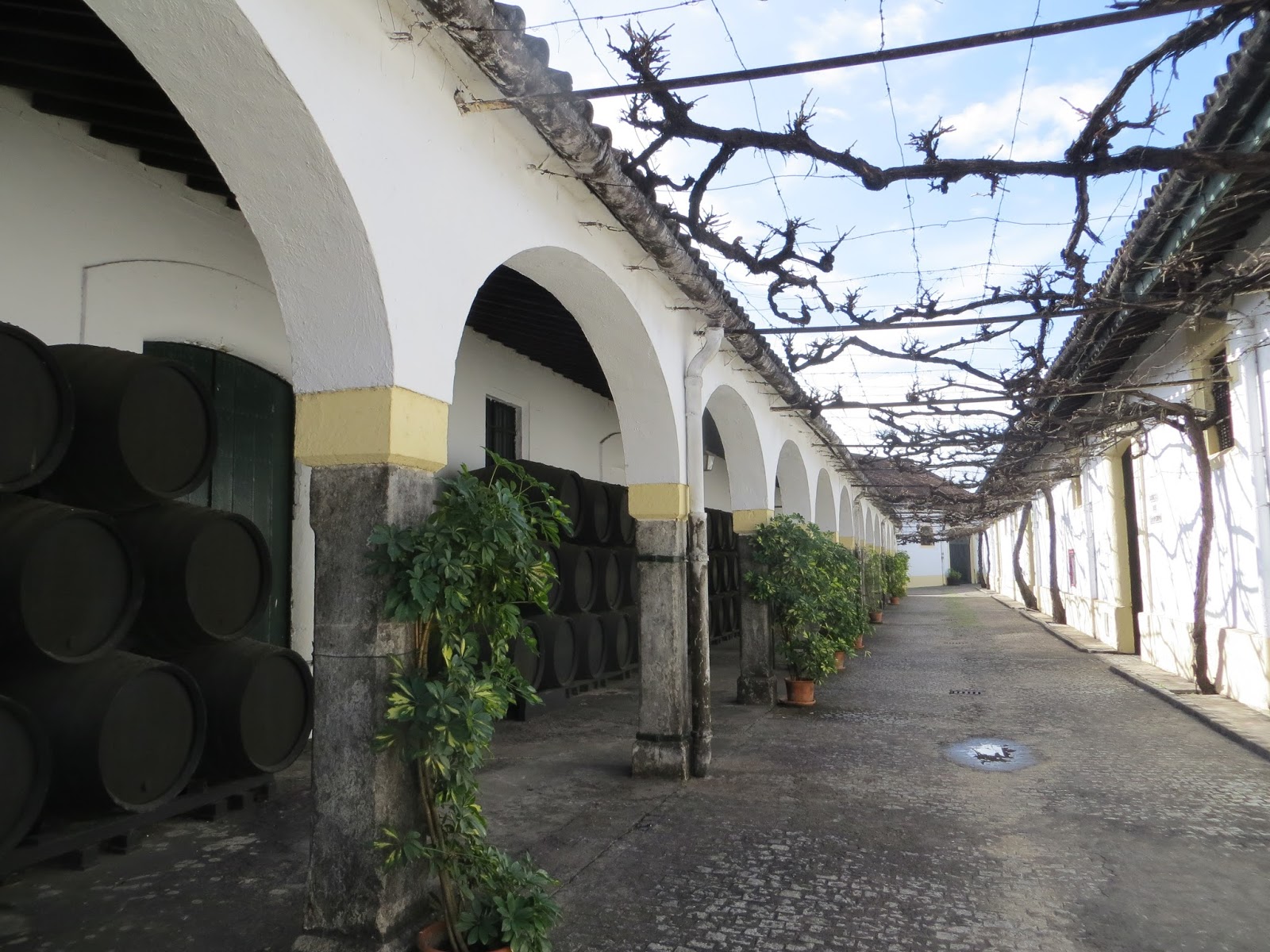
There are three main categories of sherry. The first is Vinos Generosos, which are the dry wines, Manzanillo, Fino, Amontillado, Oloroso and Palo Cortado, made from the Palomino grape. The last of these is only produced in small amounts, and it happens of its own accord when a Fino goes slightly astray, with extra yeast activity.
 |
| Bodegas Fundador, Pedro Domecq, Jerez |
The Palo Cortado is becoming very a popular type but, like the Fino and Manzanillo, it is too dry for me. These are probably the sherries to go for if you like your white wine to be a sauvignon blanc. If you're more into the fuller chardonnay, then you probably want the amontillado or oloroso. Personally, I like a nice rich flavour, so tend to go for the latter two, but I would choose a more aged one.
 |
| Bodegas Fundador, Pedro Domecq, Jerez |
The Pale Cream is the Fino, so it still has those fresher flavours, but a bit of sweetness too. The Medium has a very broad spectrum, but is typically the more rounded amontillado base. Then the Cream is the richest and sweetest, using the oloroso. The famous example of these is Harveys Bristol Cream, although it actually blends a number of the different wines together. We discovered here that all of these category should be served chilled, and the Creams should have a thin slice of orange, to really bring out the flavours.
 |
| Bodegas Fundador, Pedro Domecq, Jerez |

 |
| Bodegas Fundador, Pedro Domecq, Jerez |
 |
| Bodegas Fundador, Pedro Domecq, Jerez |
Sherry was one of the reasons we decided to come to Andalucia, and certainly why we came to Jerez, so of course we drank quite a lot of it here. We tried quite a lot just in the bars, but we also popped along to a few of the many wineries.
 |
| Lustau, Jerez |
 |
| Sandeman, Jerez |
Another was Bodegas Fundador, Pedro Domecq, which includes the brand names of Harveys and Terrys. This is a lovely winery, and being here out of season, we had the place to ourselves. They gave us a very interesting, informative and relaxed tour, which was a great introduction to the making of the wines.
 |
| Nic ready for wine at Sandeman, Jerez |
 |
| Sandeman, Jerez |
On which point, try to space out the tastings. We only did one a day, so we managed fewer wineries, but to be honest, we would have been in a pretty bad state if we had done multiple ones.
So there you have it. Sherry. Give it a try some time.
 |
| Sandeman, Jerez |
Thursday, August 11, 2016
Jerez - town and horses (Throwback post)
 |
| Jerez station |
 |
| Jerez |
There are a number of churches scattered around, and one shrine in particular (which is one of those that we found when we were lost so don't know which it is or where), which appeared to be dedicated to the healing of children.
 |
| Shrine, Jerez |
 |
| Jerez Castle |
The cathedral on the other hand, looked very impressive outside, but was unfortunately closed to visitors whenever we were there.
 |
| Jerez Cathedral |
 |
| Jerez Cathedral |
 |
| Equestrian Art School, Jerez |
When we were there at least, the training is not like a full rehearsal of a show, more a collection of different horses and riders practising different things at once, but it is interesting to watch them.
 |
| Equestrian Art School, Jerez |
 |
| Jerez bars |
We found a number of nice little places for tapas and drinks too. This is quite a traditional seeming place, so the tapas feel more classic somehow, less like they have been updated for urban trends or tourist expectations. And the guy still trundles his little barrowload of fresh seafood around to the bars, selling them by the cone.
 |
| Jerez bars |
 |
| Flamenco, Jerez |
 |
| Flamenco, Jerez |
One man, who must have been in his eighties at least, was very enthusiastic, clapping along, and getting up to dance too. I suspect that in his youth he was probably quite a good flamenco dancer, as he was pretty nifty even now, despite being obviously less nimble.
 |
| Jerez |
 |
| Jerez |
 |
| Jerez |
Subscribe to:
Posts (Atom)