Welcome to our travel blog. We are Tabitha and Nic. In 2011 we 'retired' in our early 40s and set off to travel the world. We spent our first year in South America and have been lucky enough to make two trips to Antarctica.

Our blog is a record of our travels, thoughts and experiences. It is not a guide book, but we do include some tips and information, so we hope that you may find it useful if you are planning to visit somewhere we have been. Or you may just find it interesting as a bit of armchair travel.


Showing posts with label gentoo penguin. Show all posts

Sunday, March 25, 2012

Jougla Point and Antarctic kayaking

Nic kayaking in Antarctica
In the afternoon, we were on the list for kayaking.  However as the wind had been quite strong, making the water a bit choppy, and as one of the people in the morning session had capsized, I figured I would be too nervous of, and therefore more likely to actually capsize myself, so I took my name off.

Nic did go though.  There was a group of about twenty people and he was in the back of a double kayak. They boarded them from the zodiac, which wasn't as rocky as he had expected. 
Antarctic iceberg
Unfortunately he couldn't find the rudder controls with his feet, so they just had to steer with the paddles, which made it a bit trickier when they had to avoid drifting bergy bits and bigger icebergs.

With only a couple of hours, they couldn't go that far, but they paddled around Goudier Island, close to the coast and past all of the penguins on land.

Leopard seal seen while kayaking
They were lucky to see a leopard seal jumping off a bit of ice in front of them.   Leopard seals are large carnivores that can be vicious if the mood takes them, and they have been known to have a go a the zodiacs, so it is as well that it decided to swim off while they were kayaking.


Antarctic ice
It was a tricky session at times, as it could be difficult to get through sea ice.  And when the wind turned very blowy and it started sleeting, it was difficult to turn the kayak, but they had to do so quickly to avoid an iceberg drifting in their path.  A few times, they had to just stay still to keep the kayak centered to avoid  getting an unscheduled dip in the icy water.


Nic was happy that he had been kayaking in Antarctica, and seeing the leopard seal was great, but as he said, in the main they didn't get far or see anything new, so I decided it wasn't worth the risk of falling in, and he decided it wasn't something he wanted to do again unless there were something especially good to see that you couldn't otherwise get to.


While Nic was off kayaking, I did the shore landing at Jougla Point.
This is on the main island near to the base, but is uninhabited - except of course by the penguins. 


On shore there is a reconstructed whale skeleton, and some other remnants from the days when the whalers were there, which gives the penguins some things to poke around.


They seem to like to have a few objects that they can jump on and peck at; it's sometimes like they use them as part of a game.  And that appears to include us sometimes as well.


I took advantage of others going off on a hike to wander around the point on my own and spend time watching the penguins.  You will hear about me doing that a lot during this trip, but the general consensus amongst most of our fellow passengers was that you just can't get bored watching penguins.

That is as long as you watch them properly.  Some do just sit around for ages, but especially with the gentoos, if you pick out a few of the more lively ones to watch for a while, you will soon become fascinated by them. 

One of the things that you will often see are the chicks chasing their parent around for a meal.  The chick is bigger than the adult at this stage, so it is funny to watch the chase and the parent telling the chick off for keep pestering it.

I also have a fascination for seeing their little footprints in the snow.  Whilst the idea may not be entirely pleasant, it always looked good when you could see the footprints better because they had been walking in the guano too.

As I was walking around, the weather, which had been windy but reasonable up until now, decided that it was time to remind us that we were in Antarctica, and suddenly turned very cold and started raining and sleeting.

I was very glad of my multiple layers.  I pulled my jacket hood up and tight around my face and did like the penguins do; I found a big rock to shelter behind and turned my back to the wind until the worst of it passed.  I also felt a little bit sorry for Nic out in his kayak.


Back on board, dinner tonight was an Antarctic barbecue.  The chef and his team provided an excellent meal out on the back deck.  Some of the guests collected their food but took it back into the dining room. We were having none of that. We wrapped up warm again and ate out on deck. It was a fun evening, though eventually the cold Antarctic wind set in and we all headed inside.

Monday, March 19, 2012

Port Lockroy

First sighting of penguins
Having arrived in Antarctica proper, we sailed through the Neumayer Channel  and dropped anchor at Wiencke Island.  Our first destination was the tiny Goudier Island at Port Lockroy, to visit Bransfield House, which is a former British Antarctic Station, now run preserved and run as a museum by the UK Antarctic Heritage Trust (UKAHT).
Penguins at Bransfield House
In the early 1900s, Port Lockroy was a whaling station, but during the Second World War, Britain established Base A as part of a secret naval operation.  After the war Bransfield House Base was staffed by small teams, with people each doing a stint of about two and a half years here.  This ended in the 1960s, when the place fell into disrepair.
Port Lockroy
The building was restored in 1996, and is now a historic site, cared for by three UKAHT staff who live here during the summer months to look after this and other historical sites, as well as running the post office and gift shop.  Yes that's right, even in Antarctica you can buy a T-shirt and send a postcard. Well, sometimes you can send a postcard, but I'll come back to that later.  This is one of the most popular stops on Antarctica trips, with around 17,000 visitors a year, because the big cruise ships can safely anchor here as well as the smaller ones like ours.  Of course being a tiny island, they limit it to 60 people ashore at once and no more than 350 in a day.
"How does this work then?"

Someone from the island came on board and told us about the place before we went ashore.  We were lucky that we were here today, as this being the end of the summer season, it was their last day before being picked up and taken out of Antarctica.

Of course while we were all interested in the base, generally people were more excited to already be able to see the tiny looking penguins on the shore, especially those who had not yet had the chance to see a penguin in the wild.

Zodiacs being floated 
As this was our first shore landing, we weren't entirely sure what to expect.  Despite this being the summer, it is of course still on the chilly side, so we had wrapped up warm.  Thermals, trousers and shirt, fleece, waterproofs, two pairs of socks, gloves and glove liners, scarf and hat were the required wearing, along with a pair of heavy duty wellies supplied on board.  Stylish, no, but they mostly kept us dry and if not always warm then at least not really cold.  Add the inflatable life vest, and we just had to turn our cards to show that we were off the ship, wash and dip our boots in the disinfectant, and we were ready to start boarding the zodiacs.
gentoo

Now getting onto a small zodiac from the steps of a much larger ship can be something of a challenge when the sea is entirely calm, but the crew did a fantastic job of helping us all in and out and thankfully no one went for an unscheduled swim.  The zodiacs were sometimes driven by crew members and other times by the expedition team, and they all got us around safely, though I was slightly concerned when, on one of the rougher trips, the driver counted us before we set off, as off he was concerned about whether he would still have us all in the boat at the other end!

Penguin pecking Tabitha
But today was reasonably calm, and we made it across dry and eager for our first landing.  The island is also home to a colony of Gentoo penguins, and as soon as we climbed up the rocks at the landing site, we saw our first Antarctic penguins close up.  The gentoos here are generally a little smaller than those we saw on the Falklands, and while they are curious, they are not generally quite as bold as their more northerly cousins.  That said they happily live amongst the base and the remnants of the old whaling station, and don't seem at all bothered to have a few visitors wandering around.
Penguin pecking me
The rule here is generally to try not to approach closer than five metres to a penguin, although it is fine if they come to you.  However this was clearly impossible right from the start as walking along the pathway they we all around you.  You would try to skirt around one, only to find yourself right next to another one that was behind a rock.  But again, they don't seem to mind, and you just try harder to avoid the ones that look a bit skittish.
'Flapped' by a penguin
It didn't take long before the first one had taken a quick peck at my boots.  However I was less prepared for the one that, having come up to me, started squawking around me.  If I had gone close to it, I would have thought I had scared it, but it came up to me, and it didn't seem scared.  And doubtless one of the expedition team would have told me if they thought I was bothering it at all. It took a few pecks at me, but also started flapping it's wing fast and beating it against my leg.  I didn't like to try to walk away, as I was concerned that with it moving around me, I might accidentally kick it, so I just stood there.  It soon got fed up and wandered off, but I have know idea why it did it.  It presumably wasn't personal though, as it did it to a few people too.

We did drag ourselves away from the penguins for long enough to look around Bransfield House.  We managed to pick up a couple of bits in the gift shop, but sadly couldn't make use of the post office to send our postcards as the last post boat had already for this year, and they wouldn't now be picked up until November.  We did however manage to get our passports stamped, which pleased us.

Wednesday, March 14, 2012

Volunteer Point and King Penguins

King penguins
On Valentine's Day we took a trip to Volunteer Point where there is a large King Penguin colony.

It was a few hours of driving and on the way Derek our guide also pointed out some of the locations that were in the headlines in 1982, such as Mount Longdon, where Victoria cross winner Sgt McKay was killed, Mount Harriet, and Tumbledown. We didn't take time out to walk around these old battlegrounds, but had we done so, we would still have been able to find the debris of war, such as bullet shells, blankets, boots and even an old shaving kit. Seeing the areas for ourselves, it was clear how difficult the British attack would have been as there was little cover and the terrain was rough going.
King penguin

After around three hours of driving over rough roads first and then bumpy tracks across the boggy fields, we arrived at volunteer point. A few of the king penguins were hanging around the white sandy beach, but most of the colony was at the rookery slightly inland. At last count the were around 750 adults and 550 chicks, so this is a large and successful colony.

King penguin with its egg
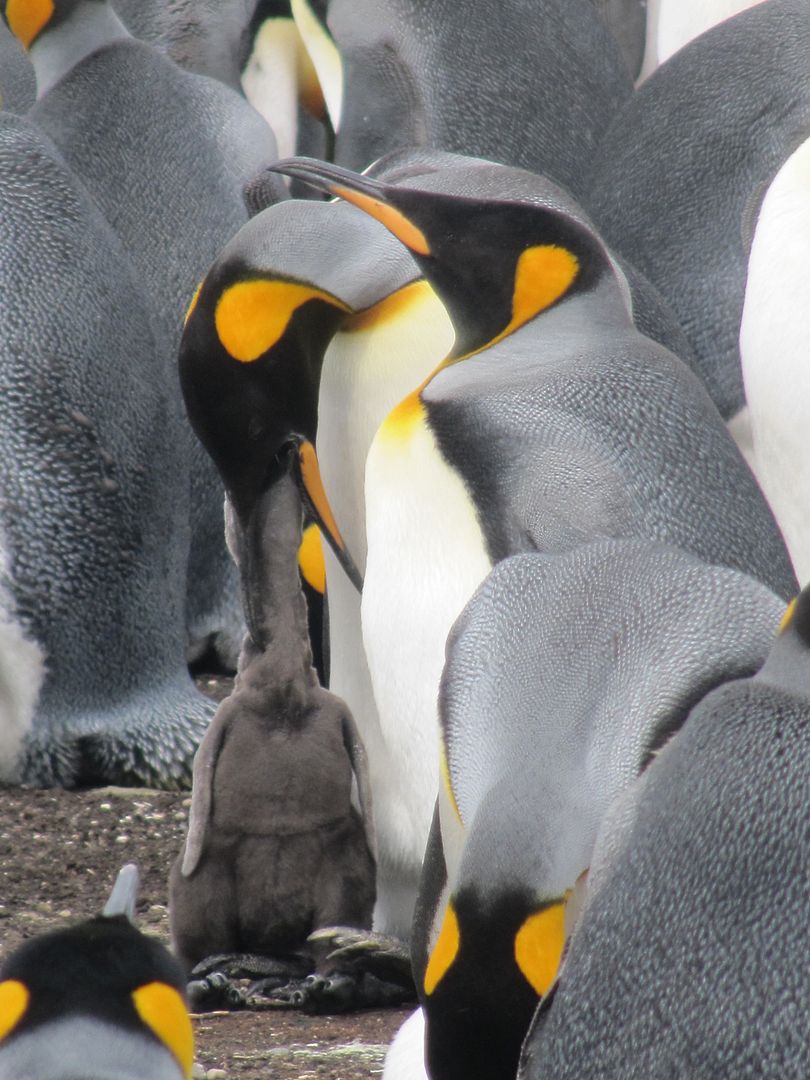
Kings only breed twice every three years so the breeding season is variable. We happened to hit a period when there was a mix of incubating eggs and young chicks. It was fascinating to see the adult males shuffling around with their egg or protecting their little brown chicks.


King feeding its chick

It was slightly strange watching them feed their chicks though as it almost looks like the adult has swallowed the chicks head entirely as it regurgitates the food for it.

We did also manage to spot one large fluffy brown chick which would have been a straggler from the last breeding season that had not yet developed its sleeker black and white plumage.

King penguin year old chick

Because the king penguins can abandon a chick if disturbed, there is a ring of white stones around the main rookery, which people do not cross. This way the penguins are content, but we can still enjoy watching them.

The kings are bigger than the other penguins we have seen, and they emphasize this even more as they generally walk high on their legs, rather than shuffling along as the others tend to. They do have a more imposing stance and their orange markings on their head and chest look most impressive.
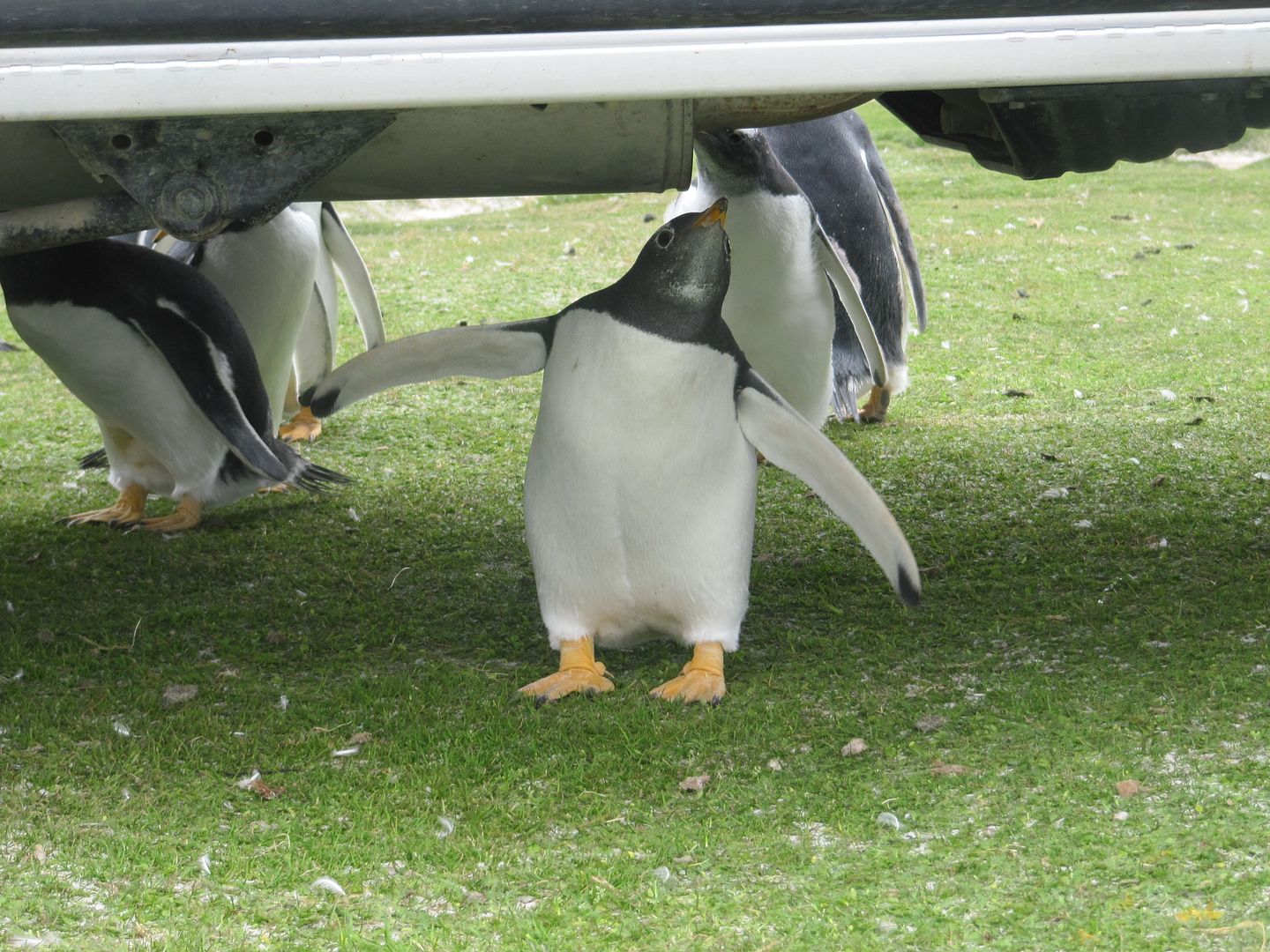
Gentoos playing under the vehicles
We watched the kings for quite a while before retreating out of the wind to the 4x4 to eat our lunch. As we sat in the vehicle, we were amused to watch the gentoos playing around it and the other one nearby. You could hear them underneath, pecking away at anything that stuck out. When we got out again, I sat down near the vehicles, watching them running around beneath them.

Gentoo pecking Tabitha
And I soon got a black and white visitor myself. After a couple of tentative approaches, the little penguin came up to me and started pecking at the tab on my fleece pocket. Having concluded that this wasn't anything to eat or worry about, it started at my trousers. It then bent down and pushed its head right underneath my outstretched leg, to see if I was hiding anything there. Finally it went around the back of me and started pecking at the top of my trouser waistband. Inevitable it got my back too, which tickled. It stayed with me for quite a while, until its friends all ran of to some new adventure and it followed them. As this one was so inquisitive, I was glad that it was also gentle, as one earlier had taken a few pecks that were a little too enthusiastic!

Of course aside from being pecked a bit too vigorously, the thing that you need to be careful of with the penguins is their projectile pooing. They stand there all innocently, then suddenly lift their tail and squirt out a stream of poo that extends over a foot behind them. Thankfully we were never in the firing line, but we know a person who was, albeit not here. And penguin poo is very smelly.

Monday, March 12, 2012

Pebble's Penguins and Petrels

Fire trailer on Pebble Island
In the morning, we were taking a tour of the west side of the island with Jackie. But first it was the airstrip run as Alan and two other guests were flying out today. There are always two of the islanders that go to the airstrip, and they have multiple responsibilities. First the airsock has to go up, and they call in the wind speed and direction to the base at Stanley. Next there is the job of driving over the airstrip and chasing away any sheep, birds, horses or anything else that might get in the way of the plane. Then they have to hitch a fire trailer up to the 4x4 and be ready to act as fire crew should there be any incident in landing or takeoff.

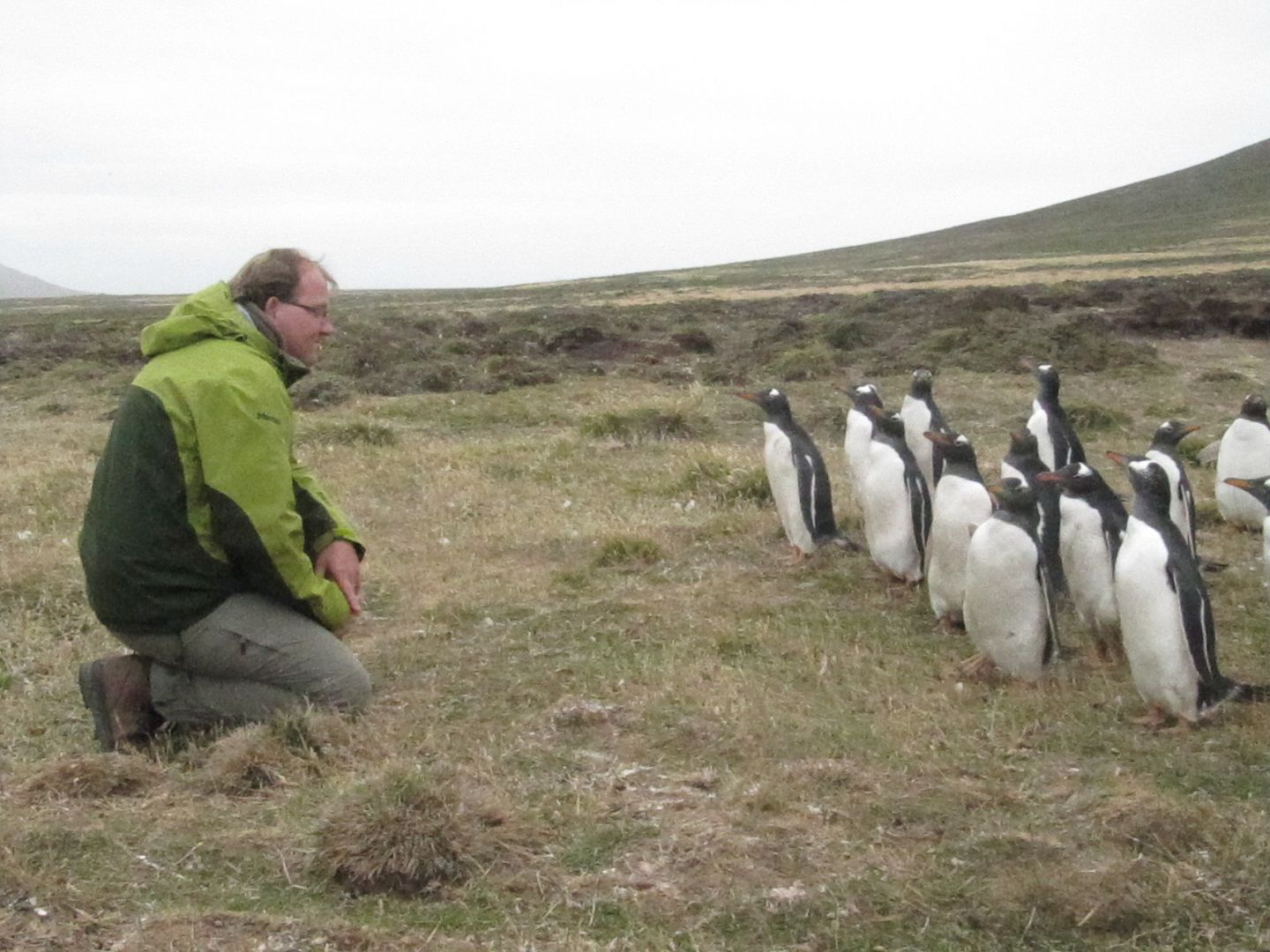
Nic with the starting line of gentoos
Air duties complete and the plane safely back in the air, we set off for the tour. There was quite a lot of driving involved today and Jackie had to negotiate her way over some tricky ditches and streams.

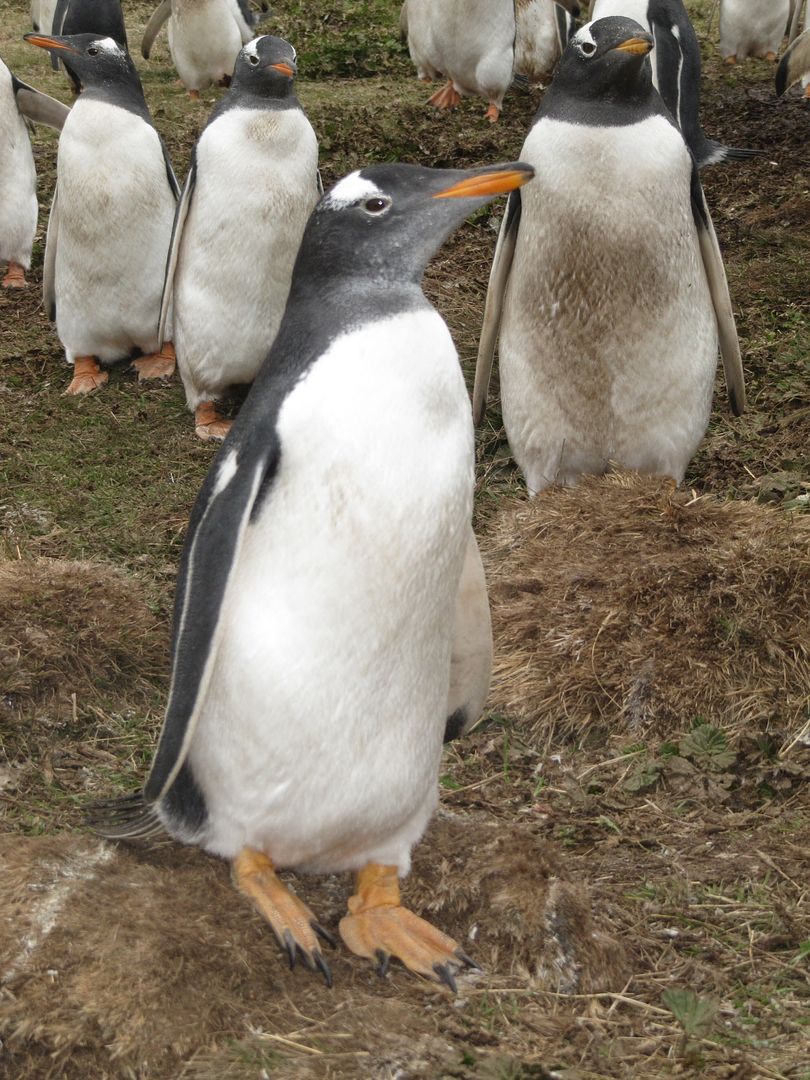
Our first stop today was the Gentoo penguin colony. Their site here is some way inland but they had created themselves a little mud bath to splash around in and many of them were filthy.

Gentoos on Pebble Island
It fascinated us the way that they would run from us initially, and then how a group of them would gradually edge back towards us in a little line.

They would stop a few metres away, until one would bravely take another step or two, and the others would follow suit. This would continue until they were quite close and then, especially if you had got down to their level, perhaps the boldest would come right up to us and maybe take a little peck to check us out. Thankfully they were usually quite gentle in their pecking, and usually their would go for the boots, trouser legs, or the tabs on the zip of the fleece.
Moulting rockhopper

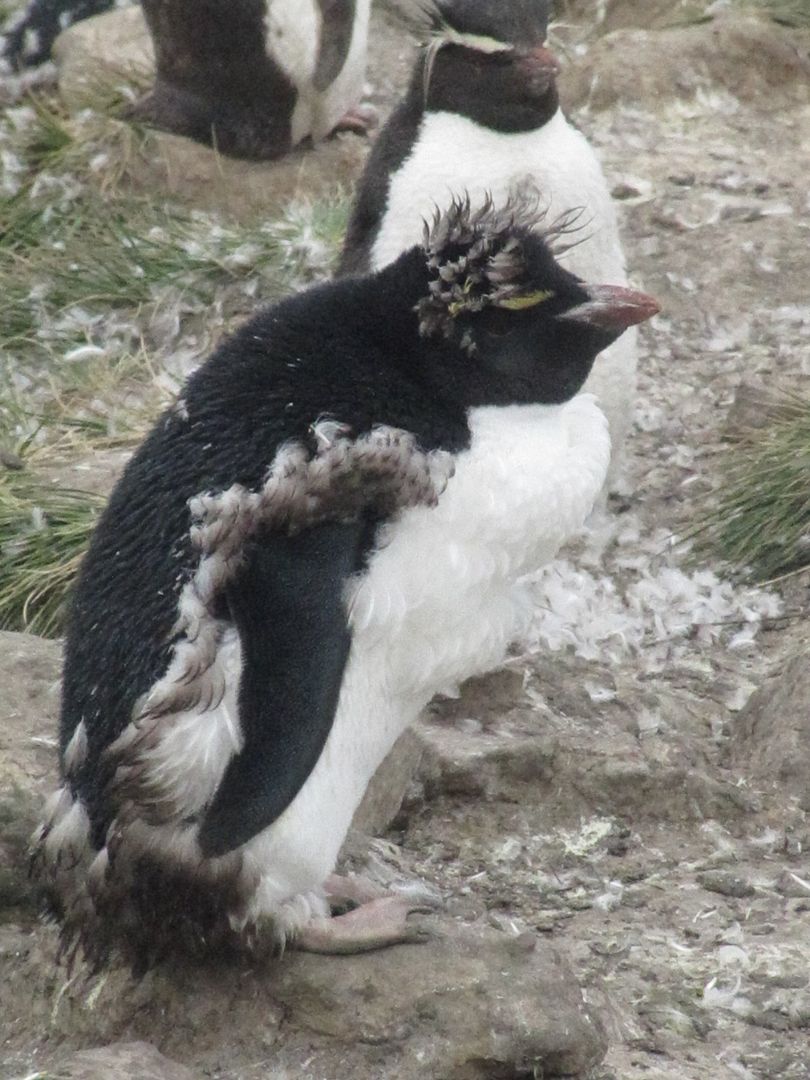
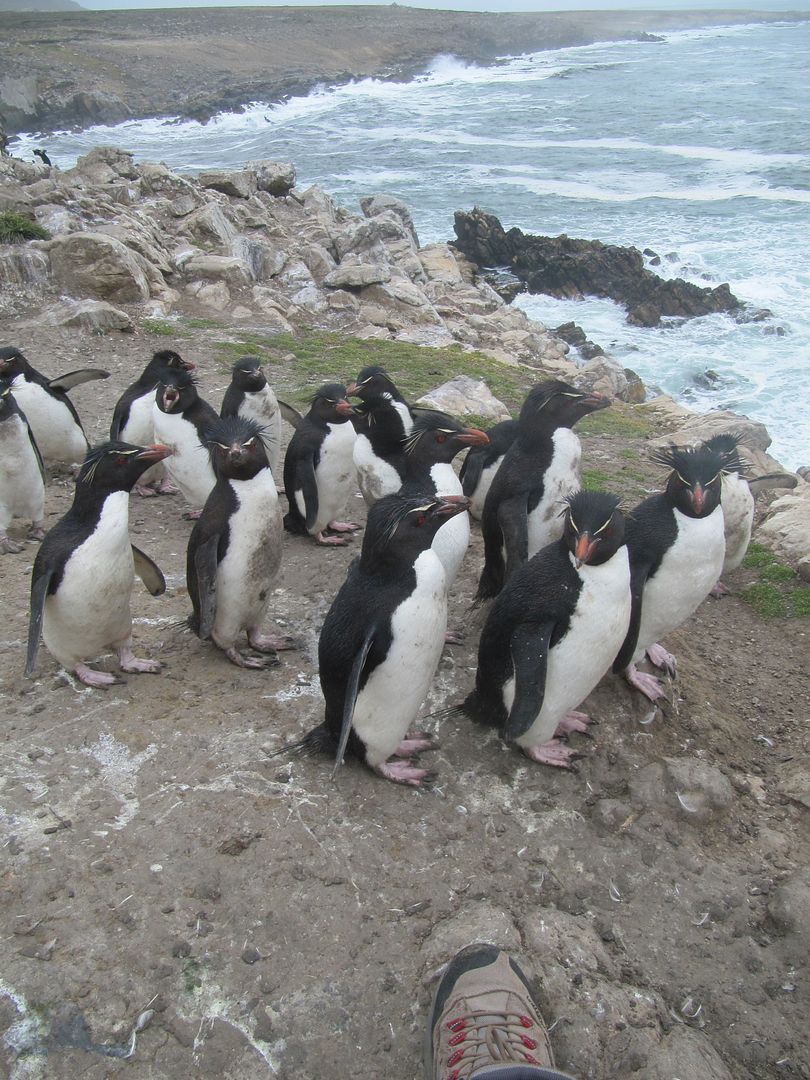
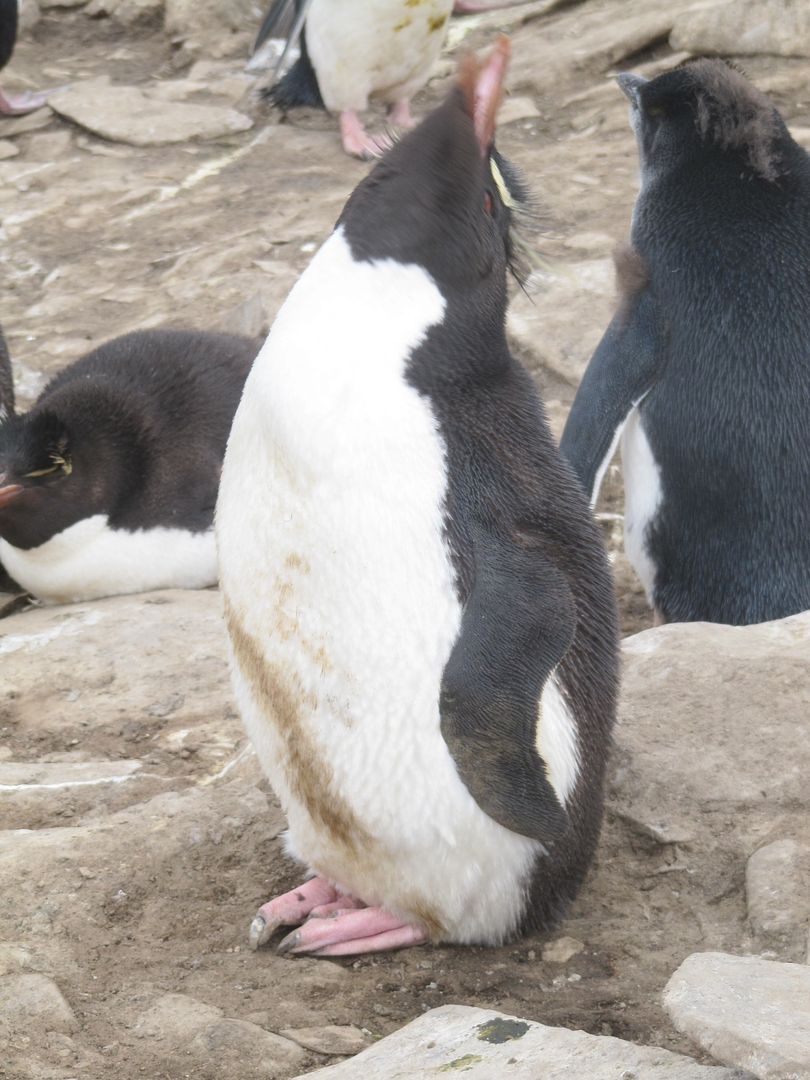
From the Gentoos, we drive on to the huge colony of rockhoppers on Pebble. Their route down to the sea is steep and fairly precarious, but they manage it quite impressively. The even more impressive thing though is that they don’t get smashed on the rocks at the bottom; the waves crash into the coast very strongly, and it is a wonder that the little penguins make it in and out of the sea in one piece.   Many of the penguins are still moulting so can't go out to sea yet, and they stay at the nest site.  They do look amusing in their various stages of shedding their fluffy feathers, and the ground around them looks like it has been snowing.

Rockhoppers passing by
Having spent some time round the nests, I wandered over to the route that the penguins take down to the sea. I sat down on some low rocks alongside their normal path and waited until some came along. Initially those that came through took a wide berth around me, but soon a small group started to gather a short distance away. They appeared to be getting up the numbers and courage to walk right by me. They hesitated for a while, but then one seemed to take the lead and they all marched by. They kept pretty close together, and the last one was keen not to be left behind, but they made it through and from then on the little rockhoppers seemed quite happy to waddle past me.

Argentine Learjet memorial & graves
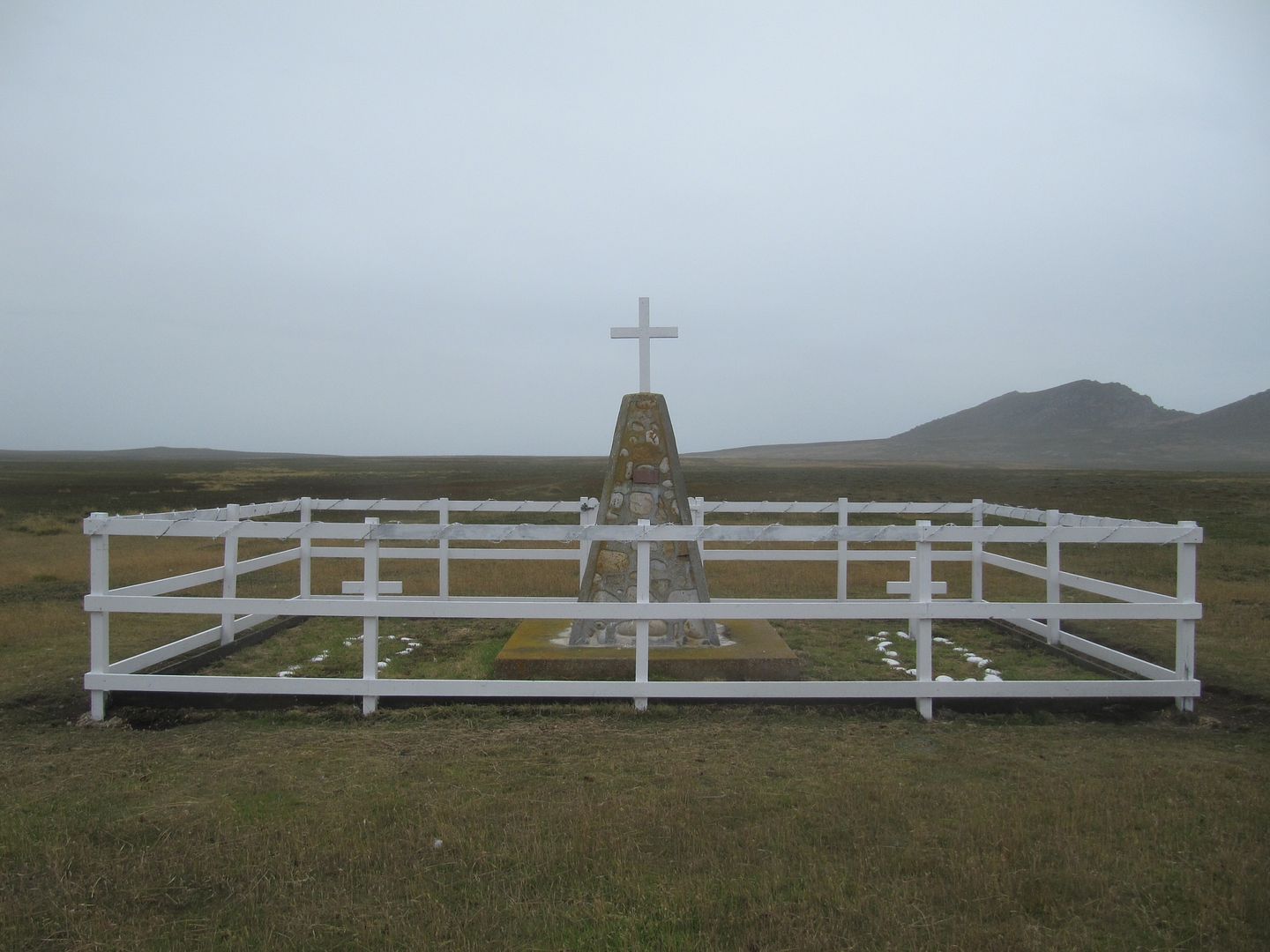
Our next stop was the site where an Argentine Learjet was shot down in the conflict. While all deaths in war are regrettable, this was more poignant for the fact that when the plane was hit it didn't explode, so the five crew on board were alive and conscious as it plunged to the ground. The radio operators could hear their screams all the way until the plane crashed down. The remains of the bodies that were found at the time were buried in the Argentine cemetery in a single grave with all five names, but years later an especially dry spell revealed some parts of the plane in a boggy area, and more remains were found. These were buried at the memorial, and again all five names were listed. I think it is a testament to the people who were on Pebble Island, who were held captive in the lodge during the conflict, that they have maintained this site as well as those to the British casualties.

Flightless Steamer Ducks

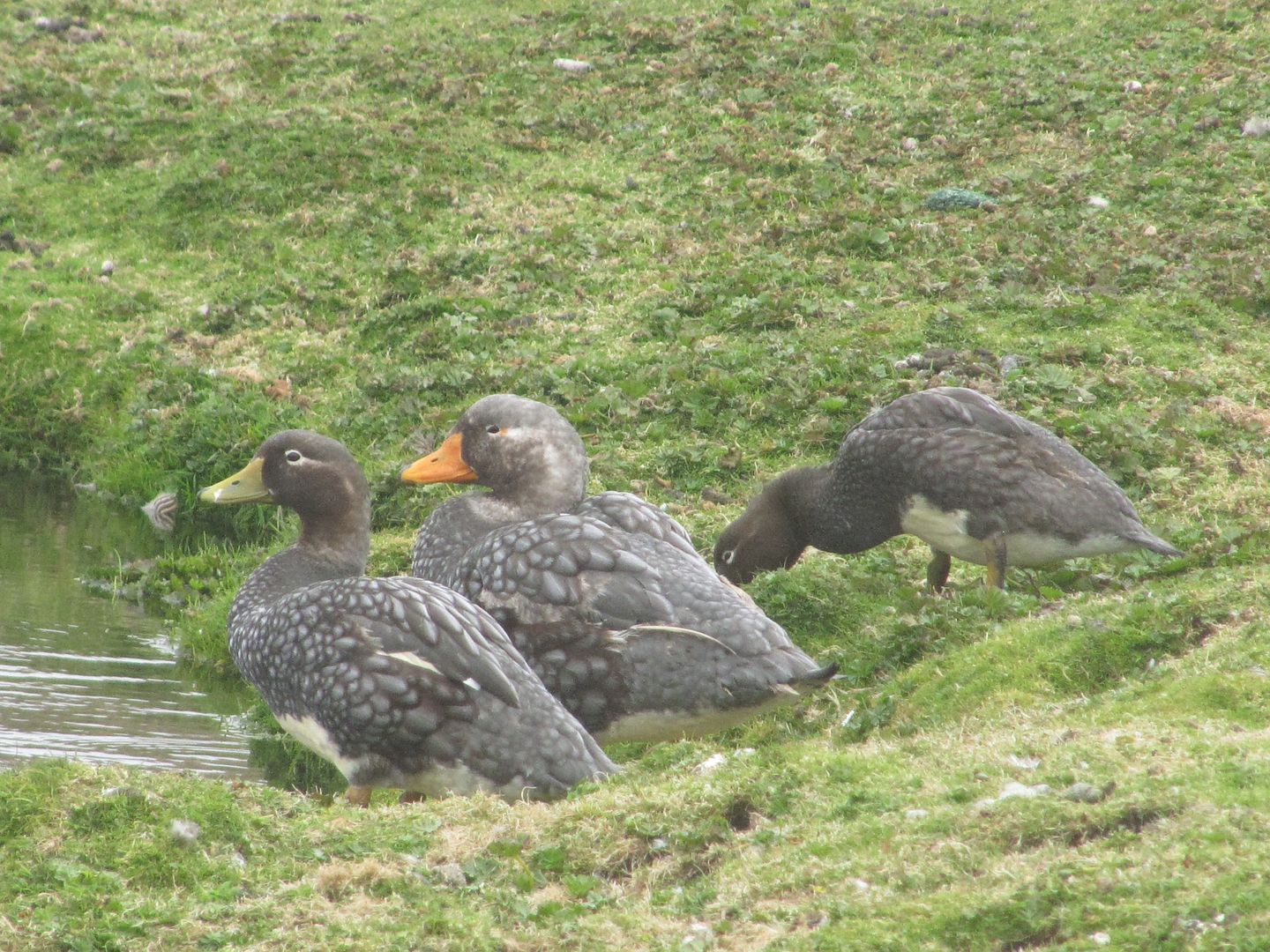
From here we drove down to the shore passing a group of steamer ducks. There are two types of steamer ducks, the flightless ones and ones that can fly. Jackie thought these were the flightless ones but as there is very little difference, the only way to be sure which you are seeing is if it starts to fly. These didn't fly but they may just not have felt like it!

Great Southern Petrels

On the beach we found more gentoos, before driving up the steep bank to watch the Great Southern Petrels.  These large birds look rather ungainly on the land, especially as they run to take off, but once in the air they move rather more elegantly, even if they do look a bit like a lancaster bomber to me.


HMS Coventry Memorial
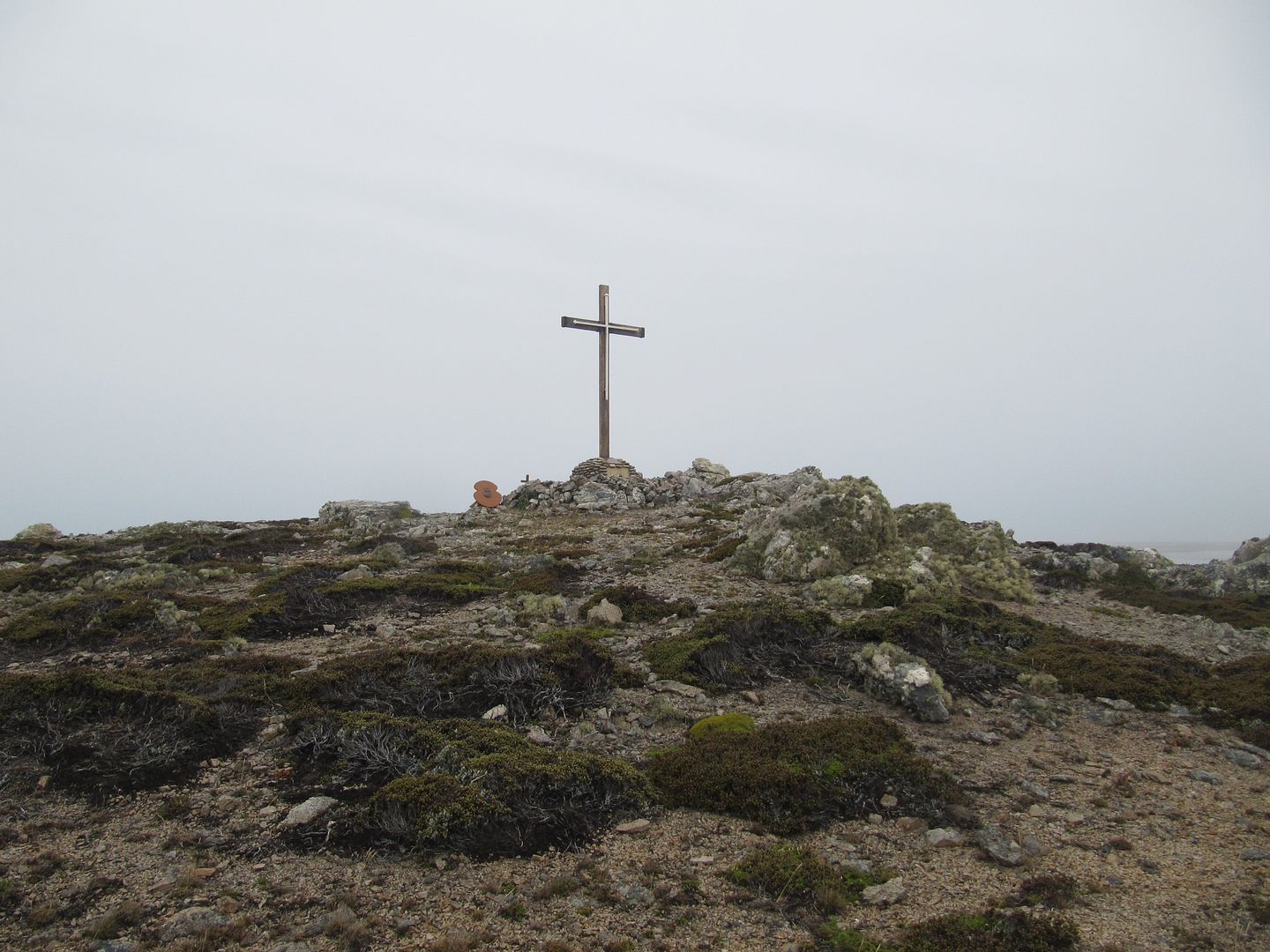
On the way back we stopped off at the memorial to HMS Coventry, which sits up on the side of First Mountain, overlooking the place that the ship went down on 25 May 1982. It had been there on radar picket duty and was effectively attracting fire away from other ships. It had successfully shot down attackers all day but finally got caught out by a sudden attack. The ship capsized in less than half an hour, killing 19 men, two of them Chinese laundry workers. The last person to leave the ship was the Captain, David Hart-Dyke (father of comedian Miranda Hart), who spent years coming to terms with the loss of the ship and the lives of some its crew. The memorial was built in 1983 by ex Coventry crew members.
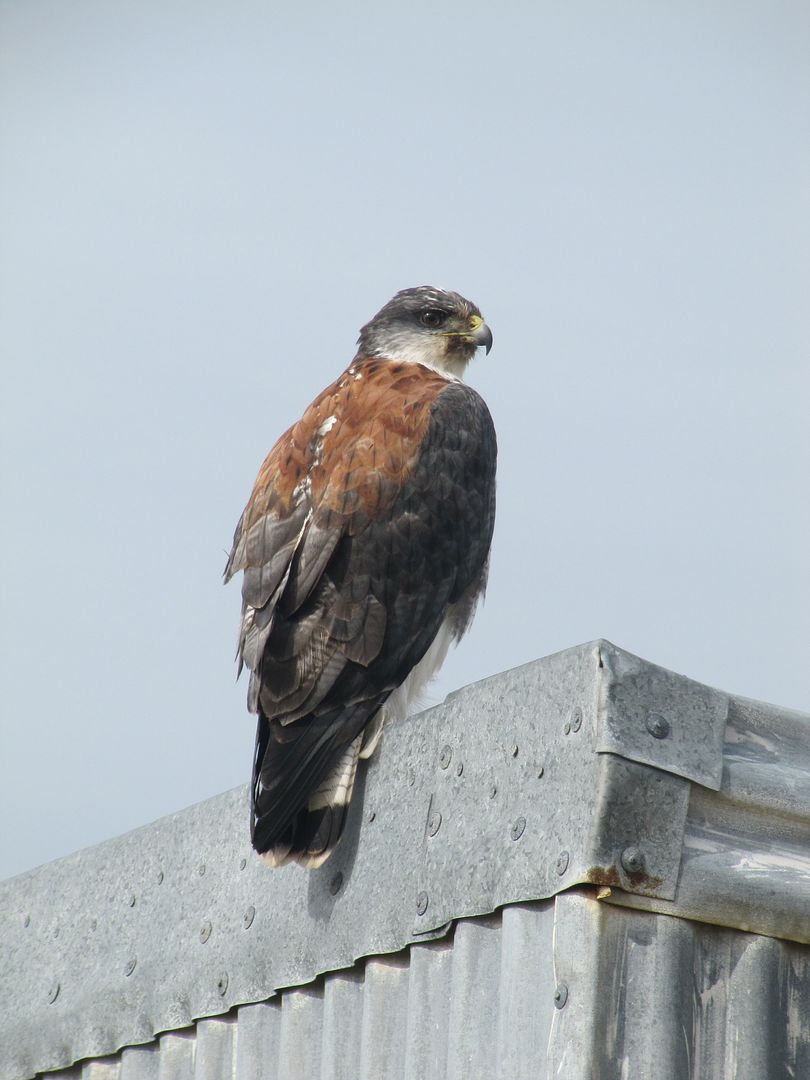
Variable Hawk
And for any bird lovers reading I'll include the picture of the other bird that we saw that I know the name of.  It is a variable hawk.  It was originally called a red backed hawk but that got confusing as the hawks are different colours depending on their age, gender and the season.  This one does have a red back so is apparently an adult female in her dark phase.  And that is probably the last bit of proper birding information you can expect from me!

Sunday, February 26, 2012

More of Sea Lion Island

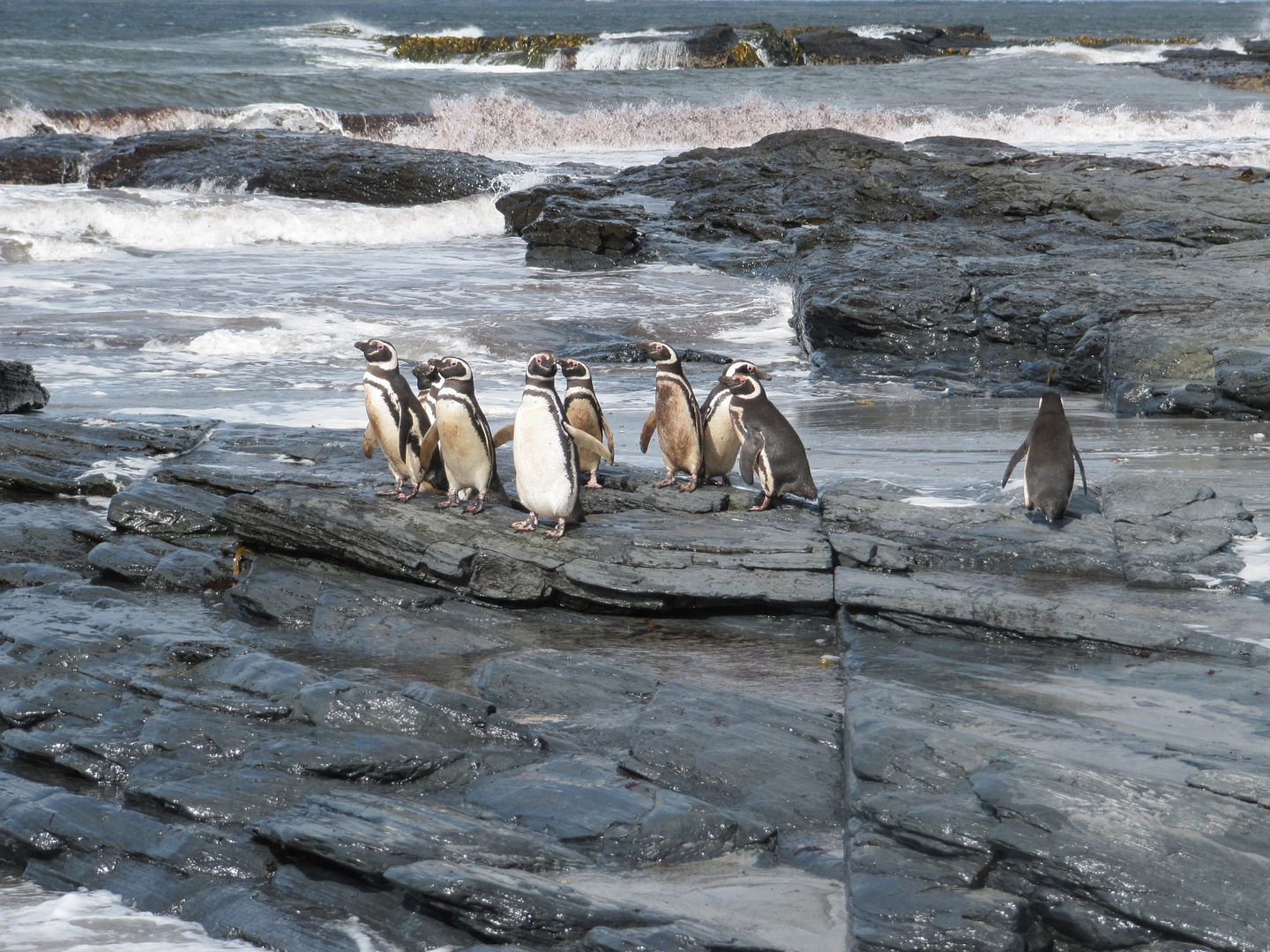
Magellanic penguins
After the tour around the island the first day, our plan was to walk around it the second day, and spend a bit longer with the penguins.  We set off after breakfast with our packed lunches,and plenty of layers to fight off the rather cold wind that always seems to be blowing through the islands.
We walked over to the beach where the elephant seals and magellanic penguins would be, and where you can sometimes see orcas out looking for a meal.  There were no orcas out today though.
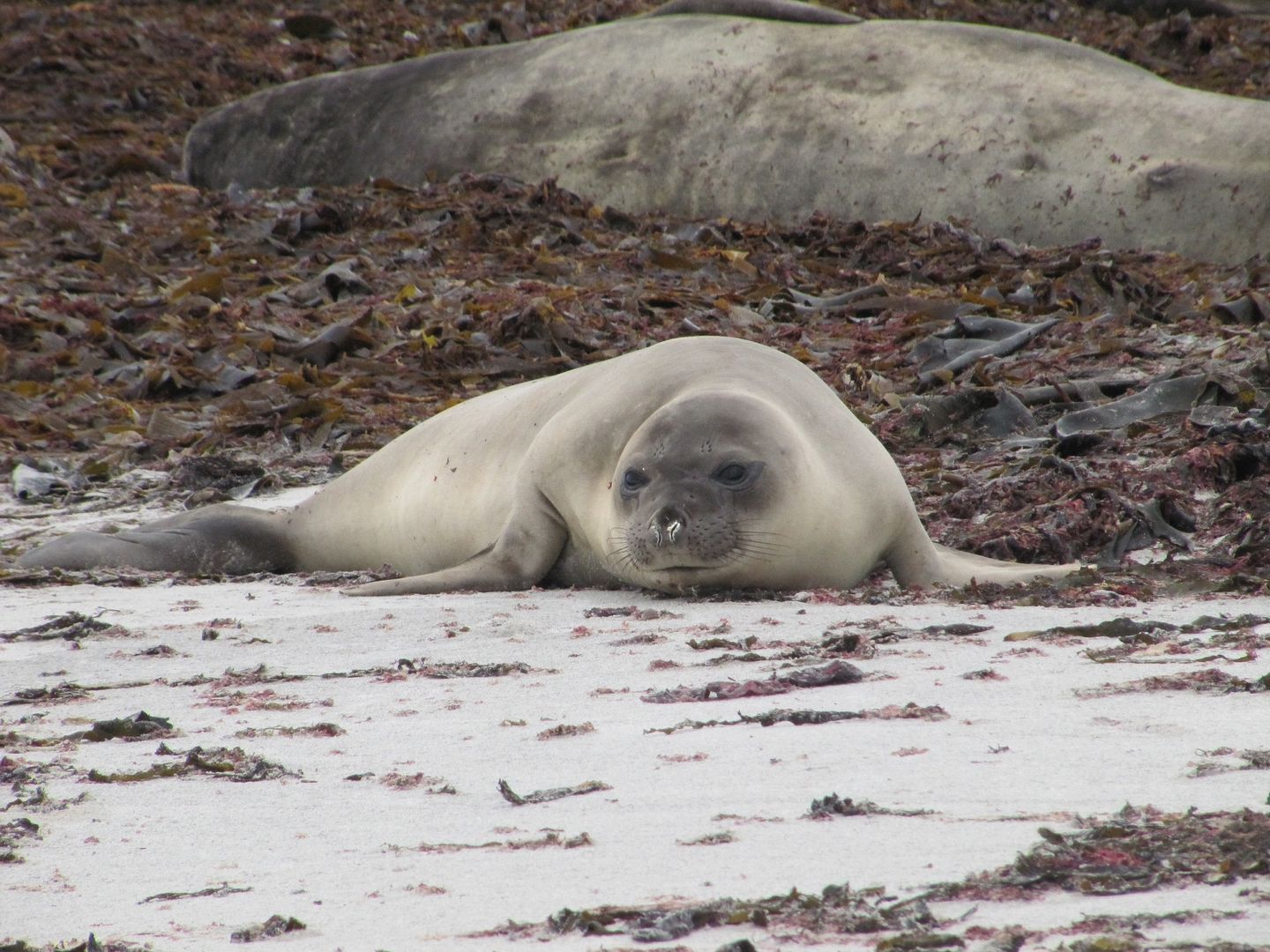
Elephant seal

The magellanics kept their distance - they do seem to be the most timid and least friendly of the penguins we've encountered so far - but it was still good to watch them hovering around the water's edge, apparently not being entirely sure whether or not they wanted to take the plunge into the cold sea.
There were a lot of elephant seals out on the beach, some of them huge ones.  You have to be careful as you approach them because if you don't look carefully you can mistake them for a rock and end up getting too close for comfort.
Elephant seals squaring up
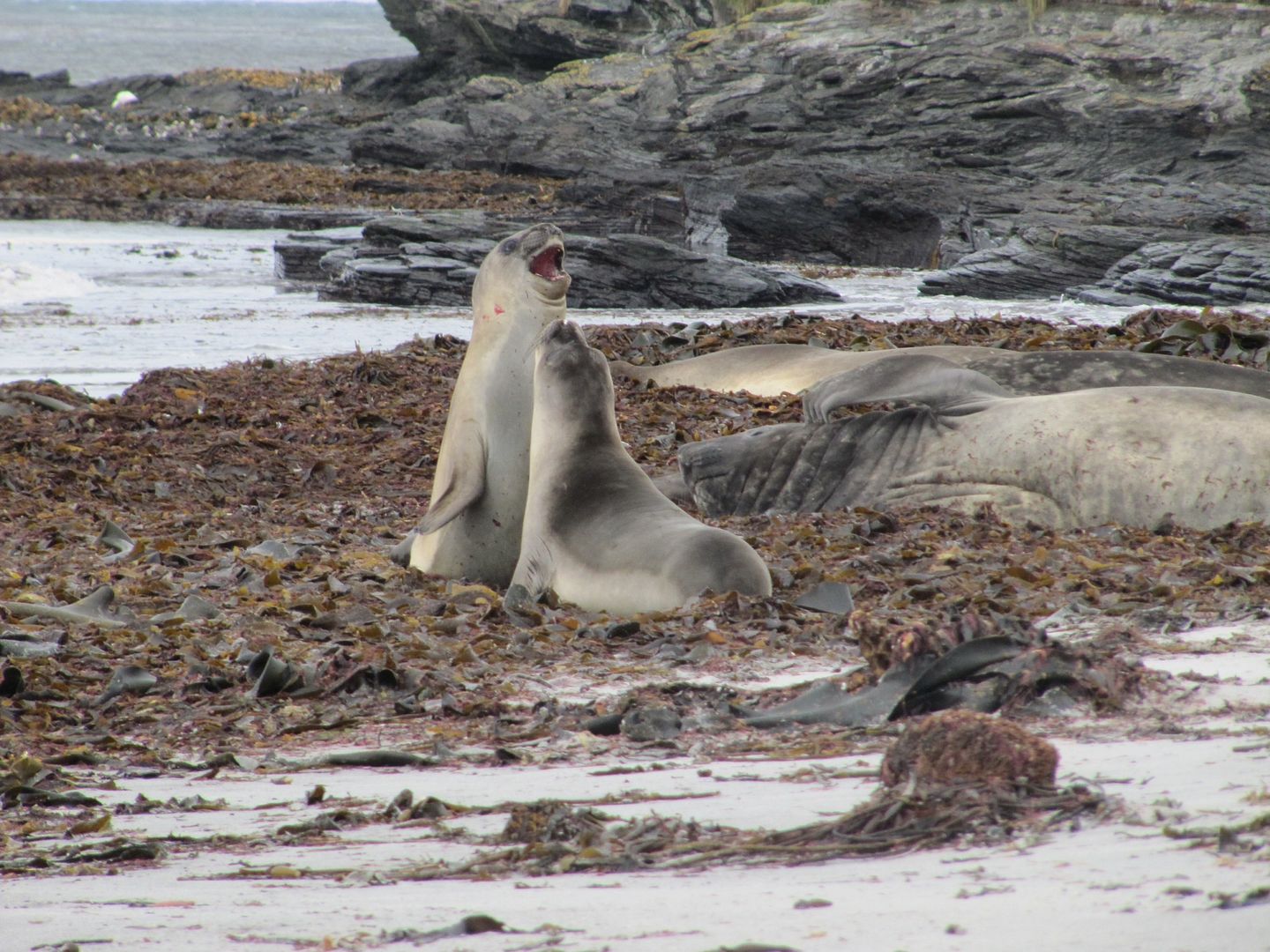
We watched a couple of seals get into a bit of a tiff and start growling and barking (or whatever seals do) at each other.  They don't seem like they would be able to do a great deal of damage in a fight, as they just face up to each other and bite, but in fact they are quite powerful and even though this seemed more like a spat than an all out fight, they drew blood.  They settled down after a while though, presumably having established an appropriate pecking order.

Diddle dee
We were just going back up the beach with the intention of walking over to the other side of the island to the rockhoppers, when it started to rain.  It rained hard and at some point at least it hailed.  Now I had my waterproof trousers on, but Nic had decided not to bother, and he in particular was getting really quite wet. So we decided that as the lodge wasn't far away, we would retreat to give the rain a chance to pass over, and for Nic to dry out. 
Snipe
We stayed at the lodge for lunch and set out again in the afternoon.
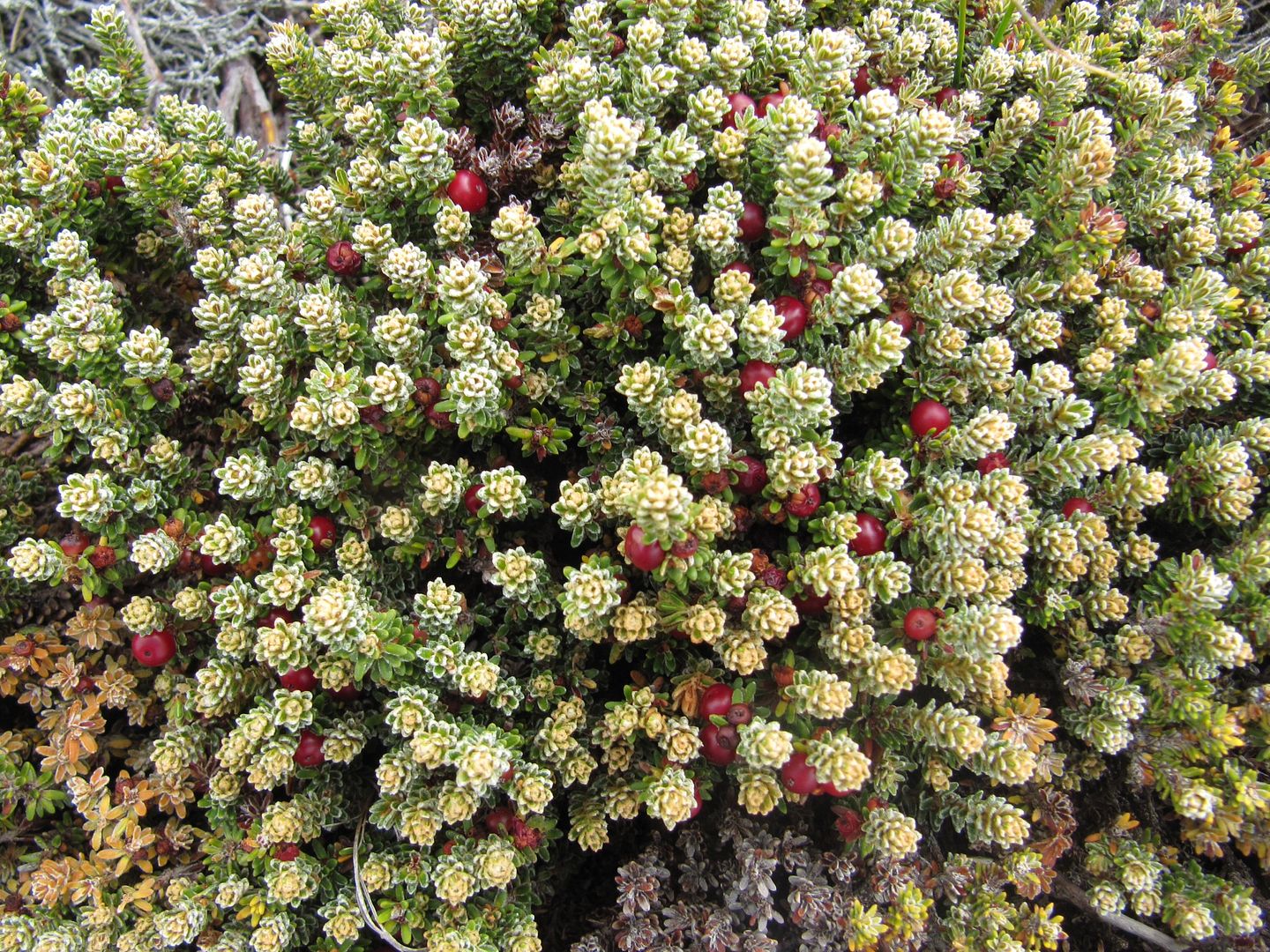
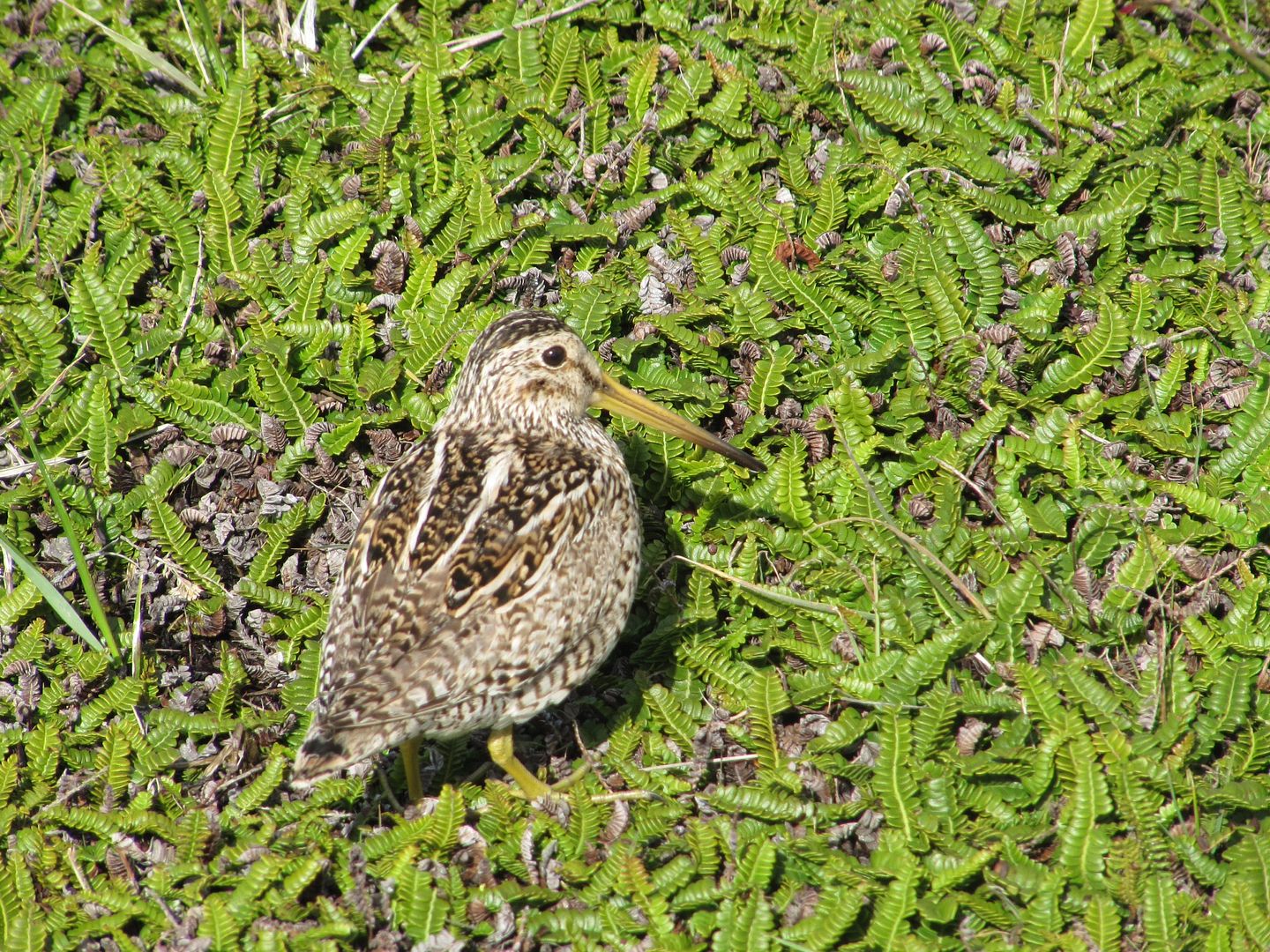
Although the other birds along the way weren't our main interest, we were at least able to recognise a few of the main types found here.  There are the little snipes that run around in amongst the grasses and the diddle dee, the bigger striated and crested caracaras, and the even bigger turkey vultures.  We had no idea what most of the others were, but never mind.
Nic in the tussac grass

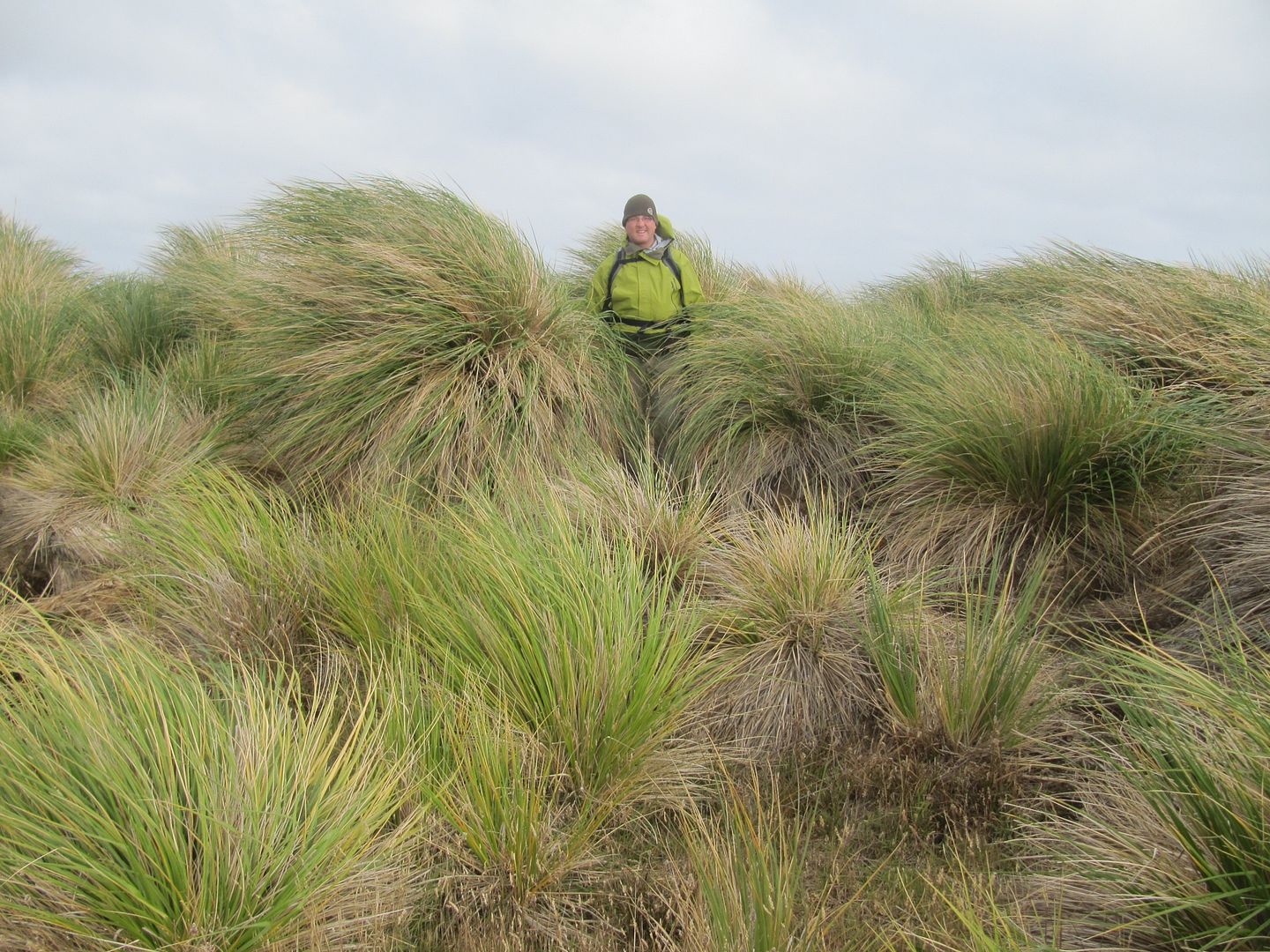
This time we did make it the two and a half miles to the rockhoppers.  We took the longer route around as we had been warned that it is possible to get horribly lost in the huge tussac grass.  Seeing the size and expensive of it for ourselves, we could see the potential for trouble so kept well away.

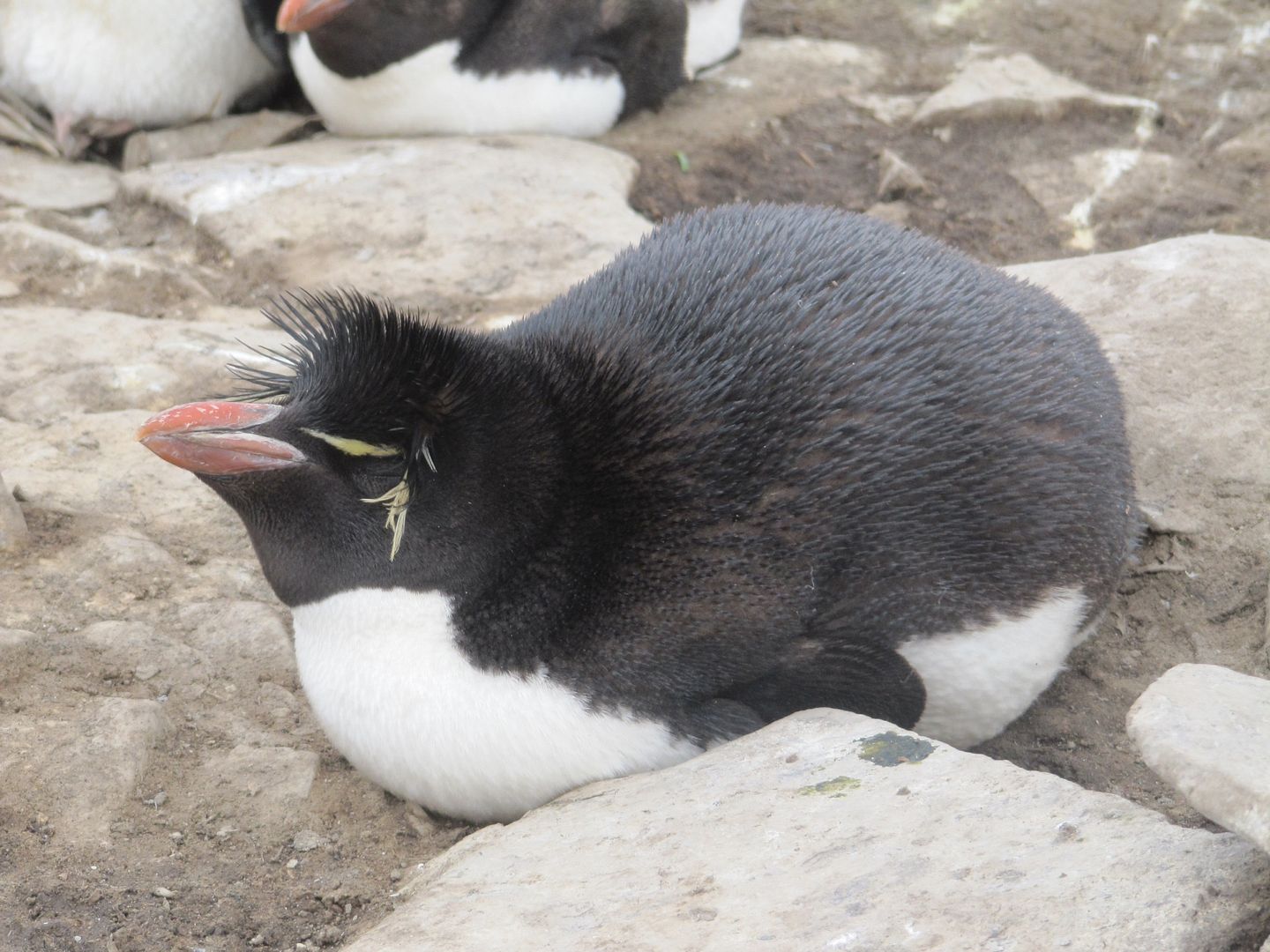
Rockhopper calling

The rockhoppers are probably the cutest looking of the penguins here and it is fascinating the way they hop along and over the rocky area they choose to make their home on.  Most of the ones here are the chicks, not yet ready to go out to sea themselves.  There are some adults standing guard, but most are out getting dinner for the little ones.


Rockhopper penguin
At this time of year, the young ones are grown to full size and are in various stages of shedding their downy feathers and growing their distinctive yellow tufts.  A few are at the unfortunate point where they have lost all the fluffy feathers from their head and neck, but none from the rest of their body, which gives them that baldy look like turkeys or vultures.

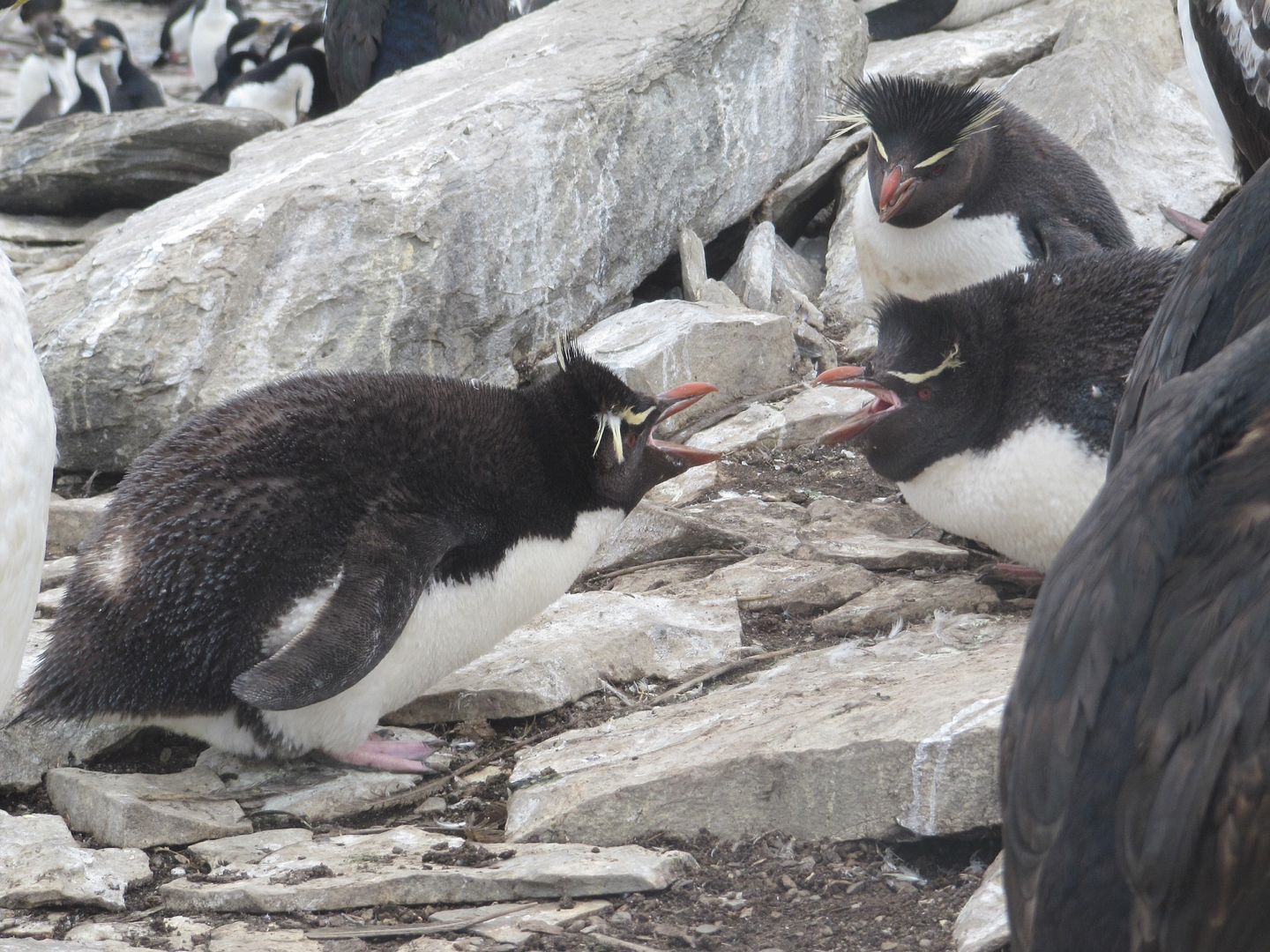
Rockhopper penguin spat
The rockhoppers generally appeared to be quite placid creatures.  Every so often there will be a territorial spat or some other disagreement, but mostly they stayed huddled on their own space, puffing themselves up a little to keep out the wind, and just quietly looked around to see what was going on.
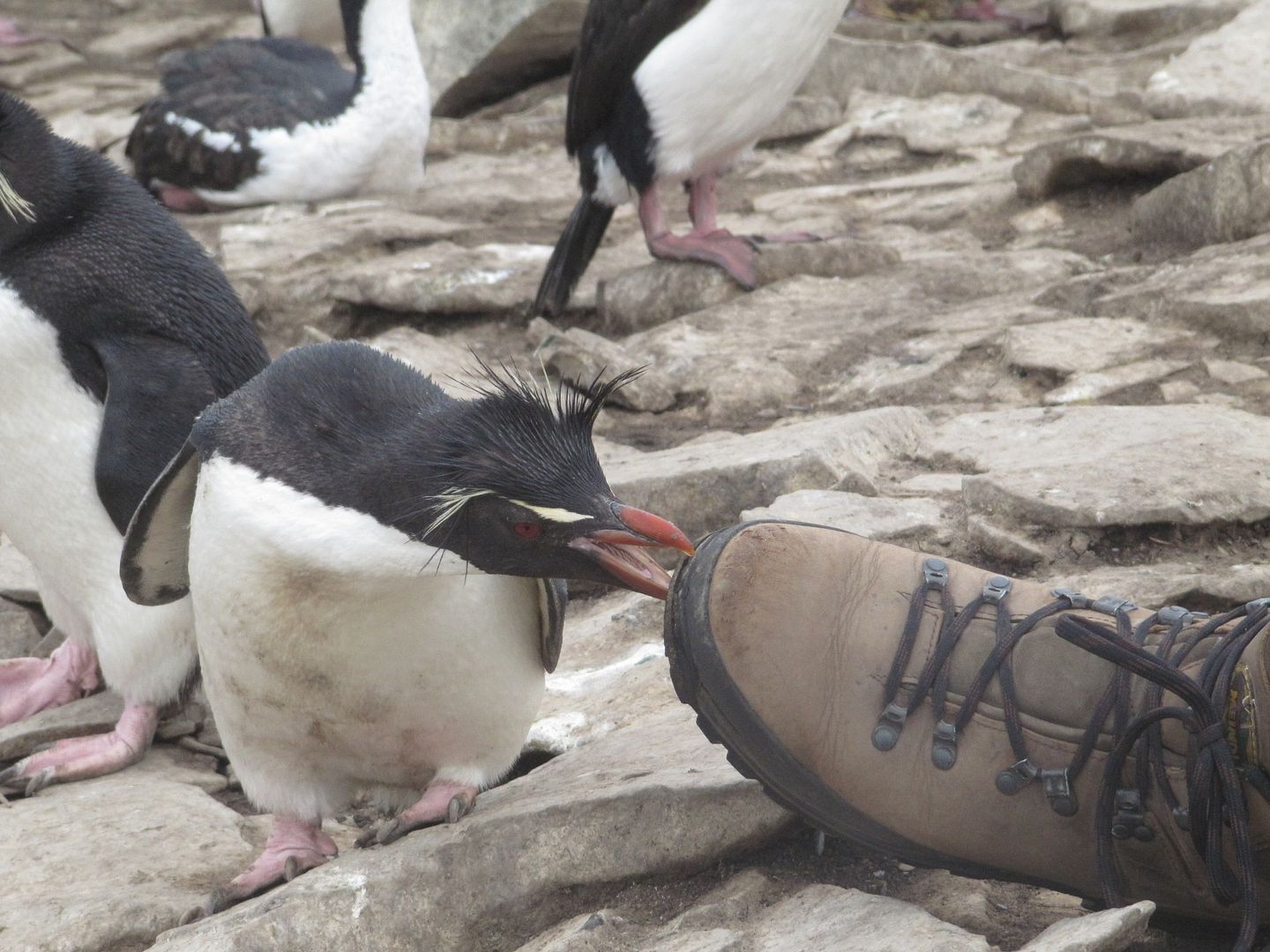
Rockhopper pecks Nic's boot
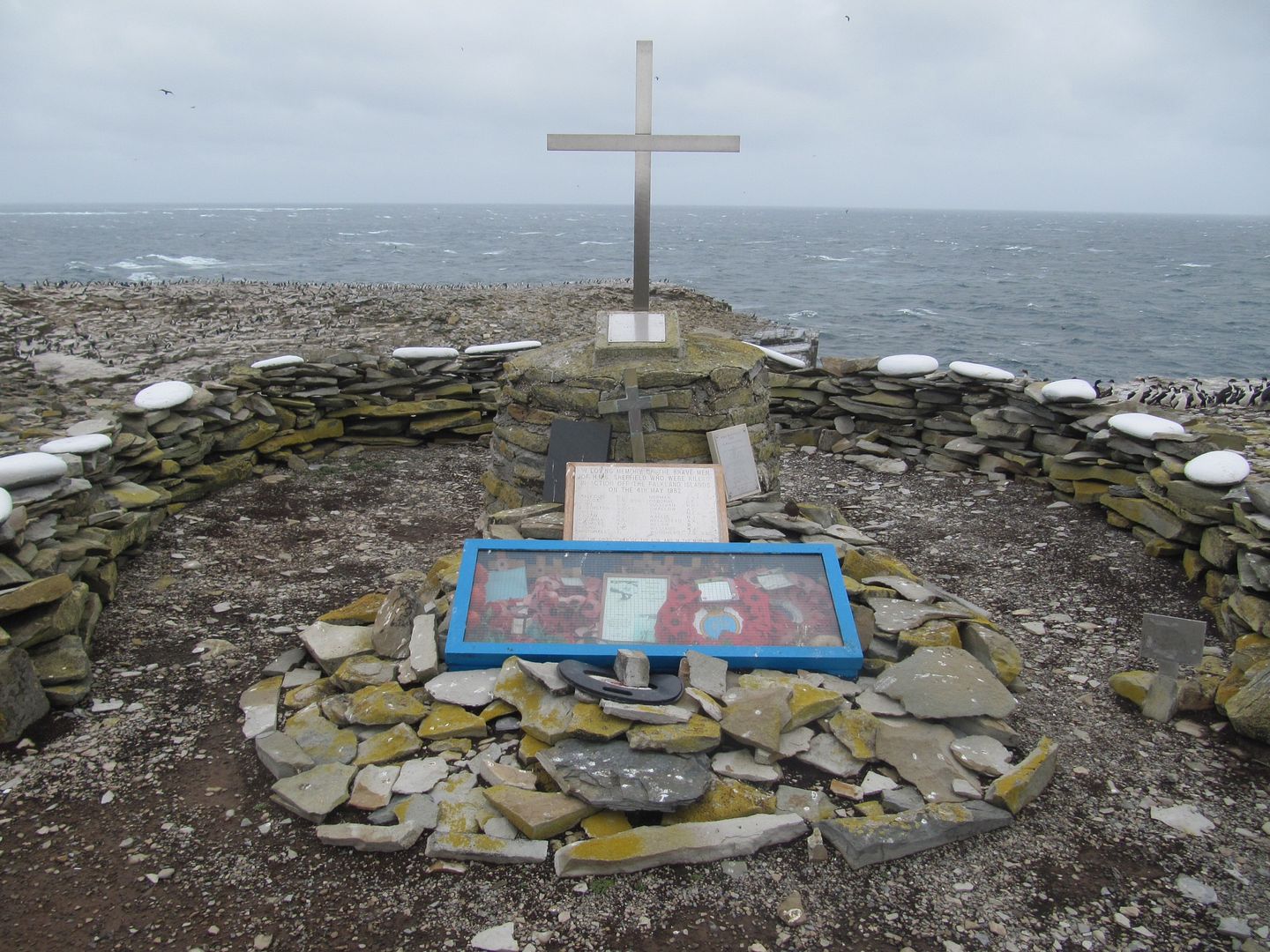
HMS Sheffield Memorial
A few were more inquisitive and came a bit closer to us to check us out.  Nic was sat on the rocks and one of the braver ones gradually approached him and had a quite peck at his boot, but soon hopped back off again.  I am pleased to say that neither penguin nor boot was traumatised by the experience.

We stayed watching them for about an hour or so before heading back to the lodge to warm up and have dinner.

First though, we took a look at the nearby memorial to HMS Sheffield and those who died on it in 1982.  The islanders are grateful to those who freed them and, along with those who visit to pay their respects, they take good care of the various memorials on the islands.

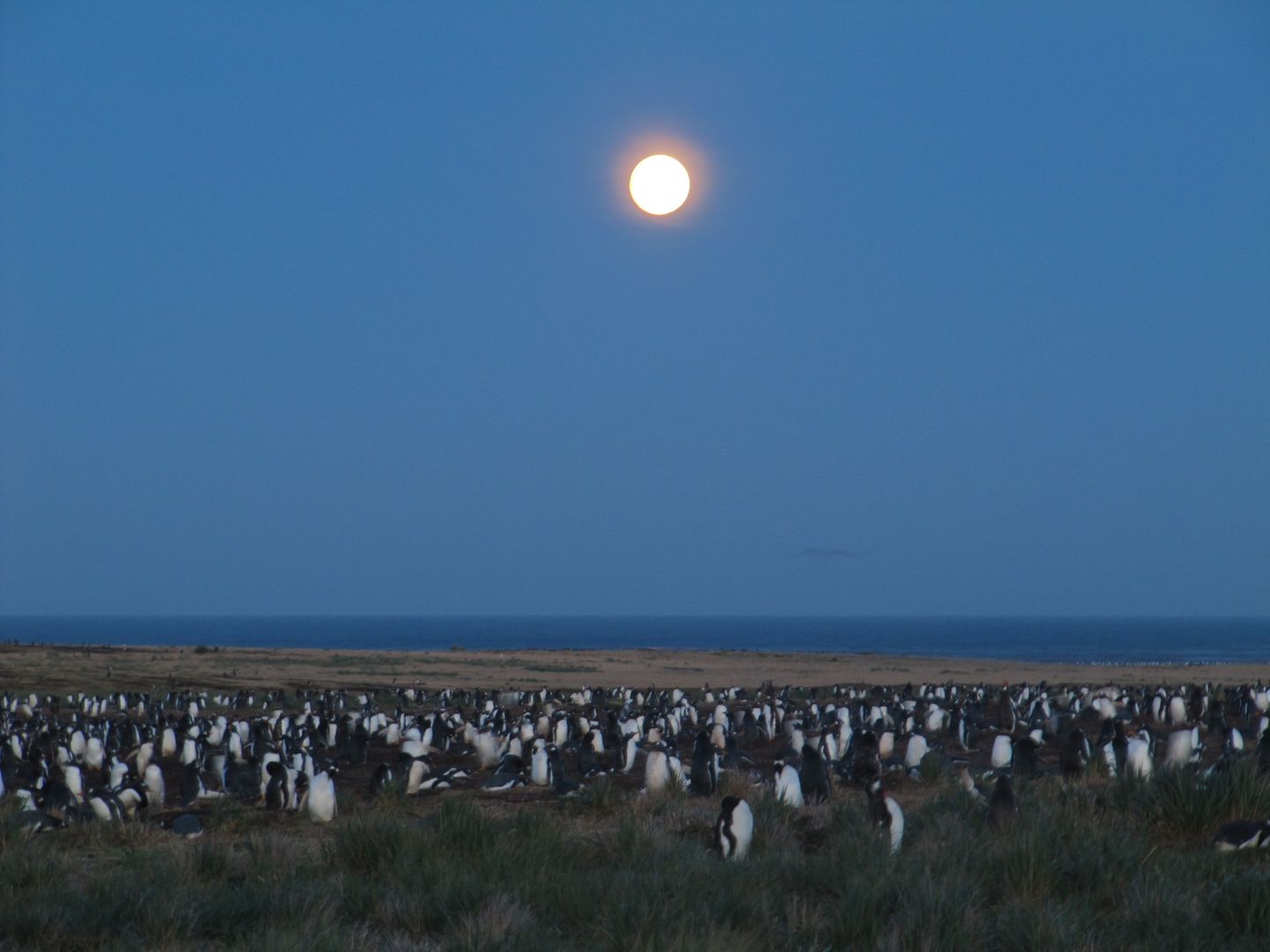
Gentoos in the moonlight


In the evening there was a fabulous moon above the Gentoos, which looked really amazing.  Again sadly my pictures don't do it justice.