Welcome to our travel blog. We are Tabitha and Nic. In 2011 we 'retired' in our early 40s and set off to travel the world. We spent our first year in South America and have been lucky enough to make two trips to Antarctica.

Our blog is a record of our travels, thoughts and experiences. It is not a guide book, but we do include some tips and information, so we hope that you may find it useful if you are planning to visit somewhere we have been. Or you may just find it interesting as a bit of armchair travel.


Showing posts with label chocolate. Show all posts

Sunday, April 16, 2017

Happy Easter from Bariloche - and the longest chocolate bar in the world!

Chocolate Festival, Bariloche
As far as chocolate is concerned, if there is a good place to be at Easter, Bariloche in Argentina has to be high on the list. Whatever time of the year, the city is known for its chocolate - its high street is full of shops dedicated to all its forms - truffles, bars, drinks and of course at this time of year, eggs.  But at Easter they go one stage further and have a chocolate festival.

The first modern settlement of Bariloche was started by a German immigrant, Carlos Wiederhold, who had originally settled closer to our last stop, around Lake Llanquihue, but then moved across the Andes and set up a shop here. The European influence is visible in the city's main streets, which were designed in the 1930s to be like an Alpine village. With the nickname Little Switzerland, it is unsurprising that chocolate became such a factor here.


Chocolate Festival, Bariloche


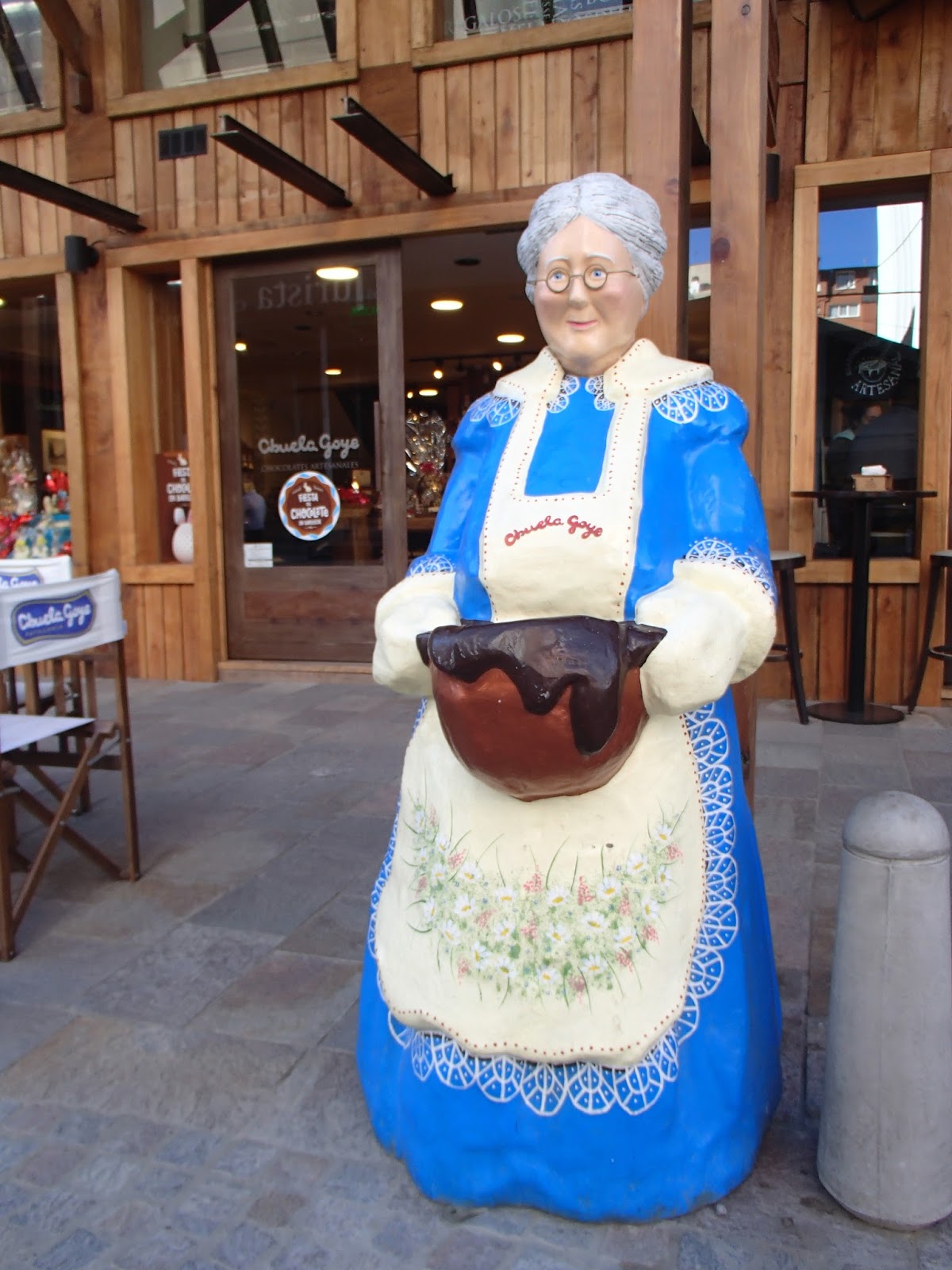
The chocolate did make sticking to our good eating plan a bit tricky here. We knew that we wouldn't be able to resist it completely. So we did a bit of checking into which of the numerous chocolate shops were supposed to be the best, and narrowed it down to three: Mamuschka, Rapa Nui, and Abuela Goye.
Mamuschka, chocolate shops, Bariloche


Whereas in days of old we would have happily bought and eaten loads of the stuff, we decided to limit ourselves to five chocolates from each of these three shops. We both agreed that Mamuschka was the best, with the best overall chocolates as well as some especially good ones, and that Rapa Nui was not far behind, with great flavours in some, just not as good overall.
Chocolate Festival, Bariloche


Then we got to Easter, and the festival. The city started holding a chocolate festival in 2012, as part of a celebration of its revival after the Chilean volcano Puyehue erupted in June 2011, causing a red alert in the area and covering the city in a layer of ash. The ash cloud went 10km into the sky, and residents were advised to seal their windows to prevent it getting into the air in their homes. It was the reason that we didn't visit Bariloche last time we were in South America, as they were still cleaning up when we were down this way.
World's Longest Chocolate Bar, Bariloche


This time, thankfully there were no more eruptions, and we made it. We were slightly disappointed to discover that this year they wouldn't be making the giant Easter Egg. In some years they have built a huge - and when I say huge I mean over eight metres tall - chocolate egg, which people come to see in the run up, and then on Easter Sunday it is broken up and distributed to all the people who queue up to get some. But this year there was to be no giant egg.


What they did have, on the Thursday, was what they claim is the worlds longest chocolate bar. I don't know whether it actually is a world record, but it is certainly long. We didn't know quite what to expect. We had in mind that they made it off site in chunks, and then put it together afterwards. We did know that it was going to be 200 metres long, and that they break it up and give it out to those there.
World's Longest Chocolate Bar, Bariloche


It was scheduled for 7pm, but we knew that we would need to get there early to get a place at the front, so we turned up a little before 6, and managed to nab a place at the barrier, at around the 130 metre mark.

We were a little disappointed initially, as we thought the tin foil on the trestle tables was covering the bar, and it looked a bit pathetic. Then we realised that the foil was just the tray, and they actually make the chocolate bar in front of you. This sounded much more interesting
World's Longest Chocolate Bar, Bariloche


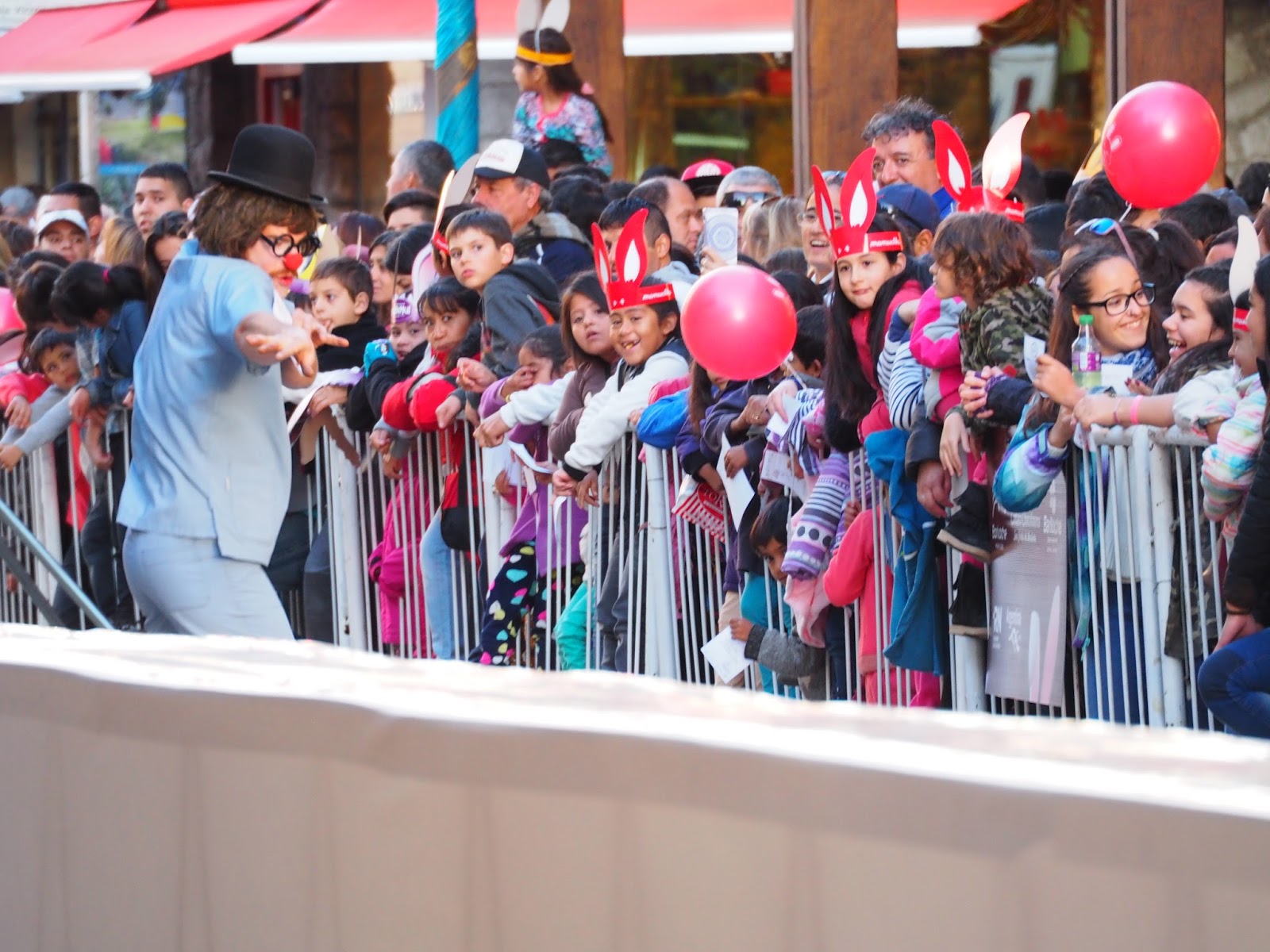
By the time they got started, the crowd was about five people deep where we were, and bigger near the 200 metre end, where the stage was. The makers are representatives from the five companies that provide the chocolate, the three we had tried, Mamuschka, Rapa Nui, and Abuela Goye, and two others, Turista, and Tante Frida.
World's Longest Chocolate Bar, Bariloche


The chocolate makers arrived, carrying their bowls, spatulas, and huge vats of melted chocolate, together with extras like sultanas, nuts and crispy things. It took them quite a while to organise themselves, and we were a bit worried at one stage when it looked like there wasn't enough chocolate around our section.


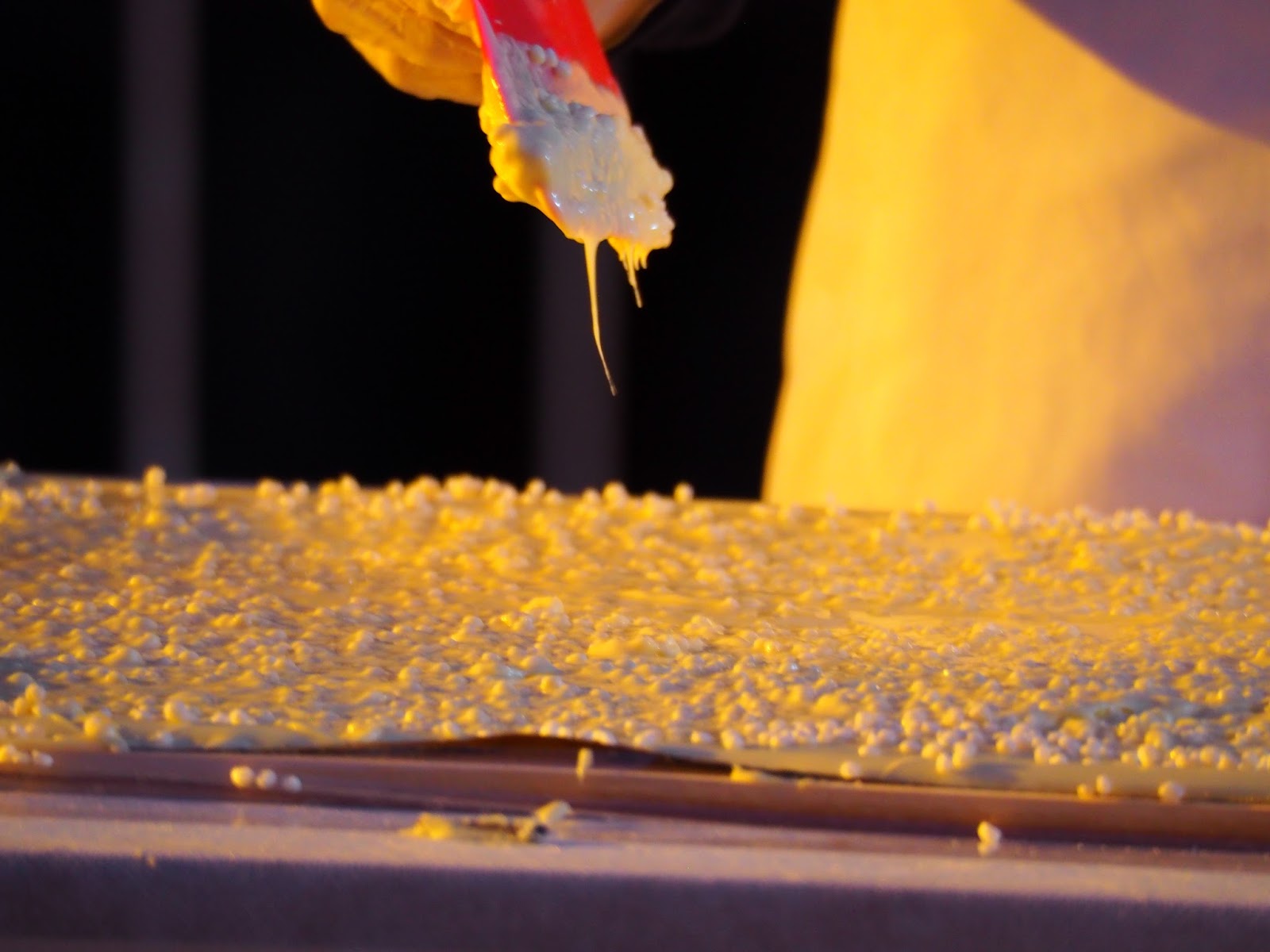
They sorted themselves out though, and began pouring their vats of rather lovely smelling chocolate onto the tray, and smoothing it out to get rid of any lumps or bubbles. When they were happy with that, the toppings went on, followed by another layer of melted chocolate.
World's Longest Chocolate Bar, Bariloche


Then came the frustrating bit - waiting for it to harden. We could see the chocolate. We could smell the chocolate. But for now at least, we couldn't get our hands on the chocolate.
World's Longest Chocolate Bar, Bariloche


It took a little over an hour to make the bar, and then it was time to cut it up and hand it out, regardless of whether it was fully set or not. Some bits were, but others were a little on the soft side, and the chefs had some trouble getting it off the table and onto the trays to serve. But they persisted and soon, we were all putting out our hands to receive our chunk of chocolate.


Protocol is that when you have got your piece, you move away, so that those behind you can get their turn. We did, but we soon realised that there was plenty of chocolate to go around, and people were going back time and time again, so we joined the back of the crowd in another section and got ourselves another couple of pieces.
World's Longest Chocolate Bar, Bariloche


I suspect that, had we tried to get more, we could have come away with quite a bit, but we were already going to have to put in extra time at the gym to make up for what we'd had, so we resisted.
World's Longest Chocolate Bar, Bariloche


We walked up the street afterwards, and the chocolate shops were full of people buying even more chocolate. We were tempted, especially as we had been handed a voucher for 15% off, but refrained, though I can't promise that we won't give in for one more set of five pieces before we leave.
World's Longest Chocolate Bar, Bariloche


I say it was a voucher, but it was actually a prescription, setting out various reasons why chocolate is medically good for you. A couple of them seemed reasonable - I can see the claim of it being a natural anti-depressant, and I have heard it is good for anti-oxidants, but others were a little more tongue in cheek I think!

We may not have had the giant egg, but actually the giant chocolate bar was quite good fun to see being made, and we did enjoy the chocolate handouts.

Happy Easter everyone.


World's Longest Chocolate Bar, Bariloche

World's Longest Chocolate Bar, Bariloche

World's Longest Chocolate Bar, Bariloche

World's Longest Chocolate Bar, Bariloche

World's Longest Chocolate Bar, Bariloche

World's Longest Chocolate Bar, Bariloche

World's Longest Chocolate Bar, Bariloche


Chocolate Festival, Bariloche

Chocolate Festival, Bariloche

Mamuschka, chocolate shops, Bariloche

Rapa Nui, chocolate shops, Bariloche

Abuela Goye, chocolate shops, Bariloche
Turista, chocolate shops, Bariloche

Thursday, April 28, 2016

Vancouver in technicolour (Throwback post)


Queen Elizabeth Park, Vancouver
At the start of May we flew from Edmonton to Vancouver and immediately noticed the difference that 500 miles makes.

Vancouver

Where still chilly Edmonton was just losing its snowy covering and looking dreary in the slushy brown mud and a few dark evergreens, Vancouver was warm, sunny (a bit too sunny for walking with a heavy backpack), and ablaze with greenery and colourful flowers.


Vancouver
We were staying in an Airbnb near to Commercial Street, which is a real neighbourhood area of town.  There are nice leafy streets of family homes as you go towards Main Street, but around Commercial Street itself, the locals tend to be younger and hipper.  Lots of students and more than the average number of piercings, tattoos and unusual clothing choices!


Vancouver
It was a great area to stay in for a while as it had a cheap cinema, inexpensive places to eat - including St Augustine's, which was excellent for craft beers as well as great value and very tasty wings on Wednesdays - but was still walking distance to Main Street and only a quick bus ride into the centre.


Vancouver
We did a bit of touristy stuff here, but mostly just 'lived' here, so. it was good to be near to the shops and bars of Main Street.  We took quite a liking to one bar, although we felt a little out of place at times as I'm sure we were the only people there who didn't have multiple, sizeable tattoos.  We also discovered that Vera's Burgers are very good, and decent value.


view from Queen Elizabeth Park, Vancouver


Queen Elizabeth Park, Vancouver
Main Street is also home to Queen Elizabeth Park, which has a small aviary at the top of the hill, but more importantly offers a great view over Vancouver.


Queen Elizabeth Park, Vancouver


Queen Elizabeth Park, Vancouver


When we were there it was graduation day, and this is where they all turned up to have photos taken in their fancy frocks.

Queen Elizabeth Park, Vancouver

It was certainly a colourful sight, and I rather liked the groups of girls that made the effort to stand according to the shades of colours, or the one group that went for the rainbow sequence.

Gastown, Vancouver
We did spend some time downtown.  The older gas light district was probably the most interesting to walk around.  Of course we needed a few breaks, and made a couple of fortuitous finds.


Gastown, Vancouver
One was East Van Roasters, an artisinal chocolate shop in Gastown that is part of the Rainier Hotel, and aims to give shelter and employment to women with a history of addiction.  They import the cacao beans in their raw state and roast them on site before shelling them and using them to make really excellent chocolate.  We took away a bag of the cacao shells after discovering how tasty and healthy they are infused as a tea.

East Van Roasters, Vancouver

East Van Roasters, Vancouver
Gastown, Vancouver
Our other find was Salt Tasting Room, which was predominately a sherry bar, with an excellent range.

We also had an unexpected surprise in Vancouver, when we got a message from Vanessa and Bert, a couple from Belgium who we met whilst on our Dragoman trip in South America.  They happened to be in Vancouver briefly while we were there, so it was great to meet up with the for a quick drink and to catch up on their news.  We knew they had got married since we last met, and now they were expecting their first baby (which they will have long had by the time I get around to posting this!). So we send our Congratulations to them both.


Thursday, January 24, 2013

Havana - cars, cigars, chocolates and crafts

For our remaining three days in Havana, we reverted to wandering the streets and sitting in cafes.  For us, the charm of Havana is not in the museums, but rather in walking along and seeing the crumbling but still beautiful buildings, the falling apart but fabulous cars and the times-gone-by but still trading counter shops.


Vintage they may be, but most at least are still vibrant in their way.


The evidence of a once very wealthy society is all around, and it is fascinating, sad and yet oddly reassuring to see how little those symbols of wealth have  been so little cared for over time.

I am very glad that they are now working to preserve the architecture that is here but the reality is, had the country continued to develop and build during these post revolution years, many of these lovely building would be long since gone.

Similarly had there not been restrictions on the import and sale of vehicles, Cuba would not have the many Cadillacs, Pontiacs and other vintage cars that we see today.  We were concerned that with restrictions being relaxed, these old cars would be sold to dealers from the States and Europe and replaced by the more efficient but soulless new cars.

Happily, we heard that the UNESCO status recognises that these cars are a part of Cuba's heritage now, and protects them as well as the buildings.

But even we couldn't resist one museum - the museum of chocolate!  Not that it is really a museum.  It is really a cafe and shop,  where you can watch them make the chocolates and see a few cabinets with old chocolate moulds and other paraphanalia.  But the chocolate was quite tasty, so we weren't complaining.

Then of course even as non smokers like us, you can't come to Cuba without visiting a cigar factory.  We had tried the one in Santa Clara, but that was no longer doing tours, so we figured we'd go to the one here.  Except that was closed too.

But at least here there was a lady sat at a workstation in the corner of the shop making the cigars for the benefit of we tourists.  So we did get to see the process and it didn't cost us anything.

We also made it to the Almacenes de San Jose craft market where we spent some hours looking around at the multitude of paintings of old cars.  These are of course slightly kitsch, but I do like them, and we spent some time considering them before finally deciding we don't currently have any walls, and by the time we do again, we will have far too many pictures and photos for this one to get put up.  So instead, I bought a colorful paper mâché boot and Nic bought a Che Guevara wallet, partly because he needed a wallet, and partly because he liked the irony of it.
 
Beyond that we spent some time in a few bars and restaurants, often with a few rum based drinks and some (usually welcome) musical entertainment. Three places that didn't have any live music, but which we rather liked were La Imprenta, Palador Doña Blanquita and El Chanchullero.

The first, La Imprenta, was a state run restaurant, which was something of a surprise as unlike most, it was really rather slick.  The food was great, they had some good wines, it was good value and the service was impeccable, but the more remarkable thing was the design.  It was an old print works building, and the decor was built around that.  The seats and tables were all carved wooden typeset letters, there were old bits of printing machinery, and many other interesting, slightly unusual, and yet still tasteful touches.  Something of a surprise really.

The second , Palador Doña Blanquita, was not state run, but rather a small restaurant on the second floor of an anonymous looking building.  The food was good, and there was a nice view across the Prado, but what amused us here was that this is so clearly  a place that someone has opened where they live.  We could tell this because at the room at the back we could clearly see the old mum asleep on the sofa.

And the last, El Chanchullero, was a lovely but tiny little bar on Plaza del Christo.  It made great cocktails and although we didn't eat here the food did look good.  But the interesting element for us was that it was very different to what we had come to expect in Cuba.  It had excellent quirky decoration, including a tiny shrine inside and was very simple and cosy.  It was the sort of place that would have gone into whatever city we were in.

Perhaps it seems wrong that some of the places that appeal to us are those that are less traditional.  We do like to go to the traditional places, but we quite like to see what is new about a place as well.

Sometimes as a tourist it can feel like all of the traditional things are a bit false - done for the tourist market rather than because it is what they would still choose to do.

They are still interesting and can tell you a lot about a place's past, but we like to mix in a bit of the more modern culture too, and perhaps get to learn a bit about where the country and it's people are going rather than just where they have already been.