Welcome to our travel blog. We are Tabitha and Nic. In 2011 we 'retired' in our early 40s and set off to travel the world. We spent our first year in South America and have been lucky enough to make two trips to Antarctica.

Our blog is a record of our travels, thoughts and experiences. It is not a guide book, but we do include some tips and information, so we hope that you may find it useful if you are planning to visit somewhere we have been. Or you may just find it interesting as a bit of armchair travel.


Showing posts with label China. Show all posts

Tuesday, January 12, 2016

Taipei - Some sights and a bit of their history

Treasure Hill, Taipei
I think we need a bit of history to explain the next few sites that we saw, Treasure Hill, the Bo pi liao historic street, and the Chiang Kai Shek Memorial.

When China's last imperial dynasty, the Qing Dynasty, was overthrown in 1911, the Republic of China (ROC) was formed. In 1912, one of the revolutionary leaders, Sun Yat-Sen became its first president. His 'Three Principles of the People' (nationalism, democracy and people's livelihood) made him a popular leader, and his Chinese Nationalist Party (KMT) maintained an alliance with the communists.

Treasure Hill, Taipei
However the alliance was fragile, and could not survive his death in 1925. His protege, Chiang Kai Shek, married Sun's widow's sister, and laid claim to be his heir. But so did Wang Jinwei, one of Sun's old revolutionary comrades, and Sun's widow sided with him. This split the KMT in 1927, and started a civil war between the Nationalists and Communists. The war paused during the Japanese invasion in WWII, but resumed after they left.

Treasure Hill, Taipei
By then, Chiang Kai Shek had moved away from the Three Principles, to a more authoritarian leadership, and it was the Communists that gained the support of the people. In 1949, Chiang Kai Shek and his Nationalist Party retreated to Taiwan. Taiwan had been recently handed over to the Chinese in 1945, after the WWII defeat of the Japanese, who had been ruling it since 1895. The takeover is somewhat controversial, as the Japanese never officially ceded Taiwan until 1952.

Treasure Hill, Taipei
With the arrival in Taiwan of some two million Nationalist Party members, military and their families, there was an urgent need for places for them to live, and one place that around 200 of the military went to was Treasure Hill. A haphazard illegal development of small shanty housing sprung up, alongside an anti aircraft gun position, and the Treasure Hill community was created.

However many of the buildings became structurally unsafe, and between 2007-10 this historic area was restored, with most residents being refocused elsewhere and only 22 returning. The area is now an artist's village, although when we visited we were quite disappointed by the lack of studios that were actually open.
Treasure Hill Temple, Taipei

Bo-Pi Liao Street, Taipei
Another area that we visited was the Bo-Pi Liao historic street from the Qing Dynasty and the Japanese colonial era. The street, which has been renovated, has some distinctly different architecture, but I think they could do a bit more to demonstrate how it would have looked at the time.

In contrast to many places that were colonised by the Japanese in South East Asia, Taiwan was relatively happy with the arrangement. The Japanese provided infrastructure, and unlike in some other places, took a fairly relaxed approach to governing the locals. So it was a bit of a shock to the Taiwanese when the Chinese Nationalist Party took over in 1945, with its authoritarian style.

Issues between the Taiwanese and the Nationalist Party came to a head on 27 February 1947, when the government's Tobacco Monopoly armed enforcement team confiscated contraband cigarettes from Lin Jiang-Mai, a 40-year-old widow at the Tianma Tea House. When she tried to insist they be returned, she was hit around the head with a pistol. People nearby came to her aid and the agents left, but one of them shot someone as he went. This caused outrage, especially as no action was taken, and the next day violence erupted.

Chiang Kai Shek Memorial, Taipei
The Nationalist Party sought to quell the riots by imposing martial law and curfews, and they shot a number of key protesters. This became known as the February 28 Massacre or 228 Incident. Initially, Taiwanese civilians appeared to have the upper hand in Taipei, and presented a list of demands regarding the governance of their country; in fact, the KMT Governor, Chen Yi was just stalling for time while he amassed a large military force, and during March 1947, he launched a major crackdown, which saw the execution of what is believed to be 3-4,000 people, but some figures suggest that during the aftermath the number of people killed could be anywhere up to 30,000.

This began what is known as the White Terror, which was the period of martial law that lasted from 1947 to 1987, and saw around 140,000 enemies of the state arrested, and others executed, or simply 'disappeared'. Governor Chen Yi himself was dismissed and, in 1950 he seems to have attempted to defect to the Communist Party, for which Chiang Kai Shek had him arrested and executed for espionage.

Liberty Square, Taipei
Chen Yi has subsequently been blamed for the 228 Incident and its consequences, but many consider that Chiang Kai Shek himself should shoulder much of the blame. Of course he didn't, and this can be seen in the enormous Chiang Kai Shek Memorial, which was completed and opened on 5 April 1980, the fifth anniversary of his death.

The memorial is octagonal, because the number 8 is believed by the Chinese to represent good fortune, and stands 76 metres tall. There are two flights of stairs, both with 89 steps, as that was Chiang's age when he died. Its blue roof tiles and red detailing represent the ROC flag. The memorial was the site of many protests, which eventually led to major reforms by President Lee Teng Hui, including Taiwan's first open elections in 1996, where he was re-elected.

Liberty Square, Taipei
In 2007, officials decided to rename the square Liberty Square, and the memorial itself the Democracy Memorial Hall. However, while the square was renamed, the opposition party successfully fought the change of name for the memorial, albeit on the basis of convenience rather than respect for Chiang. Indeed, even amongst his own Nationalist Party, there is now acknowledgement of the faults of his leadership.

The other buildings in the square are the National Theatre and National Concert Hall.

Sunday, February 22, 2015

Crossing into The Republic of the Union of Myanmar

 From Dali we drove to the Chinese border town of Ruili, with its strange proliferation of neon lit buildings, where we spent the night ready to hit the border as soon as it opened at 8:30am.


Our first Burmese Buddha of many!
We got there in good time, and our guide started the process of getting the truck cleared through customs for departure.  And then we waited. And waited. That took us around an hour and a half, and then we had to get off the truck and take our bags through the x-Ray machines.  From there it was a short drive on to the border itself, where it took another forty minutes or so to actually leave the country.

At this point we waved goodbye to our Chinese guide Jason and met up with our new Burmese guide Myo Win Tun. But Myo is not going to be our only travelling companion in Myanmar. Because we are a foreign group travelling independently, rather than using Burmese companies, we are a bit of a new experience from the country, and this is only the third time a Dragoman truck has been here.  So we have to have special arrangements.  Not only do we have to provide a plan of where we are going and where we will be staying, which cannot be altered, we also have to have an escort.

So we were introduced to Mr Khaing, who will drive the little white car that will be our shadow for the next four weeks, and Tang, the government official from the Ministry of Tourism.  These two will be with us wherever we go. As I am posting this towards the end of our time in Burma, I can tell you that in fact this was not nearly as bad as it sounds, and in fact they were both great guys who clearly wanted us to enjoy our trip. Of course they didn't speak English, so there was no real conversation, but we all got along very nicely.


Now that we were out of China, we just needed to get in to Myanmar.  That actually went quite smoothly, albeit slowly, until we discovered that one of our fellow passenger's visa was not quite right as it didn't cover the whole time here. And so began a series of lengthy discussions and negotiations about whether he could be allowed in.  Eventually someone who had sufficient authority decided to allow it, and we were in.

Our paparazzi
After a further interlude spent changing money, as you can't get currency before you arrive, we were off.  Little tip here, Myanmar is another place that if you want to exchange US dollars, they have to be in perfect condition.  Also, you get a slightly better rate for $100 notes.


Getting gifts
Almost before we could go anywhere, we needed to stop off to see the man in charge of driving licenses.  I'm still not entirely sure whether there was really an official need for this, but apparently they wanted a photo of us all with the truck.  So we all got off and smiled for a bunch of people who all wanted to get in on the chance to take a photo of these foreigners and their strange vehicle. But they did also give us all a small gift, so that was nice.

Once released from photo duty, we took a short drive to grab some lunch. Despite gaining an hour and a half in the time change, it was well after 2pm, and we had a long drive ahead of us to get to our campsite at a Monastery in Hsipaw.


Dinner stop
The plan had been to cook once we arrived, but as the hours passed and darkness fell, we stopped off en route for dinner, where I was amused to a flat screen TV box sitting where otherwise you might expect to see the TV itself, and finally arrived at around 9:30pm to get the tents up and collapse.


Friday, February 20, 2015

Dali, China - and the theme park experience of Chinese tourism

Our hostel
From Kunming we drove on to a place called Dali.  There are two Dalis, an old and a new one, both set around the edge of Lake Er Hai.  We were at the old one.  One of our fellow passengers had been here six years ago and said back then, the old town was run down, with few shops and few tourists, but lots of rubbish in the streets.

These days the town still has some old buildings, but there are newer buildings too.  The town has cleaned up its litter and has far more shops, bars and cafes catering to the new influx of tourists.  Most of the tourists are Chinese, but the westerners are coming too, so there are plenty of opportunities to eat and drink western style.  Most of the loos are still just the holes in the ground though.

The plan here was to go to see the cormorant fishing, where the locals use a cormorant to catch their fish by putting a ring around their necks, which allows them to eat the small fish, but not the larger ones.  Unfortunately we weren't able to go, but as it turns out, our fellow passengers that did go were a bit disappointed as rather than being able to spend time watching a group of genuine fishermen, what they saw was one fisher, almost certainly there just for the tourist groups, make a single catch.  Not really what any of us wanted.

Sadly, based on a couple of our own experiences and some comments from those who have been in China longer, it does feel a little like China is doing a lot of this.  They seem to take a genuine experience or sight, and make it into cleaned up tourist version.  So the cormorant fishing becomes just a display, and the Stone Forest gets paved pathways, manicured lawns and golf buggies.

Tea
This seems to be what the Chinese visitors want - a kind of theme park experience, where they can whizz around all the sights quickly and quite superficially.  We'd prefer to see the real thing and take a bit longer doing so.

Still, we did discover a liking for Lao dark beer.

Wednesday, February 18, 2015

Kunming, China

 On our first day in Kunming, we were having dinner alone, so we had to have our first attempt at ordering food.  In fact the place that had been recommended to us, close to the hotel, seemed relatively simple as you were taken to the kitchen and had to point at what you wanted.  Of course it's never quite that easy, because when I pointed to a nice straightforward looking combination of meat and vegetables, I was told I couldn't have that. After much pointing at our cribsheet of food types, gesticulations and shakings of the head, we finally seemed to have agreed on an order.  We waited with some trepidation to see what would arrive, but in fact it turned out to be quite nice. A minor success.

For our free day in Kunming, we decided to eschew the museum's and temple, and instead talk a walk into the city and check out a few of the other sights. We only set off late in the morning, so decided to stop for lunch quite early on. We picked somewhere with a cheat's English translation of the menu and pictures of the food - not something we usually do, but when you are as difficult with food as I am, and you can't even hazard a guess at what the characters mean we feel more relaxed about it. So we happily chose a couple of dishes, only to be met with a torrent of Chinese that we had no hope of understanding.  I think the lady was concerned that we were ordering one small dish and one larger dish, but she let us get on with it and we were quite happy.

We were less content with our attempt to order a couple of beers; the woman serving us understood my request for two beers (er pijiu) OK, but then she brought over a menu from which I assumed I was supposed to choose from the five beers listed in Chinese characters. I randomly picked a couple, and she then let loose with a further torrent of Chinese, which I assume was an explanation of what those two beers were.  None the wiser, and by now needing a beer more than ever, I confirmed the selection.  We ended up with a German wheat beer, which was fine but not what we were aiming for, and a Heineken, which was something of a disappointment!

Suitably refreshed, we continued to Government Square, only to find it boarded up for building works.  Then we stopped in at the tea place that we had seen recommended.  This was where we made our first of what will probably be many faux pas. We thought we could buy a cup of tea here.  So we went in and indicated as best we could that this was what we wanted.  We were ushered to a table and asked to choose a tea, so we figured we were doing OK.


The process was, as expected, long and involved.  She opened a sachet of furled tea leaves and poured the contents into a bowl which was then given to us to inspect.  In the meantime, she warmed up a handleless glass cup that had saucer and a lid. Then some of these tiny little balls of rolled up tea leaves were placed into that cup and hot water poured onto them. After a few moments, she used the lid to strain the contents into a sieve on top of a small jug.  Then the tea was poured into the tiny drinking cups.  But that presumably just to warm everything up, as it was all discarded. A second brew and pouring was done, and then finally we got our Oolong tea.  It was nice enough.


We had a few cups and then indicated we were done and went to pay. It was now that we discovered our mistake. This wasn't actually a place where you were supposed to drink tea, just to try before you buy.  We didn't want to buy, especially as we simply can't carry extra stuff around with us. We did still try to pay for our drink but were not allowed to. Oops.  They were incredibly polite to us, but I suspect they muttered something about stupid foreigners under their breath after we left.

The rest of our sightseeing was much simpler.  A wander through the shopping area - no sign of communism here - and around the flower market was interesting. And surprisingly we were not once called upon to buy something.  It seems that western tourists are relatively few here, whereas there are plenty of the newly wealthy Chinese middle class visiting, and they are much easier pickings for making a sale.

We also took a look one of the two 9th century pagodas. Pagodas were apparently built to ward off dragons and the destructive storms that they would send to the city, so the 13 storey tower has roosters, the enemy of the dragon, on top of all four corners. Today the pagodas are in a poor state of repair, but they still look impressive, and this one is a meeting place for locals who come to play mahjong or cards, or in one case, simply to sew a pair of slippers.

Tonight was a group meal, so we had the benefit of our Chinese guide to help us order.  Much simpler.

Monday, February 16, 2015

Welcome to Xara - and a Trip to The Stone Forest

So for our first leg we are back on a Dragoman trip.  Our truck this time is called Xara, our crew are Helen and Duncan, and we also have a local guide, who for this China section is Jason.

We are a small group.  There were nine people in the last segment and three of them are leaving, so with us and one other joiner, there will be nine of us going forward.


We don't officially join the truck until 15 January, but we newbies have been invited to join the group in their last activity, which is a visit to The Stone Forest.

It took us a little longer than expected to get there, as we were held up in stationary traffic for over an hour while they closed our side of a tunnel to do some roadworks.  Apparently this is not unusual.
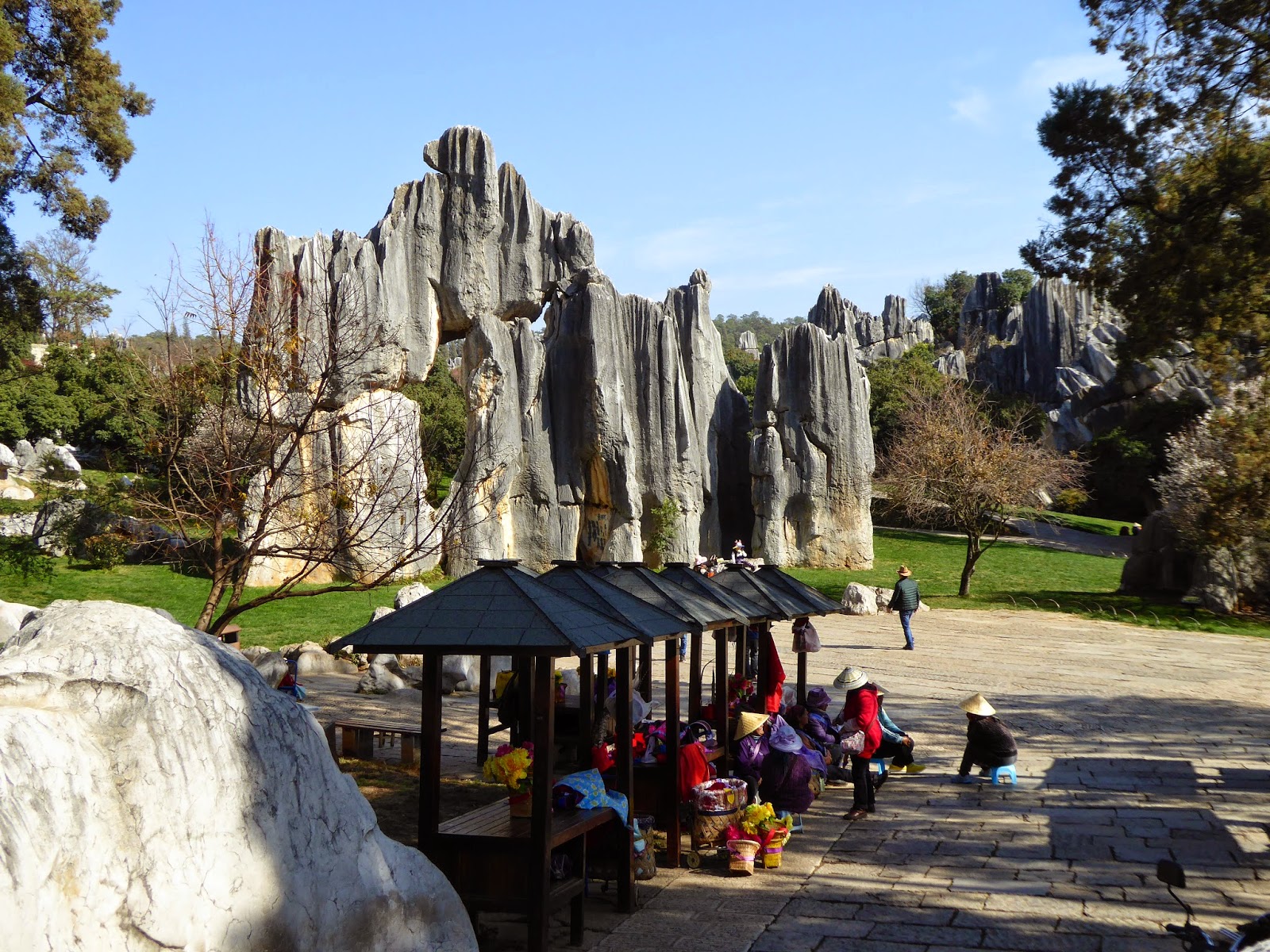


When we did arrive, we were able to see what is only a small part of a huge area of stone pinnacles which were formed by the erosion of the limestone that they are made of. We noticed that most of the Chinese visitors took oversized golf buggies around the place, only stopping off at designated viewpoints.

We had a bit of lunch here in the form of a very tasty corn on the cob and some interesting looking, but sadly not so tasty, steamed buns. The pale yellow ones were not too bad.

We walked around instead, taking in more of the atmosphere of the place, and getting off the main pathway, to be up close amongst the rocks.

We didn't walk on the grass though - how could we when there was a sign that said 'The grass is smiling. Don't disturb her.'


Not much to say about the rock formations really, unless this is to become a geology lesson, so I will simply let the pictures speak for themselves.