Welcome to our travel blog. We are Tabitha and Nic. In 2011 we 'retired' in our early 40s and set off to travel the world. We spent our first year in South America and have been lucky enough to make two trips to Antarctica.

Our blog is a record of our travels, thoughts and experiences. It is not a guide book, but we do include some tips and information, so we hope that you may find it useful if you are planning to visit somewhere we have been. Or you may just find it interesting as a bit of armchair travel.


Showing posts with label pagoda. Show all posts

Saturday, April 23, 2016

Nara - a deer little city

Nara
No, I haven't failed on my spelling, Nara really is all about the deer. There are around 1,200 deer roaming freely about the city - usually keeping to the parks and temples rather than the main town area, but they have been known to stray sometimes. Believed in Shinto to be messengers of the Gods, they are protected and have been designated a national treasure.


Nara
They are rather cute, though you do have to watch out for some of them. People feed them, so some can be quite determined in demanding food, and some will steal anything that they think might be edible.


Nara
We noticed a number of people having their maps snatched from out of their hands and being eaten. Not sure how tasty they are, but they were soon polished off.

Most though are quite docile and friendly. They sell special deer biscuits in the parks, which are rather better for them than maps, and many of the deer will happily take these from your hand.


Nara
It is quite amusing to watch the deer around the sellers. They clearly know that they aren't supposed to try to get biscuits from the seller, but sometimes can't seem to help themselves. the vendors look pretty grumpy when they persist, but we did see a couple cave and give them the broken ones.

Nara
If you don't want to be followed and pestered, keep the biscuits out of sight in your pocket or bag, and just take them out one at a time to give out.


Some of the deer have even learned the art of politeness from their Japanese neighbours, and will bow their heads to you as a request for a biscuit. How could you possibly say no to that?
Nara


Nara

Nara


Nara


Nara

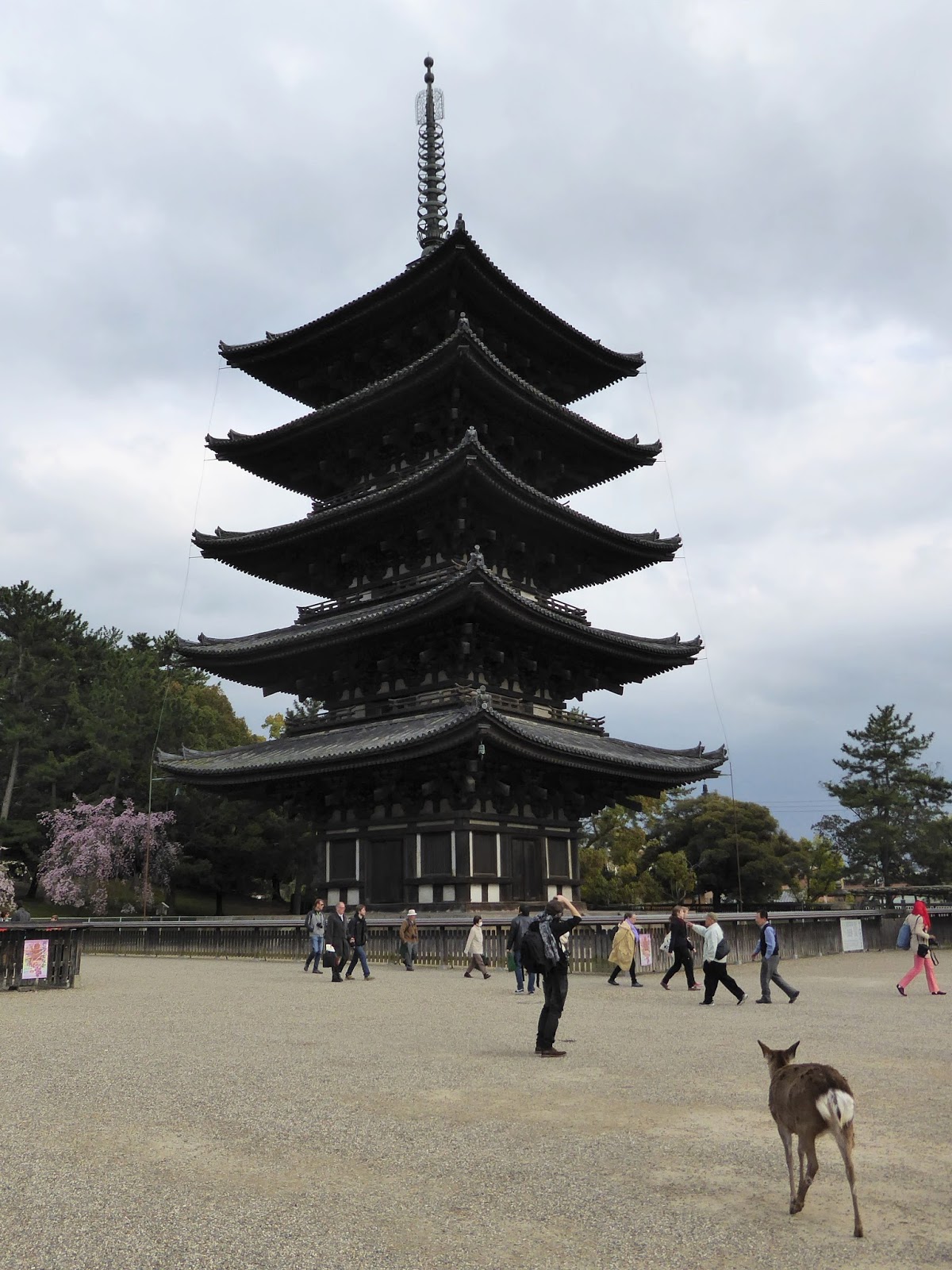
Kofukuji Temple, Nara
Of course Nara isn't just about the deer. Nara, then called Heijo, was the first capital city of Japan, way back in 710. That didn't last too long though as the government feared a threat from the powerful Buddhist monasteries based here, and moved the capital away in 784. But whilst it may have lost its political importance, it was still an important religious area, and it has the temples to show for it.


Kofukuji Temple, Nara
Close to where we were staying, was the Kofukuji Temple, with a rather fabulous 50m tall pagoda, the second largest in Japan. It was first built in 730, but like some many places in this country of earthquakes, it was rebuilt in 1426.

There is some construction work underway here, as they are in the process of rebuilding the long lost Golden Central Hall, (due to be finished in 2018,) not to be confused with the smaller Golden Eastern Hall that is still standing. We didn't go into it, but apparently, if you an pull yourselves away from the deer, the National Treasure Museum has some impressive Buddhist pieces.

Kofukuji Temple, Nara
The surrounding parks are well worth a wander around as you find your way to some of the other sites. We will visit the Todaijo Temple and the Kasuga Shrine in the news posts, but there are also the impressive Nandaimon Gate, the National Museum, and a few gardens to see if you want to.


Nara

Nara

Nara

Nara

Nara

Nandaimon Gate, Nara

Nandaimon Gate, Nara

Nara

Saturday, March 7, 2015

Mandalay - Buddhas, Temples and Pagodas

From Pyin Oo Lwin, we drove to our very nice hotel in Mandalay, where we required the assistance of a man with a big wooden pole to help us get the truck in underneath the mass of low hanging power and phone cables.

Our first day here was packed full of sightseeing, so I will cover it in three posts.  We'll start with the Buddhas, temples and pagodas.

Mandalay Hill was our first stop.  Supposedly, during his life on earth, Buddha visited Myanmar with his disciple Ananda, and he stood on Mandalay Hill and predicted that in the 2400th year of his religion, a city would be built below.

A statue was put up, with Buddha pointing to where the city would be built, and sure enough, bang on time in 1857, King Mindon did just that, with his Royal Palace in exactly that spot.


With a long day of sightseeing to be packed in to the day ahead of us, we had a good excuse for not climbing the 1,729 steps up the hill, and instead we all went up in one of the little mini truck taxis.  At the top we visited the rather impressive Su Taung Pyi Pagoda, originally built by King Anawratha, in 414, but added to over the years.

We also saw the statue of the ogress San Dha Mukhi, who severed her own breasts and gave them as an offering to Buddha during his visit. Buddha was so touched by this gesture that he said the ogress would eventually be reborn as a great king, and it is said that this was King Mindon himself.

One thing that you won't lack on Mandalay Hill - or around most of the temples and pagodas for that matter - is somewhere to buy something.  The whole route is full of little stalls selling souvenirs and flip flops.


I find the commercialisation of the temples a little strange really, and somewhat out of keeping with the religion; the selling of the footwear seems particularly ironic given that we all have to remove our shoes and socks to enter any religious building and are not supposed even to openly carry them.


Helen and Duncan did succumb to a souvenir, a coconut monkey that was really quite good, and he was respectfully named Mindon the Monkey in honour of the old king, and he now bounces about in the back of the truck.


Back down the hill, we headed to the Kyauk Taw Gyi Paya, where there is a very large Buddha made from a single piece of pale green marble.  No one seems to be quite sure how they managed to get such a large bit of marble from the hills across the river to this spot, but the one thing the various theorists agree on was that would have taken thousands of men.

Next was the Kathodaw Paya, which houses the biggest book in the world.  It is actually a collection of 729 small stupas, each housing a large stone tablet.

These tablets have engraved upon them the full set of the Buddha teachings. Bonus points to Nic on this one, as he spotted that 729 is not just a random amount, but is 9x9x9, which makes it significant as 9 is a lucky number here.


Our next pagoda was The Shwenandaw Kyaung, a teak monastery that was once part of the Royal Palace.  King Mindon died in the building in 1878, and his successor was sufficiently put off by that, that he decided to have the building moved away from the palace and used as a monastery instead.

It is good that he did, as it is now the only surviving palace building, because the rest were destroyed during fighting between the British and the Japanese in World War Two.

Our final pagoda for today is the Payagi Paya, where the star attraction is Maha Muni, a huge golden Buddha.  Some archaeologists disagree with the timeline, but it is said that this is one of only five statues made while Buddha was still alive.

He sat in meditation under a Bodhi tree for a week while it was made, and was so pleased with the image that he imbued it with his spiritual essence the next 5000 years. It is the most revered Buddha image in Myanmar.  He gets his face polished and his teeth cleaned by the monks daily at 4am.

Originally just metal, the 3.5m tall statue is somewhat fatter than he used to be due to a two inch covering of gold leaf.  Devoted followers buy small sheets of gold leaf and apply it onto the Buddha as an offering. Only the men can do this though because, as in many temples and monasteries, women are not permitted into the most sacred areas directly around the Buddha.

Apparently this is not sexist, it is just that with the monks being celibate, they are worried that a female in the vicinity might be too much of  temptation; why this overpowering allure is more of an issue in just that small space next to the Buddha image I don't know, but it is strictly enforced, as one of the ladies in our group discovered one time.  We are however allowed to watch from a safe distance, or on one of the handy TV screens.

In the same pagoda, there are four remaining bronze Khmer statues from a set taken from Anghor Wat in Cambodia.  Supposedly, you can heal a bodily affliction by rubbing the relevant part of your body on the same part of the statue.  Not entirely sure how this works with the elephant, but probably best not to ask.

Wednesday, February 18, 2015

Kunming, China

 On our first day in Kunming, we were having dinner alone, so we had to have our first attempt at ordering food.  In fact the place that had been recommended to us, close to the hotel, seemed relatively simple as you were taken to the kitchen and had to point at what you wanted.  Of course it's never quite that easy, because when I pointed to a nice straightforward looking combination of meat and vegetables, I was told I couldn't have that. After much pointing at our cribsheet of food types, gesticulations and shakings of the head, we finally seemed to have agreed on an order.  We waited with some trepidation to see what would arrive, but in fact it turned out to be quite nice. A minor success.

For our free day in Kunming, we decided to eschew the museum's and temple, and instead talk a walk into the city and check out a few of the other sights. We only set off late in the morning, so decided to stop for lunch quite early on. We picked somewhere with a cheat's English translation of the menu and pictures of the food - not something we usually do, but when you are as difficult with food as I am, and you can't even hazard a guess at what the characters mean we feel more relaxed about it. So we happily chose a couple of dishes, only to be met with a torrent of Chinese that we had no hope of understanding.  I think the lady was concerned that we were ordering one small dish and one larger dish, but she let us get on with it and we were quite happy.

We were less content with our attempt to order a couple of beers; the woman serving us understood my request for two beers (er pijiu) OK, but then she brought over a menu from which I assumed I was supposed to choose from the five beers listed in Chinese characters. I randomly picked a couple, and she then let loose with a further torrent of Chinese, which I assume was an explanation of what those two beers were.  None the wiser, and by now needing a beer more than ever, I confirmed the selection.  We ended up with a German wheat beer, which was fine but not what we were aiming for, and a Heineken, which was something of a disappointment!

Suitably refreshed, we continued to Government Square, only to find it boarded up for building works.  Then we stopped in at the tea place that we had seen recommended.  This was where we made our first of what will probably be many faux pas. We thought we could buy a cup of tea here.  So we went in and indicated as best we could that this was what we wanted.  We were ushered to a table and asked to choose a tea, so we figured we were doing OK.


The process was, as expected, long and involved.  She opened a sachet of furled tea leaves and poured the contents into a bowl which was then given to us to inspect.  In the meantime, she warmed up a handleless glass cup that had saucer and a lid. Then some of these tiny little balls of rolled up tea leaves were placed into that cup and hot water poured onto them. After a few moments, she used the lid to strain the contents into a sieve on top of a small jug.  Then the tea was poured into the tiny drinking cups.  But that presumably just to warm everything up, as it was all discarded. A second brew and pouring was done, and then finally we got our Oolong tea.  It was nice enough.


We had a few cups and then indicated we were done and went to pay. It was now that we discovered our mistake. This wasn't actually a place where you were supposed to drink tea, just to try before you buy.  We didn't want to buy, especially as we simply can't carry extra stuff around with us. We did still try to pay for our drink but were not allowed to. Oops.  They were incredibly polite to us, but I suspect they muttered something about stupid foreigners under their breath after we left.

The rest of our sightseeing was much simpler.  A wander through the shopping area - no sign of communism here - and around the flower market was interesting. And surprisingly we were not once called upon to buy something.  It seems that western tourists are relatively few here, whereas there are plenty of the newly wealthy Chinese middle class visiting, and they are much easier pickings for making a sale.

We also took a look one of the two 9th century pagodas. Pagodas were apparently built to ward off dragons and the destructive storms that they would send to the city, so the 13 storey tower has roosters, the enemy of the dragon, on top of all four corners. Today the pagodas are in a poor state of repair, but they still look impressive, and this one is a meeting place for locals who come to play mahjong or cards, or in one case, simply to sew a pair of slippers.

Tonight was a group meal, so we had the benefit of our Chinese guide to help us order.  Much simpler.