|
| MS Expedition leaving Longyearbyen |
We boarded the MS Expedition and set sail on the Wednesday evening, and having dealt with all of the practical stuff like safety briefings, evacuation drills and getting our waterproof jackets and wellies sorted out, we could get on with the important business of looking for polar bears.
 |
| Midnight sun |
Of course for the first evening, the only ones that we found were those on the ring-pulls of the Mack
Isbjorn (polar bear) pilsner. It is easy to stay up later than you intended to, as it doesn't get dark here in the Land of the Midnight Sun
 |
| Magdalenafjord, Svalbard |
The next day, we sailed up around the Magdalenefjord to Trygghamna, which is an old whaling station. If you know what you are looking for, you can see the evidence of the station today, with the remains of blubber ovens and the graves of long dead whalers.
While the historical aspect here was interesting, and our on-board historian Paul was very knowledgeable, I have to admit that I was more interested in the scenery, with the black granite mountains and the icy glaciers.
 |
| Trygghamna, Svalbard |
 |
| Svalbard |
 |
| Walrus, Svalbard |
 |
| Walrus, Svalbard |
Back in the zodiacs, we headed to a nearby beach where a group of Atlantic walrus were hauled out. It was great to watch these huge creatures shuffling around, quite carelessly flopping over on top of each other, with only the occasional spat as a result.
 |
| Walrus, Svalbard |
 |
| Walrus, Svalbard |
 |
| Nic, Svalbard |
 |
| First polar bear sighting, mother and cub, Svalbard |
On board the ship, we enjoyed a Captain's Welcome cocktail, before rushing to the decks to catch sight of our first polar bears. They were some distance away on the land, but when there is no guarantee that you will see any (it does happen occasionally), even a long distance bear is exciting.
This was a mother and her cub. The mother had a collar on, so was obviously being tracked, but she didn't seem bothered by it. We watched them for a while, before setting off again.
 |
| Svalbard |
The next morning, we had reached 80 degrees north and were cruising through the ice. Today we spotted harp seals, a fin whale, a couple of blue whales, more walrus, two bearded seals, and a couple of polar bears that were some distance away - we had some difficulty distinguishing them from the boulders - until they moved, which is always a good clue!
 |
| Bearded seal, Svalbard |
 |
| Bearded seal, Svalbard |
 |
| Fin whale, Svalbard |
 |
| Blue whale, Svalbard |
 |
| Blue whale, Svalbard |
 |
| Harp seal, Svalbard |
 |
| Walrus, Svalbard |
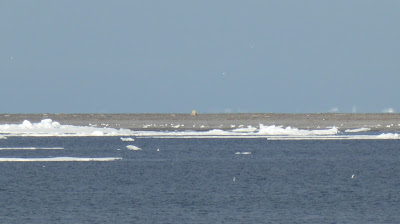 |
| Polar bear, Svalbard (right in the middle of the photo) |
But it was the second bearded seal that unwittingly caused the most excitement and trouble today. I
t
was spotted from quite a distance, and that far away, it appeared just possible that, rather than a bearded seal, it was a hooded seal, which are only very seldom seen here.
Whilst we all knew it was unlikely, given that this was potentially rare sighting, passengers and expedition team alike were all keen to take a look, and the captain happily changed course to take us there.
The only person that wasn't happy, was our expedition leader, who was more interested in getting us to go inside for the scheduled briefing. The expedition team delayed as long as they could, but eventually had to do as they were told; we passengers had no such qualms, and ignored him. Of course it turned out just to be the bearded seal, but that really wasn't the point.
 |
| Bearded seal, Svalbard |
With our detour over, and reports coming in of the Hinlopenstretet becoming potentially impassable, the captain set off to get us there as soon as possible. We needed to pass through the strait if we were to achieve the planned circumnavigation, and get to the uninhabited eastern side of the island where the polar bears are more prevalent. He and his crew did a good job, and we woke in the morning to find that we had made it through.

Our first excursion on the east side was a zodiac trip over to the basalt cliffs of Alkefjellet. The cliffs are quite stunning in themselves, and there are plenty of kittwakes to be seen, but the real attraction of this place is the huge colony of 60,000 Brunnich's guillemots, (also known as thick billed murres,) that are nesting here. In particular, this is the time when thousands of fledglings leave the cliff face and drop to the water. I say drop, because that is exactly what they do; they leave the nesting area before they can actually fly, so they literally have to glide down to the water, where the male is waiting for them.
 |
| Brunnich's guillemots, Alkefjellet, Svalbard |
During this drop, they are entirely defenceless, and the glaucous gulls are out in force to try to snatch
them out of the air as they fall. We saw quite a few being taken like this, as well as some that were scooped out of the water despite the efforts of the father to protect it.
Even for non-birders like us, this was fascinating to watch, although I would recommend wearing a hat, as with all those birds around, it is inevitable that someone is going to get pooped on. Thankfully, it wasn't our turn today.
 |
| Brunnich's guillemots, Alkefjellet, Svalbard |
 |
| Glaucous gull taking fledgling Brunnich's guillemot, Alkefjellet, Svalbard |
 |
| Glaucous gull taking fledgling Brunnich's guillemot, Alkefjellet, Svalbard |
 |
| Brunnich's guillemots, Alkefjellet, Svalbard |
 |
| Brunnich's guillemots, Alkefjellet, Svalbard |
 |
| Arctic fox, Alkefjellet, Svalbard |
Of course the gulls aren't the only danger. With all of these young birds around, the arctic foxes prowl the cliffs in the hope of catching themselves a meal too. We saw a few stalking the birds.
 |
| Polar bear, Svalbard |
 |
| Watching the polar bear, Svalbard |
After lunch, we sailed to Torelineset on Nordauslandet, with a plan was to make a landing on the beach where a big group of walrus haul out. However the scouting group spotted a polar bear on the land, which meant going ashore was out of the question.
Not that everyone in the group understood this. We heard a few people complaining that they had come to see polar bears so why not go ashore.
It had to be explained to them that polar bears are dangerous animals, and as such it is best to keep well out of their way.
The expedition team carry rifles when we are on land, as a last resort if a bear did attack a person, but neither they nor us would want to see a bear be shot, especially when the contact could have been avoided.
 |
| Walrus , Svalbard |
Instead of landing, the zodiacs took us close to the shoreline so that we could see the bear, which was sleeping a little way inland, and then along the beach to where the walrus were. After we were back on ship, the lazy bear finally roused itself from its snowy bed, and wandered along the beach to the walrus. It seemed to consider the possibility of trying to catch a meal, but thought better of it and wandered away again.
 |
| Walrus , Svalbard |
 |
| Walrus , Svalbard |
 |
| Polar bear, Svalbard |