Welcome to our travel blog. We are Tabitha and Nic. In 2011 we 'retired' in our early 40s and set off to travel the world. We spent our first year in South America and have been lucky enough to make two trips to Antarctica.

Our blog is a record of our travels, thoughts and experiences. It is not a guide book, but we do include some tips and information, so we hope that you may find it useful if you are planning to visit somewhere we have been. Or you may just find it interesting as a bit of armchair travel.


Showing posts with label Phonsavanh. Show all posts

Thursday, November 3, 2016

Phonsavanh - Plain of Jars

Jar site 2, Plain of Jars, Phonsavanh
Whilst Phonsavanh is certainly an interesting place, to find out about the terrible bombing that happened here and the great work of the QLA, it isn't really somewhere that you would visit just for itself.

However, in the surrounding countryside, alongside the bomb craters and UXOs, there is an archaeological site that is quite intriguing, and is the reason that most visitors come to this region.

Jar site 2, Plain of Jars, Phonsavanh

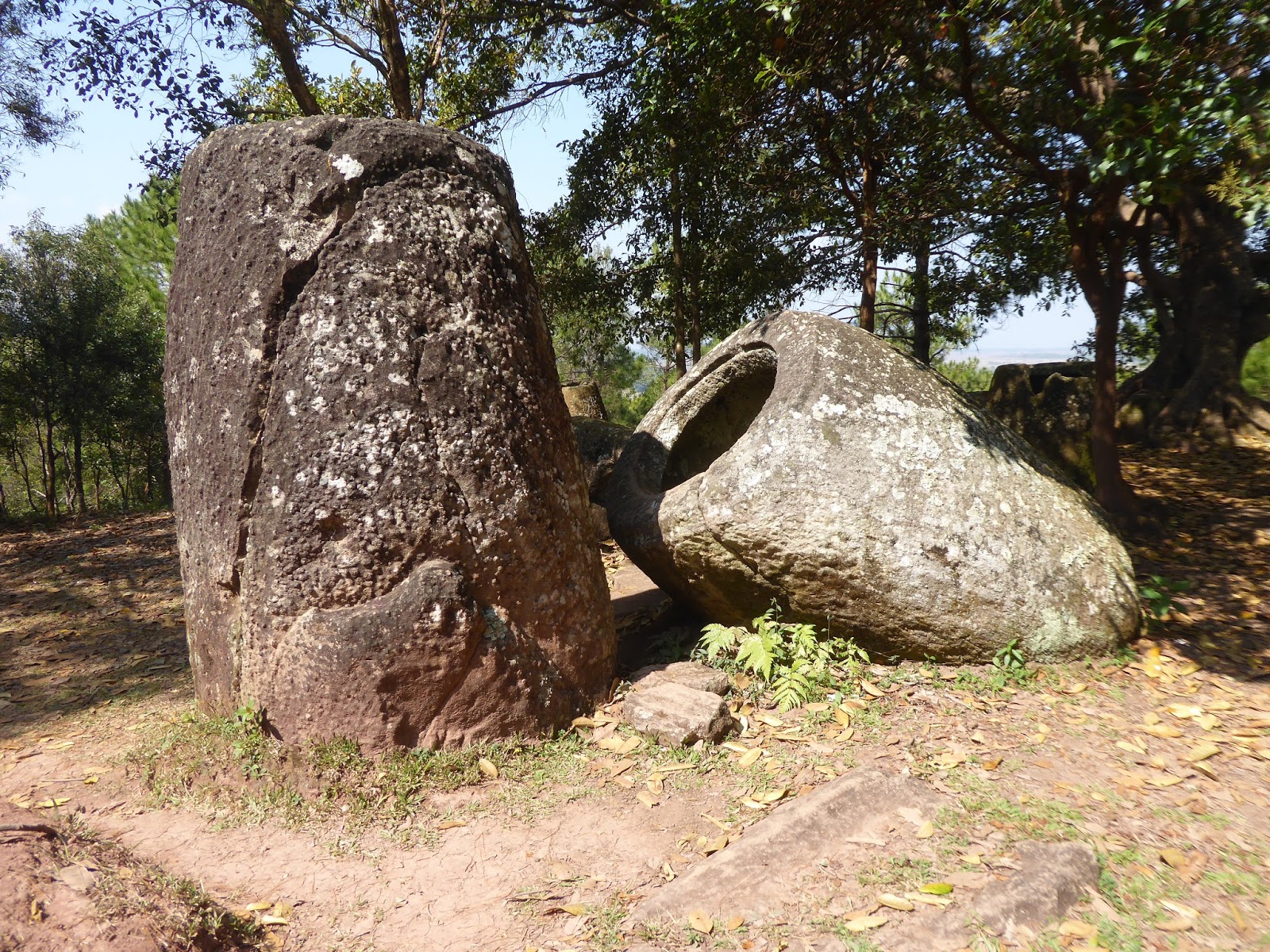
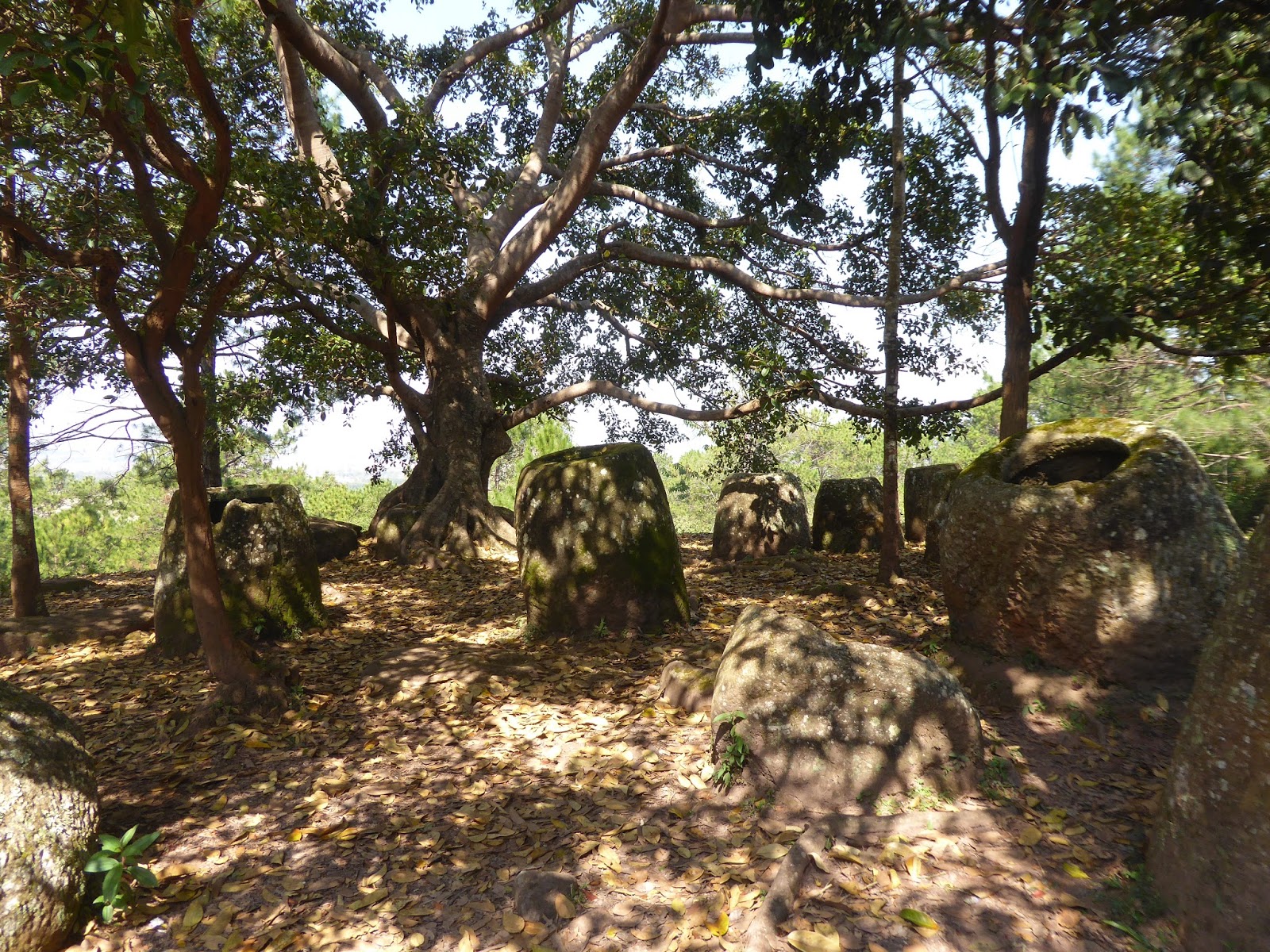
The Plain of Jars covers a huge expanse and is littered with around 2,500 large old stone jars. No-one is entirely sure how old they are - estimates range from 1,500 to 2,500 years old. And no-one is sure what they were put here for.

One theory, is that they were used to store alcohol for a huge feast  celebrate King Khun Chuang's victory over an unruly Chieftain, Chao Angka. Given that some of these jars are significantly taller than me, that would be a lot of alcohol!

Jar site 2, Plain of Jars, Phonsavanh

A more widely held view, is that the jars were used to store dead bodies while they decomposed, before then cremating them. This theory is supported by the fact that human remains have been found in the areas, a man made cave on one site seems to have been used as a crematorium, and the white quartz stones are believed to be grave markers.


Jar site 2, Plain of Jars, Phonsavanh
There are numerous jar sites around the region, but most are not open to the public, largely due to the likelihood of getting blown up. The amount if bombing in this region means that there is a very high risk of UXOs.

Those sites that are open have been cleared, which is indicated by the white and red markers. the white markers show that the pathway has been fully cleared, while the red markers indicate that the ground level has been cleared, but there is no guarantee that there isn't something deeper. These areas are safe, but it is strongly recommended that you do not stray from these cleared zones - Laos is not a country where you should decide to explore the countryside.

Jar site 2, Plain of Jars, Phonsavanh
We took a driver/guide out to the see the jars. It is a bit more expensive than going on your own, or with a big group, but we liked the freedom of it just being us, and the information that the guide was able to give us. We decided to go to the three main jar sites nearby, and to fit in a couple of small extras.

After a stop off at the information centre, which does have some quite interesting background and explanations, we set off to see the jars. Writing this some time after going, I can't recall which of the three sites it was, but there was one where our driver had to negotiate a very muddy track, where people were in the process of using a digger and their vehicles to pull down trees to build a new temple.

Jar site 2, Plain of Jars, Phonsavanh

The jar sites are intriguing. They are not as visually impressive as somewhere like Easter Island's moai, but it is the kind of place that makes you think about both the people of the past, and how, whilst we have come to learn so much about our history, there are some things that we just can't be sure of.

And not being sure of this, does also make me question some of the accepted wisdom about other aspects of our past. After all, where there are no first hand pictorial or written accounts, much of it is just educated guesswork.

Making spoons, Ban Napia, Phonsavanh


As well as the jar sites, we dropped in at the village on Ban Napia, where the local people used to melt down old bombs to make spoons and other items.

These days they tend to bring in aluminium, but the process of melting it down and casting the items in handmade moulds, is still the same. We watched a lady making them in her garden, while her child and dog played nearby. We bought a couple of the spoons.


Making spoons, Ban Napia, Phonsavanh

Our other stop off was at a garden distillery. We were able to have a look around the shed, to see where the rice was being fermented, and to taste the end product or rice whisky, or as it is know here, lao-lao.

It was certainly strong stuff, but actually not as rough as we had expected it to be. We bought a litre for around 95 pence; we still had a bit left when we visited my sister and her partner - they weren't impressed!

One thing we did find very interesting here, was the opportunity to speak with a few local people about their country. We had noticed a significant number of big fancy cars and very large houses in the area, and had wondered who could afford these things. The general consensus was that these would either be corrupt officials taking bribes, or people who were smuggling goods across the borders and profiteering that way.

Jar site 2, Plain of Jars, Phonsavanh
Certainly a consistent message that we heard, not just here, was that Laos is a very corrupt country, where individuals will often have to pay bribes to get permission to build, or run businesses. Another thing we heard often was a dislike of the amount of influence that the Vietnamese still had in the country. Of course, criticism of the ruling party or its policies is potentially a criminal offence in Laos, so anyone we spoke to would naturally be very careful to avoid doing so.
 
Jar site 3, Plain of Jars, Phonsavanh
 
Jar site 3, Plain of Jars, Phonsavanh

Jar site 3, Plain of Jars, Phonsavanh

Jar site 3, Plain of Jars, Phonsavanh

Jar site 3, Plain of Jars, Phonsavanh

Jar site 3, Plain of Jars, Phonsavanh
Making lao-lao (rice whisky), Phonsavanh


Making lao-lao (rice whisky), Phonsavanh

Jar site 1, Plain of Jars, Phonsavanh

Jar site 1, Plain of Jars, Phonsavanh

Jar site 1, Plain of Jars, Phonsavanh


Likely crematorium cave, Jar site 1, Plain of Jars, Phonsavanh

Jar site 1, Plain of Jars, Phonsavanh

Jar site 1, Plain of Jars, Phonsavanh

Jar site 1, Plain of Jars, Phonsavanh

Wednesday, November 2, 2016

Phonsavanh - town and bombies

Craters Restaurant (with old bomb casings), Phonsavanh
Our next place in Laos was Phonsavanh, and having looked at the various options for getting there, we booked onto the VIP bus. This included a pick up from our hotel, to take us out to the bus station. It arrived eventually, but of course they don't send enough out to pick everyone up, so I was sat on the back rail for the journey. At least my legs were inside - the next people to be collected had to cling on the outside. And ours wasn't the most overcrowded one we saw arriving!

Once at the bus station, we saw plenty of buses with names on to various destinations, but none labelled as Phonsavanh. After some confusion, we were ushered over towards a couple of twelve seater mini buses. We waited for a good half an hour before they told us to get on, and then it took them another thirty minutes or so to lash the luggage to the top and cover it with tarpaulins.

Then we waited again, until they decided that, as neither of the two buses was full, they didn't want to take both, only one. So they made the people from the other one get into ours. Which was all well and good, except that there were more people than seats. They squished four people onto the three seats at the back - which would doubtless invalidate their travel insurance in the event of an accident - and two other people didn't get to travel at all.


Map of bombing missions over Lao, Phonsavanh
They then had to change around all of the luggage on top, so by the time we actually left, we were about an hour and a half late. Not what I would call VIP - or even just acceptable - service.

Now I wouldn't mind this kind of thing if we were travelling on the normal buses, but this was another of those cases where they charge you way more that the normal kind of 'costs plus profit' fares, and still are late, overcrowded, and as two of our would-be passengers found, not even guaranteed to travel despite booking a seat. This is the kind of thing that made me unhappy with Laos, in a way that I hadn't found in Myanmar, Thailand or Cambodia.

Anyhow, after the obligatory lengthy stop at a place where they wanted you to spend money on food and drink so that they get a kick back, we made it to Phonsavanh. Our hotel sent a car to collect us, even though it was only just down the road. Of course the idea of this being that then we will use that driver for any trips that we want to do. In fact we did use him, as his prices were no worse than anywhere else. But we'll talk about our trip out in the next post.


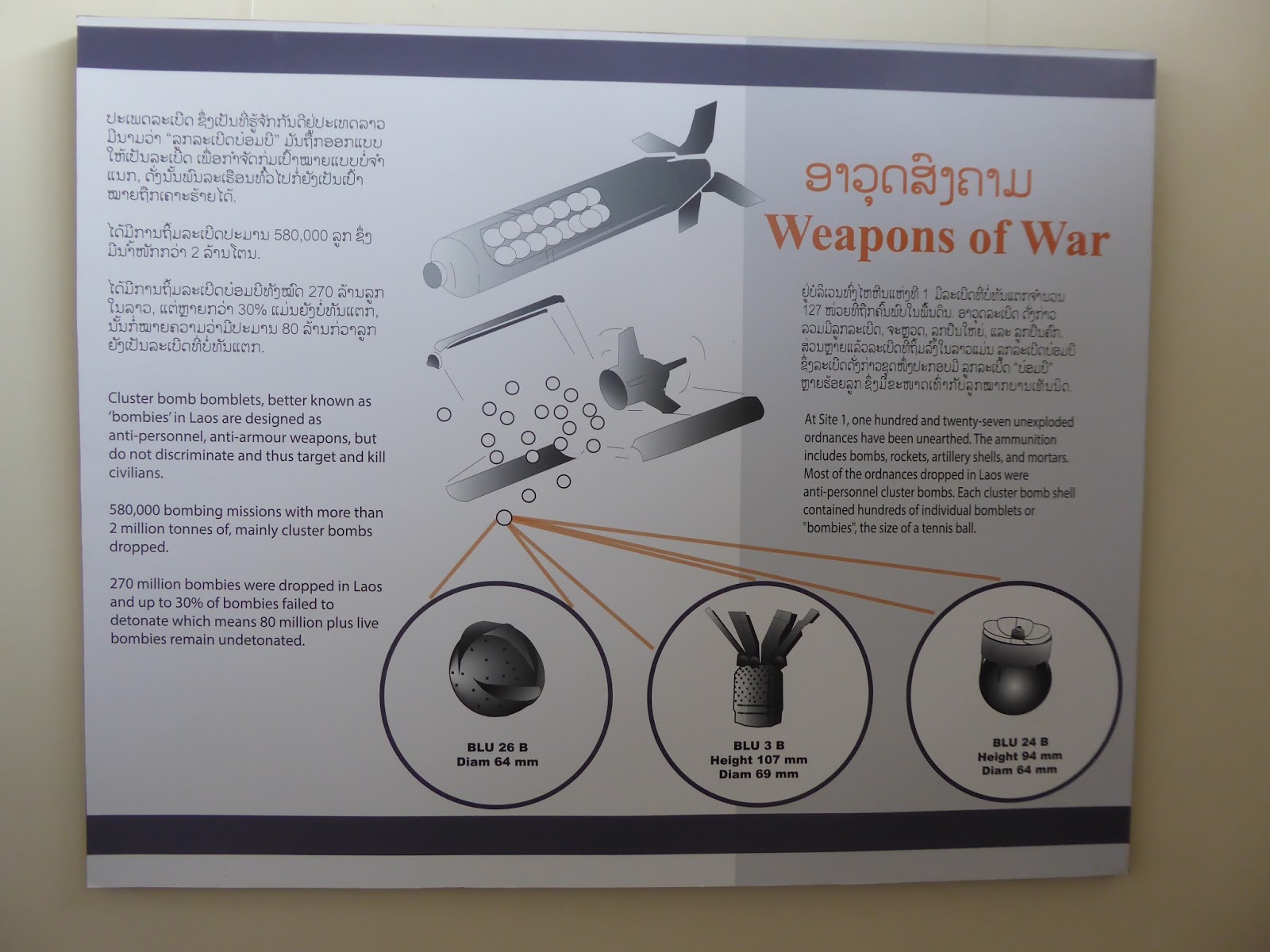
Cluster bombs, as dropped in Lao, Phonsavanh
Phonsavanh is a strange little place. This area was the worst hit by the US bombing campaign, with some 580,000 airstrikes, dropping around 1.9 million tonnes of bombs in the region. To put that into context, that is around two thirds of the amount dropped by the allied forces during the whole of WWII.

Even leaving aside the questionable practice of dropping bombs on a country that you are not supposed to be fighting, the really shocking thing is that, apparently, many of the bombs dropping here were completely unnecessary. It is widely reported that many were dropped simply because planned raids on Vietnam were called off, and the bomber crews just jettisoned their payloads here, rather than having to go through a more complex procedure on returning to base.

The original town, like so many around here, was destroyed, so this new town was built in the late 1970s. There is one main street, plus a market up by the old airstrip, and then the rest is largely just residential. The main street itself bears testimony to that terrible bombing campaign. Old bomb casings have been repurposed for practical use and as decorative features, and there are restaurants called Craters and Bombies, although we preferred to eat in Bamboozle.

You will also find the Mines Advisory Group (MAG) Office-UXO Visitor Information Centre and the UXO Survivor Information Centre. We went in to the latter, and found it a really worthwhile visit. It is run by the Quality of Life Association (QLA) which is a local not-for-profit organisation that offers support to people who have survived, or been bereaved, through UXOs (unexploded ordinance).
UXO Survivor Information Centre, Phonsavanh

It had its beginnings in the World Education Laos Group in 2009, but in 2011, a number of Laos nationals, including some who were themselves UXO survivors, obtained funding to set up this organisation, specifically aimed at having Laos people help victims.

They provide a range of assistance. They provide first aid training to local communities, so that they can provide good initial care, in what can sometimes be a number of days before the person can get to a hospital for full treatment. They help victims to obtain suitable prosthetics, and arrange transportation to get the person to the clinic - something that might otherwise prevent them receiving it. They provide psychosocial support, including peer group support, to help the individual through the psychological and social issues that they may face as a result of their injuries.

There is plenty of information about the bombing and those awful little round bombies that were dropped in the cluster bombs and now cause so many injuries and deaths every year. If you visit, do take the time to watch the film upstairs.

The countryside is still littered with the bombies, and accidents happen regularly. Many happen when people are farming their land, and hit one of them, often causing loss of feet and legs. Other victim are children, who pick them up like a ball, and play with them, often leading to the loss of hands, arms and maybe their sight. In the 19 years from 1996 to 2015, there were over 500 deaths from UXO in Laos, with about a quarter of those in this region. Over the same period, there were over twice as many people who survived but were injured, making it terribly difficult for them to farm and sustain themselves.

The items for sale in the shop are mostly made by the women who have lost husbands and sons to the bombies, and so have little other means of making a living for themselves. The QLA arranges for them to be trained in handicrafts, and to receive the materials needed, so that they can make these items for sale here. They receive a fair payment for the items sold, with the rest going to the work of the organisation to support the victims.

They do a lot of really good work here, and they do it on a very low income, so buying a few souvenirs, or making even a small donation, can go a long way to helping the victims.