|
| Yanesen, Tokyo |
If you only have a short stop in Tokyo, and want to get a good feel for the tradition and culture of the place, then Asakusa is probably the place to be. We were specifically here for the festival and I will cover that, and the Sensoji Temple where it was held, in the next post, but even without the festival, this is a vibrant, interesting and varied area.
Whilst we do, of course, go to specific 'sights', if we have the time, we do also like to spend time just wandering around areas, and trying to get a feel of the place we are in. One of our first expeditions in Tokyo was one of these wandering days, but broadly following a suggested walk, so that we knew we would pass a few temples etc along the way.
 |
| Yanesen, Tokyo |
We liked the Yanesen area, as it is what much of Tokyo would have been like before the high rises and technology arrived. As an aside, given what we have all heard about how busy and cramped Tokyo is, we were actually very surprised at how little of that we saw. Yes, the centre areas were high rise and sometimes a bit frenetic, but if you venture out just a little, then the buildings are pretty standard, and it feels far more relaxed.
 |
| Yanesen, Tokyo |
Yanasen is actually a collective name for the YAnaka, NEsu and SENdagi areas - see how they got that. We only walked some of it, missing out the cemetery and much filmed steps, and some of the biger of the hundred or so temples in the area. Instead, we stuck to some of the little alleyways and smaller temples.
The reason this area is such a connection with the past is simple - these shitamachi neighbourhoods somehow survived both the devastating 1923 Kanto earthquake, and the bombings of Word War II. What is even more impressive, is that Yanesen has somehow managed to escape the hands of developers. Long may that continue.
 |
| Enjyu-ji Temple, Yanesen, Tokyo |
This isn't an area where you will find a lot of tourists either. Most simply don't make it out this far from the main sights. Personally I thought it was worth a wander around the little shops, popping into some nice little cafes.
 |
| Enjyu-ji Temple, Yanesen, Tokyo |
The local sights aren't grandiose, but they are varied: there's the Enjyu-ji Temple, which is apparently good for healing ailments of the waist and foot; the tomb of Okubo Monto, an old samurai; and the now slightly decrepit former bread shop, Mikado Pan, with its huge old Himalayan Cedar tree towering above it.
 |
| Yanesen, Tokyo |
 |
| Mikado Pan, Yanesen, Tokyo |
 |
| Mikado Pan & cedar tree, Yanesen |
 |
| Okubo Monto tomb, Yanesen, Tokyo |
 |
| Imado Jinja Shrine, Tokyo |
Another place that we visited around Asakusa was the Imado Jinja Shrine, which is one of the places that claims to have been the origin of the maneki-neko, the beckoning cat, or lucky cat.
 |
| Imado Jinja Shrine, Tokyo |
To us westerners, the cat appears to be waving, but in many Asian countries, people beckon with their palm facing downwards, so the cat is beckoning, not waving.
 |
| Imado Jinja Shrine, Tokyo |
Often thought of as Chinese, because it is so popular over there, it actually came from Japan. There are various stories about the origin, almost of which involve a cat somehow saving the day by beckoning people over.
 |
| Imado Jinja Shrine, Tokyo |
 |
| Imado Jinja Shrine, Tokyo |
 |
| Imado Jinja Shrine, Tokyo |
It is a nice shrine, and needless to say, it has a lot of cat figures. As the maneki-neko here are said to represent a fateful encounter, it is apparently very popular with women, who leave the little wooden ema, or wishing tokens, in hope of meeting their future spouse.
 |
| Imado Jinja Shrine, Tokyo |
 |
| Imado Jinja Shrine, Tokyo |
 |
| Imado Jinja Shrine, Tokyo |
 |
| Asahi Beer HQ, Tokyo |
We thoroughly enjoyed being in Asakusa. From seeing the rather unique Asahi Beer HQ building, with the taller modelled on a beer glass (see the 'foam' on top), and the shorter having a Philippe Stark designed 'Golden Flame' (no, it isn't a poo) on top, to being in a tiny little bar and getting introduced to a guy who apparently is a famous writer of Noh Theatre. At least we think that is what he was famous for, their English was very limited.
 |
| Tokyo |
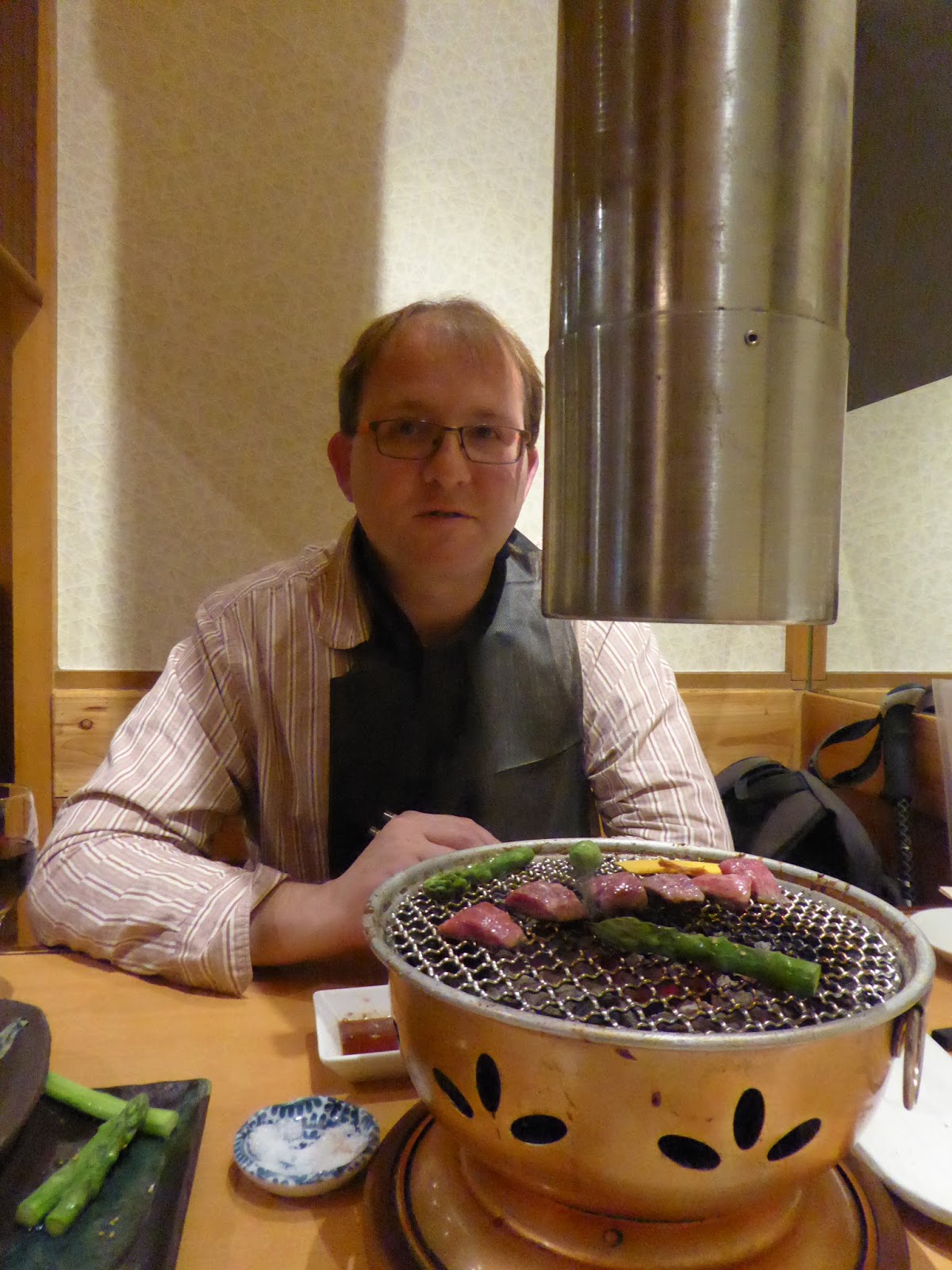
We also finally got around to trying some proper sushi here - or at least Nic did, I just had a drink! I was much happier - and less hungry - when we found a couple more yakiniku places, which weren't as nice as the Ebisu one, but did have an interesting dish where you melt a ball of candyfloss on top of the food. We had to try it, and it was OK, but I wouldn't actually recommend it.
 |
| Yakiniku, Tokyo |
Of course the main sight here is the Sensoji Temple and the Nakamise Shopping Street, which I'll tell you about on Saturday.
 |
| Sushi, Tokyo |
 |
| Nic with Sushi, Tokyo |