Welcome to our travel blog. We are Tabitha and Nic. In 2011 we 'retired' in our early 40s and set off to travel the world. We spent our first year in South America and have been lucky enough to make two trips to Antarctica.

Our blog is a record of our travels, thoughts and experiences. It is not a guide book, but we do include some tips and information, so we hope that you may find it useful if you are planning to visit somewhere we have been. Or you may just find it interesting as a bit of armchair travel.


Showing posts with label Alice Springs. Show all posts

Sunday, July 17, 2016

Alice Springs -The Camel Cup

Camel Cup, Alice Springs
Part of our timing for coming into the Red Centre, was to be in Alice Springs to catch the Camel Cup. After all, who doesn't want to see a bunch of notoriously recalcitrant camels racing around.
Camel Cup, Alice Springs

The Camel Cup was founded in 1970 when Noel Fullerton, a member of the Lions Club, wanted to settle a feud with fellow Lion Keith Mooney-Smith. He wrote "So I challenge him to a duel, weapons being camels. Time and place I leave this up to him. that is if he is not chicken as he is getting fat and I doubt if he can sit on one".
Camel Cup, Alice Springs


I couldn't find anything to say who won that race, or whether the feud was settled, but the Camel Race became an annual event, eventually moving from its first location in the dry bed of the Todd River, to a purpose built course here at Blatherskite Park in 1979. Noel himself died in September 2015 aged 81, but the Camel Cup is regarded as a lasting legacy.


Camel Cup, Alice Springs
We nearly didn't make it at all though. We knew that there was a free shuttle bus from town, but we waited and waited, and nothing turned up, so we started to wonder if we were in the wrong place. We were slightly encouraged when a few more people turned up too, but they weren't any more certain of where they be that we were, but we figured it was less likely that we had all got it wrong.

Camel Cup, Alice Springs

As it turned out, we were in the right place, but the bus had broken down. Thankfully, the driver of the regular bus that told us this, had a route that went close by, so he took us all with him, and dropped us just across the rail tracks from the park. He was very anxious that we should take care crossing the line as apparently there might be a train due next week. Hmm.


Camel Cup, Alice Springs
The  event comprises of nine races, with 21 camels participating. The camels are sponsored, with the local YHA having Backpackers Delight, and McDonald's having four camels, Chocolate Sundae, Cappuccino, Big Mac and Large Fries.

Camel Cup, Alice Springs

The races are good fun to watch, not least to see the resigned frustration of the riders when their chariot decides that it doesn't want to move, or if it must move, it will go in the opposite direction. That isn't at all unusual.


Camel Cup, Alice Springs
Then, to make matters even more complicated, there is the Honeymoon Handicap. In this race one rider starts, and then part way round, has to pick up his 'bride', wearing a veil of course.

Camel Cup, Alice Springs
The strategy varies as to whether they decide to spend time getting their camel to sit down so she can get on, or just try to hoist her up what the camel may or may not stand still for them. Needless to say, neither way is likely to be smooth sailing with these particular ships of the desert.

Camel Cup, Alice Springs


Camel Cup, Alice Springs
It isn't all about the camels though. They have best dressed competitions, where most entrants are seriously unambitious in my opinion. They have kids' hobby camel races (think riding a hobby horse, but a camel), which are amusing slimy for some kids sheer lack of effort and expertise. Some kids just picked the thing up and ran, others fell over repeatedly, and some just gave up entirely.


Camel Cup, Alice Springs
Somewhat more amusing were the Rickshaw Rallies, where teams of four had to race around the track, with two pulling and two as passengers, swapping over part way around. Again, the 'rules' seemed a little hazy, with some swapping half way, as you would presume was expected, and others just letting the weaker pair take over for the very last bit.

Camel Cup, Alice Springs
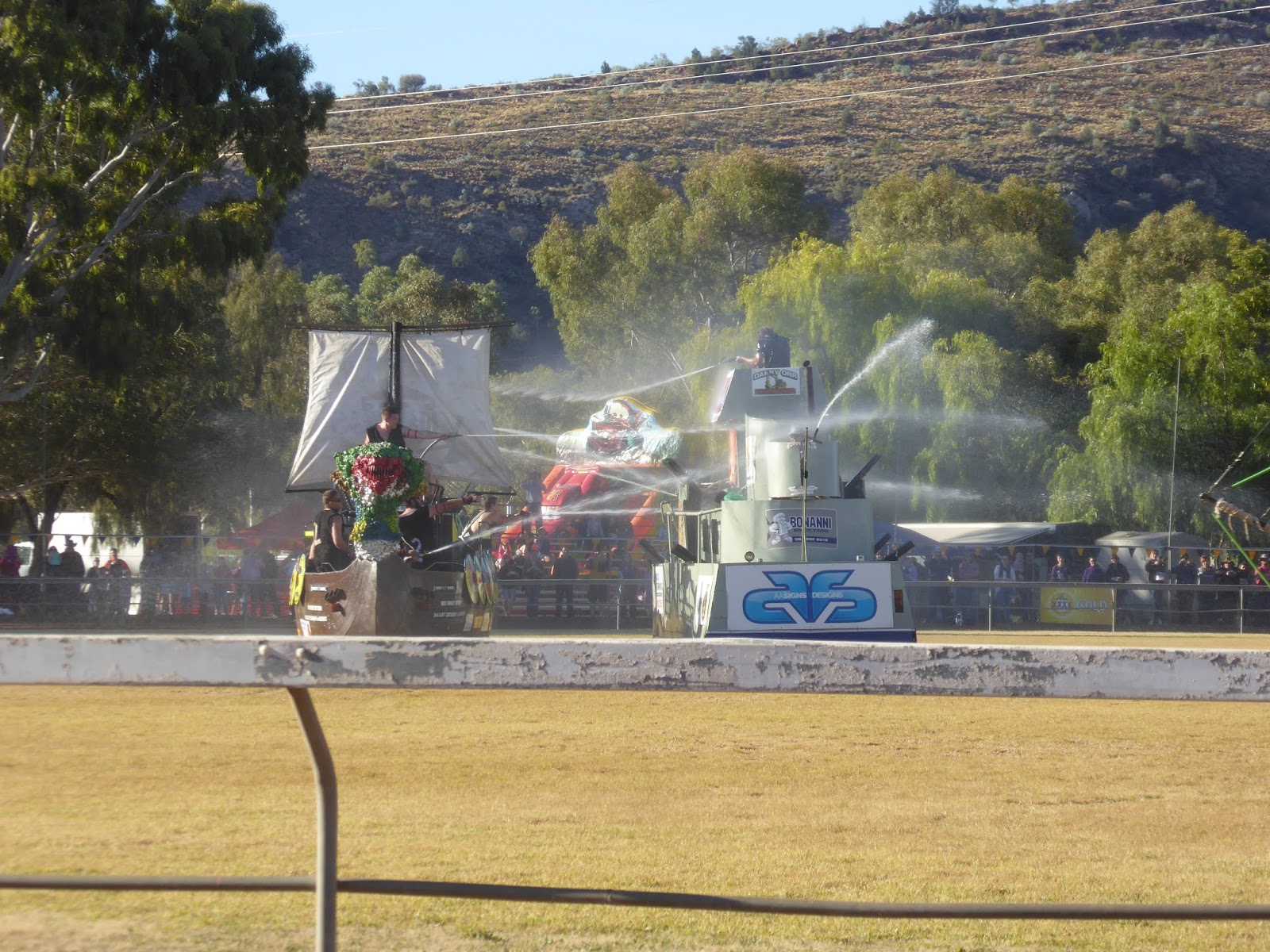
Aside from the camels though, the highlight was probably the Henley on Todd Battleship Water Cannon Hose Off. This is a glimpse of a different annual event, the Henley on Todd dry river bed race, where a multitude of motorised, pedal or foot powered 'boats' including bathtubs, compete in a riverbed race, making every effort to disrupt their competition along the way.
Camel Cup, Alice Springs

This is the only dry river regatta in the world and, somewhat unusually for a boat race, had to be cancelled in 1993 due to excessive rain flooding the area and creating an actual river in the usually sandy river bed.

Camel Cup, Alice Springs
In the event here, the three main 'boats' - the Pirate Ship, the Viking Ship and the Royal Navy - fought it out with water cannons. As you might imagine, there wasn't much playing by the rules. As the boats left after the battle was done, it didn't do to be in the firing line, unless you fancied a drenching.
Camel Cup, Alice Springs

Overall this was a fun day out. You could go and take a closer look at the camels in the paddock between races, and you could, perhaps slightly cruelly (though we still did), get yourself a tasty camel burger too.
Camel Cup, Alice Springs
There was also a little 'farmyard', where you could say hello to the little sheep, goats, chickens and alpaca. It was quite amusing to watch the goats jumping up on the stools and knocking each other off them.

Camel Cup, Alice Springs
Oh, and in case any of you are Kangaroo Dundee watchers, (we're not, but we were told about him,) we did see Chris Barnes here, but he didn't have any of his kangaroos with him.


Saturday, July 16, 2016

Alice Springs - reptiles and flying doctors

Reptile House, Alice Springs
Despite the Overland Telegraph Office being the starting point for the town of Alice Springs, we didn't actually go to see it while we were here. Neither did we go out to the Kangaroo sanctuary, which is run by Chris Barnes, the guy known as Kangaroo Dundee, who has his own TV show. Though we did see him at the Camel Cup, which I'll tell you about in the next post.
Reptile House, Alice Springs

We did go and see the reptile house, arriving at the end of a talk, but just in time to join in with the 'hold the animals' session. We got to hold a couple of lizards and a snake - if memory serves,  they were a blue tongued slink, a bearded gecko and an olive python.

Reptile House, Alice Springs
For a small place, there is a large range of reptiles here, and they give good information about how dangerous each type is. They also include a couple of stories, such as that of a guy who was holding his beer in his 'snake catching hand', but decided to try to catch a brown snake anyway. He lost his hand. But hey, he didn't have to put down his beer!


Thorny Devil, Reptile House, Alice Springs


We did rather like the little Thorny Devils, which are apparently quite rare to see. It was also fun to say hello to the free roaming goanna, which I think was called Ruby. She was a reasonably inquisitive creature, so was happy to come up to us.

Reptile House, Alice Springs

My only concern here really was the size of some of the enclosures, especially that for Terry the saltwater crocodile, which seemed rather on the small side to me. Aside from that, it was an interesting and informative visit.


Reptile House, Alice Springs


Reptile House, Alice Springs


Reptile House, Alice Springs

Flying Doctors, Alice Springs
And of course we couldn't come here without finding out about the famous Flying Doctors. They were set up by Reverend John Payne, after he was appointed by the Presbyterian Church to improve the lives of those living in the outback. He initially set up bush hospitals, but these were no help to those outside of the main settlements.
Flying Doctors, Alice Springs

Lieutenant Clifford Peel heard one of Payne's radio broadcasts about the issue, and suggested to him something that he had seen in France in 1917 - doctors reaching their patients by plane. Sadly, Peel was killed in last year of the war, so never saw his idea come to fruition.

Flying Doctors, Alice Springs
This idea, together with the development of a pedal powered radio, meant that the basis for the flying doctors had been conceived. Ten years later, Payne had got the funding he needed. He hired his first plane, a de Havilland DH-50 called Victory, from Hudson Fysh, one of the founders of Queensland and Northern Territories Arial Services (now rather better known as Quantas), and the first flight took off on 17 May 1928.

Flying Doctors, Alice Springs
In 1934, the service was expanded to a national network, known as the Australian Aerial Medical Service. It changed its name to The Flying Doctor Service in 1942, and then in 1955 it received the endorsement from The Queen and added the 'Royal' to its name.

Flying Doctors, Alice Springs
Today, the RFDS has 23 bases, 66 planes, and last year, covered 26,847,325 kilometres.

Flying Doctors, Alice Springs
The museum and visitors centre here is good, with an interesting tour, and the opportunity to get aboard a RFDS plane, to see what it is like.
 
Flying Doctors, Alice Springs


Wednesday, July 13, 2016

Alice Springs

Curtin Springs, Red Centre
From Uluru, we took a bus transfer to travel roughly 250 miles to Alice Springs. It isn't a difficult route - you basically drive down the Lasseter Highway then turn left onto the Stuart Highway, and you're there.

We stopped off a couple of times along the way, with the main one being the Curtin Springs Cattle Station and Inn. The cattle ranch was started back in 1956, when Peter and Dawn Severin arrived and brought with them 1500 cattle.
Mount Connor, Red Centre

Since then, the cattle numbers have reached around 4000, and the owners have branched out into the tourist trade, with petrol pumps, rooms and a bar and café. They have a few interesting bits of historical information on their walls, but they also have a lot of 'Daily Mail' style articles, full of sensationalist anti-foreigner type of stuff, that irritated us sufficiently that we chose not to buy anything or hang around in their presence.

Vegemite tree
We had a very brief stop to take a photo of the huge tabular Mount Connor in the distance, and also had a look at the Vegemite tree. For those who've never heard of Vegemite, (which would mean you're obviously not an eighties person then, as how could you forget Men at Work's vegemite sandwich,) it is vaguely similar to, in my opinion the much superior, Marmite. Well for reasons best known to themselves, people have taken to putting their empty jars on the branches of a tree.

As we get close to Alice Springs, we pass by Pine Gap, a large US military base where they monitor satellites. And then we follow the perpetually dry riverbed of the Todd River, through the small gap in the 400 mile long MacDonnell Ranges, to find the town of Alice Springs.


Alice Springs
The origins of the town were at the Overland Telegraph Station, established in 1872. The Todd River was named after Sir Charles Todd, postmaster general and pioneer of the telegraph. The settlement was named after his wife, Lady Alice. The present day town only emerged some fifteen or so years later, when the gold rush increased the number of people coming here. That new town was originally called Stuart Town, and it was only changed to Alice Springs in 1933.

Until WWII, the town remained a small outpost, but having had many troops stationed in the area, it became better known and increased to a population that is now around 29,000.

Alice Springs
Of course, long before Alice Springs emerged, this was an area populated by the aboriginal people. They now make up around twenty per cent of the population, but it appears to be an uneasy mix. We had been interested to visit, because we had figured that this would be a place where the two cultures would have learned to live together and combine. Sadly, it seems not.

In fact, far from being a positive experience of the aboriginal people, I found myself feeling that I could never live here. In fairness, it was only a short visit, but there were a couple of incidents that made me feel uncomfortable. The main example was, walking past a park, where an aboriginal man was standing with his beer can, and proceeded to spray beer from his mouth, onto the two women he was with. This happened a couple of times, and is the sort of behaviour that I don't think that I could put up with seeing on a regular basis.

Aboriginal Art
I know that we have some pretty awful behaviour in the UK too, but I do at least feel that there are mechanisms for dealing with that. From speaking with people here, this kind of behaviour is not at all unusual. I get that people have cultural differences, but that is not the kind of behaviour that I want to live alongside.

I also know that the aboriginal people, like many original inhabitants of places that we British and other Europeans decided to 'settle', have been pretty badly treated in the past and that this disruption to their lifestyle has been the cause of many of the issues they now have, including problems caused by alcohol. So my comments above aren't intended to condemn a group of people, I know it isn't that simple, but rather they are just to explain my discomfort with the town.

Aboriginal Art
Of course, with such a high aboriginal population, there are numerous art galleries here. We took a good look around, and picked out a couple of smaller paintings, which were still traditional in the sense that there were dot paintings representing the aboriginal culture, but they were a bit different to the normal ones that you see everywhere. Thankfully they roll up well to go in the rucksacks.