Welcome to our travel blog. We are Tabitha and Nic. In 2011 we 'retired' in our early 40s and set off to travel the world. We spent our first year in South America and have been lucky enough to make two trips to Antarctica.

Our blog is a record of our travels, thoughts and experiences. It is not a guide book, but we do include some tips and information, so we hope that you may find it useful if you are planning to visit somewhere we have been. Or you may just find it interesting as a bit of armchair travel.


Showing posts with label Cuba. Show all posts

Thursday, January 24, 2013

Havana - cars, cigars, chocolates and crafts

For our remaining three days in Havana, we reverted to wandering the streets and sitting in cafes.  For us, the charm of Havana is not in the museums, but rather in walking along and seeing the crumbling but still beautiful buildings, the falling apart but fabulous cars and the times-gone-by but still trading counter shops.


Vintage they may be, but most at least are still vibrant in their way.


The evidence of a once very wealthy society is all around, and it is fascinating, sad and yet oddly reassuring to see how little those symbols of wealth have  been so little cared for over time.

I am very glad that they are now working to preserve the architecture that is here but the reality is, had the country continued to develop and build during these post revolution years, many of these lovely building would be long since gone.

Similarly had there not been restrictions on the import and sale of vehicles, Cuba would not have the many Cadillacs, Pontiacs and other vintage cars that we see today.  We were concerned that with restrictions being relaxed, these old cars would be sold to dealers from the States and Europe and replaced by the more efficient but soulless new cars.

Happily, we heard that the UNESCO status recognises that these cars are a part of Cuba's heritage now, and protects them as well as the buildings.

But even we couldn't resist one museum - the museum of chocolate!  Not that it is really a museum.  It is really a cafe and shop,  where you can watch them make the chocolates and see a few cabinets with old chocolate moulds and other paraphanalia.  But the chocolate was quite tasty, so we weren't complaining.

Then of course even as non smokers like us, you can't come to Cuba without visiting a cigar factory.  We had tried the one in Santa Clara, but that was no longer doing tours, so we figured we'd go to the one here.  Except that was closed too.

But at least here there was a lady sat at a workstation in the corner of the shop making the cigars for the benefit of we tourists.  So we did get to see the process and it didn't cost us anything.

We also made it to the Almacenes de San Jose craft market where we spent some hours looking around at the multitude of paintings of old cars.  These are of course slightly kitsch, but I do like them, and we spent some time considering them before finally deciding we don't currently have any walls, and by the time we do again, we will have far too many pictures and photos for this one to get put up.  So instead, I bought a colorful paper mâché boot and Nic bought a Che Guevara wallet, partly because he needed a wallet, and partly because he liked the irony of it.
 
Beyond that we spent some time in a few bars and restaurants, often with a few rum based drinks and some (usually welcome) musical entertainment. Three places that didn't have any live music, but which we rather liked were La Imprenta, Palador Doña Blanquita and El Chanchullero.

The first, La Imprenta, was a state run restaurant, which was something of a surprise as unlike most, it was really rather slick.  The food was great, they had some good wines, it was good value and the service was impeccable, but the more remarkable thing was the design.  It was an old print works building, and the decor was built around that.  The seats and tables were all carved wooden typeset letters, there were old bits of printing machinery, and many other interesting, slightly unusual, and yet still tasteful touches.  Something of a surprise really.

The second , Palador Doña Blanquita, was not state run, but rather a small restaurant on the second floor of an anonymous looking building.  The food was good, and there was a nice view across the Prado, but what amused us here was that this is so clearly  a place that someone has opened where they live.  We could tell this because at the room at the back we could clearly see the old mum asleep on the sofa.

And the last, El Chanchullero, was a lovely but tiny little bar on Plaza del Christo.  It made great cocktails and although we didn't eat here the food did look good.  But the interesting element for us was that it was very different to what we had come to expect in Cuba.  It had excellent quirky decoration, including a tiny shrine inside and was very simple and cosy.  It was the sort of place that would have gone into whatever city we were in.

Perhaps it seems wrong that some of the places that appeal to us are those that are less traditional.  We do like to go to the traditional places, but we quite like to see what is new about a place as well.

Sometimes as a tourist it can feel like all of the traditional things are a bit false - done for the tourist market rather than because it is what they would still choose to do.

They are still interesting and can tell you a lot about a place's past, but we like to mix in a bit of the more modern culture too, and perhaps get to learn a bit about where the country and it's people are going rather than just where they have already been.

Wednesday, January 23, 2013

Havana - and the second old car

The next afternoon the four of us hired one of the big old open top Cadillacs for a drive around the city. This car was in somewhat better shape than last nights, although Russell had for some reason picked a bright pink one!

We drove around the old town, seeing as we passed the old churches, the tree that tradition says people have to walk around on a particular day for luck, and the old town fortifications.

We drove along the Malecon and watched people getting wet as the waves splashed over the sea wall onto the pavement. It seemed to be part of the walk to get wet - perhaps because it is hot no one cares about a quick soaking.

Our first stop was the Hotel Nacional, which was USA built in the 1920s with art deco and arabic influences, and was tremendously popular as a casino and hangout for the rich and famous.  The Mafia bosses used this place for meetings.

After the revolution, the US management left and the hotel was state run.  This is one of the few places that you can see any kind of tribute to Fidel Castro as there is a display of pictures in the lobby here. It is interesting as most longstanding unelected leaders have statues of themselves everywhere, but Fidel has none of that. There is one plaque on a wall in Havana which celebrates him but that is it, and even that is small, understated and on a corner of a building.

We stopped for a while in the Plaza de la Revolucion, which is a huge (72,000 square metre) square that is surrounded by state buildings including the office that was Fidel's and is now used by his brother Raul. This is where the big parades happen. The main structure is a 109 metre high monument to Jose Marti, with rather dwarfs the 18 metre statue of him.

Two of the buildings have large faces on them. One is the Ministry of Communications building with the face of Camilo Cienfuegos, the other is the Ministry of the Interior building with Che Guevara. We had half expected that taking photos wouldn't be allowed, but in fact there was no problem at all.

We drove through a leafy area full of big old buildings, one of which was the British Embassy.  It looked quite impressive, but we were amused to see that it was next door to that of North Korea.  Not something that would happen in most countries.

Of course one country that does not have an embassy here is the USA.  But we were surprised to see that it does still have a presence in the form of the United States Interests Section.  But just in case the US should start to feel too comfortable here, Fidel Castro has created the huge Plaza de la Dignidad next to it with a large anti-imperialist stage where the columns bear the names of revolutionary heroes and North Americans who fight for social reform.  About five years ago, around seventy huge flagpoles were erected right in front of the building to hide the anti castro propaganda that President Bush in his usual diplomatic way, was issuing from there.  President Obama stopped it, but the flags remain.
Our last stop was rather less grand. The John Lennon park is small and leafy, with is a wooden bench where you can sit down next to a bronze John for a photo or a rather one sided chat if you feel so inclined. The writing on the ground is the Spanish of 'You may say I'm a dreamer, but I'm not the only one.'

The cadillac trip is a very touristy thing to do, but it was a bit of fun, and with four of us, the price isn't too bad.

After the trip we stopped off at the Hotel Park View and had some of their excellent small plate food and lovely cocktails. The hotel isn't cheap, but the food and drink in the ornate lobby is reasonably priced and very good. They also have a decent wifi connection - though you do have to pay for it.

Appetites satisfied, we went to a nice bar that Nic and I had found the day before. The Monserrate is a fairly small and understated bar, but the drinks are good and they have excellent live music all evening. Another good evening.

Tuesday, January 22, 2013

Havana - and the first of two old cars

For our first two nights in Havana we met up with a couple of friends who are currently living and working just a short hop away on the Cayman Islands. They were staying around the old town so as our original plan to meet them at our conveniently located hotel had failed, we met them in Plaza Vieja instead.

We spotted a vacant outside table at the microbrewery called Taberna de Muralle, and grabbed it. With a nice view, a tower of reasonable locally brewed beer and some good music playing, we stayed to eat there and caught up on each others news.
After food we wandered around the streets nearby in search of a bar. We intended to try out Bodeguita del Medio, which was an old Ernest Hemmingway haunt and full of character, but unfortunately it was also very full of people already. But we found an alternative after a while and sat outside drinking our various drinks, most of which contained rum of some form or other.

At the end of the evening, as we needed a cab back to our distant hotel, we headed to the square where we were told the drivers loiter. We were soon offered a cab at the right price, and we followed the guy over to the cabs. He took us to one of the old style cars, where the driver promptly sought a high price because it was a vintage car. He didn't seem too bothered when we said no; we just wanted to get where we were going and didn't care what the car was.

And this car wasn't so much vintage as clapped out. It is hot enough in Cuba that you generally want the windows open, which was just as well in this car as there was no glass in the windows to close. The interior of the car was exactly that - the inside of the metal outside. The seat was there, but otherwise here was no upholstery inside, just the metal panels, with bits of wire to open the doors.

Half way there we reached a point where the road sloped upwards and came to an abrupt stop. The driver tried to restart with no joy, so got out and had a fiddle under the bonnet and tried again; still no luck. Two attempts later he got it going; we held our breath for the rest of the journey and when we made it there I think we all breathed a sigh of relief.

Sunday, January 20, 2013

Havana - with no place to stay

From Santa Clara we made our final bus journey back to Havana. We had decided that for these last five nights we would treat ourselves to one of the not too pricey, but nice colonial hotels in the older part of the city.

We arrived on the bus and the driver offered to arrange a taxi to the hotel, which we agreed to. The 'taxi' turned out to be two plastic chairs strapped into the back of the mini van that was taking the post sacks from the bus to the sorting office. It looked like something out of a movie where we would be forced in at gunpoint and gagged until they found somewhere suitable to shoot us and dump our bodies! Thankfully nothing like that happened, and we arrived safely at our hotel.

Though as we were about to find out, it wasn't our hotel at all. We had booked through Hostelbookers, which we had used quite a lot in South America, and though that agency had sent us confirmation and taken our deposit, apparently the hotel itself doesn't work with them, and had no reservation for us. They also had no rooms available, so we couldn't stay there.

Of course by this time the Hostelbookers office was closed, so we couldn't contact them, and had to find somewhere to stay. That was not going to be easy, as we had reached tourist season, and places were full. With hard to find and interminably slow Internet, there was no way we were going to quickly find somewhere else, so after a few phone calls that came to nothing, we turned to the tour agent sat in the lobby.

She didn't look too optimistic either. She first found a very expensive place, which we weren't prepared to pay for. She phoned a few that we said we would be happy with but with no luck. Then she found us a place way out in the Miramar area that could do the first four nights. The price was OK, even though annoyingly we were paying for included dinners which we knew we would not use more than one night, so we agreed.

We left a message at the front desk for the friends that we were supposed to be meeting there later in case we couldn't contact them beforehand, and set off for the new hotel.


The hotel was OK, but is was definitely a resort style hotel, where many people don't really bother to leave the hotel area for the whole of their stay unless it is for an arranged tour. We have nothing against that, but it just doesn't suit us, so we never stay usually at these places.

But it was somewhere to stay, and we left the other guests to their morning poolside dancercise classes and went into town instead. We did eat there one night and the food was fine, but generally we ate in town.

Once we finally got access to Internet, we booked our last night at a hotel along the Malecon. It was quite cheap, and once we got there we knew why. The room was OK and was clean, but the lift took forever (and we were on the eleventh and top floor), the balcony door was held together with a screw and a prayer, and when we arrived the water wasn't working - though by the time we returned that evening it was fine.

The water problem in our room may have had some connection with a water problem in the lobby, where there was rather too much of it! Multiple buckets and other containers were catching the drips - or not. There was water everywhere, and it stayed like that until we left the next day. It wasn't even as if we'd had a lot of rain.

As for Hostelbookers, this is the third time that somewhere we booked through them has been a problem. You can't contact anyone at the time there is a problem and their site doesn't let you access accommodation for the same day, so when it goes wrong you're stuck and all they ever do is say sorry and refund the deposit. So we will in future be using Hostelworld instead, which we have never yet had a problem with.

What would Che say?

Whether you consider Che Guevara to be a revolutionary freedom fighter hero or a terrorist villain, I think most would have to accept that he genuinely believed in the communist ideals that he fought - and in the end died - for.

So what would he think of Cuba now?

In his day, communism had a couple of mighty super states, but Russia and China have long ago embraced the unevenly distributed wealth of capitalism, and there now are few places that can genuinely claim to be communist. Can Cuba?
 
Well it is still a very state led country, and there are certainly still a lot of elements of communism that are going strong. Many people live in homes owned and provided by the state. Of course lots are in a terrible state of repair. A recent documentary that we saw suggested that people can wait over fifteen years for repairs to be done. And it is difficult to do your own maintenance or improvements because the materials and services are controlled by the government so not only are the items expensive to get privately, but if you are caught having made improvements that you can't show were approved and how you paid for them, then the work can be demolished.
 
The Government issues ration books which you can take to a State run store for free food staples such as bread, sugar, oil, and matches. These stores also sell other foods cheaply, but they are not the best quality goods and choice is very limited. People who can afford to, supplement their shopping elsewhere where prices are a little higher but there is more available.
 
As for work, you will be given a job to do for the State with an average wage of around £15 month. The doctors here may be well trained, but they still don't get paid much.
 
Internet access is highly constrained and there have been significant blocks on trading with capitalist countries, which severely limits the flow of consumer goods into Cuba, hence the abundance of worn out old Cadillacs and the old fashioned or handmade furnishings. And as a matter of principal, Castro has never cashed any of the cheques that the US pay for their lease on the Guantanamo Bay area
 
So that all sounds very communist so far. Even down to them having high levels of incompetence and corruption amongst their public workers - because after all, if you have a guaranteed job, and you all earn the same, where is the incentive to be efficient? Sadly, the communist ideal of fairness and equality sounds good, but in reality most people only strive when they can achieve something beneficial to them, which communism just doesn't give you.
 
And no country can sustain inefficiency. In the heydays of communism, Cuba's big communist brother the Soviet Union used to help out by buying entire crops of sugar at inflated prices. But when newly capitalist Russia stopped doing that, Cuba's economy hit trouble.
 
So Cuba embraced tourism; let a lot of wealthy people from capitalist countries come and spend their money in government owned and run hotels, restaurants and tour companies. Give them their own currency and keep them apart from the locals, partly so they don't know how much more they pay for the same things, and partly to stop the locals getting capitalist ideas.
 
Alongside the export of rum and cigars, the influx of tourism meant that capitalism was helping keep communist Cuba afloat.
 
But more was needed, so gradually Castro started allowing people to apply for licenses to work independently on a list of approved work areas. So people were starting to work for themselves, paying taxes to the State but still making more than people around them. The documentary we saw showed a man who was a fully trained doctor earning more money in the street from buying and selling sinks, piping and whatever else he could lay his hands on.
 
Many of the new self employed work in the tourist areas. They run the Casas Particulares, have small restaurants, drive taxis and bici-taxis, or sell souvenirs. These people not only don't have the wage restrictions of state workers, but they also have regular contact with we tourists. They can charge us more, get tips from us, and get access to the more valuable tourist currency. So they are making much more than those working for the state.
 
In a population of just over eleven million, there are already over 400,000 people licensed to work privately. Doubtless many more are doing things like driving a 'taxi' in their spare time to earn extra. And the people who are on their £15 a month resent this. They see these newly richer people with their newer cars, nicer housing, and electrical goods, and they want it too.
 
Does this sound like communism - or does it ring bells for those of us from capitalist countries? We certainly felt that Cuba had gone too far down the path of capitalism to turn back, not that it could afford to anyway, and now it is only a matter of time before communist Cuba is a thing of the past.
 
So Che could be forgiven if, were he alive, he were feeling a bit aggrieved.
 
But if this rise of capitalist style wealth for some was not bad enough, then look at the blatant commercialism of his own name in Santa Clara. If you read the Santa Clara blogposts then you know the link already, but everywhere you go people are trying to make money from the connection.
 
Che t-shirts, Che books, Che postcards, Che hats, Che lighters, Che light shades, Che jewellery, Che sweets, Che just about anything you could ask for!  In the streets people are selling coins and banknotes that had a picture of Che, or his signature from when he was the treasurer after the revolution.  And even if people aren't selling Che, they are using the tourism that he generates to beg for money or soaps.
 
Surely Che must be turning in his beautiful mausoleum.

Friday, January 18, 2013

Che Guevara in Santa Clara

Students and money makers aside, Santa Clara's main claim to fame is the connection to Che Guevara, so we figured we had to fit in a few of the Che sights.
The link to Che comes about because it was here that in December 1958 he masterminded a defeat of General Fulgencio Batista's military and the taking of Santa Clara for Fidel Castro's revolution.

His plan to derail the armoured train was successful and Che's men were able to capture the soldiers, weapons and ammunition before they could mount a defence. The taking of Santa Clara was hailed as a tipping point in the success of the revolution and cemented Che as a hero.
The site of the derailment is now a memorial to the event, displaying the old train carriages and the tractor used to derail them. A modern looking sculpture represents the train tracks that were displaced.
Somewhat smaller is the nearby statue, in which Che is carrying a child. What makes it interesting are all the little details; his belt buckle has a group of tiny people on it, there is a small motorbike, and revolutionaries climb over him.
But the main monument is the mausoleum. Che died in Bolivia, executed on 9 October 1967 for his participation in an attempted uprising there. Thirty years later, Fidel Castro had the bodies of Che, and some of the revolutionaries who died with him, brought to Cuba for burial there. Later, the bodies of others of his comrades were brought over too and there are now thirty of them in the mausoleum.
The place is huge, with a statue that is over twenty feet high standing atop a plinth about three times that. The monument as a whole celebrates different aspects of his life, but clearly the overriding aspect is of his part in the Cuban revolution. The scale of the site and structure is clearly intended to reflect the high esteem that Fidel Castro held Che in.
The burial tomb itself is a rather more understated affair. No one is allowed to take any bags in with them, no photographs are permitted and we were watched while we were in there; Che's final resting place is clearly well looked after and protected.

'We want them to be like Che'
Free to get in to - it would have seemed very wrong had they been charging I think - it is built within the main monument and feels very serene. With dry stone walls and a rolling slatted wooden ceiling, it resembles a mountain hideaway rather than a tomb, with the eternal flame adding an unexpected cosy warmth. The thirty people interred all have a small plaque marking them, and the one for Che is identical to the rest, no larger or more ornate than the others. As it should be for a staunch believer in communism.

Wednesday, January 16, 2013

Camaguey

From Trinidad we took another bus to Camaguey, the third largest city in Cuba and another Unesco site.  The city has lasted somewhat longer here than it did in its first location.  When established in the early 1500s, it was called Santa María del Puerto del Príncipe and was on the coast.  However a never-ending barrage of pirate attacks meant that only about fifteen years later they moved the city to its present site with a new name.

As well as dictating an inland site, the history of pirate attacks influenced the layout of the new city.  To confuse any potential marauders it was built with  winding alleys and irregular street patterns.  There was only one way in or out of the city so if pirates ever got in this far inland they would be trapped, lost and therefore easy prey for the residents.

Apparently a lot of visitors find the layout a problem but we quite liked it.  I guess that in many countries, especially in the Americas, the streets are laid out in a grid pattern which is very easy to get around, so this is probably a bit confusing.  However having been used to the UK and London's maze of streets in particular, this felt far more natural for us.  In fact it made us realise that we had rather missed the haphazard layout and had found the grid system a bit sterile.

Piracy may have been the first problem for Camaguey, but the city later suffered another difficulty with a lack of water.  To solve this the residents made large clay pots, called tinajóns to capture rainwater.  This gave the city a new nickname, The City of Clay Pots. We heard that there is a story that if you drink water from a girl's personal tinajón, you will fall in love with the girl and never leave her.  Another version is that you will fall in love with the city and one day return.

We spent our time in Camaguey wandering around and watching Cuban life go by.   It was interesting to see the main shopping street with its mix of a few more modern looking shops alongside the more traditional old fashioned counter shops, where you are served your goods rather than helping yourself. We went into a small supermarket to check out what was available and were amused to see that in the drinks section the racks had exactly the same bottles of drinks in exactly the same order on all of the rows, creating neatly identical columns of alcohol.

A definite thing to do in Camaguey is to see some of its great squares.  Plaza de Agramonte is small and cosily formal square with a great bar called Bar El Cambio on the corner.  Opened in 1909, this tiny bar has slightly eccentric decoration, including a mural by artist Oscar Lasseria.  There was also Cafe Ciudad, built in 1878 which looked quite nice, but played 80s classics the whole time which, though we do like the music, just seemed wrong here.

Plaza San Juan de Dios is a rather more modest square that looks like something out of a western.  When we were there there were kids playing football until the rain started belting down when they scattered and we ducked into a place for lunch.

 But I think that my favourite square was Plaza del Carmen.  While tourists certainly come here, it was in a less obviously touristy area.  The buildings are pretty, whether well restored or endearingly ramshackle, and the square still looks traditional despite the craft shops and restaurants that are springing up around it.  The added interest comes from the statues depicting people in their daily life.

There is someone with a tinajon and a group of ladies sitting having a chat, with a spare place on their bench for you to join them, and a man reading his newspaper.  As we looked at the latter one, an old man on a nearby bench came of to us.  He told us that he was the person who modelled for this statue years ago.

Initially we were cynical and thought this was just a way to start a conversation that would eventually lead to a request for money, but as it was at least a more original ploy, we were happy to go along with it and would have given him some small change.  But I am pleased to say it seems we were wrong to doubt him.  He never asked us for any money but just had a nice chat with us.  And when he sat next to the figure on the bench, the resemblance was quite striking, so we like to think he was telling us the truth.

Tuesday, January 15, 2013

Cuba's Casas

An increasingly popular alternative to Cuba's government run hotels is the Casa Particular, where you rent out a room in someone's house.  They still have to be licensed by the government, but they offer a much more personal experience.  Casas started up in the mid nineties, after Cuba found it needed to boost its income with tourism when the international decline of socialism left it lacking funds.

Initially used predominantly by hardened backpackers, they have gradually become more mainstream and are now an essential part of the Cuban experience for all independent travellers. Of course there is a question of whether this kind of private enterprise - and therefore earning power - is appropriate in a communist society, but that is a question for a different posting.

We stayed at Casas in three of the cities that we visited. The first was in Cienfuegos, run by Anay and Efrain.  The second was in Trinidad, run by Hiraida and Jose and one in Santa Clara. The first two were both lovely places with a real feeling of being in someone's home.  In Cienfuegos the house was a regular terraced building and we had an en suite bedroom and the use of a small lounge, as well as access to the roof terrace, which is where we ate.

The one in Trinidad was a beautiful large home in a lovely colonial building, and we had a large ensuite room and use of their lounges and a gorgeous patio garden. Both Anay and Efrain and Hiraida and Jose were friendly and happy to chat, although they generally left us to our own devices.  Both couples gave us small gifts when we left; we especially liked receiving a CD of some of the Cuban music that the latter had been playing.

Most Casas offer reasonably priced breakfasts and evening meals too, so in both places we took them up on this for one of our two nights there.  And they certainly feed you well.  We had a nice variety of tasty home made dishes and they were happy to cater to my food awkwardness.

The Casa in Santa Clara was a little different.  We had considered ourselves quite lucky to have managed to book into one that was highly recommended but had only two rooms available.  It was especially well known for its food, which was said to be some of the best in the town.  They now open up for dinner to non guests too.

However, sadly I think this is one of those cases where somewhere has been spoilt by its success.  When we arrived, we discovered that we had in act been farmed out to another Casa a couple of blocks away.  While that place was fine, it was not nearly as nice. We could go to the original one for meals, but the new Casa weren't happy that we weren't there for breakfast as that would have been extra money for them.  The meals we had didn't disappoint, but it felt like a restaurant, and not at all like being in someone's home.

Generally though, I would definitely encourage staying at a Casa and certainly would be happy to recommend either of the first two.  One bit of advice though, regardless of how you book, you will need to call ahead a day before you arrive to confirm your reservation.

Monday, January 14, 2013

Trinidad

We turned up at the bus station an hour early as instructed to be told that they would sell us tickets fifteen minutes before the bus went.  We found this a lot in Cuba; for some reason, even though the person is there, is doing nothing, and we are waiting, they won't sell you the ticket until just before the bus leaves.  In some cases, it may be that they need to check how many seats are available, but if so, it rather casts doubt on their reassurances that there will be no problem getting a seat!  But we did get our tickets, so we were soon on our way to Trinidad with no breakdowns this time.
We arrived to find a large group of people standing at the edge of the bus station - they obviously weren't allowed to cross the line, but they were all very keen to get our attention and offer us somewhere to stay.  We found the lady from our Casa easily enough though as she had a card with our name on it. 

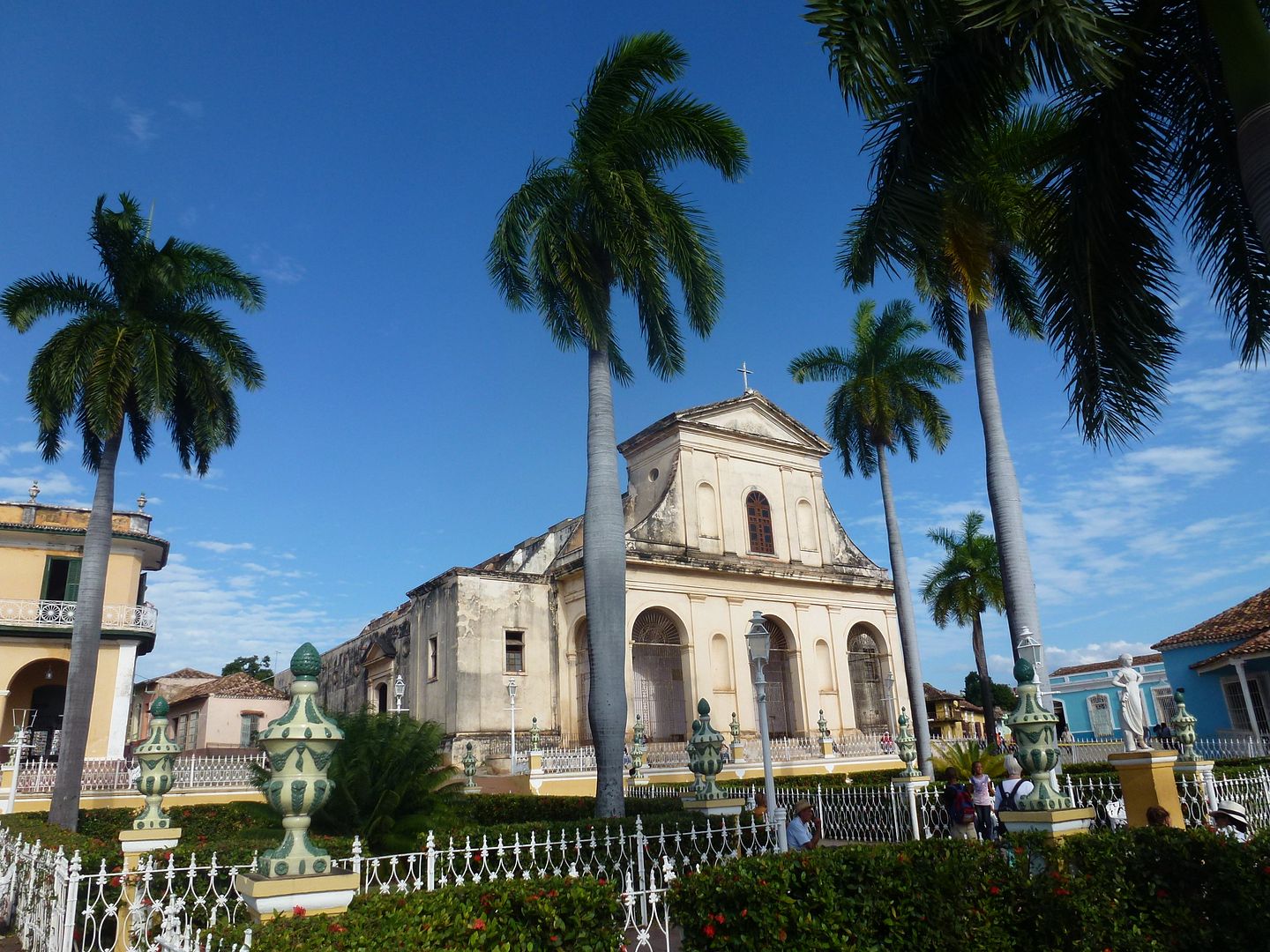
Trinidad is a Unesco site and has recently received funding to restore and rebuild many of the beautiful old colonial buildings that have gradually crumbled since the revolution.  It is not a city for wearing stilettos as it is all large and very uneven cobbles - perhaps this is why the Cuban heel exists!

Presumably because of the wonderfully historic feel of the place, Trinidad is slightly more touristy than Cienfuegos, so you do get a few people trying to get you into their restaurant or asking you for soap etc, but it is certainly not oppressively so.

We visited the Museo de la Lucha Contra Bandidos - or the museum of the struggle against the bandits.  It was only a small place and the information and artifacts were a bit scanty, but it was interesting to see what they had and there was a nice view of the city from the upper floors.

Otherwise we mostly just wandered around the streets, looking at the buildings and cars, and being amused by sights like the large pig being walked around and washed down with a bucket of water.

Although it was a very touristy spot, we enjoyed a drink on the steps of the Casa de la Musica watching the kids flying kites while the sun set.

This place obviously trades on having bands in, but in fact in most bars, restaurants and cafes you will find that at least one band will set up and play, and then of course come around with a hat.  Whilst this can get a bit irritating after a while, they do at least only ask each table once.  We were surprised to find that many bands also have their own CD to sell too.

The Casa de la Trova had a good mix of locals and tourists for the evening salsa music show.  The mojitos were reasonable and it was fun to watch the couples strutting their salsa with varying degrees of proficiency.

One of the first up was an older couple who looked like they were British, had obviously been for lessons and were keen to show off their moves.  They weren't bad, but compared to the locals you could see that this was rehearsed rather than instinctive.

Mind you, I preferred them to the other British couple that clearly thought they were fabulous, when in fact their flamboyant routine looked like an exaggerated comic pastiche.

A surprising find in Trinidad was a small restaurant called La Botija.  With staff dressed Japanese style it seemed a bit out of place, but they were friendly and helpful and the food was cheap and tasted excellent.  We went back a couple of times and would happily recommend it to others.
 
Overall we liked Trinidad as a sightseeing place.  It is a classic Unesco site, but it is charming and beautiful and well worth a visit.