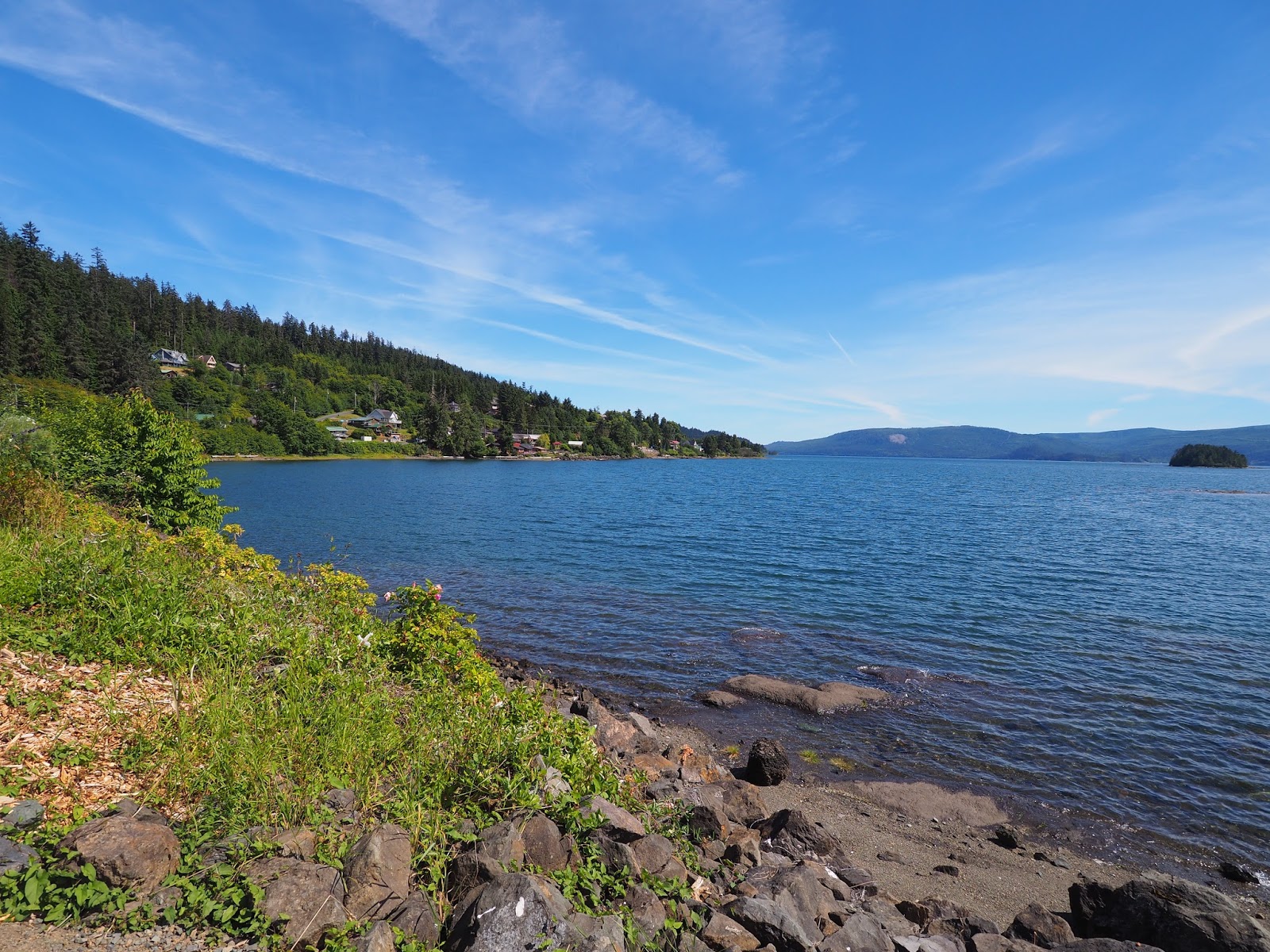
Welcome to our travel blog. We are Tabitha and Nic. In 2011 we 'retired' in our early 40s and set off to travel the world. We spent our first year in South America and have been lucky enough to make two trips to Antarctica.

Our blog is a record of our travels, thoughts and experiences. It is not a guide book, but we do include some tips and information, so we hope that you may find it useful if you are planning to visit somewhere we have been. Or you may just find it interesting as a bit of armchair travel.


Showing posts with label bald eagles. Show all posts

Tuesday, October 3, 2017

Queen Charlotte, Skidegate and a rather unfortunate incident …

Queen Charlotte, Haida Gwaii
Queen Charlotte is the largest town in Haida Gwaii, but it still feels pretty small.

We were staying close to the harbour, which also had the large and helpful tourist information office, the Ocean View Restaurant with the great pizza, a lovely little café called Queen B’s, where we failed to resist the nice looking – and equally nice tasting – cakes, and a few other little shops and eateries.


Volunteer celebrations, Queen Charlotte, Haida Gwaii


This is also where the ‘town square’ is, complete with a small stage. We were quite pleased to discover that there was due to be an event on; it was a celebration of the volunteers in the community, and it was to have live music, food stalls, a cake, and a presentation to a specially honoured volunteer. It sounded interesting, and we were told everyone was welcome, so we decided to stick around to check it out.


Queen Charlotte, Haida Gwaii
Well, a few dozen people turned up. There was a band, and they were OK, at least until the vocalist let another band member have a go at singing, when it went a bit south for a few songs. There was a food stall, and there was a cake. They couldn’t cut the cake though, because that honour was for the person being presented to, and she hadn’t arrived. I don’t know whether or not she knew that she was supposed to be receiving something, so had to turn up, but an hour and fifty minutes into the two-hour event and she still hadn’t arrived. Oops.

Skidegate, Haida Gwaii
Further down the road, was the supermarket, and a few more places to eat, including a nice little shop/café/ice cream place called Junebug. That is pretty much it, but it covers all the necessaries, and we were pleasantly surprised at the quality in the places we tried.

There is no public transport on the island, and as you’ll know from my post about our arrival here, taxis are few and far between, so hitchhiking is commonplace. That would probably have been how we would have got between Queen Charlotte and Skidegate had we not managed to hire a car.

We had saved Skidegate and the nearby museum for our last day, as before we knew we were getting the car, it seemed easier to just make one trip in this direction, and then we would be in the right area to get the ferry from Skidegate in the evening. Having the car made things much easier though, as it’s a reasonable distance between Skidegate town, the museum and the ferry terminal, and as it turned out, there wasn’t a suitable café in Skidegate, so we still ended up driving back to Queen B’s in Queen Charlotte.

Model of old Skidegate, Haida Gwaii Museum, Haida Gwaii

Skidegate is the second of the two sites that the Haida people moved to when they abandoned their villages. The Haida Museum has a great little model of what the village would have looked like then, and while it is certainly very different now, you can still see the basic layout of the properties around the bay.


Skidegate, Haida Gwaii
There isn’t much to do in Skidegate itself, but then that wasn’t really a surprise by now, based on everywhere else we’d been. We checked out a couple of touristy shops, looked at a couple of totem poles, and that was about it. Our favourite thing in Skidegate was probably the old rusting fire engine that was sat on the grass, gradually disintegrating, with a tree growing out of the top.

Old fire engine, Skidegate, Haida Gwaii


We had also been told, by someone we’d met at the Airbnb the previous evening, to sneak a peek into the shed next to the fire engine. It was locked, but there was a small opening at the back that we could peer through. Inside, were the blackened remains of a totem pole, which had presumably been rescued from a fire at some point, but were now lying forgotten in this shed.


The main thing to do here though, is to visit the Haida Gwaii Museum and Haida Heritage Centre. We did, but I’ll talk about those in the next post.


Burnt totem pole, Skidegate, Haida Gwaii

For now, I’ll leave you with the rather unfortunate incident that happened to Nic, as we were about to leave Queen Charlotte. We were walking back to the car, and passed under a lamppost. Just as we did so, Nic got splattered with bird poo. But this wasn’t just any old bird poo, this was courtesy of a bald eagle that was sitting on the lamppost.

Now bearing in mind that a bald eagle is generally between 70cm and a metre tall, with a wingspan of around two meters, you can imagine that they produce quite a lot of poo. It wasn’t pretty. Thankfully, because we had the bags in the car, Nic was able to grab a change of clothes and go and use the tourist information office loos to clean up and change. The eagle just sat there.

Old fire engine, Skidegate, Haida Gwaii


Sunday, September 17, 2017

Port McNeill and the totems of Alert Bay

Port McNeill
We spent the night back at Port McNeill, which is one of those places that probably doesn’t get a huge number of tourists itself, but acts as a gateway to another destination. There is nothing wrong with it, and it is always interesting to see a ‘normal’ town, but there isn’t a great deal to do. Of course, some thirty minutes into the drive out of town, we realised that we had forgotten to go and see the one claim to fame that they do have here – the world’s largest burr. In fact, not just one, but two.


In case you are not familiar with a burr, it is that lumpy outgrowth that you sometimes get on a tree, usually caused when the tree is trying to protect itself against some kind of attack, and envelopes the invading disease or bug, to prevent it getting into the core of the tree.


World's Largest Tree Burr, Port McNeill


Now you may wonder just how big something like that can get, and I can tell you; these two have circumferences of 45 foot and 62 feet, and weigh in at 22 and around 30 tonnes.


No, we didn’t turn the car around and do an hour of extra driving just to go back, but I have borrowed a photo for the town’s website to show you, one of them sitting in it little gazebo, so that you don’t miss out on seeing it!


Alert Bay

So, if we weren’t there for the giant burr, why were we there. Well, this is where you get the ferry to a Cormorant Island, and more specifically, to Alert Bay. The island is only eight miles all the way around, but it has become a popular place to visit because of its colonial and First Nations heritage. Getting off the ferry, we stopped off at the visitor’s centre, where we were given a very helpful introduction and maps etc.


Alert Bay


A number of the main buildings in town date back to around the end of the 1800s, or the start of the next century. There used to be a huge 1870s Fish Saltery next to the location of the ferry terminal, which then became a canning factory in 1902, until the business closed in 1941. That is gone now, but a bit further down, you can see the old net loft buildings.


Alert Bay


Some of the prettier, more colourful buildings are the old Municipal Hall, the Old Customs House and the Old Court House. Aside from the first of those, which is now the Visitor’s Centre, the buildings here are generally are private premises or lodgings, so you can’t go inside them.


Alert Bay
Another attraction, albeit one that we didn’t have time to check out, was the Ecological Park. This is an unusual swamp area on a hill, that was created when a dam was built half way up the hill to store water for the fish cannery, the natural springs caused the whole area to flood, and it killed off the trees. The area has now been set aside with a boardwalk of trails created. Apparently, they used to call the place Gator Park, even though it never had any alligators; they have since dropped that name, but it seems to have stuck with the locals.


Alert Bay
One thing that there aren’t a lot of here, is places to get something to eat, especially if, like us, you are pressed for time.  We did follow a local recommendation to try the bannock, a name that I was equating with the Scottish fruitcake, but which turned out to be basically deep-fried dough. It really wasn’t going to do our diets much good, so we had it to take away, ate about half between us – it was rather tasty after all – but ditched the rest, in an admittedly fairly poor effort to limit the calories.


Bald eagle, Alert Bay


The main attraction here though is not the houses, the swamp nor the bannock, but rather it is the collection of totem poles and the U’mista Cultural Centre. I’ll talk about the Cultural Centre in the next post, but for now, we can take a look at some of the poles, including what they claim is the tallest totem pole in the world. I say claim, because I have seen the same claim made about one in Victoria too, and I can’t say which is right. The leaflet we were given refers to a 163 foot tall pole and a 10 foot pole, but then says that the top of the pole fell down during high winds in 2007, so it may be that with the extra 10 foot it was the tallest, but no longer.


In any case, it is quite tall. I got Nic to stand at the bottom of it for a photo, to give you a sense of the scale of it. It was carved by Jimmy Dick and five assistants, and as it is not a specific family post, its images show some of the tribes of the local Kwakwaka’wakw people. The carving was finished in the late 1960s, but was only raised up in 1973.


As to the rest, I can’t tell you a great deal about them. There are a couple of stories, but I should leave those for you to discover for yourselves if you ever visit the place. So, I will just leave you with some photos.


Old Cemetery, Alert Bay

Old Cemetery, Alert Bay


Alert Bay


Alert Bay


Alert Bay

World's Tallest Totem pole (perhaps), Alert Bay

Long House, Alert Bay

Alert Bay

New Cemetery, Alert Bay

New Cemetery, Alert Bay

Saturday, September 16, 2017

Whale Watching

Orcas, Telegraph Cove
We only had one night in Telegraph Cove, as they were all booked up for the second night, so we stayed in nearby Port McNeill, which was going to be our next destination, and was only a thirty-minute drive away. But we had to come back in the morning, as we had another trip booked, this time with Stubbs Island Whale Watching.

Fin whale skeleton, Telegraph Cove


We had arrived a bit early, and used the spare time to take a look around the Whale Interpretative Centre. As I mentioned before, it is small, but it is interesting, and has lots of information about how they identify the different orca pods in the region, as well as some skeletons of whales and other sea mammals.

Sea otter skeleton, Telegraph Cove


In all honesty, we weren’t feeling as enthusiastic for this trip as we might have been. The boat is a bit bigger than yesterday's, with more people on it, and we had had such good sightings of orcas yesterday, that we didn’t really think that this trip would match up.


Jellyfish, Telegraph Cove

Not that there was anything wrong with the trip. We set off straight away to find the orca pod that was in the area. It took a while, as they were quite a way out, but when we arrived it was a large pod, and they allowed us to get nice and close, with a couple of them coming right up around us briefly.  There was a zodiac nearby, and the orcas treated them to a really close encounter, which would have been great for them being so low in the water.


Orcas, Telegraph Cove
It is lovely to see the orcas all around, and so close by, but sadly they weren’t feeling playful today, so we didn’t really get any spy hops, and no breaches, which is a bit of a shame. It was still great, it’s just that we were spoiled yesterday.

Our guides today did give us a bit more information about the orcas and their situation, which was both interesting and worrying. They showed us the results of some tests that they ran to check on the level of microplastics that the orcas are absorbing into their bodies.

Orcas, Telegraph Cove

The microplastics, about the size of coffee grains, are ingested by everything from plankton to orcas, and as well as damaging the creatures internally, they can also make them think that they are not hungry, which can cause them to starve. Of course, because the orcas eat the smaller marine life, they ingest the microplastics in their bodies too.


Microplastic pollution
The bottles in the picture show a representation of the levels that they found. The smallest amount is the acceptable level. The middle amount is the level that is found in the orcas in this area, at the northern end of Vancouver Island, where the human population density and pollutants are lower. The largest amount is what they found in orcas at the southern end of the island, closer to Victoria and Vancouver.

The levels are quite concerning, and they seem to be reflected in the life expectancy of the orcas. The females are living to around 70-80 years old, but the males are only surviving to about half that age. The experts believe that the pollutants are the cause of the shorter lifespan in males, and that the reasons that the females are no affected, is that they unwittingly pass on the pollutants to their calves when they give birth.

It is sad to see the damage that we are doing to the habitat of these lovely creatures, and indeed that we may still be endangering their existence. We had been feeling a little awkward about keep insisting on not being given a straw in a drink, but this just renewed our resolve to keep on with that, and feeling even more determined to minimise our use of all plastics.

Eagle, Telegraph Cove


After watching the orcas for a while, we set off in search of other creatures, and came across a big flock of birds feeding on the water, including a couple of eagles, which we watched for a while.


Humpback, Telegraph Cove
Our next encounter was with a humpback, which hovered on the surface briefly before giving us a nice tail fluke as it dived back down again.


Humpback, Telegraph Cove


Squiggle the Humpback, Telegraph Cove


After that, the guides took us over to an area where they had spotted a second humpback diving. They positioned the boat a little way from where they thought it would emerge, and we all gazed expectantly off into the distance, waiting for it.


Squiggle the Humpback, Telegraph Cove


Then, all of a sudden, it appeared, not off in the distance, but literally right next to us.

She was so close, that we actually felt her bump the boat. Needless to say, we were thrilled to have her pop up so close.


Squiggle the Humpback, Telegraph Cove

She hovered for a moment, presumably thinking “Bugger, where did that lump of metal come from?”, and then ducked down and passed under the boat, popping up on the other side. It stayed on the surface briefly, giving us an excellent view of her slightly mangled dorsal fin that had led to her being named Squiggle, and then flicked up her tail and dived down.


Bald eagle, Telegraph Cove


Of course, with having the zoom lense attached to the camera, it wasn’t easy to get her properly into the frame for photos, but that wasn’t really the point. It was great to see her so very close. In any case, we did better than the professional photographer on board, who had one of the huge fixed zoom lenses; he had no chance of taking any pictures that close up. Like us though, he was just excited to have seen her there.

We finished off the day with a bald eagle that was drying itself out on some rocks.


Telegraph Cove


In the end, what had started out as a nice, but unremarkable trip, became an unforgettable one, simply due to that one close encounter with a humpback called Squiggle. And that is the nature of wildlife watching.

Orcas, Telegraph Cove

Orcas, Telegraph Cove

Orcas, Telegraph Cove

Orcas, Telegraph Cove

Orcas, Telegraph Cove

Orcas, Telegraph Cove

Orcas, Telegraph Cove

Telegraph Cove

Bald eagle, Telegraph Cove


Telegraph Cove