Welcome to our travel blog. We are Tabitha and Nic. In 2011 we 'retired' in our early 40s and set off to travel the world. We spent our first year in South America and have been lucky enough to make two trips to Antarctica.

Our blog is a record of our travels, thoughts and experiences. It is not a guide book, but we do include some tips and information, so we hope that you may find it useful if you are planning to visit somewhere we have been. Or you may just find it interesting as a bit of armchair travel.


Showing posts with label religion. Show all posts

Tuesday, March 14, 2017

Hill of Crosses, Siauliai, Lithuania

Art in Siauliai, Lithuania


From Rundale Palace, we drove across the border into Lithuania, and to our next destination, Siauliai.


We arrived in the rain, so had to make a dash with our stuff when we got to our apartment. We had a huge place, with multiple beds for just the two of us.


We wandered into town for a meal in the evening, and found a place called Arkos. It was a bit mixed, but fine overall, so we would try it again.


Art in Siauliai, Lithuania


One thing we rather liked about the town was the odd little artworks dotted around. There was no obvious theme or style to them, but they added a nice quirky little touch.

Siauliai, Lithuania


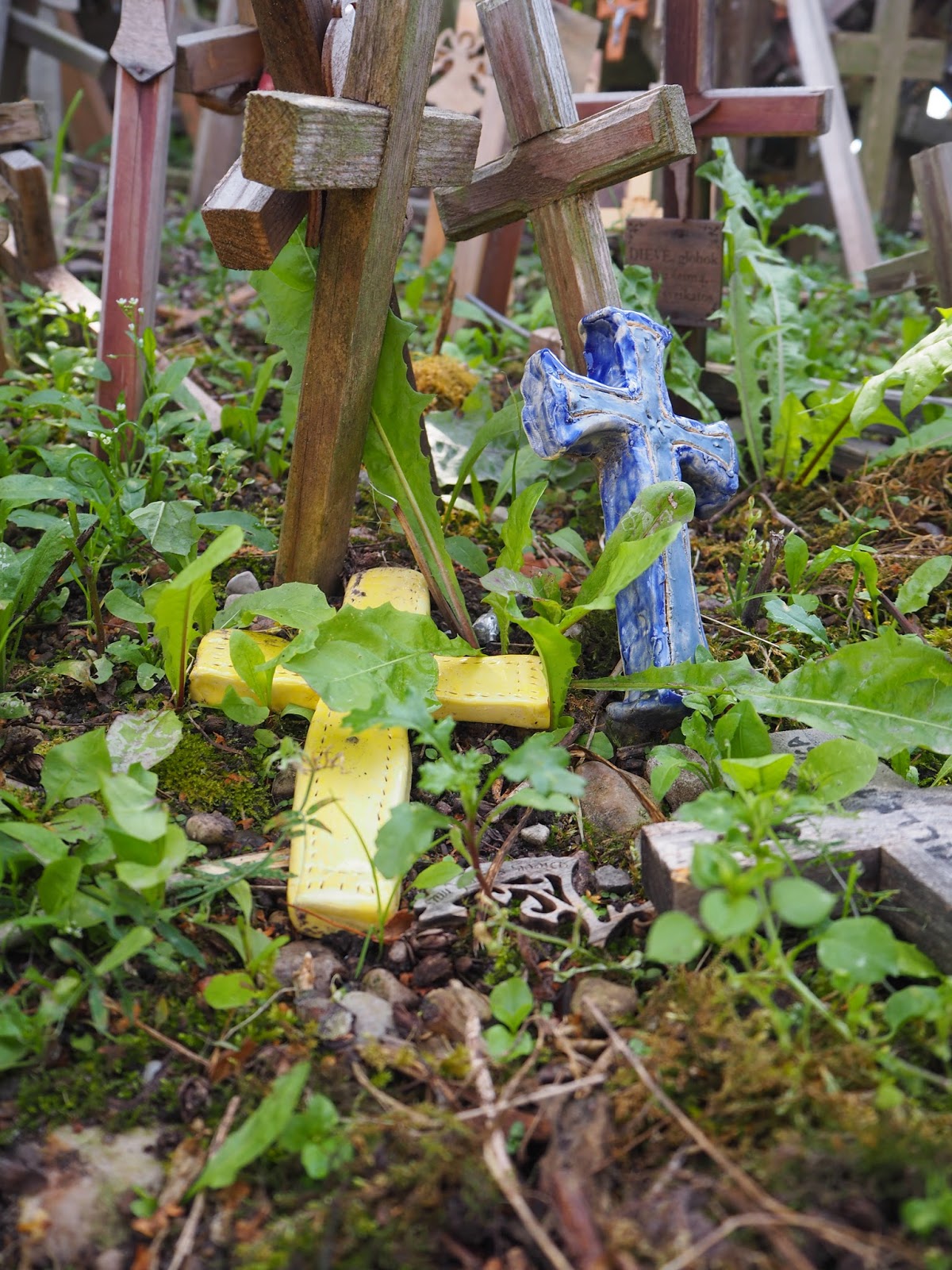
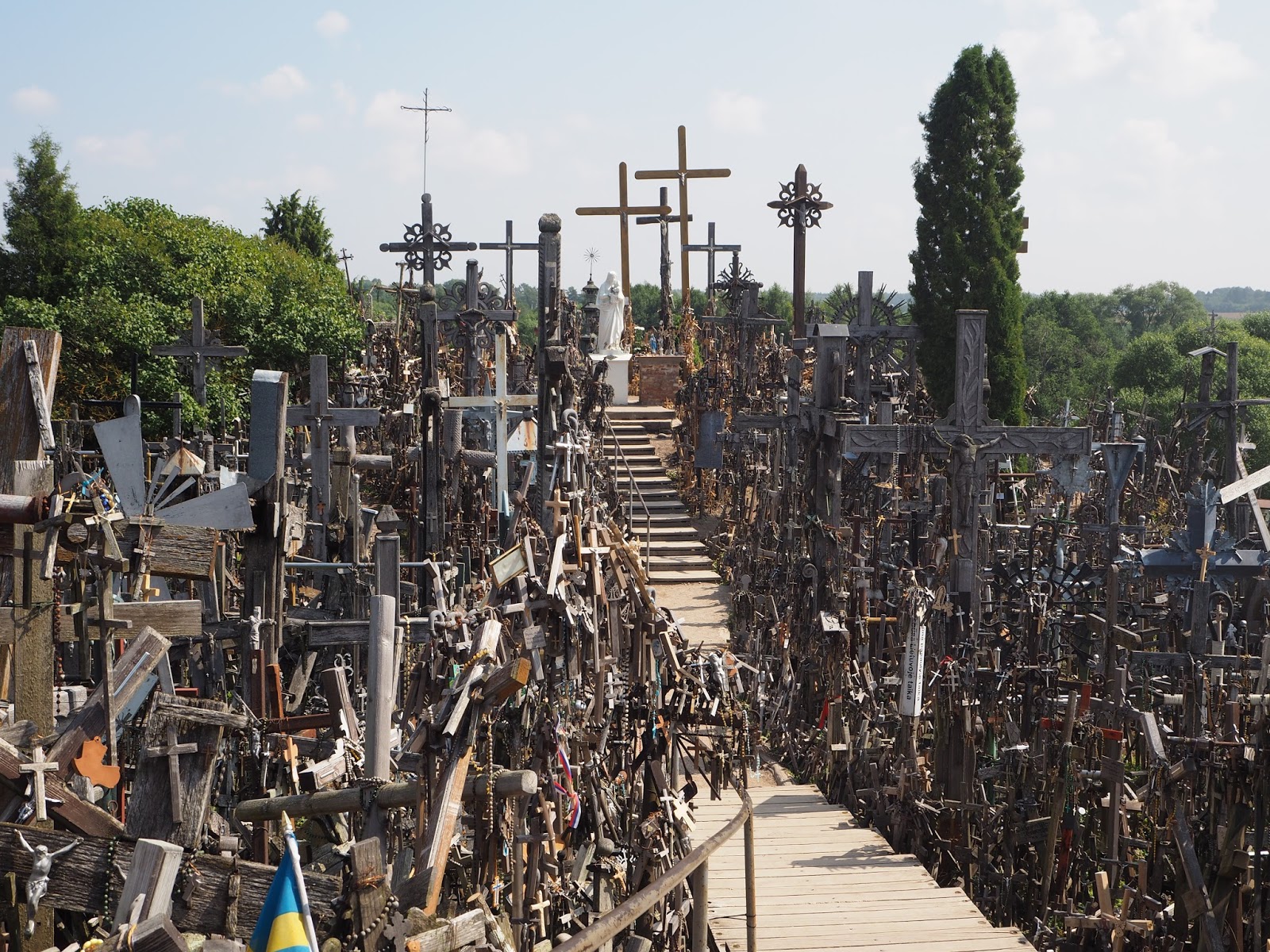
The next day, we arrived at the Hill of Crosses just before midday, and there were already a dozen tour coaches and many other vehicles, so if you want the place to yourselves, you would have to come early.

Strangely, many of the groups didn't really seem to spend much time on the hill itself, and the density of the crosses hid most of the people that were on it.


This was an interesting place to visit. Neither of us is religious, and we both have serious doubts about the way that many people practise their religion, and the negative impact that it can have on individuals and society.


Certainly, the idea of just coming and leaving a cross in expectation of some kind of spiritual or physical payback, is not something that we see any merit in.


We certainly didn't see any evidence of this being a pilgrimage for people. Most of those here seemed to be coming as tourists rather than worshippers.


Very few appeared to offer any sort of prayer or even contemplation, and those that did leave crosses, had generally bought it in the gift shop at the entrance. There didn't seem to be anything meaningful or spiritual in most of the actions that we saw.


Having said all of that, you may wonder why we bothered to come here. Well, firstly, just because I don't believe in something, doesn't mean that I don't recognise how important it might be to others.


I do see a value in visiting places that are meaningful to others. It does no harm to be open to things that fall outside of your own beliefs and opinions, and sometimes you might be pleasantly surprised when you do.


But for us, this wasn't so much a symbol of religion, as it was a monument to human resilience, dedication, perseverance and resistance. This Hill of Crosses is testament to people who have refused to give up, and who fought on for something that mattered to them.


Siauliai was founded in 1236, and by the fourteenth century, it was occupied by the Teutonic Knights. Some accounts suggest that it was during this period of occupation that crosses first began appearing on the hill here.


But it was much later, during the Russian occupation, that they began to appear in earnest. During the peasants' uprisings, from 1831-1863, people placed their crosses as a symbol of defiance and of national identity. By the end of this time, there were said to have been 150 large crosses, and numerous smaller ones with them.


Lithuania regained its independence briefly in 1918, but from 1944 until 1991, it was occupied again, this time as part of the USSR. It was during this time that the Hill of Crosses really blossomed.


The Soviet authorities were not happy with the crosses being left. Not only were they a symbol of religion, which the Communist regime disliked, they were also a symbol of the Lithuanian defiance of their authority and control.


Stalin took relatively little action against the church during his time in charge, but Nikita Khrushchev, and subsequently the Central Committee of the Communist Party, under Leonid Brezhnev, were less tolerant, and a crackdown on churches and religious symbols continued until the mid 1980s.


By 1960, the crosses on the hill had reached around 2500, crackdowns began. There were a series of Soviet attempts to demolish the site, with crosses being burned, metal ones being taken for scrap, some buried or thrown in the river, and the site being bulldozed. But no sooner had they demolished it, then the crosses started to reappear.

They  tried having police guard the hill. They announced epidemics of swine fever and rabies, forbidding all access. They even flooded the hill with sewage. But still the people of Siauliai were undeterred. They made all sorts of crosses from whatever materials were available, and they placed them on the hill.


Now, there are over 100,000 crosses here.

For me, it is this courageous defiance, the refusal of the people to give in to their occupiers, and their determination to keep on placing the crosses, that makes this place special.


Friday, February 3, 2017

Dubai - an interesting discussion about Islam, and some camel milk

Something we did enjoy in Dubai, was a visit to the Jumeirah Mosque. It isn't big or fancy like the one in Abu Dhabi, but you can do a tour here, with the Sheikh Mohammed bin Rashid Centre for Cultural Understanding. They run the programme 'Open doors, Open minds', which aims to help non-Emirates, whether tourists or those living and working in Dubai, to better understand the local culture.


They run a few different tours, but we opted to visit the mosque. The dress code is a little less strict than the mosque in Abu Dhabi, so I was able to just add my headscarf this time. They do lend headscarves for those who didn't bring them, and also abaya and kandura, the men's robe, for those who have worn short skirts or shorts, which are not acceptable.


The tour was simple, but informative. They showed us the ablutions that all Muslims are required to perform, so that they are cleansed before they pray. they are required to wash their hands, arms up to the elbows, feet and their face, including their mouth and inside the nose. the also wipe over their hair. You will only see men doing their ablutions outside the mosque, as women will do them either inside a separate women's prayer room if there is one at the mosque, or at home beforehand, so that they preserve their modesty. Women who are on their period do not pray, because it is still considered to be unclean; it also exempts them from fasting in Ramadan.


They also explained the layout and design of the mosque with it's minarets to call people to prayer, and the alcove and dome, which amplify the sound of the Imam's voice, so that he can be heard by all.


The tour was run by a man and woman, both of whom were very open and friendly, and encouraged people to ask any questions they might have. They were fully aware of some of the preconceptions, misconceptions and anxieties that many non-Muslims have about the religion and culture, and they were happy to discuss them openly.


They described Islam, which means submission, derived from the word istaslama, to surrender, as a peaceful religion, although recognised that this may not be how it seems sometimes. They said how disappointed they are that some people choose to behave in such a violent way, as it is not what they believe is expected of followers of Islam.


We were given a simple but interesting description of the Five pillars of Islam: one god, prayer, charity, fasting and pilgrimage.


The first pillar, One God, looks for followers to have a willing belief in Allah and all of his prophets and their teachings. The fact that you need to believe of your own accord, rather than being forced by others, does in itself make something of a mockery of groups like ISIS, who would force their beliefs on others. Whilst children are raised by their parents as Muslim, they are expected to decide for themselves whether they wish to follow the religion, once they reach puberty.


Islam believes in the same God - or Allah - as Christianity, but does not believe that Jesus was the son of God. They consider him to have been a prophet, like Adam, Noah and Mohammed. They focus on Mohammed, because he was the last of the prophets. Muslims also believe in angels, and that you have two angels with you always, one on your right writing down all of the good things that you do, and one on the left writing down any bad things. At the final reckoning when you die, these lists will be used to decide whether you go to paradise and to which of the seven levels.


The second pillar is Prayer, and Muslims are required to pray five times a day, fajr, at dawn, dhuhr at midday, asr in the afternoon, maghrib at sunset, and isha'a at night. The prayers must be done facing Mecca, which is the location of the kabaan, the first religious structure. Men are expected to make the effort to go to the mosque; they receive ten 'rewards' for praying there, but only one if they pray elsewhere.


Women, on the other hand receive ten 'rewards if they pray at home too, which is because Islam recognises that women tend to be the carers for children, so rather than forcing them to get the children out of the house and take them with her to the mosque to pray five times a day, they are able to receive the same rewards when praying at home. Not surprising therefore, that fewer women go to the mosque, and explains why, if women have a separate prayer room, it will be smaller. Simple numbers, not, as some like to suggest, because they regard women as less important.


Our hosts showed us how the prayers are performed, and explained what was being said. If you want to pray for anything for yourself, you may do so only at the point when you are fully prostrate with forehead and nose to floor. At the end of the prayers you turn and say 'peace be upon you' to your left and right, which whilst it would greet those next to you in prayer, is actually intended to greet your two angels.


Generally people stand very close together, so as to remove any space for the devil - which in this case is in the form of perceived difference in wealth or status -  but they will always keep a gap between men and women, to prevent distraction from prayer. Normally, if in the same room, men will be at the front, children in the middle and women at the back. This way, when all that bowing and prostrating goes on, the men can't be looking at the women' bums!


The third pillar is Charity. Muslims are required to give 2.5% of their wealth to help others; the phrase 'charity begins at home' is very valid here, as the potential recipients of your help starts with close family, then works through extended family, your circle of friends, your local community, and then the wider community. You are also expected to perform acts of kindness, which while they may be large, it is said that even a smile will keep the good angel busy.


The fourth pillar is Fasting. During the month of Ramadan, which is the ninth month of the Islamic calendar, and so can fall between mid May and mid July depending on the year, Muslims are expected to fast during daylight hours. For this one month each year, you are expected to refrain from eating, drinking, smoking, sex, or anything else that is unnecessary, during daylight hours.


The intention is to purify your soul, so that you can focus your efforts on serving Allah. It also encourages you to remember those that are less well off than you, encourages time with your family, and attributes such as patience, self-discipline and sacrifice. They suggested that on a practical note, it has the added benefit of giving the body a detox, and also helps if you want to give up smoking or other addictions.


The final pillar is Pilgrimage. All Muslims, as long as they are financially and physically capable, are expected to do the haaj, a pilgrimage to Mecca, once in their lifetime. They are not expected to borrow money to do the pilgrimage, in fact they are supposed to pay off any debts first. The pilgrimage is a quest for forgiveness, but apparently you should expect to use it to get away with having done anything really bad!


At the end of the tour, our hosts were happy to take any other questions, and unsurprisingly, the issue of clothes arose. Our female host, who was wearing the black abaya, but no face covering, explained that women can wear whatever they choose when they are in the company of only women and men who are blood relations (i.e. who they could not marry) or their husband, but when they are in the company of other men, they are expected to dress modestly, covering all but their hands and face.


This could be with trousers and a blouse, but most wear the abaya, a full length black 'dress' over the top of their normal clothes. She said that in the UAE, women started wearing the abaya in the days when they were a poor people, living in the desert, and had only a few good dresses. These dresses would become ruined by the sandstorms and the intensity of the sun, so the women took to wearing a black cloth over the top of their dress, to protect it when they went outside. This gradually became the abaya, and became the traditional clothing.


She told us that women in the UAE can choose whether or not to wear the abaya and headscarf, and that, while she has chosen to, neither her mother nor her daughter do. In common with many younger women, she does not choose to wear the niqab, the leather face covering that was originally designed to keep the sand and sun form their faces.


There were lots of other questions, all of which were answered, and I think most people learned at least something new that day.


After the tour, we went back in to the Café area, where we tried out some of their camel milk products. as well as the milk in our drinks, we had some chocolates using it, and something called khishnah kanafeh, which is a sort of cheesy pastry sweet dish. The camel milk was OK, not as musty as goats' milk, and the chocolates and khishnah kanafeh were both tasty.

Sunday, January 10, 2016

Taipei - temples

Longshan Temple, Taipei
From Singapore we flew to Taipei in Taiwan. What a difference. From a place that we found to be pretty but false, to a country that we found to be less obviously appealing, but entirely genuine.

Longshan Temple, Taipei
Having had a break from temples in Singapore, we did visit a number here. Religion here is a mix of Buddhism, Taoism and Matsu, so the Gods being worshipped are numerous. The first one we went to was the oldest temple in Taipei, the Longshan temple, built in 1738.

Longshan Temple, Taipei
It has shrines of more that 165 gods, including the gods of money, education, peace and mercy; it was very busy, with a constant stream of people lighting incense and making other offerings to go with their prayers. The temple has been partially or completely destroyed a number of times, but on each occasion, the image of Guanyin, the goddess of mercy, has survived unscathed.


Longshan Temple, Taipei
When people arrive at the temple, they will buy (or bring with them) a pack if incense sticks, and will light them and leave them at various shrines around the temple. The sticks are both a greeting, and a method to enhance their communication with the gods, as it is believed that the smoke helps construct the link.

Longshan Temple, Taipei
Other more usual offerings include food and drinks, which are given either in thanks for the guidance and help given, or because they believe that the spirits of the departed can get hungry, and flowers, which can have various meanings, including hoping for a child.

Qingshan Temple, Taipei
One of the offerings we were less clear about were the stacks of paper; this is joss or Ghost/spirit money, which is made from another bamboo or rice paper, and is burned to venerate the dead.

Qingshan Temple, Taipei
Prayers are offered for health, wealth, and succession, the latter including success in education and exams - it is said that the prayers and, offerings are viewed just as essential to exam success as the actual revision of the subject.

Qingshan Temple, Taipei
As we wandered around the streets, the temples and shrines were certainly plentiful, with lots of little ones poked in amongst the shops and houses. We stopped off at a few, but our next notable one was the Qingshan temple, built in 1854. It is said that the image of the God King Qingshan was being carried through the streets, but when it got here it stopped and refused to be carried any further, so they built the temple here.

Qingshan Temple, Taipei
At the time, there was a deadly plague in the area, but of course the people prayed to the God and credited him with it lifting, so apparently people came here to pray for protection during the SARS outbreak.

What I primarily remember this temple for though, was its God images, as they had strikingly long and bright eyebrows and beards.

I'm not sure where the Homer Simpson image fits in to the religion though!
 
Confucious Temple, Taipei
Our next stop was the Confucius temple, from the 1870s Qing dynasty, established as a place of education and to teach the tenets of Confucianism. I knew little about him, so it was interesting to read a bit about his teachings.

Confucious Temple, Taipei
But if we're being honest, aside from seeing a different style of temple, our main reason for visiting here was that it is the home of the Three Wise Monkeys. Aside from King Kong, The Jungle Book's King Louie, and Tarzan's Cheetah, and Clint Eastwood's Clyde - which, for the sake of Nic's blood pressure, I should point out are of course all actually apes not monkeys - this 'see no evil, hear no evil, speak no evil' trio, named Mizaru, Kikazaru and Iwazaruby the way, must surely be the most famous monkeys. (Nic thinks that honour goes to Marcel from Friends, but I'm not convinced by that!) 

Confucious Temple, Taipei
Anyhow, we looked all around the, admittedly very nice, gardens, but we couldn't find the monkeys! There were some outside though, so I took a photo of those instead. As it happens, the original three wise monkeys are thought to be from a carving at the Tosho-Gu shrine in Nikko, which we visited later in the year, so you can see them when we get there.


Bao'an Temple, Taipei
Our last temple, the Bao'an temple, was by far the prettiest. Probably helped by the fact that we visited when it was dark, so all of the lanterns were lit up, it looked really stunning. 

Bao'an Temple, Taipei
The Taiwanese temples are generally quite impressive actually, with intricate carvings, lots of artwork and lanterns, and, of course, huge numbers of images of their gods.

Bao'an Temple, Taipei
We rather liked them, partly because they looked so good, but more importantly because they were so much in use, with people regularly coming in to try to improve their lot.

Bao'an Temple, Taipei
We may not be religious ourselves, and I have to say we are always slightly dubious about people hoping and expecting that a God all sort out their lives for them, but it is nice to see a place of worship being used properly.
Bao'an Temple, Taipei