Welcome to our travel blog. We are Tabitha and Nic. In 2011 we 'retired' in our early 40s and set off to travel the world. We spent our first year in South America and have been lucky enough to make two trips to Antarctica.

Our blog is a record of our travels, thoughts and experiences. It is not a guide book, but we do include some tips and information, so we hope that you may find it useful if you are planning to visit somewhere we have been. Or you may just find it interesting as a bit of armchair travel.


Showing posts with label totem poles. Show all posts

Sunday, September 17, 2017

Port McNeill and the totems of Alert Bay

Port McNeill
We spent the night back at Port McNeill, which is one of those places that probably doesn’t get a huge number of tourists itself, but acts as a gateway to another destination. There is nothing wrong with it, and it is always interesting to see a ‘normal’ town, but there isn’t a great deal to do. Of course, some thirty minutes into the drive out of town, we realised that we had forgotten to go and see the one claim to fame that they do have here – the world’s largest burr. In fact, not just one, but two.


In case you are not familiar with a burr, it is that lumpy outgrowth that you sometimes get on a tree, usually caused when the tree is trying to protect itself against some kind of attack, and envelopes the invading disease or bug, to prevent it getting into the core of the tree.


World's Largest Tree Burr, Port McNeill


Now you may wonder just how big something like that can get, and I can tell you; these two have circumferences of 45 foot and 62 feet, and weigh in at 22 and around 30 tonnes.


No, we didn’t turn the car around and do an hour of extra driving just to go back, but I have borrowed a photo for the town’s website to show you, one of them sitting in it little gazebo, so that you don’t miss out on seeing it!


Alert Bay

So, if we weren’t there for the giant burr, why were we there. Well, this is where you get the ferry to a Cormorant Island, and more specifically, to Alert Bay. The island is only eight miles all the way around, but it has become a popular place to visit because of its colonial and First Nations heritage. Getting off the ferry, we stopped off at the visitor’s centre, where we were given a very helpful introduction and maps etc.


Alert Bay


A number of the main buildings in town date back to around the end of the 1800s, or the start of the next century. There used to be a huge 1870s Fish Saltery next to the location of the ferry terminal, which then became a canning factory in 1902, until the business closed in 1941. That is gone now, but a bit further down, you can see the old net loft buildings.


Alert Bay


Some of the prettier, more colourful buildings are the old Municipal Hall, the Old Customs House and the Old Court House. Aside from the first of those, which is now the Visitor’s Centre, the buildings here are generally are private premises or lodgings, so you can’t go inside them.


Alert Bay
Another attraction, albeit one that we didn’t have time to check out, was the Ecological Park. This is an unusual swamp area on a hill, that was created when a dam was built half way up the hill to store water for the fish cannery, the natural springs caused the whole area to flood, and it killed off the trees. The area has now been set aside with a boardwalk of trails created. Apparently, they used to call the place Gator Park, even though it never had any alligators; they have since dropped that name, but it seems to have stuck with the locals.


Alert Bay
One thing that there aren’t a lot of here, is places to get something to eat, especially if, like us, you are pressed for time.  We did follow a local recommendation to try the bannock, a name that I was equating with the Scottish fruitcake, but which turned out to be basically deep-fried dough. It really wasn’t going to do our diets much good, so we had it to take away, ate about half between us – it was rather tasty after all – but ditched the rest, in an admittedly fairly poor effort to limit the calories.


Bald eagle, Alert Bay


The main attraction here though is not the houses, the swamp nor the bannock, but rather it is the collection of totem poles and the U’mista Cultural Centre. I’ll talk about the Cultural Centre in the next post, but for now, we can take a look at some of the poles, including what they claim is the tallest totem pole in the world. I say claim, because I have seen the same claim made about one in Victoria too, and I can’t say which is right. The leaflet we were given refers to a 163 foot tall pole and a 10 foot pole, but then says that the top of the pole fell down during high winds in 2007, so it may be that with the extra 10 foot it was the tallest, but no longer.


In any case, it is quite tall. I got Nic to stand at the bottom of it for a photo, to give you a sense of the scale of it. It was carved by Jimmy Dick and five assistants, and as it is not a specific family post, its images show some of the tribes of the local Kwakwaka’wakw people. The carving was finished in the late 1960s, but was only raised up in 1973.


As to the rest, I can’t tell you a great deal about them. There are a couple of stories, but I should leave those for you to discover for yourselves if you ever visit the place. So, I will just leave you with some photos.


Old Cemetery, Alert Bay

Old Cemetery, Alert Bay


Alert Bay


Alert Bay


Alert Bay

World's Tallest Totem pole (perhaps), Alert Bay

Long House, Alert Bay

Alert Bay

New Cemetery, Alert Bay

New Cemetery, Alert Bay

Thursday, September 7, 2017

Duncan

Duncan
Our other trip out of Nanaimo was to Duncan, which we had read about, and also had recommended to us by a local couple who we met when we were in Puerto Varas in Chile earlier in the year. They are still on their travels too, so no catch ups today.


With an area of less than the old City of London, and a population of under 5,000, Duncan is the smallest city in BC, but it does service the much larger (around 80,000) outlying population. Like much of BC the city has roots in the lumber industry, but it also sits in the fertile Cowichan Valley, so there is an abundance of farming and nowadays, wineries too.


Of course, with our diets seemingly in freefall, and being already full of Nanaimo bars, we had to resist the temptation to check out all of the local wines.


Duncan is a pleasant place. The original settlement here was called Alderlea, and was just farmland, owned by William Chalmers Duncan. In 1887, he donated a section of the land for the town to be created, and that was the beginning of Duncan.


The city has a number of ‘heritage buildings’, that are probably quite interesting for visiting Canadians or others from newer countries, but which we find difficult to get excited about when they are only a hundred or so years old. That isn’t meaning to be dismissive, but just a reflection of a difference in perspective. As someone said to us recently Canadians are impressed by things that have even a relatively moderate age, that feel new and inconsequential to Europeans, but Europeans are put off by distances that Canadians wouldn’t give a second thought to.


What we did notice here, is that there was a better quality in the First Nations style souvenirs available than we have seen generally. And that brings me nicely to the reason that most tourists come to Duncan – the totem poles and Quw’utson Cultural Centre.


World's largest hockey stick, Duncan


Unfortunately, the cultural centre was closed on the day we visited, but we did get to see the largest hockey stick in the world. It was made for the 1986 Vancouver Expo, as part of a collection of large items celebrating aspects of the Canadian lifestyle, and bought by the city afterwards. Later in our trip, we would pass through Houston on the train, which is home to another of these items, the world’s largest fly fishing rod.


But enough of inexplicably large paraphanalia, and back to what the city is really known for - the totem poles. The City of Totems Project was begun by the then Mayor, Douglas Barker in 1985, as a way to attract new visitors. They commissioned numerous poles from recognised First Nations artists, and raised them around the main streets. This is now the world’s largest collection of publicly displayed totem poles, and in 2012, as part of their celebrations of the centenary of becoming a city, they created a trail that you can follow to see them.


I have chosen a number of the poles that we found more interesting for the photos, and whilst I won’t tell you any of the stories that go with them – you can read about those yourself if you visit one day – I have included details of what they depict, so you can make them out more easily.


Wind Spirit, carved by Doug LaFortune in 1986, and the first one that he made for the collection. It shows a Thunderbird, a Wind Spirit, a bear and a halibut.


Three poles, left to right are: The Feast, carved by Doug LaFortune in 1987, showing a bald eagle, a killer whale and Spirit Helpers; Raven’s Gift, carved by Doug LaFortune in 1989, showing a raven, a totem pole, a man and a beaver; and Pole of Wealth, carved by Hwunu’metse’(Simon Charlie) in 1988, showing a Thunderbird, a Spirit, a killer whale, a black bear and a copper.


Transformation, carved by Laverne Roy ‘Corky’ Baines in 1987, showing a bald eagle, a killer whale a man and a wolf.


Transformation in Life, carved by Chief Swaletthul’t’hw and Nelson Canute in 1987, showing an Eagle Guardian, a young person, a bald eagle and a man.


Two poles, left to right are: The Friendship Pole, carved by Cicero August in 1987, showing a bald eagle, a bear and a salmon; and Owl Pole, carved by Khut-Whee-Mul-Uhk in 1987, showing an owl, a bear and a human.


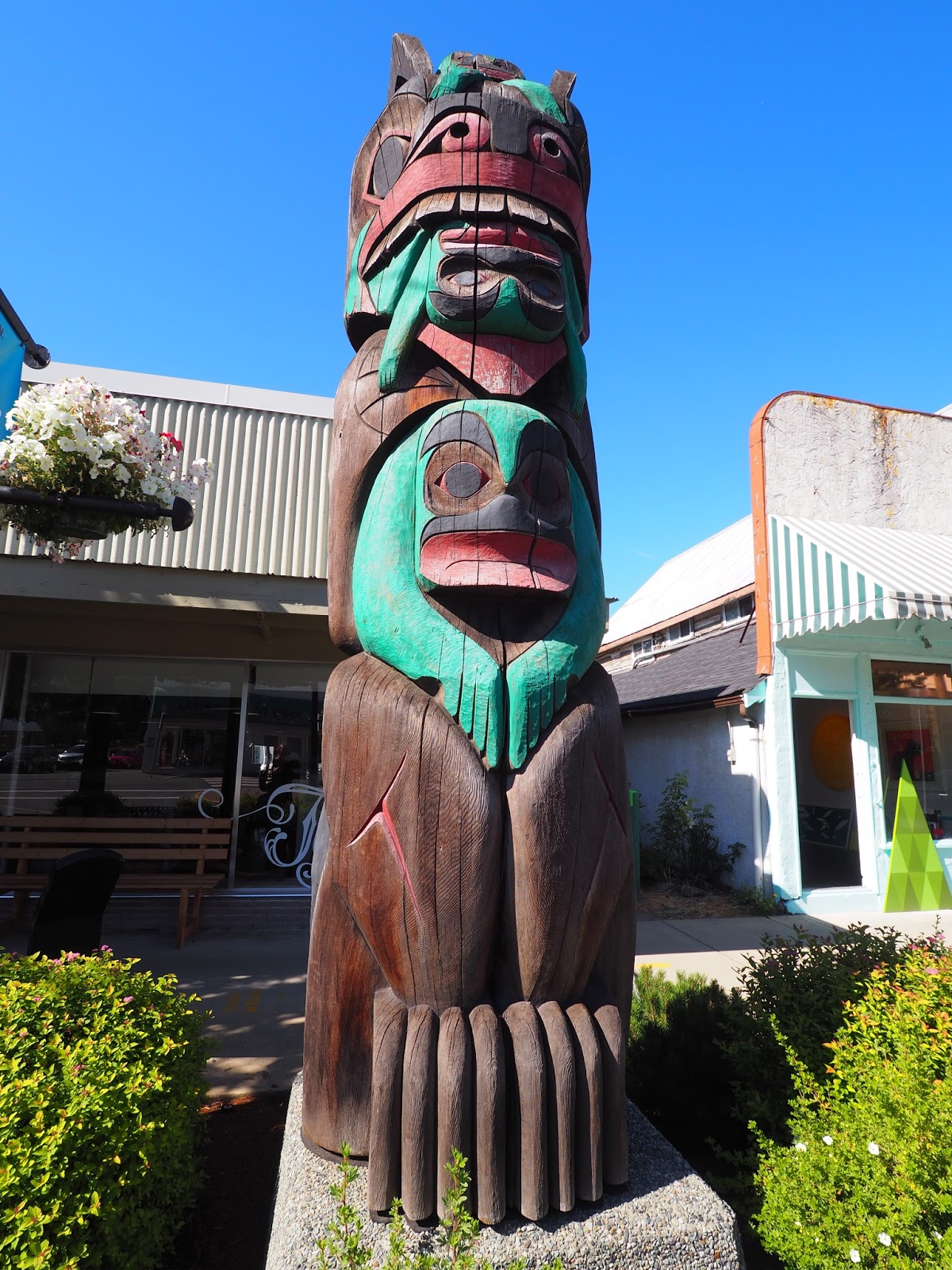
Kwagu’l Bear Holding a Seal, carved by Gwe-la-y-gwe-la-gya-les in 1987, showing a frog, a bear and a seal.


Centennial Pole, carved by Kwagu’t Chief Tlasutiwalis in 2012, showing a bald eagle, William Chalmers Duncan, a Thunderbird, a killer whale, a Chief Maker (which honours women of the city) and a frog. It also has salmon on the rear of the post.


the right hand pole is Thunderbird with Dzunuk’wa, carved by Moopin’kim in 1990, showing a Thunderbird and a Dzunuk’wa, or a wild woman.


Owl Spirit, carved by Ketwtel (Tom LaFortune) in 1986, showing an owl, a Human Spirit and a Chief.


Abolishment Pole, carved by Si-yaaxultun in 1990, showing a frog, a bear, another frog and a youth. I have to wonder whether this one is intended as a warning to any local tearaways, as the story is of a boy who kept terrorising his tribe, so eventually was cast out, left to wander aimlessly and then die, ending up covered in frogs.


Sea and Sky, carved by Harold Alfred in 1990, showing a Thunderbird and a killer whale.


Peaceful Boundaries, carved by Norman John in 1988, showing a raven, a Maquinna Sun Mask, and a double headed serpent.


Cedar Man Walking Out of The Log, carved by Gwe-la-y-gwe-la-gya-les in 1988, showing a man holding a walking stick that itself is carved with a copper and family crests of a baby Thunderbird, a killer whale and a man. This is the world’s widest totem pole with a diameter of 1.8 metres. The cedar tree that it is carved from is over 750 years old and has marks in the back where you can see that planks were once taken out to make First Nations homes.


Three poles, left to right are: The Guardians, carved by Khut-Whee-Mul-Uhk in 1986, showing Watchmen and a bald eagle; Dzunuk’wa, carved by Hokwawadi in 1989, showing a wild woman and a copper; and Chief’s Pole, carved by Khut-Whee-Mul-Uhk in 1986, showing a human child, a killer whale, a Chief and a copper.


Wednesday, September 6, 2017

A bit about Totem Poles


Compared to other areas of Canada, British Columbia retains quite a lot of its First Nations Heritage, and of course we wanted to find out a bit more about the people and take a look at one of the most iconic aspects of their culture, the totem pole. As we will be seeing a bit about this over the coming posts, I thought I’d drop in a quick background post, to help make sense of the posts to come.


We tend to think of Canada as a relatively new country, and that is true in terms of the white European settlement here. But of course, like so many countries that we British and other Europeans decided to claim as our own, there were already people living here when we arrived. The First Nations people are believed to have settled here at least 12,000 years ago, but it could have been longer ago than that. They lived in numerous tribal communities, with those in this British Columbia area known generically as the Pacific Coastal group.


The First Nations people did not have a written language, and totem poles form an important part of their culture, history and storytelling. They are all made of cedar wood, but can vary considerably, depending on the tribe, the carver, the wealth and status of the family, and the purpose of the pole.


There are three different types of pole. The first is a house pole. This was placed outside the home, and was decorated with family crest at the top, followed by other crests or symbols that are meaningful about the owner. A post could only show the crests that the owner was entitled to use, be that the symbol of their own tribe, or a crest that had been gifted to them through friendship, trade or other means.


The house pole therefore shows the story of the family, and can be viewed as a kind of address, as if you were visiting, you could look at a pole, and see information about the person that lived there and whether or not you would receive a warm welcome.


This type of pole was often taken by settlers and tourists, so is often found in museums around the world.


The second type is the memorial pole. These would predominantly have been put up by the Chief, and would have been created to commemorate a special event, and the carvings would represent the event that had occurred. These poles would also have had rings carved around it to record the potlatches that had been hosted by the Chief, as these were a symbol of his generosity and therefore his importance.


The third type is a mortuary pole. The First Nations people did not bury their dead. The bodies of those of a lower standing would be placed in a tree or cave to decompose, and allow their spirit to rise, and then their bones would be placed in a mortuary house behind the home. However, those of sufficient importance or wealth, would have their body put into a bentwood box, which would be placed on top of a mortuary pole, which would have carvings that represented the individual who had passed away.


The First Nations people generally believe that these posts should not be maintained, as when they fall, it is because the spirit of the person is now free, so the posts are left and allowed to gradually decay where they drop. It is these posts that are most likely to be the type that can still be found in old villages, as they were less likely to be removed.


While the carvings on totems are very symbolic, there is surprisingly little information about what they mean. Because the symbolism was personal to the owner, and the storytelling and nuances were created by the carver, each is very individual, and so similar images may in fact represent quite different meanings. Some of the stories of the totem would have been ‘told’ through dances and storytelling at the potlatch that would have been held to celebrate and witness the raising of the pole. I’ll talk more about potlatches in another post.


Stories of the totems may have been passed down through families, but they often get distorted, intentionally or otherwise, and when the colonial governments banned the language and the traditions of the First Nations people, much of their history, culture and stories were lost.


The crests and images are often steeped in supernatural beliefs, like the belief that many ancestors had the ability to change between human form and that of a particular animal or bird. Some of the beings were in themselves supernatural too, such as the Thunderbird, that controls the upper world and came down from the sky, took off its bird regalia, and became human, or the Dzunuk’wa, a wild woman, who smelled bad and was wicked, but a little stupid. She would capture children, but they would usually be able to escape.


Popular tribal crests include both these beings, plus more familiar creatures such as the eagle, raven, grizzly bear, killer whale and mountain goat. Some images are pretty recognisable, others might require a little imagination, or simply a bit of knowledge, like the fact that the depictions of the eagle and raven may look similar, (especially when the post is old and worn,) but the raven will always have a straight beak, while the tip of the eagle’s will be hooked over. The Thunderbird’s upper beak often will curve right under it’s lower beak .


That is just a quick introduction to some aspects of a totem pole, which I hope will be useful as we carry on our trip around British Columbia.

Tuesday, May 24, 2016

A little bit of history, and keeping an old culture alive (Throwback post)

Legislative Assembly, Victoria
Victoria is the capital of the province of British Columbia, and is a pretty important place in terms of Canada’s history. Aside from the name, which you may have guessed is after Queen Victoria, whose statue stands in front of the Legislative Building, there are strong links back to the early days of European settlement.


Legislative Assembly, Victoria

When the Europeans arrived in the late 1700s, they recognised Vancouver Island as a good trading location, and in 1841, James Douglas was tasked with setting up the first fur trading post of the Hudson's Bay Trading Company in Fort Victoria. It's completion two years later saw the start of the permanent British settlement here.

With the influx of prospectors in the British Columbia gold rush, the area developed into a supply base, and the population grew. When the province joined the Canadian Confederation in 1871, Victoria was confirmed as its capital.
Legislative Assembly, Victoria

Legislative Assembly, Victoria


The grand Legislative Assembly building was completed in 1897, but by this time, the completion of the railroad on the mainland had seen Vancouver usurp Victoria as a commercial centre, leaving the it to become the sedate 'garden city' that is still is.


Royal BC Museum, Victoria
We took a tour of the Legislative Assembly building, led by people dressed as characters from its history, and it was worth seeing.

Royal BC Museum, Victoria
The Royal BC Museum here is worth a look around, and it is useful to take advantage of the free guided tour too. It did rather amuse us that our guide blamed the rush hour traffic for being late though – there’s hardly a car to be seen compared to London standards!


Royal BC Museum, Victoria


Thunderbird Park, Victoria
There is also quite a good collection of first nation totem poles and house poles in Thunderbird Park. Obviously you are driving, the best thing to do is get yourself over to Hauda Gwaii, but that wasn’t an option for us this time. Something to do next time though.

British Columbia has many indigenous First Nations groups. The main one from Victoria was the Lekwungen People, and there were nine groups from the wider area, collectively known as the Coastal Salish.


First Nations Event, Victoria
Talking of the First Nations people, there was an event on here during our stay, which was put on by them to showcase their culture and try to encourage more awareness and respect for it. There were some stalls, selling jewellery and other items, and they did displays of music and dances.

First Nations Event, Victoria
It was interesting enough, but we were left with the impression that this was something that they were putting on for us, rather than it being a genuine expression of their culture.


First Nations Event, Victoria
That seems rather sad really, as from what we saw, there remains a big divide between the First Nations people and the main population, and I'm not sure that half hearted 'spectacle' type events will do much to help with that. It is a complex issue though, which I'm not going to try to deal with in this post.


First Nations Event, Victoria

First Nations Event, Victoria