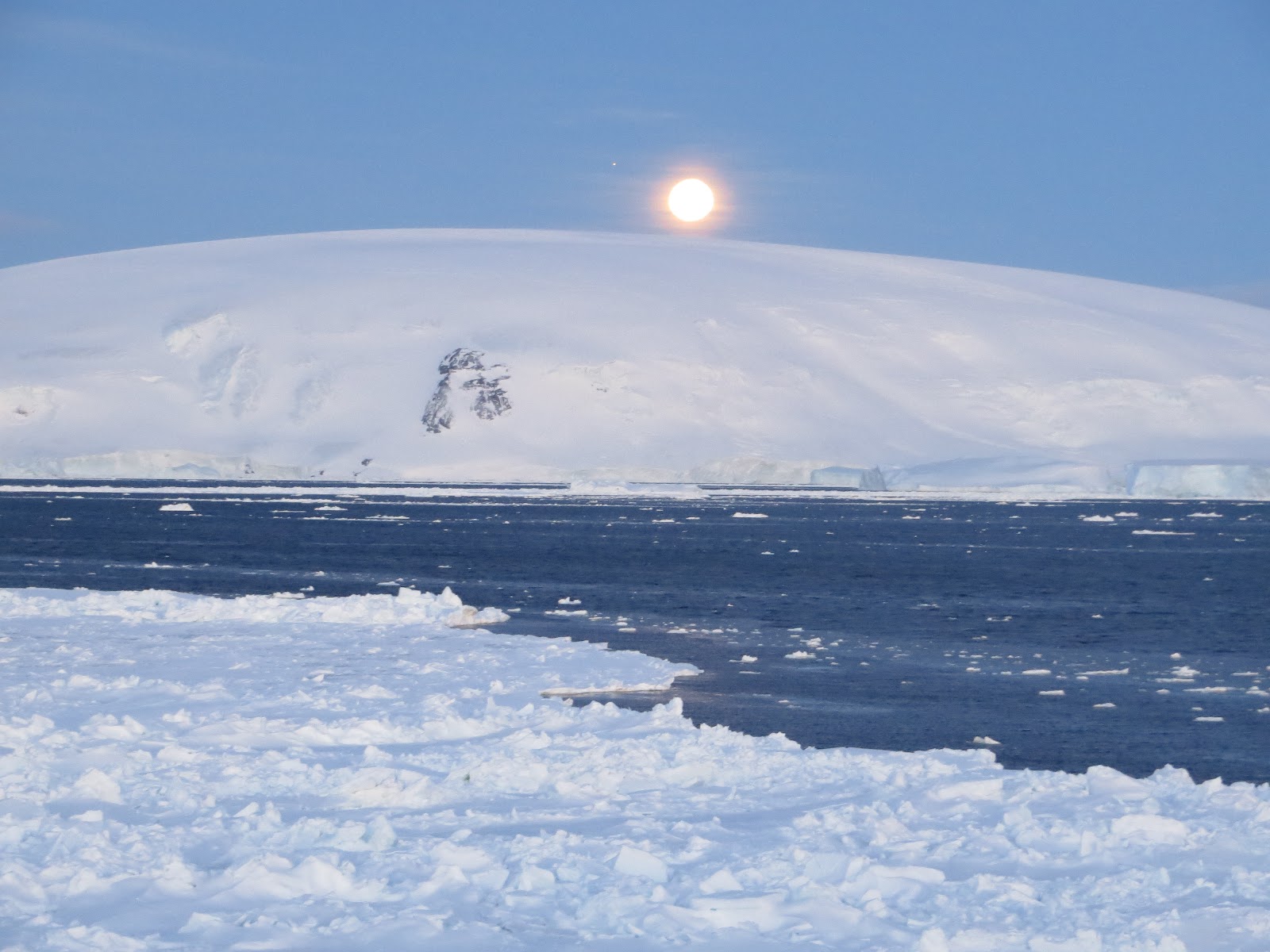
All too soon our second Antarctic adventure had come to an end and we were putting our seasickness patches behind our ears, wedging everything securely in pace in our cabins, and preparing for the two and a half days' of rolling waves back to Ushuaia.
But nothing happened. Yes of course there were some waves, but nothing at all like the other three crossings we've made. This was that novel experience that they call Drake Lake. A smooth and easy journey back.
It was quite strange to find that we could walk without holding on, we still had a full complement of passengers in the dining room, and that no glasses, cutlery or chairs went flying during a meal.
 We spent some time on deck, watching the birds, and we're lucky enough one day to sail close by some pods of whales. The humpbacks were a bit far away to get a good sighting of, but we got fairly close to some fin whales and spent quite some time watching them alongside us.
We also went along to a few of the talks. I particularly enjoyed Sarah's fantastic rendition of a poem called The House that Cherry Builthind it. It is a silly poem, one of those cumulative ones which adds a line but continually repeats the whole of the story so far each time, but it tells a story of an horrendous journey made by Wilson, Bowers and Cherry-Garrard shortly before the ill fated trip to the South Pole, where the Wilson and Bowers died alongside Scott.
This journey was incredible not so much for its destination, but rather for the fact at it was done in the middle of the Antarctic winter. Back then in 1911, there was a belief that the embryo of the emperor penguin may hold some vital information about an evolutionary link, and so they were eager to get hold of some eggs. The problem with this is that the emperors nest in middle of the winter, so any egg collection would gave to be done then when the weather is at its worst and the sun never rises.
 The three of them set off on their trip on 27 June and made their way in the perpetual dark, howling winds and temperatures that froze their clothes solid. They quickly learned that when they first put their head out of the tent in the morning, they had to remember to have it in the right position that they would want it in for the rest of the day because theitr necks froze in that position!
They reached their intended base camp area Mount Terror on 15 July and built a stone igloo with their tent as a roof, but they still had 6.5 treacherous km to go to Cape Crozier where the emperors had their rookery. This journey took them five days because the conditions were so bad and they had to haul themselves over huge ice ridges and dangerous crevasses.
 At the rookery, they collected five eggs; two of them got broken on the journey back to the camp at Mount Terror and they pickled the other three embryos in alcohol. But then the blizzard set in so they were going nowhere. Though it turned out that even being in the tent was dangerous, as one night the fat used to fuel their stove spat and hit Wilson in the eye, temporarily blinding him.
On 22 July the blizzard blew away their supply tent, with everything in it. The next night, the tent that was covering their igloo blew away too, so they were left exposed to the wind and snow, huddled in their frozen sleeping bags.
Somehow they managed to survive like this for two days and nights, with nothing to eat and their only liquid coming from sucking the ice on their sleeping bags. Even their teeth were frozen, so much so that when their teeth chattered in the cold, they actually shattered.
Finally the storm relented. They were lucky enough to find their tent and some supplies, and they set off back to the base camp at Cape Evans, arriving exhausted, frost bitten, but alive.
 Cherry-Garrard returned to London after the bodies of Scott and the others were found, and in 1913 he delivered the prized embryos to what is now the Natural History Museum. Unfortunately the start of World War I meant that the eggs were not examined until much later. The results were finally published in 1934, by which time they had long realised that the emperor penguin was not the missing link that that had been searching for after all.