|
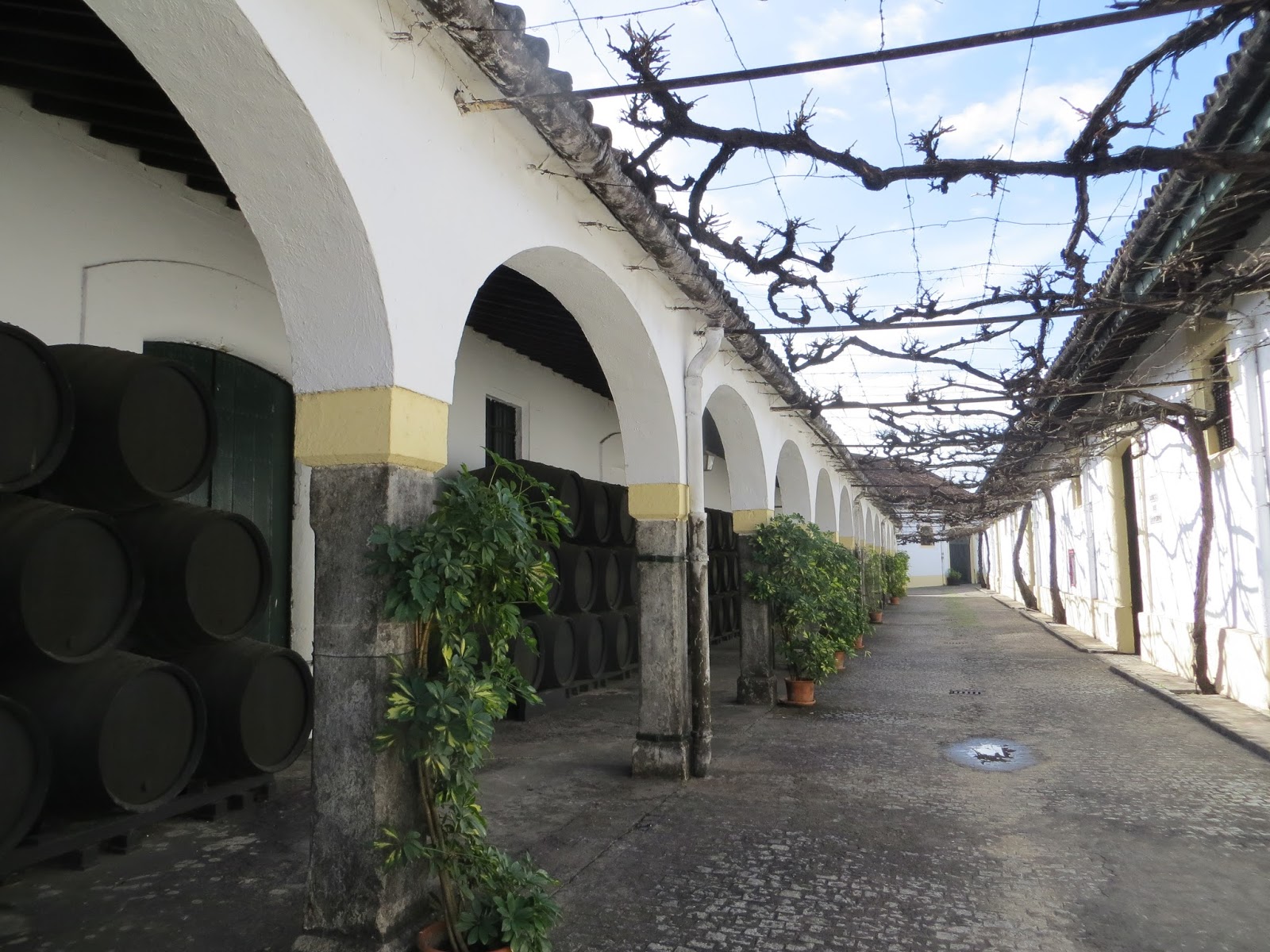
| Bodegas Fundador, Pedro Domecq, Jerez |
Wait! Don't just stop reading because I said the word 'sherry' - you might be surprised; you may even find your new favourite drink.
Sherry seems to be one of those things where people hear the word and immediately recoil, with thoughts of that dreaded bottle that hung around in your great aunt's drinks cabinet to be brought out every Christmas, and tasted vile. British soap operas love to make it the favoured tipple of the old spinster or widow, which helps to cement its fate as something to be avoided at all costs.
 |
| Jerez |
But hear me out for a moment, because sherry really doesn't have to be like that. For a start, that bottle that has been hanging around open for years would taste terrible - it's gone off. Depending on what type it is, an open bottle of sherry can last between a few days and a few months, but it is not a spirit, it does not last indefinitely. Throw that old open bottle away.
 |
| Jerez |
They have been making wines in the Jerez region for around 3000 years. The trade survived the Moorish period of around 550 years, when the consumption of alcohol was forbidden by the Koran, by also distilling the grapes for ointments and perfumes, and making raisins for eating.
 |
| Jerez |
Once the Catholic reign began in 1264, the vines became an important crop for the region. We British in particular, started buying the wines in large quantities, with Henry I agreeing a trade of the sherries for wool. Later, the marriage of Catherine of Aragon to King Henry VII's eldest son Prince Arthur, and her subsequent marriage, (after Arthur died and the Pope annulled the first marriage,) to his brother Henry VIII further increased the British interest. By the way, I don't know about you, but I did not know that she was married to Henry's brother first.
 |
| Bodegas Fundador, Pedro Domecq, Jerez |
Sherry became traded around the world, but remained popular in England, with Queen Elizabeth I, Francis Drake and William Shakespeare all said to be devotees. In the late 1600s, its trade was boosted with the prevalence of the port of Cadiz, with the ruling required that a third of the cargo be from the area.
Of course these were turbulent times, and in order to make sure that the newly formed United Kingdom continued to get its sherry, British wine merchants started to establish their own businesses in the region. Even today, the UK remains a huge importer of sherry wines - it is actually quite hard to buy the ubiquitous Harvey's Bristol Cream in Jerez, as it mostly goes abroad.
 |
| Bodegas Fundador, Pedro Domecq, Jerez |
Sherry is unlike most other wines, in that it is fortified, which means that alcohol is added while the wine is being made. This both makes the wine more resilient, especially for long transportations, and means that the wine maker can get more variation during the aging process.
 |
| Bodegas Fundador, Pedro Domecq, Jerez |
There are three main categories of sherry. The first is Vinos Generosos, which are the dry wines, Manzanillo, Fino, Amontillado, Oloroso and Palo Cortado, made from the Palomino grape. The last of these is only produced in small amounts, and it happens of its own accord when a Fino goes slightly astray, with extra yeast activity.
 |
| Bodegas Fundador, Pedro Domecq, Jerez |
The Palo Cortado is becoming very a popular type but, like the Fino and Manzanillo, it is too dry for me. These are probably the sherries to go for if you like your white wine to be a sauvignon blanc. If you're more into the fuller chardonnay, then you probably want the amontillado or oloroso. Personally, I like a nice rich flavour, so tend to go for the latter two, but I would choose a more aged one.
 |
| Bodegas Fundador, Pedro Domecq, Jerez |
The Pale Cream is the Fino, so it still has those fresher flavours, but a bit of sweetness too. The Medium has a very broad spectrum, but is typically the more rounded amontillado base. Then the Cream is the richest and sweetest, using the oloroso. The famous example of these is Harveys Bristol Cream, although it actually blends a number of the different wines together. We discovered here that all of these category should be served chilled, and the Creams should have a thin slice of orange, to really bring out the flavours.
 |
| Bodegas Fundador, Pedro Domecq, Jerez |
The final category is the Vinos Dulces Naturales, the naturally sweet grape varieties of Moscatel and Pedro Ximinez (PX). The former has a lighter, slightly floral sweetness. It can actually be made as a fairly dry wine, in the same way that a Riesling can be dry or sweet, but typically it will be along the lines of the lighter , more elegant dessert wines.
 |
| Bodegas Fundador, Pedro Domecq, Jerez |
 |
| Bodegas Fundador, Pedro Domecq, Jerez |
Sherry was one of the reasons we decided to come to Andalucia, and certainly why we came to Jerez, so of course we drank quite a lot of it here. We tried quite a lot just in the bars, but we also popped along to a few of the many wineries.
 |
| Lustau, Jerez |
Our favourite was the Lustau winery, purely for the wines themselves. The winery, like many here, looks a little down at heel from the outside, but again like many, is charming inside. The tasting was formal in agenda, but relaxed in style, and the wines were definitely our favourites. We came away with about six bottles.
 |
| Sandeman, Jerez |
While we were up at the horses, we tried the Sandeman winery next door. The tasting room here is huge, set up for the many coach parties they receive. There is a short tour, and then the wines are given to you with tasting notes after a brief explanation. They are generous with both the number and the pour, and you can try the brandies too. Whilst we enjoyed the wines here, they weren't ones we would particularly chose.
Another was Bodegas Fundador, Pedro Domecq, which includes the brand names of Harveys and Terrys. This is a lovely winery, and being here out of season, we had the place to ourselves. They gave us a very interesting, informative and relaxed tour, which was a great introduction to the making of the wines.
 |
| Nic ready for wine at Sandeman, Jerez |
Now I suspect that this doesn't usually happen, but for the tasting, they poured us a very generous first one, then left us with the bottles and let us pour our own, for both the wines and the brandies. We tried very hard to restrain ourselves, and largely succeeded, except for the Pedro Ximinez, where we succumbed to extra large pours and seconds! We did buy some wines though, so that's not so bad.
 |
| Sandeman, Jerez |
On which point, try to space out the tastings. We only did one a day, so we managed fewer wineries, but to be honest, we would have been in a pretty bad state if we had done multiple ones.
So there you have it. Sherry. Give it a try some time.
 |
| Sandeman, Jerez |