Welcome to our travel blog. We are Tabitha and Nic. In 2011 we 'retired' in our early 40s and set off to travel the world. We spent our first year in South America and have been lucky enough to make two trips to Antarctica.

Our blog is a record of our travels, thoughts and experiences. It is not a guide book, but we do include some tips and information, so we hope that you may find it useful if you are planning to visit somewhere we have been. Or you may just find it interesting as a bit of armchair travel.


Showing posts with label Opera House. Show all posts

Saturday, October 29, 2016

Luang Prabang - Town, temples and a bit of a disappointment

Royal Palace Museum, Luang Prabang
From Chiang Rai, we took an overnight bus to Luang Prabang. The nice thing about the journey is that you arrive at the Thai/Laos border, in this case the International Border Control Friendship Bridge IV, fairly soon, so none of that nasty 'middle of the night border crossing' disruption.

On the subject of the border crossing, we got our visa on arrival, at a cost (at that time) of US$35 each.


Royal Palace Museum, Luang Prabang
That is for UK passport holders, but it does vary by country, (a) whether you can get a visa on arrival, and (b) how much it is, so do check first. Be aware that the fee has to be paid in cash in dollars; you might be able to pay in Thai Baht, but it will cost you significantly more, and if you are there any time other than 8am to 4pm on a normal (non-holiday) weekday, there will be an extra out-of-hours charge of US$1. There was also a 10,000 Laos Kip entry fee.

The not so nice thing about the journey, other than a distinct lack of sleep, was the time and place that we arrived in Luang Prabang. We got there at around 6am, but the bus didn't drop us in town, it dropped us at the main bus station, some distance out, just as it was starting to rain. The jumbos - the mini trucks that are the common form of transport here - soon arrived to take us in to town; we thought the price was far more expensive than seemed reasonable, but of course they rather have you over a barrel.

Wat Mai Souvannaphummaham, Luang Prabang
At least the hotel were had booked had a night duty guy on, who let us in to the reception area, where we could sit and have a hot drink while we waited for the day to start. We did consider that, as we were actually up before sunrise, we might take the opportunity to go along to see the famous gathering of alms by the local monks.

Wat Mai Souvannaphummaham, Luang Prabang

However, this was another one of those times where we feel that tourists are in danger of ruining a local tradition, as we have seen video of tourists getting in the way, interrupting, and generally being totally obnoxious. Obviously we would not have behaved that way, but we took the view that we didn't want to add to, or encourage, this being viewed as a sightseeing opportunity. So we gave it a miss.

Luckily the hotel had a room ready for us nice and early, so we were able to get a bit of sleep before heading out for the day.

Wat Mai Souvannaphummaham, Luang Prabang
Now, Laos is a country that I have been looking forward to visiting for a while, because it appealed as a place that might still be relatively unspoiled by large scale tourism. It is also somewhere that we have only ever heard positive things about - everyone who has been here seems to love it, and they often return.

But we didn't love it and I'll explain why in this and some of the other Laos posts to come. That doesn't mean we didn't enjoy any of it - there were some good aspects - but overall, we felt that Laos was the country where we most felt like we were being treated as a cash cow, to be ripped of if possible. It also felt like there was a real split between the local people and the tourists here, with we tourists being corralled into our own areas.
Luang Prabang

Here in Luang Prabang, the peninsula of the city, which is a UNESCO world heritage site, is effectively entirely given over to tourism, with locals living further inland. Aside from the temples, almost everything here was a hotel, tour group agent, souvenir shop or a western style restaurant or bar.

Now don't get me wrong, as an easy place to chill out, to take a break from any Asia overload, or to have a holiday somewhere in Asia without having to immerse yourself too much into the food and culture, it is probably perfect.


Night Market, Luang Prabang
And we enjoyed our time here as a relaxing break. But it really doesn't feel like you are engaging with the country. I suspect that you need to go to less well known areas, probably in the south of the country, to do that.

And then there are the prices. We were genuinely surprised at how much things cost here, be it tours, meals or souvenirs. Given the low price of groceries, and what we learned about wages in the country, there is absolutely no way that the prices we were being charged were anything other than extortionate.
Morning Market, Luang Prabang

I know that they have to import some many things, making base prices a little higher than Thailand, and I don't mind that they put prices a bit higher for tourists, but the amounts here felt unreasonable. Even worse, we got the distinct impression that those people working directly with tourists, and those that own the factories where the souvenirs are made, and various officials, all make a very nice profit, while those working for them or in the rest of the country, are left in poverty.

It also seems that most of the tours are not very ethical. The hill tribe tours sounded like they are of the 'human zoo' variety, and the elephant ones all seem to involve riding.

Garavek storytelling, Luang Prabang
So anyway, what about what we did like here. You can quite see why the whole of the old town here on the peninsula is a UNESCO site. It is full of lovely old buildings, from temples to French Colonial. You can very easily imagine the streets devoid of any kind of motorised vehicle, and you will still see the odd handcart being pushed now.

There were some nice places to eat and drink. The Coconut Garden was a reliable and reasonably priced place. If you want to spend a bit more L'Elephant is supposed to be good, though we didn't try it, the 3 Nagas was OK, and Blue Lagoon was excellent.

There were some good cafes - Saffron Coffee and Le Café Ban Wat Sene - which were also by far the best place to get wifi and aircon. Another café, Le Banneton, is known for its croissants.


Wat Sensoukaram, Luang Prabang

We also rather liked a nice little bar and tapas place called Opera House, which also had good wifi. There are other, livelier bars like Utopia, Hive etc, but we didn't bother with them.


Wat Sensoukaram, Luang Prabang
And bear in mind that Luang Prabang has a curfew; I can't remember the exact time, but it was about 11:30pm, and many of the smaller hotels do actually close their doors then, because the staff go to bed.


One evening here, we went along to Garavek, which is a little company that holds story telling shows, in a little room with about thirty seats. It isn't a totally authentic experience - realistically, nothing for tourists ever is - but it is enjoyable and sufficiently informative to be worthwhile. You can buy a drink there to take in with you if you want to.

But perhaps the most interesting thing that we did in town, was a couple of hours spent at Big Brother Mouse. BBM is part of an aim to get Lao people reading. Sasha, Khamla and Siphone have worked together to provide childrens' story books that are written in the Lao language and English, so that children can learn to read, learn English and learn enjoy reading. In addition, in Luang Prabang, they run two sessions a day where tourists come in to help local youths with their English. That can be reading to them, listening to them read, helping them with their homework, or even just having a conversation with them.
Wat Sensoukaram, Luang Prabang

Wat Xieng Thong, Luang Prabang

Wat Xieng Thong, Luang Prabang

Wat Xieng Thong, Luang Prabang


Wat Xieng Thong, Luang Prabang

Wat Xieng Thong, Luang Prabang

Wat Xieng Thong, Luang Prabang


Wat Xieng Thong, Luang Prabang

Wat Xieng Thong, Luang Prabang

Wat Xieng Thong, Luang Prabang


Wat Xieng Thong, Luang Prabang


Wat Xieng Thong, Luang Prabang

Wat Xieng Thong, Luang Prabang

Wat Xieng Thong, Luang Prabang

Wat Xieng Thong, Luang Prabang

Mekong River, Luang Prabang

Mekong River, Luang Prabang

Mekong River, Luang Prabang


Saturday, September 10, 2016

Sydney - History and Icons

Sydney Harbour Bridge and Opera House
Coming from Europe, with its many centuries of history, one of the things that I have to remind myself when travelling to places like Australia, is just how new these settlements are. I know, of course, that the indigenous people of these countries have been here much longer, but it is strange to think how recent are the European settlements that dominate now.

Hyde Park Barracks, Sydney
Sydney got its name from the man who recommended that be used as a penal colony, the Secretary of State, Thomas Townshend, Lord Sydney.

The first fleet of transport ships left Portsmouth in May 1787, and the sailors and guards, with their charge of 759 convicts, various livestock, plants, and two years worth of provisions, arrived at Port Jackson on 26 January 1788, and was established under the authority of Captain Arthur Phillip.

Discipline here was severe, with the first hanging, for the crime of the theft of food, taking place only a month after their arrival. Harsh as that may sound, I suspect that food was likely to be one of the greatest concerns for the new colony.

It was soon to become evident that many of the seeds and crops that they had brought with them from the UK were not suitable for the soil and climate here, and so anything that depleted their foodstock was harshly dealt with.

Museum of Sydney
Two further fleets of convicts arrived in 1790 and 1791. If they worked hard and behaved themselves, they could earn their freedom, though of course many did reoffend. In 1793, the first free settlers arrived in Sydney.

One of the many building projects that the prisoners had to work on was the construction of Hyde Park Barracks, which opened in 1819. It was designed to house 600 convicts, though at times there would have been up to 1,400 held here. The transportation of prisoners ceased in 1840, so eight years after that, in 1848, the remaining convicts were moved to cockatoo Island. Some 50,000 convicts came through these Barracks during those 29 years.

Sydney Cove
After 1848, the Barracks became an Immigration Depot, and over the next 38 years it also provided temporary housing for around 40,000 single women and children who arrived here. In 1887, the Barracks was turned into government offices and Courts Buildings, which it remained until late in the last century. After lengthy archaeological excavations and restorations, it opened as a Museum in 2010.

The Rocks, Sydney
We had visited the Museum under the expectation that it was largely about the convict transportations and their life and progress once here, so we were a little disappointed when that actually turned out to only be a very small part of what was here. However, the rest of the exhibition was interesting, so I would still recommend it as a place to come.

The Rocks, Sydney
We also visited the Museum of Sydney, which is on the site of the first Governor's House. The museum tells us about the history of the city through the stories of some of its most important residents. Although this makes the picture a little disjointed at times, it is quite an interesting, and generally effective way of doing it. They do also include stories of some of the aboriginal people, and give some reasonably honest accounts of the interaction between them and the new settlers.

Two museums is about our limit these days, so the rest of our historical interest came from a wander around The Rocks. This is the oldest part of Sydney, where the convicts settled, so it was generally quite a notorious slum area.

The Rocks, Sydney
Much of it was demolished, and the remainder would have been in the last century had it not been for the efforts of local residents and the builders' union, which put a ban on its members doing the work.

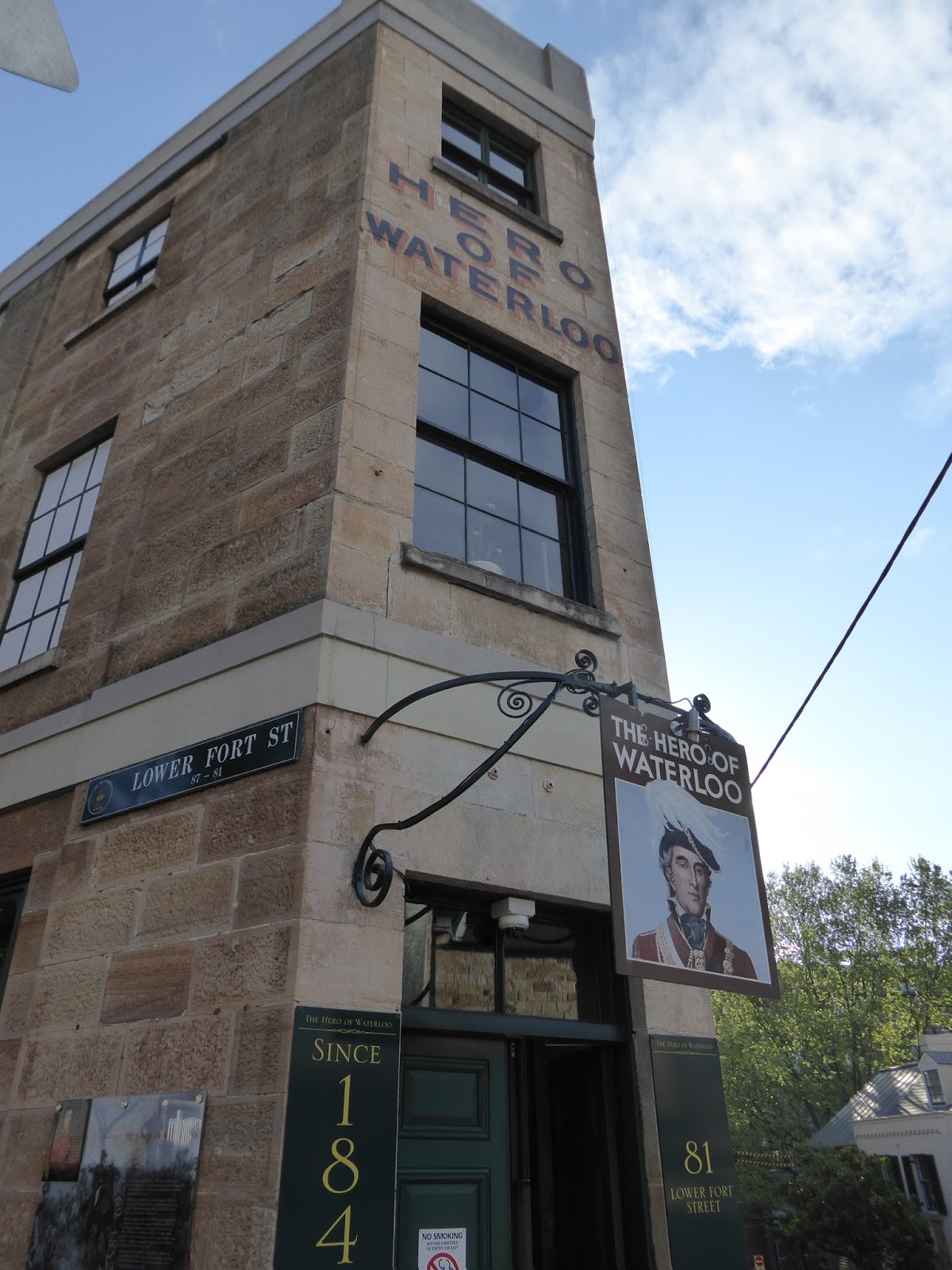
Cadmans' Cottage, built in 1816, is one of the only buildings that remains from the early settlement, and the area is also home to some of Sydney's oldest pubs, like the Lord Nelson, which provided a welcome watering hole after we'd walked up the hill in the very hot sunshine.


The Rocks, Sydney
The Rocks also has a great food market on a Friday, and a more artsy crafty one at the weekends.

There are a few art installations dotted around too, although personally I didn't really get the meaning in most of them.


Sydney Harbour Bridge


So that is a bit about the history, what about the icons. After all, if Sydney is known for anything, it is the Opera House and the Sydney Harbour Bridge. The 3770 feet long bridge was started on 28 July 1923, and finally opened on 19 March 1932. It certainly provides an interesting focal point in the harbour.

Sydney Opera House
The Opera House, which these days it seems hard to imagine Sydney without, is only 43 years old. It was designed by Danish architect Jorn Utzon, who won a competition for the design in 1957. After a new government questioned his design and stopped paying him, Jorn resigned from the project in 1966, and had left Australia before it finally opened on 20 October 1973.

Sydney Opera House
Although he won various accolades and prizes for the design, and was persuaded to return for further works decades later, he never actually went back to Australia to see the completed building.


Sydney Harbour Bridge
Sydney Opera House

Sydney Opera House
Sydney Opera House
  
Sydney Opera House
Sydney Opera House


Sydney Opera House

Sydney Harbour Bridge
Sydney Opera House

Luna Park, Sydney