Welcome to our travel blog. We are Tabitha and Nic. In 2011 we 'retired' in our early 40s and set off to travel the world. We spent our first year in South America and have been lucky enough to make two trips to Antarctica.

Our blog is a record of our travels, thoughts and experiences. It is not a guide book, but we do include some tips and information, so we hope that you may find it useful if you are planning to visit somewhere we have been. Or you may just find it interesting as a bit of armchair travel.


Showing posts with label Nara. Show all posts

Wednesday, April 27, 2016

Kasuga Shrine

Kasuga Shrine, Nara
We liked Nara. It is a pretty, peaceful city, with enough to see, but not so much that you exhaust yourself trying to fit it all in. It has deer. It has nice places to drink, as discussed in our earlier post. And it had a great place for my new favourite food of Tonkatsu, the breaded pork cutlet (in the covered shopping arcade next to Kintetsu Station), which we couldn't help but make a return trip to during our stay.

Kasuga Shrine, Nara
But the food and drink aside, possibly my favourite place in Nara was the Kasuga Taisho, or Shrine, and more specifically, the grounds, with all of its hundreds of moss covered stone lanterns.

The shrine itself was originally built in 768, but in accordance with the Shinto rituals, it was torn down and rebuilt every couple of decades to ensure purity. Thankfully, they stopped doing this around the end of the Edo period, so the current shrine dates back to around the mid 1800s.

Kasuga Shrine, Nara
The lanterns continue inside too, only now in bronze. I would love to be here for one of the twice yearly festivals where they light them all up, as I am sure it would look truly stunning.


As I have no particular wish to make a history lesson out of this
Kasuga Shrine, Nara
post - in honesty my interest here was far more the look of the place than its historical or religious significance - I'll just leave you with some photos to look at.


Kasuga Shrine, Nara


Kasuga Shrine, Nara

Kasuga Shrine, Nara

Kasuga Shrine, Nara

Kasuga Shrine, Nara

Kasuga Shrine, Nara

Kasuga Shrine, Nara

Kasuga Shrine, Nara

Kasuga Shrine, Nara

Kasuga Shrine, Nara

Kasuga Shrine, Nara


Kasuga Shrine, Nara

Kasuga Shrine, Nara

Sunday, April 24, 2016

Todaijo Temple and a nostril to enlightenment?

Todaijo Temple, Nara
One of the most important places, and most popular attractions in Nara, is the Todaijo Temple. It was built in 752 as the head temple of all Japanese provincial Buddhist temples, and it was the power that developed here that caused the move of the capital away from Nara.


Todaijo Temple, Nara
The primary draw for visitors is the Daibutsuden, or the Big Buddha Hall. It is ambiguous to me whether the 'big' refers to the size of the Buddha or the size of the Hall, but I suppose that question is irrelevant as both are undoubtedly big.


Todaiji Temple, Nara
The hall is said to be the world's largest wooden building; that is despite this version, that was rebuilt in 1692, being only two thirds the size of the original.


Buddha's nostril, Todaiji Temple, Nara
Just to give us a sense of how big the 15m tall Buddha really is, the hall has a pillar with a hole in the bottom, that is the same size as the Buddha's nostril.

People queue up here to try to wriggle and squeeze their way through this hole. This seems a strange thing to do, but apparently anyone who achieves it can expect to gain enlightenment in their next life.


Todaiji Temple, Nara

In case you are wondering, no, neither Nic nor I will be expecting enlightenment; the Buddha's nose isn't that big!


Todaiji Temple, Nara


Todaiji Temple, Nara

Todaiji Temple, Nara


Saturday, April 23, 2016

Nara - a deer little city

Nara
No, I haven't failed on my spelling, Nara really is all about the deer. There are around 1,200 deer roaming freely about the city - usually keeping to the parks and temples rather than the main town area, but they have been known to stray sometimes. Believed in Shinto to be messengers of the Gods, they are protected and have been designated a national treasure.


Nara
They are rather cute, though you do have to watch out for some of them. People feed them, so some can be quite determined in demanding food, and some will steal anything that they think might be edible.


Nara
We noticed a number of people having their maps snatched from out of their hands and being eaten. Not sure how tasty they are, but they were soon polished off.

Most though are quite docile and friendly. They sell special deer biscuits in the parks, which are rather better for them than maps, and many of the deer will happily take these from your hand.


Nara
It is quite amusing to watch the deer around the sellers. They clearly know that they aren't supposed to try to get biscuits from the seller, but sometimes can't seem to help themselves. the vendors look pretty grumpy when they persist, but we did see a couple cave and give them the broken ones.

Nara
If you don't want to be followed and pestered, keep the biscuits out of sight in your pocket or bag, and just take them out one at a time to give out.


Some of the deer have even learned the art of politeness from their Japanese neighbours, and will bow their heads to you as a request for a biscuit. How could you possibly say no to that?
Nara


Nara

Nara


Nara


Nara

Kofukuji Temple, Nara
Of course Nara isn't just about the deer. Nara, then called Heijo, was the first capital city of Japan, way back in 710. That didn't last too long though as the government feared a threat from the powerful Buddhist monasteries based here, and moved the capital away in 784. But whilst it may have lost its political importance, it was still an important religious area, and it has the temples to show for it.


Kofukuji Temple, Nara
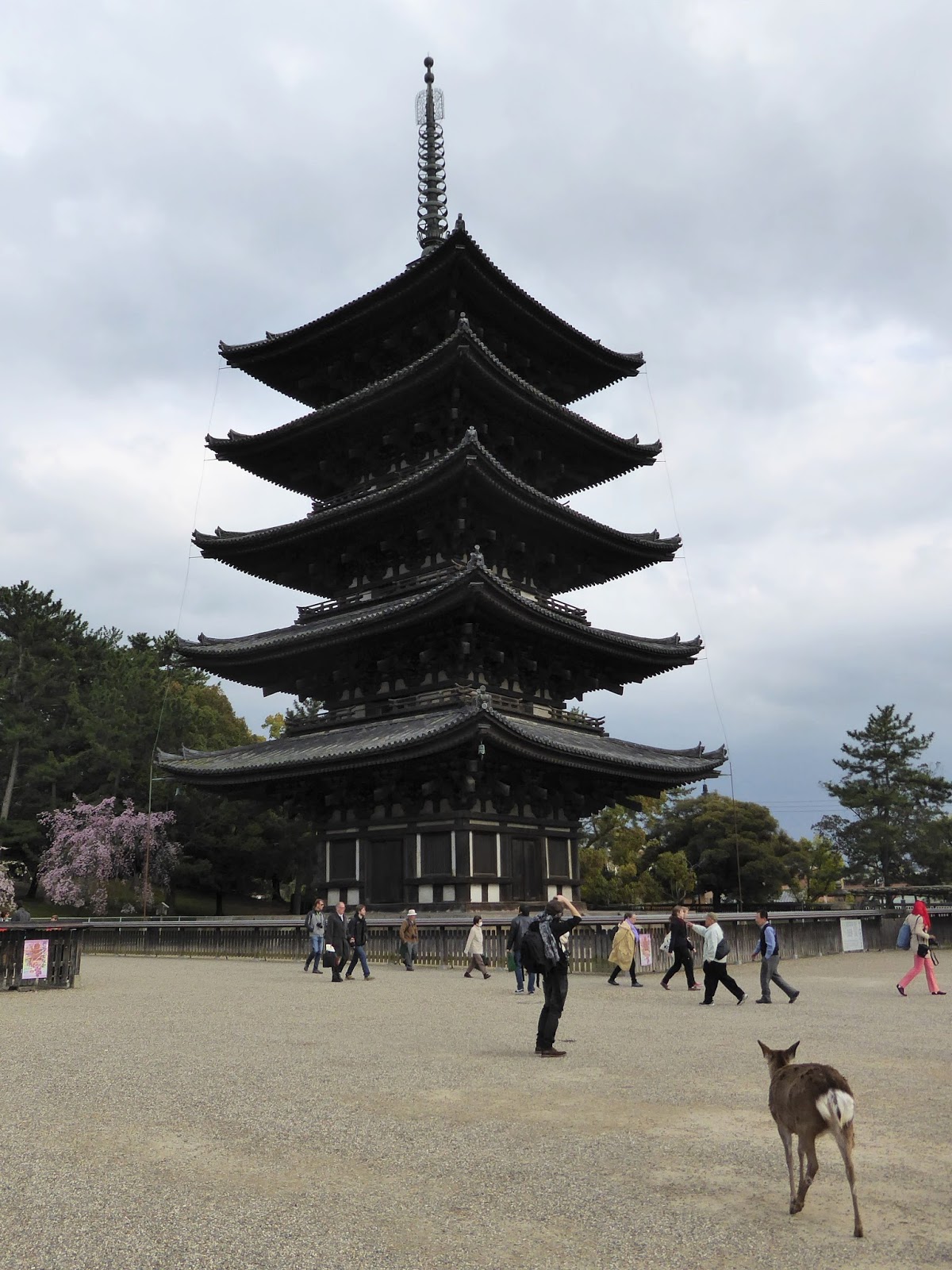
Close to where we were staying, was the Kofukuji Temple, with a rather fabulous 50m tall pagoda, the second largest in Japan. It was first built in 730, but like some many places in this country of earthquakes, it was rebuilt in 1426.

There is some construction work underway here, as they are in the process of rebuilding the long lost Golden Central Hall, (due to be finished in 2018,) not to be confused with the smaller Golden Eastern Hall that is still standing. We didn't go into it, but apparently, if you an pull yourselves away from the deer, the National Treasure Museum has some impressive Buddhist pieces.

Kofukuji Temple, Nara
The surrounding parks are well worth a wander around as you find your way to some of the other sites. We will visit the Todaijo Temple and the Kasuga Shrine in the news posts, but there are also the impressive Nandaimon Gate, the National Museum, and a few gardens to see if you want to.


Nara

Nara

Nara

Nara

Nara

Nandaimon Gate, Nara

Nandaimon Gate, Nara

Nara

Wednesday, April 20, 2016

Kanpai! in Kobe and Nara

Nihonshu in Kobe
Japan doesn't really have bars or pubs like we do in the UK. There are some, typically run by and aimed the British, Irish and Australians, but in the main, the bars are small - sometimes tiny.

It can be a worrying thing going in, because you generally can't see inside, so you never know what you're walking in to. Will it be empty? Will it be filled with those austere looking black suited businessmen, who clearly don't want you bulky foreigners taking up the tiny space there is? Will there be a grumpy bartender, who will pretend he doesn't understand what you are asking for?

Nihonshu in Kobe
All of those things can be pretty off-putting, but you shouldn't let that stop you, because if you go in and that is what you get, you can always leave, but if you don't go in at all, you are likely to miss out on some great evenings.

We were nervous about walking in, and I must admit we favoured places where we could get a hint of what might be hiding behind the curtain. But we were glad we did, as we almost invariably found people welcoming and friendly, and we had some lovely experiences.


Shochu in Kobe
In Kobe, we wandered around the town for a while before deciding on a place down a back street that had lots of brightly labelled shochu bottles in the window, and a warm looking light coming from inside.


Nihonshu in Kobe
When we got inside, we realised it was bigger that we'd thought, with a section out the back which soon filled up. But for now, it was just us, and we were welcomed by a lovely man who took great delight that we sat at the bar and wanted to try different types of nihonshu (sake).


Nihonshu in Nara
He spoke just enough English to describe the various types that he had, he listened to what we said we liked, and he helped us work our way through a good number of very individual, and very enjoyable nihonshu. We tended to order different ones, and taste each other's to increase the number we could try, and he added to that by regularly throwing in extra free tasters too.

Nihonshu in Nara
Not only did we get free drinks, we also ended up with free food. Two women had come and sat at the bar and started ordering a number of small dishes. they spoke to the barmen, and the next thing we knew, we were getting tasters of each thing winging its way to us too. They seemed to like the idea of us trying the drinks, and wanted us to try the foods too. We had a lovely evening.

Nihonshu in Nara
In Nara, we tried out a few bars. The first was a small standing bar that had been recommended in various guides, but we found difficult to find. In the end, two very nice ladies helped us out. They couldn't direct us, so they actually walked us to the bar, which was about ten minutes away.

Nihonshu in Nara
Once inside, we slightly got the impression that the owner was maybe slightly fed up with foreigners coming in and not really caring about the drink. However when, instead of just asking for sake, we asked for particular types of nihonshu, he perked up and was quite friendly.


Nihonshu in Nara
Shortly afterwards, a guy from the USA came in, knowing nothing about them, and he reverted to being unhelpful and his English ability seemed to decline. We got to talking with the newcomer, and I gave him a brief explanation of the different types and what they were called etc. when I finished, the barman, and the two Japanese customers at the bar, all gave me a round of applause. Things lightened up again after that, and it was clear that a little effort to know about the drink goes a very long way.


Nihonshu in Nara
In another Nara bar, the lady serving us was equally happy that we knew about the nihonshu, and drew us a little penguin picture. In a third place, which was more of a shop with some seats, we were sat outside, but I went inside to order the drinks each time from a lady who was friendly, but spoke no English at all. We managed OK though, and with my few words and names of types and her willingness to help, we got some lovely nihonshu, with a Junmai Daiginjo that I especially liked.


Nihonshu in Nara
During my efforts at ordering, I had been watched by a Japanese couple inside, who were clearly amused, but seemed also to like the fact that I was trying and knew what I wanted. We exchanged a few grins. Then while we were outside, the couple left. As they did so, he handed me a bag, smiled, and was gone. When I looked in the bag there was a full bottle of the Junmai Daiginjo that I had been drinking. How nice is that!


Our gift
These were far from our only great experiences here, but they are a few that particularly stuck in our minds, and made us glad that we both took the chance to walk in a place, and had bothered to find out a bit about the nihonshu first.

Oh, and if you are wondering about the title, Kanpai means Cheers!