Welcome to our travel blog. We are Tabitha and Nic. In 2011 we 'retired' in our early 40s and set off to travel the world. We spent our first year in South America and have been lucky enough to make two trips to Antarctica.

Our blog is a record of our travels, thoughts and experiences. It is not a guide book, but we do include some tips and information, so we hope that you may find it useful if you are planning to visit somewhere we have been. Or you may just find it interesting as a bit of armchair travel.


Showing posts with label Kobe. Show all posts

Wednesday, April 20, 2016

Kanpai! in Kobe and Nara

Nihonshu in Kobe
Japan doesn't really have bars or pubs like we do in the UK. There are some, typically run by and aimed the British, Irish and Australians, but in the main, the bars are small - sometimes tiny.

It can be a worrying thing going in, because you generally can't see inside, so you never know what you're walking in to. Will it be empty? Will it be filled with those austere looking black suited businessmen, who clearly don't want you bulky foreigners taking up the tiny space there is? Will there be a grumpy bartender, who will pretend he doesn't understand what you are asking for?

Nihonshu in Kobe
All of those things can be pretty off-putting, but you shouldn't let that stop you, because if you go in and that is what you get, you can always leave, but if you don't go in at all, you are likely to miss out on some great evenings.

We were nervous about walking in, and I must admit we favoured places where we could get a hint of what might be hiding behind the curtain. But we were glad we did, as we almost invariably found people welcoming and friendly, and we had some lovely experiences.


Shochu in Kobe
In Kobe, we wandered around the town for a while before deciding on a place down a back street that had lots of brightly labelled shochu bottles in the window, and a warm looking light coming from inside.


Nihonshu in Kobe
When we got inside, we realised it was bigger that we'd thought, with a section out the back which soon filled up. But for now, it was just us, and we were welcomed by a lovely man who took great delight that we sat at the bar and wanted to try different types of nihonshu (sake).


Nihonshu in Nara
He spoke just enough English to describe the various types that he had, he listened to what we said we liked, and he helped us work our way through a good number of very individual, and very enjoyable nihonshu. We tended to order different ones, and taste each other's to increase the number we could try, and he added to that by regularly throwing in extra free tasters too.

Nihonshu in Nara
Not only did we get free drinks, we also ended up with free food. Two women had come and sat at the bar and started ordering a number of small dishes. they spoke to the barmen, and the next thing we knew, we were getting tasters of each thing winging its way to us too. They seemed to like the idea of us trying the drinks, and wanted us to try the foods too. We had a lovely evening.

Nihonshu in Nara
In Nara, we tried out a few bars. The first was a small standing bar that had been recommended in various guides, but we found difficult to find. In the end, two very nice ladies helped us out. They couldn't direct us, so they actually walked us to the bar, which was about ten minutes away.

Nihonshu in Nara
Once inside, we slightly got the impression that the owner was maybe slightly fed up with foreigners coming in and not really caring about the drink. However when, instead of just asking for sake, we asked for particular types of nihonshu, he perked up and was quite friendly.


Nihonshu in Nara
Shortly afterwards, a guy from the USA came in, knowing nothing about them, and he reverted to being unhelpful and his English ability seemed to decline. We got to talking with the newcomer, and I gave him a brief explanation of the different types and what they were called etc. when I finished, the barman, and the two Japanese customers at the bar, all gave me a round of applause. Things lightened up again after that, and it was clear that a little effort to know about the drink goes a very long way.


Nihonshu in Nara
In another Nara bar, the lady serving us was equally happy that we knew about the nihonshu, and drew us a little penguin picture. In a third place, which was more of a shop with some seats, we were sat outside, but I went inside to order the drinks each time from a lady who was friendly, but spoke no English at all. We managed OK though, and with my few words and names of types and her willingness to help, we got some lovely nihonshu, with a Junmai Daiginjo that I especially liked.


Nihonshu in Nara
During my efforts at ordering, I had been watched by a Japanese couple inside, who were clearly amused, but seemed also to like the fact that I was trying and knew what I wanted. We exchanged a few grins. Then while we were outside, the couple left. As they did so, he handed me a bag, smiled, and was gone. When I looked in the bag there was a full bottle of the Junmai Daiginjo that I had been drinking. How nice is that!


Our gift
These were far from our only great experiences here, but they are a few that particularly stuck in our minds, and made us glad that we both took the chance to walk in a place, and had bothered to find out a bit about the nihonshu first.

Oh, and if you are wondering about the title, Kanpai means Cheers!


Sunday, April 17, 2016

Kobe Beef: It's beef, but not as we know it

Kobe beef, Kobe, Japan
I like steak. I like steak a lot. And I've eaten a lot of it, some excellent, some not. So when our travelling took us to Japan, one of our must-go cities was Kobe. Yes, the temples of Kyoto are stunning; yes, Hiroshima is an amazing testament to both the inhumanity and humanity of man; and yes, the metropolis of Tokyo is fascinating. But Kobe has beef - not just any beef - the beef.

There are a lot of misconceptions about Kobe beef, starting with the name. Many people refer to it as Wagyu, but that just translates as beef, so doesn't actually mean anything in terms of quality. Then there's the whole beer drinking, massaged cows myth. It sounds good, but it's not true. The cattle are fed a specially selected mix of grasses and grains, but no beer. And while they are very carefully and lovingly reared, for much longer than your average cow, that doesn't quite extend to the luxury of massage.


Kobe beef, Kobe, Japan
And then there's the biggest lie of all - that you might actually have eaten it. As its fame has grown, 'Kobe beef' and 'wagyu' has popped up on menus anywhere anyone might have the money to pay for it. Sometimes it's burgers - like anyone is going to put beef that good or that expensive in a burger - and sometimes it's in a fancy restaurant with a authentically expensive looking price tag. But in all likelihood, it wasn't Kobe beef at all.
Until recently, there was a complete ban on export of the beef to anywhere other than Macau. And even now, exports are very low, and very pricey. There are a few lucky restaurants that have genuine Kobe beef to offer, but you probably wouldn't have to take your socks off to count them.

Kobe beef sashimi, Kobe, Japan
So if the beef won't come to me, then I just have to go to the beef. For it to be the real thing, it has to be Tajima-gyu, a specific breed of Japanese cattle, that has been born, raised and slaughtered in the Hyogo prefecture, of which Kobe is the capital. And here we were, in the city that shares it's name with supposedly the best beef in the world, planning to blow our budget to try it.

Our first Kobe meal was found courtesy of friends from London, who were over in Japan to see family, and met us here. Them speaking Japanese meant that they found a less touristy restaurant, where we had a less distinctive experience, but excellent steak none the less. But far from quenching our hunger for the steak, it just made us want to go back for more.


Kobe beef, Kobe, Japan
Kobe beef has to meet exacting standards of meat quality and marbling before it gets its unique tracking code, it's guarantee of authenticity. We didn't want to come this far and be given duff beef, so we did our research, and chose the well recommended, but expensive, Wakkoqo as our restaurant.

We opted to have the sashimi starter, then the tenderloin for me and the sirloin for my husband; all proper Kobe of course. We sat at a countertop grill, where our own chef prepared and cooked our beef, an art form all of its own. Any outside fat was trimmed off and set aside to cook separately, giving us tiny tasty morsels to add to our rice.


Kobe beef, Kobe, Japan
The steaks themselves were cut into small chunks, which our chef grilled in small batches, searing them on all sides so that they were a perfect temperature to let the beautifully marbled fat do its work. It was served straight off the grill, with just the simplest of accompaniments, salt, pepper, roasted garlic and Wakkoqo's own sauce.

Strangely, we felt a bit nervous about our first taste. Would it really be that good? Would we like it? Would it be worth the money? The answer was an emphatic yes, yes and yes.

Kobe is really not like normal beef. I've had excellent Argentine, Scottish and US beef, and the best is tender, with a full meaty flavour. Kobe tastes great, but it isn't such a strong flavour. The texture is what makes it special. It literally melts in your mouth, like little buttery explosions. It is ridiculously good, and like nothing I've ever had before. We loved it.

There is one downside though. Once you've tasted Kobe beef, you're going to want to have more!

Wednesday, April 13, 2016

Kobe

Our main purpose in visiting Kobe was for the beef, which I will post about soon, but of course we took a look around while we were here. It is definitely not the best place that we visited in Japan, but it does have some interesting aspects to it.

The area that we were staying in was not the most salubrious; travelling on a budget means booking cheaper accommodation, and though we do take care to avoid any really dodgy or dangerous areas, we have on occasion ended up in or around the more seedy area of town. In Kobe, we were advised by the receptionist at the hotel that it was best not to walk down the road at the side of the building, as that was the massage parlour and 'gentlemen's club' area. We did walk down during the day, and it wasn't too bad - in fact one of the guys on the door even looked a not embarrassed at seeing me go past.

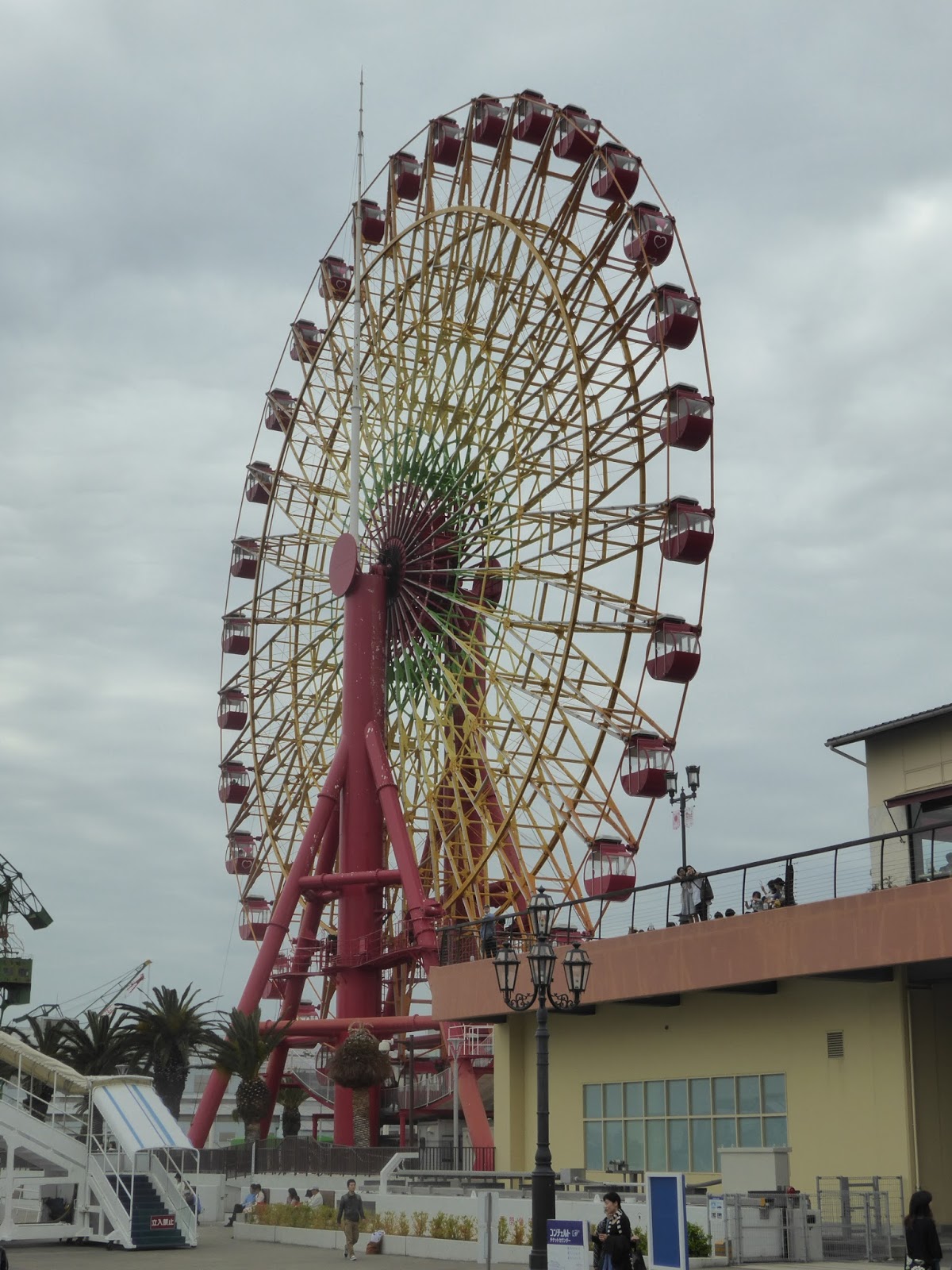
The rest of Kobe was rather more respectable though. We took a walk around harbourland, which has been given a bit of a half-hearted redevelopment, with a couple of museums, a Ferris wheel, and the rather nice looking Kobe Port Tower, which is 108m high and was built in 1963. But there isn't too much else.

Somewhat strangely, there was a statue of Elvis Presley. Apparently former Japanese Prime Minister, Junichiro Koizumi, is an avid Elvis can, who proudly shares his birthday of 8 January, and helped pay for a statue to mark the tenth anniversary of his death. The statue stood outside the Love Me Tender shop in Harajuku, Tokyo from 1987 until the store closed down and Elvis needed a new home. Kobe residents petitioned to have the statue, and here it now stands. Koizumi even came down for the unveiling. Sadly I appear to have lost my photo of the statue, but if you're not sure what Elvis looked like (!) You can ways check out our recent Throwback post from Graceland.

Something else we came across in Kobe was a mini grand prix of remote controlled cars. It seemed to be  being taken very seriously, despite most of them not actually appearing to be much good.

But by far the best bit of proper tourism - i.e. not just eating or drinking - that we did in Kobe, was our visit to the rather awkwardly named 'Disaster Reduction and Human Renovation Institution'. While the name may be terrible, the museum itself certainly isn't. It tells the story of the Great Hanshin-Awaji Earthquake, that devastated Kobe in 1995.

The earthquake hit Kobe at 5:46:53, on 17 January 1995, just as many people were commuting to work. Many of Kobe's buildings were wooden structures, predating the 1960s requirements to make buildings earthquake proof, and they simply collapsed, and then caught fire. The elevated expressway collapsed too. Over 4,500 people from Kobe itself were killed, and almost 6,500 overall.

Some 45,000 homes were destroyed. The city was truly devastated, and whilst it would have been nice to have seen them take the opportunity to create a nicer layout of the city, that was probably unrealistic given the level of destruction and the cost of the works, and Kobe has shown great fortitude in rebuilding itself so quickly.


As well as telling people's stories of the event, the museum looks at how we can protect ourselves against such disasters in future. The exhibition is excellent, and we were disappointed that we hadn't allowed ourselves enough time to see more of the information available. I would definitely recommend allowing a few hours.