Welcome to our travel blog. We are Tabitha and Nic. In 2011 we 'retired' in our early 40s and set off to travel the world. We spent our first year in South America and have been lucky enough to make two trips to Antarctica.

Our blog is a record of our travels, thoughts and experiences. It is not a guide book, but we do include some tips and information, so we hope that you may find it useful if you are planning to visit somewhere we have been. Or you may just find it interesting as a bit of armchair travel.


Showing posts with label Uruguay. Show all posts

Friday, May 18, 2012

Carmelo

Our stopover in Carmelo was really just a matter of convenience.  We had a boat to catch from here the next day and didn't want to chance a late bus making us miss it. There are no hostels here, so we had booked ourselves into the cheapest hotel.

Well actually I say cheapest, but really least expensive would be more appropriate, as after our two accommodation splurges in Mendoza and Santiago, this is the most expensive place we have been.

And it was so not worth it. Hotel Centro - yes I am happy to name and shame -  is also the worst place we have stayed.  I can forgive the dodgy electrics in the showers in Bolivia, and for the prices, some of the pokey hostel rooms are to be expected, but the problems here were just pure lack of care.

Starting with the door to the room; the bottom pane of glass in the door was broken, and a couple of rather large and sharp looking shards were just left in the frame.

The room was cramped, dark and pokey.  The bathroom looked like it may have been fancy when it was put in, but the ceramic toilet seat was broken clean through, so when you sat on it you had to be careful not to get a nasty pinch.  There was actually a jacuzzi bath, but it looked like if you used it some very nasty stuff would come out of the holes with the bubbles.

In fairness the sheets and towels were clean. Which is more than can be said for the rest of the room. It wasn't all filthy, it just looked like they quickly clean the obvious areas and then the out of the way bits never get touched. But the real problem was the mould. The bedroom was full of mouldy spots and black patches. You could smell it.

The curtain, which was torn by the way, was covered in it too. Now even if you struggle to control the mould on the walls - and there was no evidence to suggest that they had even tried to - you can wash or replace the curtain.  We thought we might change rooms, but I looked at others and they looked no better. We knew that most places were either unavailable or way beyond our budget, so as the bed itself was OK, we decided to bear it for the one night. We stayed out all the rest of the day and evening and literally went back just to sleep.

As to Carmelo itself, well there is not much here either. The square is OK with a nice fountain that when it is lit up at night looks a bit like three candles. There are two attractions advertised in town. The first is the swing bridge, which is hand operated to open the central section.

The other is the old house of Colonel Ignacio Barrios, which is now a cultural centre. We took a quick look at both, but neither filled us with any great excitement. I found it more interesting to watch the sight of the various horse and carts and things like the old truck with a fancy antique looking sofa in the back of it.

Carmelo did have one slightly unusual thing. Its graffiti was on the streets rather than on the buildings. Not sure why, but I suppose it could be considered more considerate that they don't daub their rubbish on people's property. Rather less unusually, we were of course followed everywhere by various dogs.

There were a couple of reasonable places to eat in the square.  Both were simple, but had decent, cheap food and they were happy to let us while away our spare hours before we returned to our awful room.  We noticed here that people coming into a restaurant will often say 'buen provecho' which is bon appetit, to the customers already there.  We had seen this before in Montevideo, but as that guy was dressed like a clown, we figured he was just in character.

In the evening, the restaurant had on an Argentine football match, Olimpo v Boca.  We didn't really take much notice of it until the end when it got interesting.  It was Copa Argentina match, so a clear result was needed to decide who went through, but at the end of extra time it was still level at 1-1, so it went to penalties.  Being English, we know that a penalty shoot out can be entertaining to watch, especially one that doesn't hold the threat that your team will lose.  This one was especially good.

Olimpo went first and missed. Boca missed too.  Olimpo recovered themselves and scored the next, so did Boca. They both scored the third, and the fourth and the fifth, taking them into penalty sudden death.  They both scored the sixth and the seventh.

OK perhaps not so sudden death then. When they had both scored in the eighth, ninth, tenth and eleventh, they had got through the whole team, which is something I have never seen happen before.  Starting back through the team, Olimpo had the twelfth saved.  So did Boca.  On the thirteenth, Olimpo shot wildly over the top, and Boca finally managed to consolidate that by scoring theirs.  Final score 1-1 after extra time and 10-11 on penalties.

Monday, May 7, 2012

Colonia

From Montevideo we took the bus back to Colonia to spend some time there.  We'd decided that we'd take it relatively easy for these last few months and not rush from place to place, so although many people 'do' Colonia in a day trip, we choose to spend longer here and take advantage of its sleepy charm.


We thought it was a beautiful place.  It is a UNESCO world heritage site, and is all cobbled streets, old buildings and pavement cafes.

There is hardly any traffic in the old town, so it is a peaceful place to wander around and take in at your leisure.  They did have a couple of old carts and vintage cars hanging around which, though clearly just there as dressing, did look right at home.


Not that there is anything much here.  Just a church, an old lighthouse, and the odd little museum, but really the thing to do is just admire the old buildings, sit outside one of the cafes and have a beer or three.  Which is exactly what we did.  In one we even found a friendly feline, which made a nice change from being followed around by dogs all the time.


In the evenings, we headed to the waterfront to watch the sunset which, although not spectacular like some, was still very pretty.


We were lucky that the weather was great, because that makes it nice to sit outside, and the old buildings and cobbles look their best when they are bathed in sunlight.

And the beauty of staying here longer and out of the peak season is that, whilst you get the occasional wave of tourists when the ferries come through, most of the time there are very few people around.

We weren't entirely on our own though.  We bumped into a couple from the Plancius while we were in town, and at the hostel we joined them in the asado evening.

Travelling on our own most of the time is fine, but it is nice when the hostel has other people staying that you can chat to and swap stories with, and these evenings are great for that.

The Uruguayans also have a far more efficient way of arranging their barbecue, which is to burn the logs in a grate to the side of the grill, and just spread the coals underneath it when they are at the right stage for cooking.  Avoids all of this burnt on the outside, raw in the middle issue, even if you need to add more fuel part way through.

Mercedes and mopeds

In an effort to not just stick with the tourist hotspots, we visited Mercedes, which is a bit further north than most tourists venture.  And Mercedes definitely isn't touristy.


Coming from Colonia, with it's numerous hostels and hotels, and plentiful restaurants with payment options in Uruguayan pesos, Argentine pesos or US dollars, Mercedes was something of a contrast.

We arrived at our little hotel where we had booked their apartment room, to find no one there.  We waited, and waited, and waited.  We phoned a number on the door, but the person on the end seemed to have no idea what we were talking about.  And we waited some more.

Eventually, a woman turned up.  We think she was the one we spoke to on the phone, but she clearly had no idea we were coming or that we had already paid the deposit.  Thankfully, she let us in and accepted our word about the money.  The place was fine, and she was friendly, but we were just relieved that we hadn't had our first accommodation failure.


And as for restaurants.  Well the first evening we hadn't spotted much around and didn't feel like going far so just went to a place on the square that was linked to the hotel there.

But the next day, as we wandered the streets during the day, we couldn't find anywhere to eat that was actually open. In fact, aside from the supermarket - which meant that we could at least eat - and the post office, and we hardly found anything open at all.  Siesta here starts early and ends late apparently.


And the place was like a ghost town.  As well as most places being closed, we walked around for hours and for a town of this size we saw surprisingly few people.  Goodness knows where they all were, because there weren't any shops or restaurants open for them to be in.

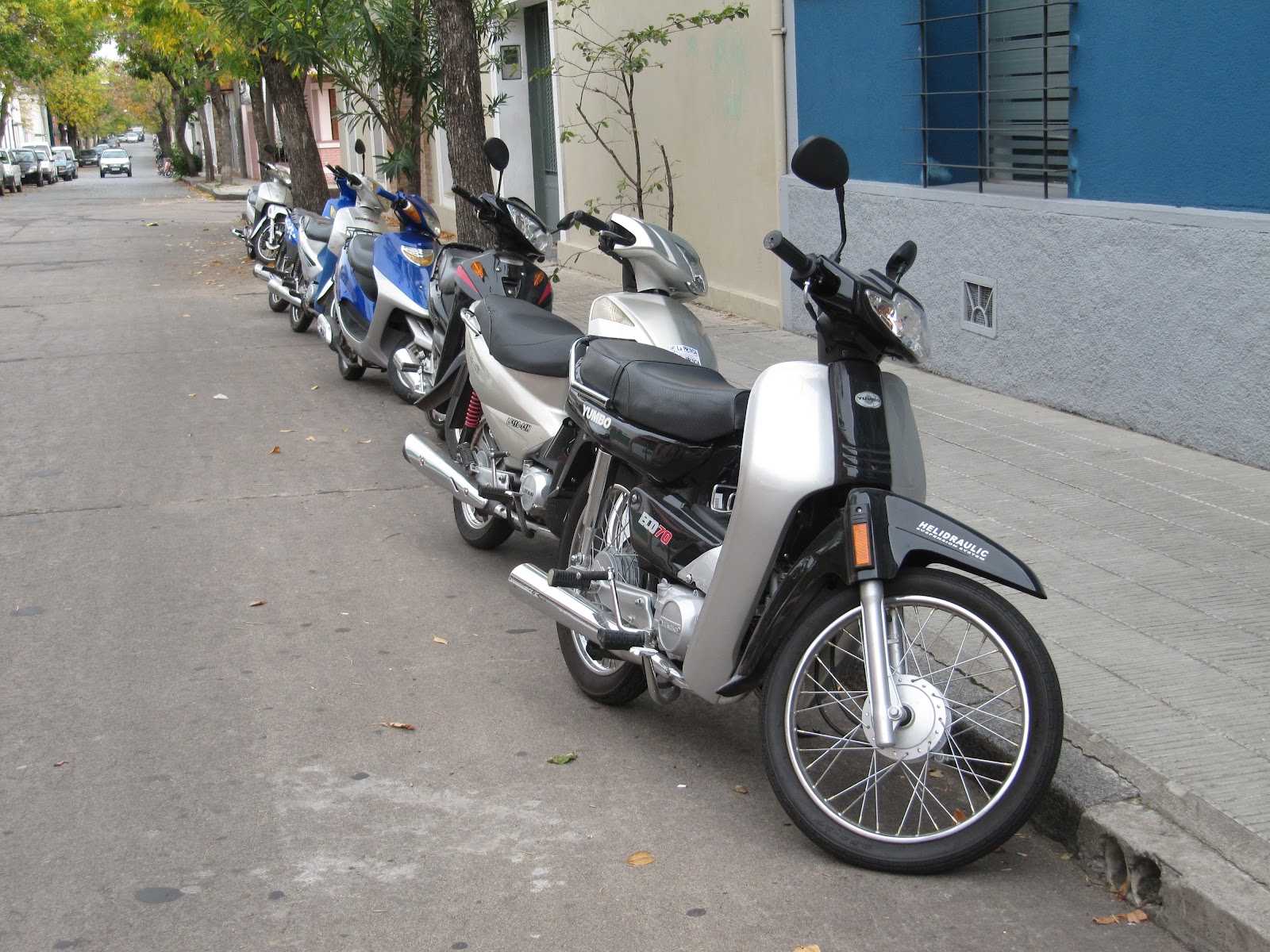
And most of those we did see were on mopeds.  This place appears to be obsessed with mopeds.  They are everywhere.  As usual in South America, no one wears a helmet, and there are often whole families on a single bike.


Like Montevideo and Colonia, many of the buildings were beautiful but decrepit. The post office was built in the 30s and is very art deco, with depictions of various modes of transport either side of the doors.

Aside from that, there is nothing much in Mercedes, but it was good to see a real town without the tourist window dressing.

Saturday, May 5, 2012

To buy or not to buy, that is the question....

Whenever we have been on holiday usually, if we saw something that we liked, we probably could afford it, so as long as we could carry it back safely, we would probably buy it.  Not that we used to bring many things back, but we could if we wanted to.

Travelling now, things are quite different.  Firstly, we are on a reasonably tight budget.  We give ourselves a small 'pocket money' allowance for the year, which is intended for souvenirs or little extras, but beyond that, anything that we spend will mean we have to cut back on what we have allocated for those more essential things like accommodation and food.  So our approach to spending money is much more restrained.

But even if we decide we like something enough to spend the money, there is still the question of carrying it. When you are moving around a lot, you become very aware of the weight of your backpack, and the last thing you want to do is add a couple more kilos because you just couldn't resist that amazing bronze sculpture. And really, that piece of fine glassware, or that beautifully weird looking handmade thing with all the sticky out bits, is never going to make it through numerous bus loadings and unloadings, and get home in one piece is it?

And if it isn't too heavy or too fragile, it could well be too big.  We have a lot of stuff for travelling for a year, so the rucksacks are pretty full, and the last thing you want to be doing is carrying extra boxes or bags around.  If you did the chances are someone would pinch it, or you'd accidentally leave it on a bus or in that out of the way place you left it to keep it out of harm's way in some tiny hostel room. So the other option is to post it back to the UK.  We did post some stuff a few times, when we finished being on the truck and had to get rid of some of the accumulated bits, or when we left BsAs and no longer needed to carry  thermals, waterproofs and extra sleeping layers around with us.  But that costs money too, so you come back to the first point - is it worth it?

That isn't to say we haven't bought anything, but we have generally tried to keep it to a minimum and really weigh up having something versus the cost and hassle of buying it and bringing it home.  Sadly, there aren't that many small, lightweight, non fragile and cheap things that we like! Being into our final couple of months though, we have now succumbed to a piece of sculpture by a Montevidean artist.  Thankfully it is light, not too big and not overly fragile, so we have been able to pack it up and put it in the rucksack.  Hopefully it will make it home safely.

Friday, May 4, 2012

McCartney mania in Montevideo

So we arrived in Montevideo to discover that Sir Paul McCartney is also in town as part of his tour.  And before some of you get all excited, no we didn't meet him. But this as clearly a big deal here because everyone was talking about it.  There were McCartney posters all over the place, the market stalls all had any McCartney or Beatles items prominently displayed, and whenever anyone heard that we were British the first thing they asked was whether we were here go the concert.

In the pub one evening, we shared a table with a man who we realised was also from the UK and started to chat.  Turns out he is the electronics expert with the tour.

On the big day itself, we were walking through the city centre when we were deafened by huge sets of speakers at the side of the road.
They had set up scaffolding outside of the government building and had closed off the section of the main street through Montevideo, so that they could show the concert on a huge screen to people in the square.  We walked past at around 5pm, just as the were showing Sir Paul singing Lady Madonna as a sound check.  We didn't go back for the main event though.

Football and friendly waiters

Along with proper cheddar cheese, my high heels, and having our own bed in our own home, we fully expected that being able to watch english football was one of the things we would no longer have and that Nic in particular would miss. In fact, we soon discovered that there are more premiership games shown on the TV here than there are in the UK. Quite often Nic will be convinced that we need to stay in the hostel to do some practical stuff, and I will find that it just happens to coincide with a match.  Or we walk into a bar and find a match on screen.  Hmmm, I smelt a rat a while ago, but I figure that if I let him get away with that, he can't complain when I drag him around yet another crafts market.
Occasionally though there is a particular match on, usually involving Liverpool or one of the cup games, when a special effort needs to be made to see it.  Like here, when Liverpool were playing Everton in the FA Cup semi final.  The match was at 12:45 in the UK, but that is 8:45 here, which some of you will know is a bit on the early side for us.
The hostel here didn't have a TV, so we had to get into the main town area and find somewhere open and showing the match. Most of the places that we had seen with TVs don't open that early, but we spotted a cafe that was open and had a big screen.  It was showing cartoons.
But undaunted, we went in and Nic asked them if whey were going to be showing the match.  They clearly hadn't been planning to, but a very friendly waiter quickly ushered us to a table near the screen and gave Nic the remote so that he could find the match. Every so often, our friendly waiter would pop over and have a few words about the game.  He was very happy to see Suarez, one of Uruguay's footballing stars, on the pitch, and even more pleased when he scored a goal.  Both he and Nic were happy with the Liverpool win.
The cafes are very good for this kind of thing here, and generally happy to accommodate requests.  We have found most waiters to be really friendly towards us too, probably helped by the fact that we always try to speak to them in Spanish, rather than English or just pointing.  They often ask us where we're from, and when they see us playing cards, they ask who is winning.  Nic gets a bit put out, because it is clear that they consistently like it if I am, but look disappointed if he is.

Tuesday, May 1, 2012

Montevidean markets and mate

We like visiting markets in the places that we visit.  Whether the market is focused on food, crafts or just general goods, it is an excellent place to see the locals.  The things being sold, and the people visiting, give you a glimpse of who they are and how they live. While here we visited two main markets.

The first was the Mercado del Puerto, down by the docks.  It is a beautiful old wrought iron building, that is now full of parillas.

The Montevideanos gather here, especially on a Saturday, to look at the craft stalls outside and, more fundamentally, to eat steak.   You get hungry just being here and smelling the meats cooking.  Needless to say we found a table and joined in the eating. We also tried out the local tipple; medio y medio, or half and half, is a mix of white wine and sparkling wine that is very popular here. It wasn't bad.

Nearby, we sat in a park for a while and watched while some green parrot like birds vandalised the trees. There were some trees with lovely pink flowers on and these birds kept picking the flowers off and dropping them to the ground.  As far as we could see they weren't eating anthing from them, but I guess they had their reasons.

Our other market was the general street market on the Sunday.  This is apparently one of the largest street markets in South America, and it was certainly big.  You seem to be able to buy most things here, from everything connected with mate, through clothes and bric a brac, to pets and poultry.  It is said that if your house is robbed in Montevideo, then the chances are you can come here and buy your stuff back.

We also noticed that the passion for Mate appears to be stronger here than anywhere else. You constantly spot people from all walks of life going around with their mate cup in hand and their flask under their arm. If you don't know about mate, the flask contains the hot water to top up the mate cup over the Yerba.

After wandering around the stalls for a while, we stopped for a late lunch in one of the little cafes. It was a busy place with tables close together.  As we played cards waiting to be served a woman came in with her little boy.  We bought our cards in the Falkland Islands and they have gentoo penguins on them, so when he spotted them he was immediately interested in them and us.  He started asking us lots of questions, but he spoke very quickly and we found it hard to catch some of what he was saying.  His mum didnt speak any English but she helped out by repeating what he said or finding another way to say it if we didn't hadn't understood.

The little boy was both fascinated with the fact that we were from such a long way away, and completely unable to comprehend that we didn't speak Spanish properly. And when he asked my name and I told him what it was, the look of confusion on his face was absolute.  He actually tapped his head as if trying to make it compute such a strange and unusual name.  Mum was pretty surprised too, but she absorbed it more readily and in fact made a very passable attempt at pronouncing it properly, which is quite unusual.
Now those of you who know me will be aware that children are not my strong point, and it is especially hard going when you add a language barrier, but we managed to get by.  Amongst other thing, we discussed that he loved penguins, that we had been to Antarctica and seen lots of penguins - and yes it was very cold there - , and that Nic supports Liverpool and they have Suarez from Uruguay on their team. When the time came for them to go, I got the traditional goodbye kiss from both.  Nic also got a kiss from mum, and a rather solemn handshake, albeit with the wrong hand, from the boy.

Montevideo

Fom Buenos Aires we took the ferry to Uruguay.  Rather than go direct, we took the cheaper option of a ferry to Colonia and a connecting bus to Montevideo. It was a good journey and we had soon got our latest currency, still pesos, but now Urugayan ones, and found our hostel. The hostel is owned by a guy from the US but lived in and run by his brother.  He regards it more as renting rooms in his house than running a hostel.

It was a great house, with big spacious rooms, and his fairly laid back approach made for a relaxed stay.  We were a bit out of the main old part of town, but it was walkable and there were plenty of buses for the way back.

When we arrived, he told us that there was a problem with the water as a nearby mains pipe had burst.  He offered us the option of staying elsewhere, but he was hoping they would get it fixed soon and we figured that it wouldn't be the first time we'd had to rely on using buckets of water to flush the loo, so why worry.  As it was it quickly was sorted and we had hot showers and flushing toilets again in no time.

Montevideo is a nice enough town.  The centre is quite small, with a commercial area and an old town with smaller cobbled streets.  We passed an interesting fountain with all of of the railings around it covered in thousands of padlocks.  It was called the locks fountain and the story goes that if you adda lock to represent a couple, they will return to the fountain and their love will be sealed for ever.
Unfortunately we need our padlock for hostel lockers so couldn't add one, but then I guess that as we will already have been together for twenty five years in November, we're not doing too badly anyway.

What I really liked here though was the architecture.  The city is generally quite run down with many buildings being in a bad state of disrepair and a lot simply abandoned.

Apparently Montevideo has a fairly old population and no system of recording ownership of property, so when people die, buildings can simply be left forgotten and decaying. But despite their decrepitude  some of the old buildings were really beautiful, with intricate mouldings and ironwork that looked fabulous.  In fact in some cases the peeling paint and plants growing out of the broken windows just added to the visual appeal.

It seems to us that there are some wonderful opportunities for property development here.  We discussed the idea of buying up a block of some of the nice buildings in the old town and developing them into a mini hub for visitors.

We figured a nice boutique hotel, good hostel, bar, restaurant, and a bike rental place, together with a few artisanal and local produce shops using some kind of local cooperative, could draw people to it and also boost the surrounding areas.  Of course we couldn't actually do it because we have no income and it would stop us travelling, but it was fun to think about.