Welcome to our travel blog. We are Tabitha and Nic. In 2011 we 'retired' in our early 40s and set off to travel the world. We spent our first year in South America and have been lucky enough to make two trips to Antarctica.

Our blog is a record of our travels, thoughts and experiences. It is not a guide book, but we do include some tips and information, so we hope that you may find it useful if you are planning to visit somewhere we have been. Or you may just find it interesting as a bit of armchair travel.


Showing posts with label Kent. Show all posts

Monday, March 27, 2017

Oh I do like to be beside the seaside ...

Tankerton Beach
Back in the UK after being in the Baltics for a month, we spent some of our time at the seaside. Part of that was in Kent, where our families are, and part in Brighton.


In Kent, we spent a lovely day enjoying a BBQ with family at their beach hut. I do love a beach hut. It is one of those things, like fish and chips and bright pink sticks of rock, that absolutely screams 'British seaside'.


Tankerton Beach


And it's a bit like glamping, in that you can have all the informality of a picnic or BQ at the beach, but still have a chair and the ability to make a good old British cup of tea when it starts getting colder.


The beach at Tankerton isn't exactly the Caribbean. It's pebbles rather than sand, the water is generally cold, and you'll have to make do with a 99 ice-cream instead of a pina colada in a coconut shell.


But one thing that I have always liked here is the stunning sunsets that you can get. When I lived here and commuted into London, I loved to see the sun setting across the beach if I happened to pass by at the right time.


Tankerton Beach


That evening wasn't the one of best sunsets, but it was still beautiful, and I rather liked the inclusion of a stray sky lantern floating across, and people paddling through the dregs of the outgoing tide.


Old Sea Bathing Hospital, Margate


While in Kent, we also took the chance to catch up with some of my family in Margate. Now Margate really is one of the classic British seaside resorts.

Years ago, this would be a destination of choice for the seaside holiday, or just a day out. From factory workers on a daytrip from London, to groups of Mods and Rockers coming to have a scuffle in the sand, Margate was a major attraction.

Dreamland, Margate


I remember coming here as a kid, playing on the sandy beaches, going as high as possible on the swing-boats (which when I see them now are much, much smaller that I remember them), and best of all, going to Dreamland.

Dreamland was my first taste of an amusement park, albeit on a much smaller scale than somewhere like Alton Towers, and at that time without the big rollercoasters. But it did have the Bumper Cars, the Waltzers (still a favourite of mine), and the Scenic Railway.

The latter was an old wooden roller coasters, that at the time, felt very big and very fast, but really wasn't! Enough about Dreamland for now though - perhaps I'll write about that some other time if we get around to going to it again.


Margate Carnival


For now, we were here to go with family to watch the carnival. Now as a child, I remember going along to the carnival of whatever town we lived in at the time, and seeing all the big, colourful floats, throwing change for the charity collections and trying to catch the boiled sweets that they threw.


Margate Carnival


The best decorated floats - and the ones that sometimes had better sweets or even little gifts - were the big company one, but the prettiest ones were usually those that carried the Carnival Princesses.

Each town would have crowned it's own Princess and ladies in waiting, and they would turn up at all of the local carnivals, waving and smiling. it was always a fun day out.


Margate Carnival


Now I don't know if it's just that everything just looked bigger and better when you were a child, that I'm older and more cynical now, or that I've been thoroughly spoiled by seeing the huge Mardi Gras carnivals in New Orleans, but I have to say I was pretty unimpressed by this Margate Carnival.

There weren't that many floats, and most of those that were there were clearly far more about the advertising than about the carnival. The decorations were generally a bit sad, and in a very sad indictment of your average British carnival goer these days, the Princesses' floats had been surrounded my netting, to stop people from trying to hit them with projectiles. We used to throw money onto the floats for charity - now they are using the poor girls as target practice!

Hmm, perhaps carnivals aren't really the thing for me anymore. But at least the kids seemed to enjoy it. For me, the best bit was the yarn-bombed mini.

Margate Seafront

After the procession passed, we headed down to the seafront to pick up some fish and chips, and sat eating those and fending off the increasing bold seagulls.

It is still a fun day out, but these days Margate is a little down at heel. The town is working on a revival, but it still made me laugh out loud when one of the travel guides included it is a 'must go' list a little while back. It definitely isn't there yet, but maybe in time it will be back at its best

The other thing that we did in Kent was a quick visit to Howletts, the local John Aspinal zoo park famous for its gorillas. So I'll leave you with a few lemur photos at the end of the post, and an odd pig.


Margate Seafront

Our other seaside destination was Brighton. We were doing a weekend cat sit, but first we treated ourselves to a couple of nights at the fancy little Blanche House hotel, which we had been to once before some years ago, back in the days when we worked and earned money!

I like Brighton, it has a nice feel about the place, although it can be unbearably busy at times. We've been here a few times before, so we didn't do the touristy stuff like the Pavilion - which is definitely worth going to, but just strolled around the streets and lanes, doing a bit of window shopping and finding nice places to stop for refreshments.

Margate Carnival


Margate Carnival


Yarn-bombed mini, Margate Carnival


Crowned lemur with baby, Howletts

Black and White Ruffed Lemur, Howletts

Red Bellied Lemurs, Howletts

Crowned lemur with baby, Howletts

Red River Pig, Howetts

Thursday, February 23, 2017

A Carpet of Bluebells

British bluebells in Kent
Certain flowers, even though they may well grow naturally in other places, are just synonomous with a particular country - like tulips from The Netherlands, cherry blossom in Japan, and Austria's edelweiss. In the UK, roses may be an obvious choice, but I think another option would be the bluebell. After all, surely the sight of a carpet of blue under a canopy of trees is a much loved, if fleeting, sight in our woodlands.

And fleeting they are, appearing only for a few weeks, some time from mid April to late May. So popular are they, that many woodlands arrange special bluebell walks at this time of the year, to limit the number of people traipsing through them.

Of course, for the authentic experience, it is important that it is our native bluebells, and not the Spanish ones that do seem to be taking over, to the degree that even though we have half the world's population of them, our British bluebells are now regarded as endangered.

British bluebells in Kent
There are a lots of ways to tell them apart, as they are quite different to look at. The Spanish ones have conical flowers, with tips that flare out. The stems are upright and straight, with the flowers coming all around it. The colour is generally a pale to mid blue, with blue or green pollen on the stamens, though they can also be white or pink.

The British ones have long, straight, narrow flowers with the tips curling outwards. The stems droop over to one side, where the flowers that grow just on that side are weighing them down. The colour is a strong violet blue, and the pollen is a creamy white.

We found these bluebells in one of the local Kentish woodlands, just parking at the side of the road and taking a look. You can see from the photos that some people who came before us have trampled a path through them. If you visit a bluebell wood, please don't do that, as they are endangered, and definitely don't pick them, as they are protected. It takes five years for a bluebell to grow from a seed to a flower, which is partly why they are such a delicate species.

I hope you enjoy looking at the photos, but of course they do look far better in reality.

British bluebells in Kent

British bluebells in Kent

British bluebells in Kent

Tuesday, July 12, 2016

Fort Amherst (Throwback post)

Fort Amherst, Chatham
Like most people, we are generally pretty bad about visiting places where we live. So while we were back in Kent, we joined my family for a trip to Fort Amherst, in Chatham. We had been to the Chatham Dockyards before, but never here.

Fort Amherst, Chatham
The Fort has its origins in a Dutch attack on Chatham Dockyard, way back in 1667. The resulting damage and loss prompted a bid to improve security from both sides - the river Medway and the land behind.

It took them a long time to actually get around to it though, and it was 1755 before work started. They made use of an old chalk pit, extending out the caves to form a big network of tunnels. With their own well, cannon positions and entrances that were strategically planned to improve their defence, the tunnels gave an excellent base for the garrison to defend the dockyards.
Fort Amherst, Chatham

One small artefact that I found interesting was a petard, which is a lump of cast iron with a hollow centre. The well was filled with gunpowder and hung on the gates of a fortified structure, with the opening against the gate.

Fort Amherst, Chatham
When the gunpowder was lit, if done correctly, it would blast open the gate. Of course, setting these was a dangerous task, with a nasty death awaiting should the job be done wrong, or the powder blew too early. In which case you were said to be 'hoist on your own petard'.
Fort Amherst, Chatham

The tunnels fell out of use in 1820, but they were put back in action in World War II, when it was used as the Civil Defence Headquarters. A section of the tunnels has been set up as it would have been during the war, and you can see the kind of incident boards they used, as well as other paraphanalia from the times.

I was a little concerned to hear about the SS Richard Montgomery, a US Liberty ship still containing around a quarter (1,400 tonnes) of its cargo of ammunition and explosives, that was wrecked in 1944. It remains there, only 1,2 miles offshore near Sheerness, in water shallow enough that you can see the top of the masts poking up, with the structure of the vessel deteriorating. If the contents were to detonate, it would cause a vast explosion, which, depending on which account you read, could blow out every window in Sheerness, or kill thousands of people.

Fort Amherst, Chatham


Fort Amherst, Chatham


Fort Amherst, Chatham


Fort Amherst, Chatham

Fort Amherst, Chatham


Wednesday, December 19, 2012

Margate and the Shell Grotto

Along the coast from where our parents live is the Kentish seaside town of Margate.  Made not quite famous by those cockney knees up singers Chas'n'Dave, Margate is one of those towns that used to be the place to go, with its Victorian Royal Sea Bathing Hospital from 1706, but that now has seen better days.  I have some family in the area, so remember going there as a child.
 
Unlike most of the coastline here, it does have sand rather than pebbles, which always helps to draw in those looking for a bit of UK beach time, and it still has the children's swing boats which I remember being somewhat bigger than it turns out they actually are.

Of course the real draw of Margate for me was Dreamland.  Tame by today's standards, Dreamland was the place to go for fairground rides.  It's Scenic Railway ride was quite basic really, but as one of the first wooden roller coasters built in 1920 and possibly the only remaining ride that has no brakes on the track and so still needs a brake man to ride on the train, it is now a grade 2 listed site.  There is a project to reopen it as a heritage fairground, but that seems some way off yet.

Like many of these seaside towns, Margate lost some of its appeal when people started to head further afield to be sure of some sun with their sea and sand.  It got a bit down at heel, with shops closing up and a reputation of being a bit of a trouble spot.  They are working on that now, but again there is some way to go.
 
 
Retro shops have started popping up close to the seafront, and Mary Portas has chosen it as one of the towns where she will help rejuvenate the high street.  It even has its own art gallery now, the Turner Contemporary, perhaps in part at least because that Tracey Emin hails from round here.
 
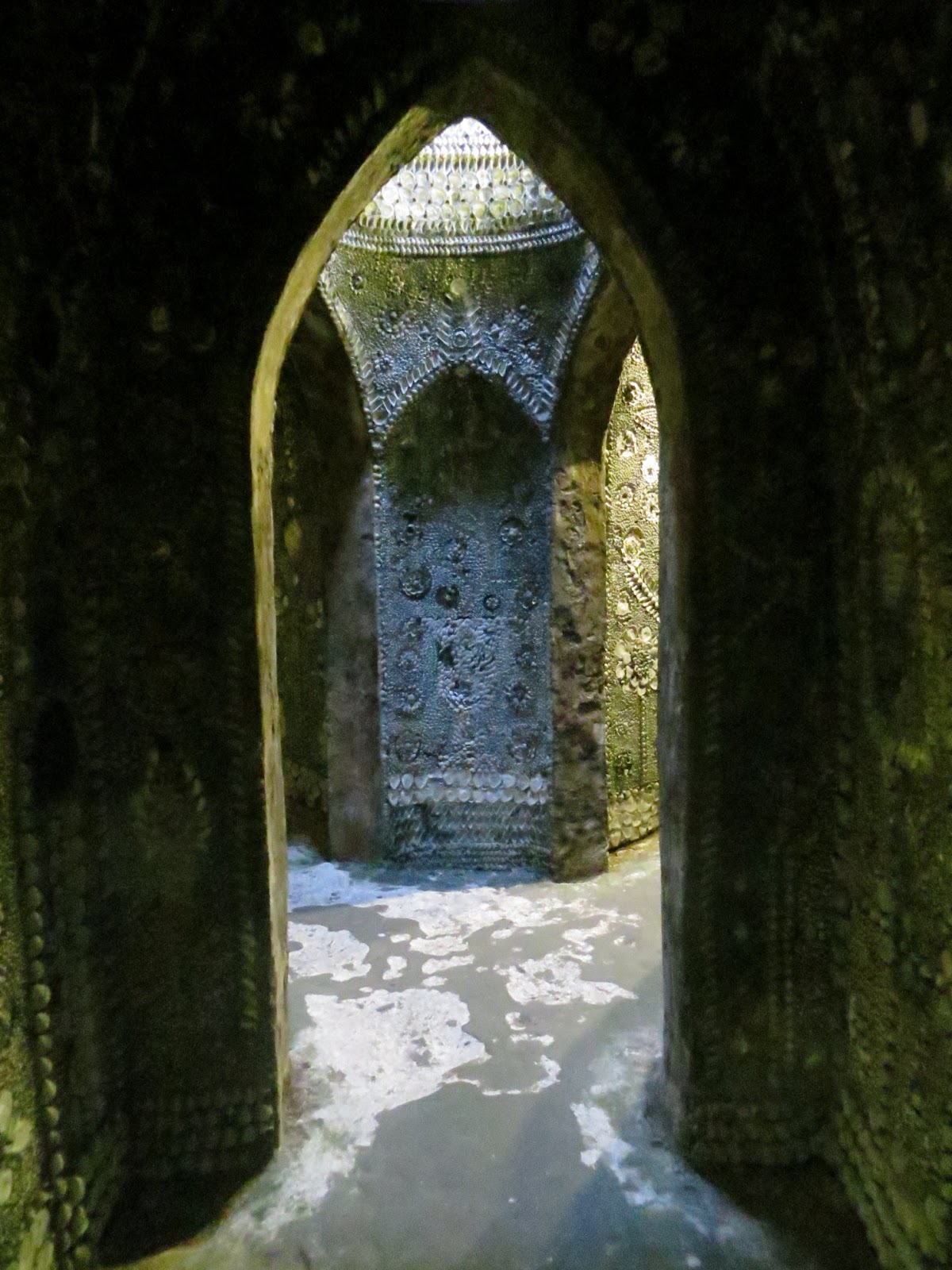
But we visited Margate on this occasion to check out one of its older attractions - The Shell Grotto.  No one really knows who built this underground grotto, when or why, but it was discovered underneath someone's house back in 1835 and opened to the public three years later.
 
Venturing under the cellars of this very normal looking property in the back streets of Margate, you find a passage that goes around in a circle, and then along a short corridor to a little chamber.  It is only 104 foot long in total, but all along the route, the walls are covered in shell mosaics.  Whoever put them there must have had incredible patience as there are around 4.6 million shells stuck to these walls.

They are put on in a panel design, with each panel having a different central pattern.  With some of them it is fairly clear what they depict, such as fleur de lis, a tree, or flowers; others require a little more imagination.  Someone at some stage has had a go at interpreting the panels, coming up with skeletons, phalluses, turtles, canoes, and gods amongst other things.  We could see how they got to some of them, but struggled with a few.
 
So what was this place?  One suggestion is that the end chamber was a chapel, and that this was some kind of secret place of worship.  Another idea is that this was a smugglers passage, though that seems a bit unlikely as it is quite a way inland, has no apparent connection into other passages, and you would think that the smugglers would have little need of such elaborate decoration!
 
Personally, I think my mum might be on to something with her theory that someone had a relative with a mental illness and an artistic leaning, perhaps a form of autism.  Being that the done thing back then was to lock such people away in institutions, they may instead have hidden them down in the cellars and given them barrow loads of shells to keep them occupied.
 
Whoever did it, and whatever their reasons, it is certainly very impressive.  It has become rather dirty over time, largely due to the use of oil/gas lamps to light it up years ago, but that doesn't really matter.  It is quite nice though that they have created a replica panel using the same type of shells to show what the colours would have looked like originally.

It is not somewhere that anyone is likely to travel that far to see, but it is worth a visit if you are in the area.  And there is a very friendly cat in the shop and tearooms upstairs.
Since drafting this blogpost, it has been reported that Margate has made the Rough Guide top ten 'must see' worldwide destinations for 2013, alongside places like Dubrovnic.  Much as I can see that Margate is working to improve itself, I had to laugh.  I do think that Margate has something to offer, but there is still a long way to go before I would actively recommend it as a 'world destination', let alone a 'must see'.  Quite honestly if I turned up in Margate on that basis, I would feel pretty let down.  I'm not saying don't visit it, but let's be realistic about what it has to offer please!  It does rather put me off trusting a recommendation from Rough Guide in the future.