Welcome to our travel blog. We are Tabitha and Nic. In 2011 we 'retired' in our early 40s and set off to travel the world. We spent our first year in South America and have been lucky enough to make two trips to Antarctica.

Our blog is a record of our travels, thoughts and experiences. It is not a guide book, but we do include some tips and information, so we hope that you may find it useful if you are planning to visit somewhere we have been. Or you may just find it interesting as a bit of armchair travel.


Showing posts with label murals. Show all posts

Tuesday, September 5, 2017

The ‘World Famous’ Murals of Chemainus

Chemainus
Having got our hire car in Nanaimo, we could take a trip out to a couple of nearby towns, and the first of these was Chemainus. Like a number of towns in this area of British Colombia, Chemainus was built on the forestry industry, and from its beginnings in 1858, right up until the 1970s, this was fine. However, with such industries becoming increasingly fragile, the residents realised that their reliance on forestry alone was precarious, and decided to branch out.

Chemainus


The town already attracted some tourists, because it offers an old town style in a nice coastal setting, so they decided to encourage more visitors with an ‘open-air art gallery’ of murals depicting the town’s history. They had the first murals completed by the summer of 1982, and there are now forty-two, plus some extra artworks and they have created a new theatre festival too.

I’m not at all sure about the claim that these are ‘world famous’ murals – I certainly had never heard of them before – and they aren’t something that I’d travel great distances to see, but if you are in the neighbourhood then they ae probably worth a quick detour. You can pick up a leaflet at the visitors’ centre which has a map and description of each mural; it costs $3, but the money goes back in to the creation and maintenance of the murals.


Chemainus


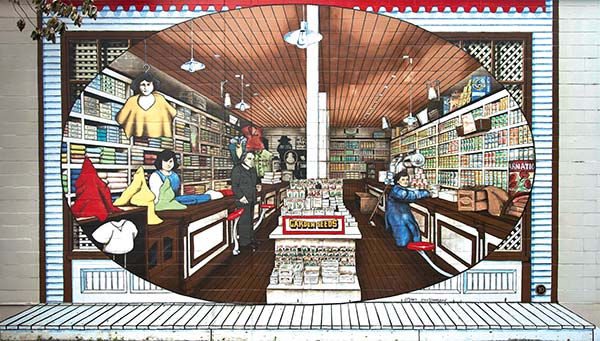
Mural $10 — The Company Store


Typically, we somehow missed one of the murals that I particularly wanted to mention, so I have used the picture from the leaflet. This is mural number 10, The Company Store, and I have included it because they claim that it shows one of the first-known credit card systems. The company in question was The Victoria Lumber & Manufacturing Company, and apparently the employees would make purchases from the store using coupons, the store would get the money directly from the Company, and they in turn would deduct the payment directly from the employee’s pay.


I’ve picked out a few more of my favourites to show you.


Mural number 35. First Chemainus Sawmill 1862 – I had to include this one, as this first, water-powered sawmill, built just four years after the first arrivals, represents how the town really got started.


Mural number 6. Arrival of The Reindeer in Horseshoe Bay – This is a simple painting of a First Nations woman calmly watching HMS Reindeer arrive on one of its visits. The description refers to her contemplating the arrival, but of course, knowing how badly the British Empire treated the First Nations people, one has to wonder whether her thoughts would really have been rather less friendly.


Mural number 1. Steam Donkey at Work – I liked this because it isn’t often that you see something like a steam donkey, which was used to haul in a log from the forest, over all sorts of rough terrain and natural obstacles.


Mural number 37. Star Novelty Works – This is an old town scene from around the end of the 19th century, showing The Star Novelty Works bicycle shop.


Murals number 26. and 34. Chemainus, The War Years, Circa 1915 and Letters From the Front – These two both give us scenes from the First Word War, with the former showing soldiers of the 67th Battalion waiting at Chemainus Station for the train that would begin their journey to a war from which many would never return.


The second, which is on the post office building, commemorates how letters would keep families in touch during the war years.


Mural number 30. The Lone Scout – This mural shows Edward Shige Yoshida, who in 1929, started the 2nd Chemainus Boy Scouts Group, which was the first all Japanese group in Canada. Of course, this was only necessary because he had been barred from joining the existing group.


Mural number 29. The Winning Float – On 30 June 1939, The Victoria Lumber and Manufacturing Company celebrated its Golden Jubilee with a parade, and this was the winning float. It was chosen as a mural because, as well as referencing the anniversary of The Company, it also represents the strong Japanese influence on the town.


Mural number 39. Skating on Fuller Lake – Unlike some parts of Canada, the winters here on Vancouver Island are comparatively mild, but this shows a time when they were colder, and Fuller Lake froze over, allowing the locals to skate and play hockey.

Chemainus

Chemainus

Chemainus

Chemainus


Thursday, June 23, 2016

Around Winnipeg (Throwback post)

Assiniboine Park, Winnipeg
While in Winnipeg, we visited a few places, some on our own, and a couple with our host.

Assiniboine Park, Winnipeg
One visit was to the nearby Assiniboine Park. the park is pretty big, and we only visited a little bit, so we focussed on some of the gardens and the Pavilion. I really like waterlilies, so enjoyed looking at those, especially as we also spotted some lovely little frogs amongst the lilypads.
Assiniboine Park, Winnipeg

Assiniboine Park, Winnipeg
We checked out the art galley, but weren't really that impressed. We preferred the Leo Mol Sculpture Garden outside. The park is definitely a good place to walk about, sit and relax for a while if you are in the area.
Assiniboine Park, Winnipeg

Fort Gibraltar, Winnipeg
We also checked out the historical site of Fort Gibraltar. The fort was built in 1809 by the North West Company, who were in the fur trading business and were bitter rivals of the Hudson's Bay Trading Company. Battles were fought, but in the end, the two companies merged in 1821, under the Hudson's name.

Fort Gibraltar, Winnipeg
These days, Fort Gibraltar is a living museum, with displays of weaving and blacksmithing, as well as tours of the fort with decent explanations of the history of the place and what life here was like.
Fort Gibraltar, Winnipeg


Fort Gibraltar, Winnipeg


Fort Gibraltar, Winnipeg


Fort Whyte, Winnipeg
Our host took us out to a couple of places that were a bit further out of town. One of those was Fort Whyte, which is a nature reserve, with nature trails and interpretative walks. It is a pleasant enough day out, and there is the added bonus of seeing the herd of bison, the little Manitoba Burrowing Owls, and the rather cute Prairie Dogs.

Fort Whyte, Winnipeg


Bison at Fort Whyte, Winnipeg


Prairie Dogs at Fort Whyte, Winnipeg
Fort Whyte, Winnipeg


Burrowing Owl, Fort Whyte, Winnipeg
Prairie Dogs at Fort Whyte, Winnipeg
Prairie Dog at Fort Whyte, Winnipeg

Ducks at Fort Whyte, Winnipeg
Turtle atFort Whyte, Winnipeg


Gimli, Lake Manitoba
Our other trip out was to the town of Gimli, on the west shoreline of Lake Manitoba. Gimli is one of three sites that made up New Iceland, after the Canadian Government gave land to Icelandic settlers back in 1875. Until 1887, they their own laws and arrangements, before they merged into the Canadian system.

Gimli, Lake Manitoba
In 1897, they opened the town to other settlers from Ukraine, Poland, Germany and Hungary. The town is certainly part of Canada, but it retains strong links to the culture and history of its first inhabitants. There is an annual Icelandic Festival, that dates back to 1932 in Gimli, and earlier still elsewhere in Manitoba.
Gimli, Lake Manitoba

Gimli, Lake Manitoba


Sea Wall, Gimli, Lake Manitoba
One rather nice touch in the town, is the decoration of the otherwise dull sea wall with 72 painted murals. The work began in 1997, and carries on as the older ones  become weather worn and need replacing.

Gimli Glider, Gimli, Lake Manitoba
Many of the paintings depict something of relevance to the area, and there is one of an Air Canada aeroplane, known as the Gimli Glider. The aircraft was en route form Montreal to Edmonton on 23 July 1983, when it somehow ran out of fuel. It's crew, Captain Robert (Bob) Pearson, and First Officer Maurice Quintal, somehow managed to glide the plane down and make an emergency landing on a race track which was a former military air base. Everyone made it safely off the plane.

Gimli, Lake Manitoba


Sea Wall, Gimli, Lake Manitoba