Welcome to our travel blog. We are Tabitha and Nic. In 2011 we 'retired' in our early 40s and set off to travel the world. We spent our first year in South America and have been lucky enough to make two trips to Antarctica.

Our blog is a record of our travels, thoughts and experiences. It is not a guide book, but we do include some tips and information, so we hope that you may find it useful if you are planning to visit somewhere we have been. Or you may just find it interesting as a bit of armchair travel.


Showing posts with label Mandalay. Show all posts

Saturday, March 21, 2015

Big Buddhas en route to Monywa

From Mandalay, we set off for Monywa. Unfortunately, neither of us was feeling great this morning, with Nic especially worse for wear; initially, we put this down to the amount of rum we had consumed the previous evening, but as we later realised, alcohol was not the culprit. It turned out that just about everyone on the truck felt dodgy to some degree either today or over the next few days.


Our first stop was a silver smiths, that we had intended to visit on our first day, but ran out of time. We watched them carefully drawing on the designs, beating out the reliefs and engraving the items in very intricate detail. The work really is painstaking, and the finished products are excellent quality.


 Because he wasn't well, Nic had made the mistake of letting me go in alone, so when we got to looking in the shop, I spent some money. I was relatively well behaved though, I just picked up a couple of charms for my bracelet - a dragon to represent China and unsurprisingly, a Buddha for Myanmar.

A short way on we stopped in Sagaing, which is where Myo did his childhood stint in the monastery, to see the Kaunghmudaw Paya, a pagoda that is some 150 feet tall and shaped like a huge breast.  It was built in 1636, and legend has it that the king was struggling to decide what style of pagoda to build, so his wife took out her breast and said it should look like that. Experts apparently have a rather more mundane opinion that it may in fact be based on a similar shaped stupa in Sri Lanka, called the Suvarnamali Mahaceti.


We drove until lunch time, where I realised I was in a bad way when I couldn't even manage a coke, let alone any food, so once back in the truck I went to sleep. When I awoke, it was with an immediate and very urgent need to be sick. There was no time to move, and I daren't open my mouth, therefore I was most pleased that Nic quickly understood my frantic gestures and got the window open for me, so that I could stick my head out and do some quite impressive projectile vomiting out onto the road.  As Nic said, it was just as well that there wasn't someone alongside on a bike or moped, as they would have been pretty surprised and doubtless quite angry!

I think Helen (and our fellow passengers for that matter) was quite relieved that I had managed not to get any in the truck, but she still handed me a bucket, just in case. Thankfully the rest of the journey passed without any further incident.

Sadly neither Nic nor I felt up to getting off to see the next batch of Buddhas at Bodhi Tataung, but he did take a few photos from the truck. It was a shame, as this was quite an impressive set of sights.

The first was a huge area filled with neatly planted bayan trees, each with a small seated Buddha image underneath it. Apparently the aim is to have a thousand, and they are close to that number now.

The other two Buddhas are enormous. The reclining one is 312 feet long, and the standing Buddha is 424 feet tall, which is the world's biggest. On the inside of the standing one, the different floors have images representing the various levels of the Buddhist heavens and hells.


Further on, and Nic had recovered sufficiently to venture into the caves at Hpo Win Daung. Whilst everyone else was away, it was quite amusing to see the local men all looking around the truck, checking out the panels and tyres.  The local monkeys had a quick look too.

Our overnight today was at a resort style hotel in Monywa. It had a nice bar and pool, and spa facilities, so had we been feeling OK, we might have made use of them, but as it was, we just collapsed into the room, thankful for a comfortable bed, air conditioning, and an en suite bathroom!

Thursday, March 19, 2015

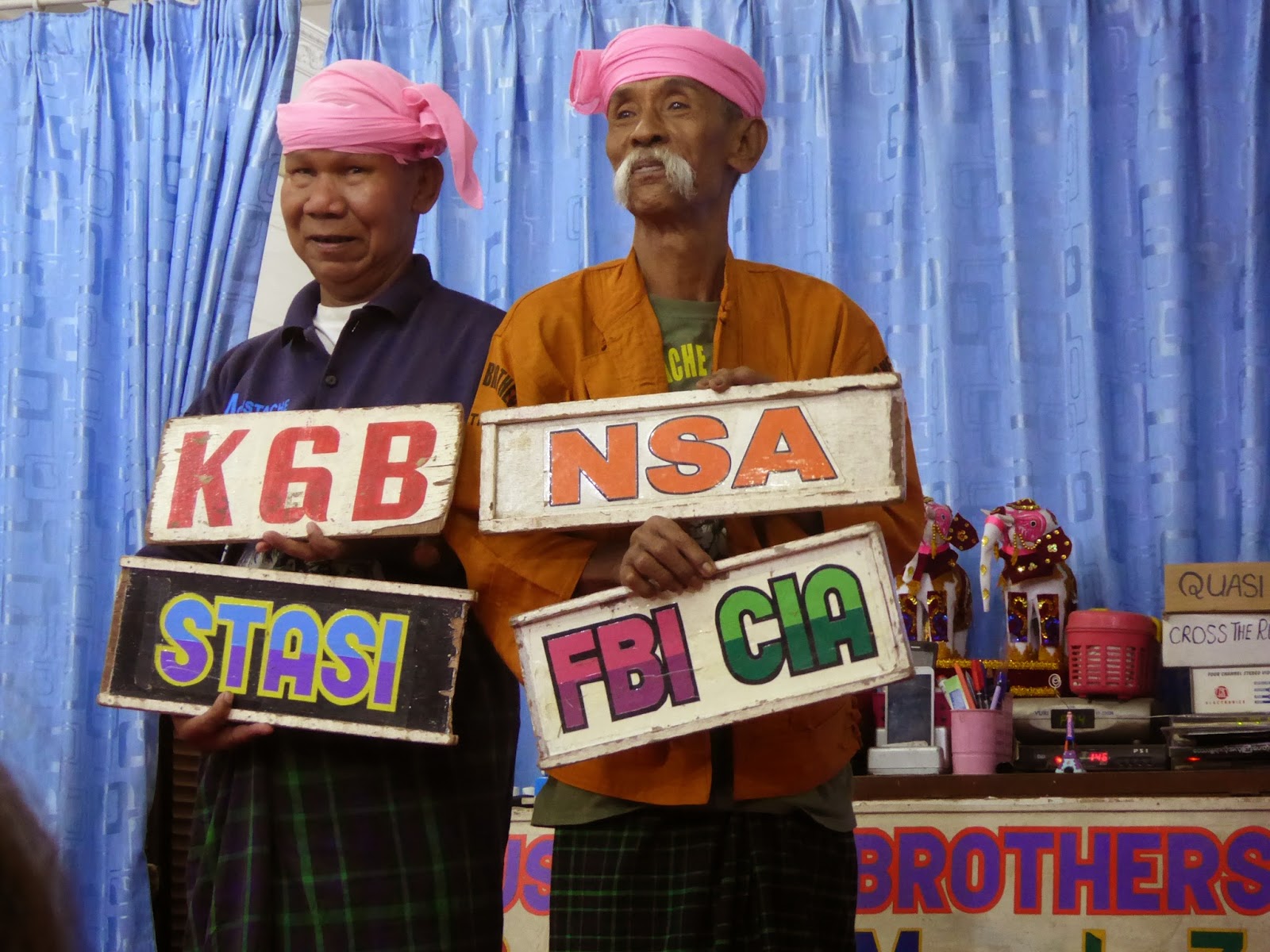
Mandalay - defiant Moustaches

Our final post on our packed two days in Mandalay is something a little different.  If you read the post about the political situation here, or indeed if you have seen the recent news reports about violent clashes between police and students, you will know that Myanmar is still not really a place where you can get away with being critical of the government. Unless you are one of the Moustache Brothers.

In recent years the Moustache Brothers have been getting away with doing a nightly show that accuses the government of corruption and cronyism. How? Well it is a hard won privilege.

The Moustache Brothers, actually two brothers, Par Par Lay and Lu Maw, and their cousin Lu Zaw, were a successful theatrical and comedy act.  In 1996, they did a show at the home of Aung San Suu Kyi, and included a relatively innocuous joke about corrupt government officers. She laughed. The government, however, were not amused and Par Par Lay and Lu Zaw were sentenced to seven years in prison.

Par Pay Lay actually gets a mention in the film About A Boy, when the Hugh Grant character volunteers at a human rights charity and the other volunteer mentions that in Burma you can get seven years in prison just for telling a joke.

 They were released a year early in 2002 after an Amnesty International campaign, with a strict proviso that they could only perform for foreigners in English.  As they were also kept under house arrest, these performances have to be in the garage of their home. With very minimal English, and the help of word boards to make their points, they carried on performing.


When Par Par Lay was imprisoned again in 2007, his brother carried on the shows. He and his cousin are now doing a two man show as Lay died in 2013, which Maw attributes to leadpoisoning from his time in prison.

So some of us went along to see the show, which really is just in the garage of his house.  The show isn't great. There is a bit of slapstick humour, a few jibes about the government, and some traditional Burmese dancing for which he ropes in the rest of his family. But it was an interesting experience, and I guess the quality of the show isn't really the point.

During the show, Lu Maw suggested that the KGB (which is how he refers to the government security people) were watching us and would come and arrest us all. He couldn't have known that as a group we have our own government escorts and occasional police guards too; who knows whether we were in fact being followed that evening. We don't think we were ever followed by the way - it just amused us to think that it could have been the case.

Tuesday, March 17, 2015

Mandalay - a walk through the back streets

On our way back from Inwa, we decided to get off the truck downtown and walk back to the hotel, to get a bit more of a feel for the city. Being on the truck is great, but with quick turnarounds and a packed itinerary, you can end up isolating yourself away from the general life of the place. So after grabbing some lunch, and passing by one side of the huge old fortress that used to house the palace, we decided to just wander our way back through some of the non touristy bits.

What we rather liked about Mandalay is that it seems to be an unpretentious city that is just getting on with its own business. Yes, we had earlier driven past some newer shopping areas, but most of the city was still low level buildings where people live simply, often over the top of their workplace if they have a business.

As was usual here, we noticed that it was the men who had time to spare sitting around in tea shops, whereas all of the women we saw were constantly busy.

 The areas we passed through were not exciting or photogenic, but they showed us a slice of life.  We had been wondering whether any recycling happened here, and found our answer when we chanced upon a road that was dedicated to the sorting and recycling of rubbish.  Each place was collecting together a particular product - plastic bottles, cardboard, tins, scrap metal, glass, old tyres - each each type of thing was being collected together and packaged up.

As we passed through, we got some surprised looks - obviously this is not usually where the tourists end up, even the dogs looked confused. We said a few mingalabars (hellos) as we went and most people smiled and said hello back. Some of the children ran alongside us practising their English, albeit just hello and goodbye.

We also found ourselves in a tiny alleyway that was just lots of small homes crammed in. The women here found it most amusing to see western tourists in their little lane.  At one point the street became so narrow that we thought we might have reached a deadend, but the ladies waved us, on through.

When we emerged onto a road again, a man helpfully pointed us down the street we should take to get back to the hotel. I'm not sure whether there is only the one hotel nearby, or whether he was one of the crowd that watched our arrival in the truck and he actually remembered us; neither would surprise me.

So we arrived back safely at our hotel, having enjoyed our wander through the streets, and looking forward to sampling some of the £1.50 bottle of local dark rum that we had picked up along the way.

Sunday, March 15, 2015

Mandalay - Inwa

Our second day in Mandalay started with a trip out to Inwa, known as Ava during the  British time, which was the royal capital on various occasions between the 14th and 19th centuries. It was finally abandoned in 1839 after a number of devastating earthquakes, so much of what is left is now in ruins, but it is an interesting change from the hustle of Mandalay.
The drive out to Inwa took us along the bank of the Ayeyarwaddy River (or Irrawaddy River), where the people were busy on their boats, or on the side of the roads selling great piles of watermelons.

Inwa sits at the meeting point between two rivers, the Ayeyarwaddy and the Myitnge, so was mostly surrounded by water. The King who first established it as his capital took this a step further and had a canal dug between the rivers on the only land side, so that it sat as an island, securely isolated.

So to reach the old city, we had to leave Xara behind and get in a small ferry boat, which was simple enough in itself, but did involve running the gauntlet of ladies selling hats, jewellery and other trinkets.

They knew their sales patter in multiple languages, and were most determined. If you still said no after a few attempts, their tack changed to "maybe later?", with a request to "remember me" and her repeated promise of "I'll remember you".  At least I think it was a promise and not a threat; after all we were her "number one tourist", her "favourite customer" and her "best foreigner", and we are absolutely certain that she didn't say that to anybody else!

Having escaped across the water, and been beseeched to remember a new batch of sellers on the other side, this time mostly men selling gongs, pictures and ornaments, we now got into the main form of transport for visitors, the horse and cart. Unlike in Pyin Oo Lwin, these ponies were big enough for their two person carts and looked well treated and cared for, so we were happy to use them here.

Not that leaving did anything to stop one determined seller, who hopped onto her bike and followed one of the carts quite some way before finally giving in.

Our first stop at the Daw Gyan pagodas was, for me at least, the nicest. It was just a few old brick stupas, now in ruins, but I thought they were quite beautiful.

Back in the carts, we took a very tranquil trot through some lovely rural scenery to our next destination, which was the rather lovely Bagaya teak monastery. With 267 teak pillars, the largest of which is 9 foot wide and 60 foot tall, this is an impressive structure. It used to function as a monastic college for young royalist.

 After a slightly more bumpy ride over rutted tracks through the banana plantations, we reached the only remaining part of the old palace, the Nanmyin watchtower, which one leans somewhat precariously, earning it the nickname of the leaning tower of Inwa.

Our final stop was the Maha Aungmye Bonzan Monastery was built in1818 by King Bagyidaw's chief queen Nanmadaw Me Nu. Once Bagyidaw himself became reclusive, she and her brother were effectively the leaders of the Burmese empire and it was they that took their country into the first war with the British.

The Burmese had, in the early 1800s, invaded parts of India, in particular Assam, which brought them into border conflicts with the British. The British supported rebellious uprisings in the annexed areas, and eventually the skirmishes led to the First Anglo Burmese war in 1824-6.  A decisive British victory resulted in a huge financial penalty to the Burmese, which significantly weakened the country.

Bagyidaw's brother deposed him, executing the warmongering wife and her brother, but the conflict did not die with them and two further wars with the British led to their eventual takeover of Burma and the end of the Burmese monarchy.

Wednesday, March 11, 2015

Mandalay - U Bein Bridge

Our final visit on our first day in Mandalay was, in my opinion the most picturesque visit, which was to the U Bein Bridge at Amapapura. At 1300 yards long, it is the world's longest teak footbridge.

Only a few of the 1060 original teak poles have been replaced, but in my opinion it could do with having a few more of the planks on the top changed.


It does feel a little bit rickety in places, and with the number of people on it at this time of day, it wouldn't be all that difficult to end up with someone in the water; thankfully no-one took an unexpected swim today.


In fact at the time of year we were here, the water was pretty low, but in the wet season the water can be literally only just below the walkway, so then a quick dip of the toes would be quite easy. For the sake of the view, I was glad we were here in the dry season.

The reason so many people were here now, was the approaching sunset. This bridge looks stunning against the backdrop of the setting sun. Sadly for me, this means another little boat. We walked halfway across the bridge, to a little island in the middle, and got into little boats to go out on to the lake and wait for the sun to go down.


On this occasion though, having to overcome my dislike of wobbly boats was well worth it. The boatmen here are well practised at this, and they know how to give you the best views.

I had already spotted a great tree that I knew would look good, and sure enough, he paddled straight there. He also made sure to take us under the bridge, going slowly through the teak uprights, before settling into a neat row of boats lined up to watch nature's show.


There isn't much else to say about this really; I didn't much worry about the history of the bridge, I just thought it looked stunning. The only reason it gets a separate posting is that I couldn't bear to only post one photo.

Monday, March 9, 2015

Mandalay - crafting gold, marble and wood

For part two of the grand tour of Mandalay, I will focus on the crafts that we saw being done. The first of these was making gold leaf, which you will know from the last posting, is likely to end up on a Buddha image. Most places these days use machines to hammer out the gold leaf, but here they do it the old fashioned way.

Before they even start on the gold leaf, they have to make the bamboo paper, which is a very strong waxy paper that they use to separate the sheets of gold leaf. After stripping down and splitting the bamboo into small sticks, they then have to soak it in lime for three years - no, that isn't a mistake, it takes three years to break down.


It then gets broken down to fibres and then pulped. The pulp is then spread over a mesh tray to form a thin film, which is left to dry out to make the paper. The paper is cut into 4.5" and 6" squares, each of which has to be placed on a brass plate and then beaten with sticks for thirty minutes until it get the required waxy finish.

Compared to the bamboo paper, the gold leaf process is quick, but it is much harder work. The gold is measured in ticals, which are 16.3 grams.  The molten gold is passed through an extruder to create a thin ribbon of metal.  That ribbon is cut into 1" squares, 200 of which are stacked, separated by 4.5" square sheets of bamboo paper, and bound into a small leather wrapped package.

That package is pounded with a large sledgehammer for about 30 minutes, until each piece of gold has spread to about six times its size. These leaves are then cut into six pieces, and all of the layers are restacked, and beaten for another 30 minutes. The gold leaf is now restacked in 6" square bamboo paper and the bundle beaten for a further 5 hours.

Three men share the hammering, to keep a constant speed and rhythm going, as it is important that the gold leaf keeps the right temperature so that it will spread well.  To ensure the thickness is even, there is a strict regime of altering where the hammer hits the package; the number of hits is timed using a coconut shell with a hole drilled in it, which will sink in just over three minutes, during which time they will hit the package 120 times.


The cutting and packaging is done by women in a separate room, where they take care to ensure that there are no drafts to waft away the ultra thin gold leaf. The final product is sold in various sizes and amounts, and used for lacquerware as well as on the religious buildings and images. At the end of our visit, we ladies were all anointed with a small piece of gold leaf on our foreheads.

 The next craft was the somewhat disturbing stonemasonry, where whole families turn lumps of marble into intricately carved Buddha images. I say disturbing because we were all quite horrified to see everyone working with no face masks. Even just walking past, we could taste the stone dust and feel ourselves breathing it, so it must be doing terrible things to their respiratory systems. The guys doing the carving were covered in white dust, and every so often they would hack up a load of gunk.


Health and safety aside, it was quite fascinating to see the amazing work that they do here.  The carving of some of the statues was incredibly detailed and quite beautiful.  It was slightly strange to see many of the Buddhas with no faces though; apparently it is only the master stoneworkers who are permitted to carve the face of Buddha, so someone else does the rest and in the meantime it leaves these faceless bodies.

Once the men and older boys have done the carving, it is over to the women and girls to polish up the stone.  The whole process seems pretty slick, and the finished products are sold on to temples and businesses to be adored - and possibly garnished with gold leaf!


Our final craft destination for today was the wood carvers. Unsurprisingly they were making Buddha images too, but they were doing other things as well; elephants featured quite strongly here.  There were some really lovely pieces, and we were quite tempted by a large pair of panels with lotus on them, but they were a bit too pricey.