Welcome to our travel blog. We are Tabitha and Nic. In 2011 we 'retired' in our early 40s and set off to travel the world. We spent our first year in South America and have been lucky enough to make two trips to Antarctica.

Our blog is a record of our travels, thoughts and experiences. It is not a guide book, but we do include some tips and information, so we hope that you may find it useful if you are planning to visit somewhere we have been. Or you may just find it interesting as a bit of armchair travel.


Showing posts with label fur seals. Show all posts

Sunday, October 2, 2016

Tasman Peninsula and Tassie Devils

Tasman Peninsula, Tasmania
We did choose to do one tour while we were in Tasmania, and we picked one the took us on a boat trip round the Tasman Peninsula in the morning, dropping off at Port Arthur, and then in the afternoon, went to the Tasmanian Devil Conservation Park.

We used a company called Pennicott Wilderness Journeys, which has decent eco credentials, and we would happily recommend them.

Tasman Peninsula, Tasmania


Tasman Peninsula, Tasmania

The collected us from the harbour in Hobart at some horribly early time of the morning, and tooyk us to Eaglehawk Neck, where we got on one of the 43 seater open deck boats for our cruise.


Tasman Peninsula, Tasmania


Obviously as our trip was by boat, we didn't visit, but there is an village nearby called Doo Town, where in 1935, a resident called Eric Round named his weekend place here 'Doo I', and started a trend. All of the places in the village we soon being renamed with things like 'Doo Me', 'Doo Us', 'Xanadoo', 'Love Me Doo' and 'Doolittle'. It seems that there is now only one exception - a place called 'Medhurst'.

Fur seals, Tasman Peninsula, Tasmania


Tasman Peninsula, Tasmania
The tour took us around the quite spectacular scenery of the Tasman Peninsula, with its soaring dolerite cliffs, that are home to many nesting birds.


The base of the cliffs at areas like Cape Hauy, act as a place for the Australian and New Zealand fur seals to haul out and take a rest.

Humpback whale, Tasman Peninsula, Tasmania


Fur seals, Tasman Peninsula, Tasmania

Tasman Peninsula, Tasmania


There are numerous rock formations along the way, where the sea and weather have carved out arches, like the Tasman Arch and Devil's Kitchen, and left tall standing pillars, such at the Candlestick and the Totem Pole.


Tasman Peninsula, Tasmania


Tasman Peninsula, Tasmania

Tasman Peninsula, Tasmania


Tasman Peninsula, Tasmania
At the end of the peninsula is Cape Pillar, which has the highest vertical sea cliffs in southern hemisphere, reaching some 300 metres.


Tasman Peninsula, Tasmania

Tasman Peninsula, Tasmania


There is a lighthouse on the top of the cliffs, and you can still see the old flying fox that they used to haul provisions up to it, before it was automated.


Tasman Peninsula, Tasmania

Dolphins, Tasman Peninsula, Tasmania


As well as the seals and birds, we also spotted humpback whales and common dolphins along the way.


Dolphins, Tasman Peninsula, Tasmania


Dolphins, Tasman Peninsula, Tasmania


Port Arthur, Tasmania


The boat trip finishes up at Port Arthur, which was began as a convict penal settlement in 1830, but became an important industrial area too.

Echidna, Tasmania
It has also been the site of a more recent, but tragic event, which had a major impact on Australian gun laws. On Sunday 28 April 1996, a young man from Hobart went on a shooting rampage here. He was captured, and subsequently sentenced to life imprisonment with no option for parole, but he had murdered 35 people and injured many more.

The nation was shocked, but it opened up a debate on the ownership of automatic and semi automatic weapons, which although there were strong feelings on both sides, led to Australia bringing in some of the strictest gun control laws in the world.

Whilst no doubt this is an interesting site, we chose not to stay to look around here, but instead to go on to the Tasmanian Devil Conservation Park. We knew there was next to no chance of finding one of these iconic creatures in the wild, so figured a conservation park was our next best option.
Tasmanian Devil, Tasmania

On the way, the driver spotted an echidna, or spiny anteater, and stopped so that we could go and get a better look.


The Tasmanian Devil does, as the name implies, only live in Tasmania, and even here, they has been in terrible decline owing to a prevalence of facial cancer, which at best causes them nasty disfigurements, but also can make it impossible for them to eat, thereby causing them to starve to death.


Tasmanian Devil, Tasmania

Like kangaroos, they are marsupials, but these are the largest of the carnivorous marsupials. They are nocturnal and will often eat carcasses of already dead animals.

They eat everything, including the bones and hair. They are small in size, but they have very muscular jaws, giving them one of the most powerful bites in the animal kingdom.


Tasmanian Devil, Tasmania


They are typically quite shy creatures and the males in particular are generally solitary, perhaps because they generally have a pretty lousy temperament.

In any perceived threat, they becoming enraged, growling, baring their teeth, and attacking. They also make a quite disconcerting screaming noise.


Tasmanian Devil, Tasmania


Their aggressive behaviour and bad temper is not confined to unknown threats. In the conservation park here, while we saw some pairs happily curled up asleep together, even some of those that are in a shared enclosure can act very nastily towards each other, especially around meal times.


Tasmanian Devil, Tasmania


Tasmanian Devil, Tasmania


Kangaroo with joey, Tasmania


The park doesn't just have Tassie Devils, we also saw kangaroos and wallabies, and various birds.


Wallaby with joey, Tasmania


Quolls, Tasmania

One of our favourite animals was the quoll, which again is a carnivorous marsupial, but smaller and cuter than the devil.
Quolls, Tasmania


Saturday, August 27, 2016

Christchurch and Akaroa

Christchurch
The earthquake obviously had a huge impact on Christchurch, but that isn't all I'm going to tell you about here. Whilst the city was badly damaged, there are a few aspects that remain. 
Christchurch
Christchurch

New Regent Street, Christchurch

One place worth a wander down is New Regent Street, with its forty colourful painted shops in the Spanish Mission Revival Style, which were built by H Francis Willis in 1930-2, as a new concept in speciality shops.

And if you’re wondering, no, I don’t know why there were three wizards sitting outside one café, except that I assume that they were thirsty.


Bridge of Remembrance, Christchurch
The city has a lovely old tram system, which is back up and running. It will take you past the Bridge of Remembrance, built in 1924, originally to commemorate those fallen in WWI, but now remembering those who died in all wars.
Christchurch
Christchurch

Akaroa
We also took a drive out of the city, through pretty countryside and along some very wind roads in places, to nearby Akaroa. The village is on the Banks Peninsula and sits in a bay on the remnants of an old volcano. Its name means Long Harbour.

Akaroa
It is a pretty little village of only about 700 people, and has a heavy French influence, that can be seen in its buildings. It is best to try to time your visit to avoid the arrival of a cruise ship, as it can get pretty busy then.
Akaroa


Akaroa
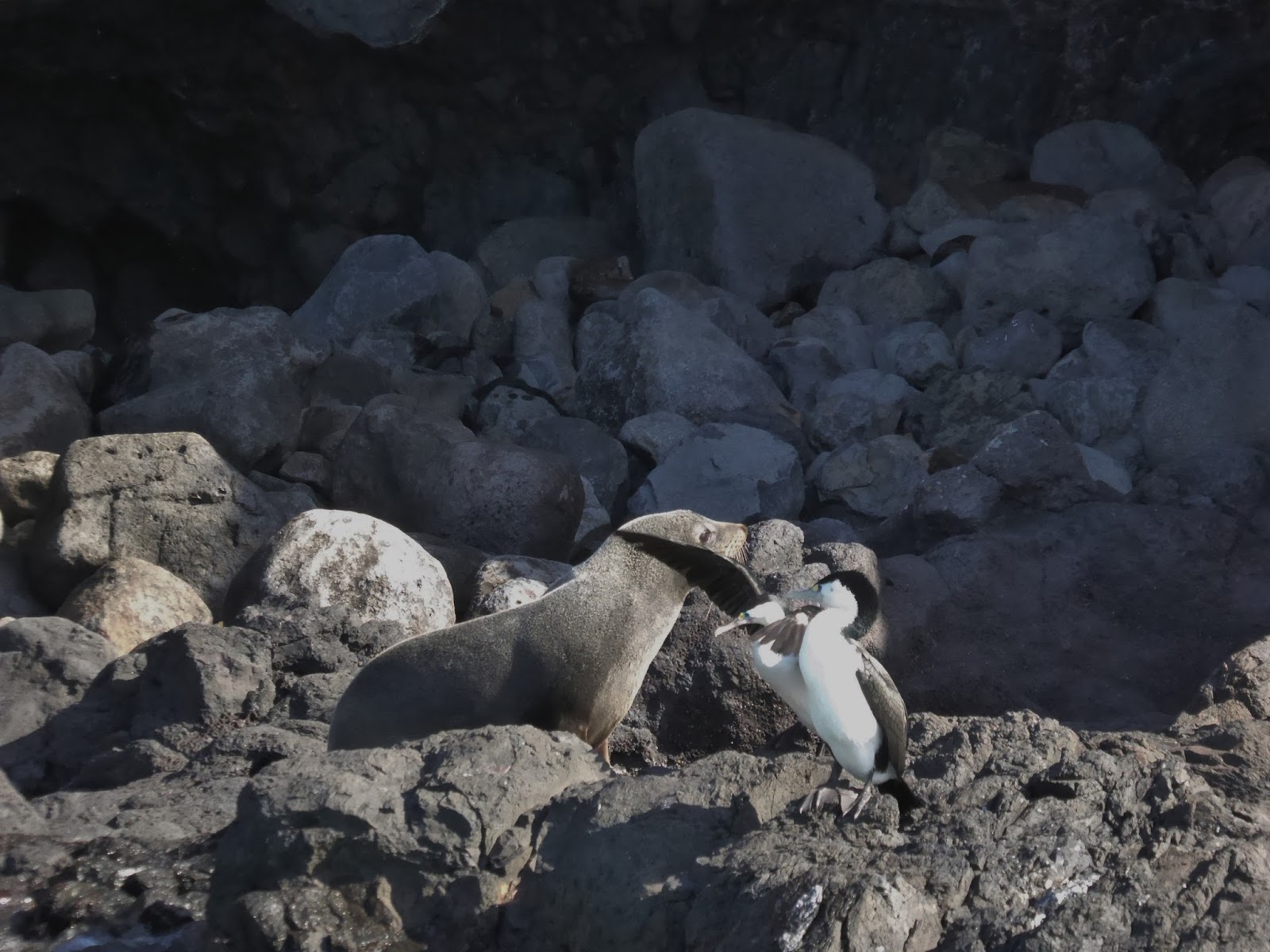
We took a little boat tour out into the bay, largely for a bit of wildlife spotting. We saw a few New Zealand fur seals along the rocks, and we were able to brave the swell of the mouth of the bay to catch a view of the little Hectors dolphins.

We were also very pleased to spot what we were reliably informed was not just a Little Blue Penguin, but rather their close relation, the White Flippered Penguin, which in endemic to this area and is only distinguished from the Little Blues only by the larger band of white along the front edge and back edge of their flippers. Penguin type number eleven. 

Fur seals, Akaroa
Fur seals, Akaroa


Hectors Dolphins, Akaroa
White Flippered Penguin, Akaroa
Little Blue Penguin, Akaroa


Wednesday, August 10, 2016

Kaikoura - with two kinds of whale

Fur seals, Kaikoura
By the time we left Nelson, my back was just starting to get a little better, and I could hobble along with my stick for a much improved fifty metres or so! Our car, however, wasn't doing quite so well.

We had noticed a little noise, which we couldn't work out where it was coming from. That noise was getting worse, and by the end of our drive to Kaikoura, we had discovered that the problem was a section of the bottom trim hanging down underneath the car. We contacted the company, and they agreed to swap it out when we passed through Christchurch on our next leg. We used Jucy, by the way, and we were very happy with the cars and the service.
Kaikoura


Kaikoura
Aside from the noises, the drive to Kaikoura was quite a pleasant one. That is the nice thing about driving in New Zealand, in most places there isn't too much traffic, and the scenery is good to look at. We wound our way back through the hills and along the coast, and eventually got close to the town, to be greeted by a beautiful sight of blue skies and seas, white capped mountains and green hills. It really did look like a postcard - just a shame that there was nowhere safe to stop to take a photo.
Kaikoura

We did however, make a brief pause at the coast before town, to watch the fur seals basking on the rocks and playing in the shallow pools of water.

Now if I'm honest, I would have to struggle to find anything interesting or especially positive to say about the town of Kaikoura, with the possible exception of a good little cheese shop. But Kaikoura isn't really about the town, it is about the setting that the town is in, and the inhabitants of the ocean that it is next to.


Sperm Whale 1, Kaikoura
I have already mentioned that the scenery around Kaikoura is pretty, but the most important thing here is something that you can't see - The Dropoff. Kaikoura is an unusual spot in that only about a mile offshore, the same movement of the earth's plates that created those pretty mountains, also created a huge chasm in the sea bed.


Sperm Whale 1, Kaikoura
The Kaikoura Canyon drops to a depth of about 1000m, which is nothing compared to the 10,000m that the Kermadec Trench that it eventually joins up with reaches, but is none the less, very deep and quite unusual so close to land.


Sperm Whale 1, Kaikoura

It is this drop off that attracts the sperm whales. These are huge creatures, the largest of the 'toothed' whales, typically around 55 foot long, but can be up to about 67 foot. They dive very deep for their food, as are mainly on the hunt for giant squid. They have been recorded diving as low as 9,000 feet, and they stay down for up to an hour and a half.


Sperm Whale 1, Kaikoura

So Kaikoura is one of easiest places to spot sperm whales, as there are usually males feeding here before heading off to the breeding grounds. Of course, when they only surface for around ten minutes, and then disappear for ninety, there are still no guarantees.


Sperm Whale 1, Kaikoura


We decided to double our chances, and booked both a helicopter trip, with Kaikoura Helicopters, and a boat trip with Whale Watch Kaikoura. Both were excellent and well worth doing.


Sperm Whale 1, Kaikoura


Sperm Whale 2, Kaikoura


Sperm Whale 2, Kaikoura
Humpbacks, Kaikoura
We had to cancel the boat trip we had booked as the weather was rough, and they advised me that, with my back as it was, it was best not to go out. Happily though, they had space on another trip, and that one worked out fine. Nic was pleased too as he gets seasick, so wasn't too keen on the idea of choppy waters.
Humpbacks, Kaikoura

The helicopter gives you the best chance of finding them in the time you have, and enabled you to see the whole body from above, so that you can see just how huge it is. We managed to spot two while we were up, which we were pretty happy with, and then for good measure we saw a couple of humpbacks on the way back, closer to shore.


Humpbacks, Kaikoura
Humpbacks, Kaikoura


Humpbacks, Kaikoura
Humpbacks, Kaikoura


Humpbacks, Kaikoura
Humpbacks, Kaikoura
Sperm Whale 3, Kaikoura

The obvious advantage of the boat trip is that you get closer. Not too close of course, they respect all of the guidelines that protect the whale, but enough to get a feel for it's size and power, even at a distance. We had started to think we weren't going to spot one on this trip though. we hadn't found one, and the one that they knew was around had started its last dive around the start of the trip, so we weren't sure if it would come back up in time.
Sperm Whale 3, Kaikoura

Happily for us all, it did, and we had time to watch the whale swim along for a while, replenishing its oxygen supplies and relaxing for a bit, before it flipped its tail fluke and disappeared again.


Sperm Whale 3, Kaikoura

This isn't such an entertaining viewing as you have with the humpbacks, because they don't do anything flashy like slap the water with their fins or breach out completely, but if you like seeing wildlife, it is an excellent experience in its own right.
Sperm Whale 3, Kaikoura


Sperm Whale 3, Kaikoura

Sperm Whale 3, Kaikoura

Sperm Whale 3, Kaikoura