I said in an earlier posting that both while we were travelling, and since we have been back, we frequently have been asked which was our favourite country or place. I also said that I find it impossible to give a single answer to that question as I don't feel I can reduce such a fabulous year down to just one 'best' thing.
So instead, we have come up with a short-list of our highlights from this first year. In no particular order, it would have to include:
* laid back and gastronomically fabulous Palermo area of Buenos Aires, not least for its cafes, cakes, steak and wine.
* amazing scenery on the Bolivian Altiplano between the Atacama Desert and the Uyuni Salt Flats;
* satisfaction at managing a proper conversation in Spanish with our home stay host in Raqchi, even if our teacher would have been horrified at all of the mistakes;
* exhilaration of adventure activities, such as ziplining, white water rafting and sand boarding;
* relief that we all made it safely out of the fire at Shangri-la
* unconditional friendliness from Colombians who were so pleased to welcome us as tourists to their country;
* seeing the moai left as they were abandoned in the quarry on Easter Island;
* watching - and more particularly hearing - chunks of ice cleaving off the vast and beautiful Perito Moreno glacier;
* grandeur of the fjords, lakes, mountains and volcanoes of southern Chile;
* experiencing the strange feeling of being in a village in England despite being 8000 miles away in the Falkland Islands and having the chance to talk to the islanders first hand about how they feel about the question of their nationality;
* being pecked by penguins and watching their comical antics in the Falklands and Antarctica;
* simply being in Antarctica, the coldest, windiest, driest, and highest place on earth;
* getting wet at the spectacular Iguassu Falls;
* meeting some fabulous people, some fleetingly, some who have become friends and we will hopefully be seeing again sometime, somewhere in the world!
Over the coming weeks I may add a few posts about some of these highlights and what made each of them so special.
Welcome to our travel blog. We are Tabitha and Nic. In 2011 we 'retired' in our early 40s and set off to travel the world. We spent our first year in South America and have been lucky enough to make two trips to Antarctica.
Our blog is a record of our travels, thoughts and experiences. It is not a guide book, but we do include some tips and information, so we hope that you may find it useful if you are planning to visit somewhere we have been. Or you may just find it interesting as a bit of armchair travel.
Showing posts with label Bolivia. Show all posts
Wednesday, August 1, 2012
Sunday, September 25, 2011
Busking while you eat
While we were eating in Copacabana, a woman came in to play a few traditional tunes on her flutes, one of which was a double flute that sounds like you are playing two different instruments at once. Of course the hat then comes around for a donation.
That kind of thing is quite common here, as in some of Europe, but I find it a bit irritating. It's OK if the person is good, and you enjoy the music or songs. Then I am happy to give them a bit of change, especially when it gives me a taste of the local music and so I feel like I have gained something.
Sadly though, quite often they aren't any good at all, and you spend the time wishing they would go away and let you eat in peace - and then they get grumpy when you don't give them anything. And often it isn't just the one that turns up. You get a succession of them coming through, as well as the people who come in trying to sell you biros or torches etc.
In this case, the woman with the flutes was fairly good so she got a donation, but when the guitarrist came round later he wasn't great so got nothing. I used to feel bad about things like that, partly because I know that a couple of pesos is nothing much to me but can be a lot for them. But I don't feel bad anymore, especially since I noticed that the locals don't feel obliged to give anything themselves. Not that I have yet been brave enough to do what one of our group did an when the hat came round simply say I didn't like it. Maybe next time.
Copacabana and the Isla del Sol
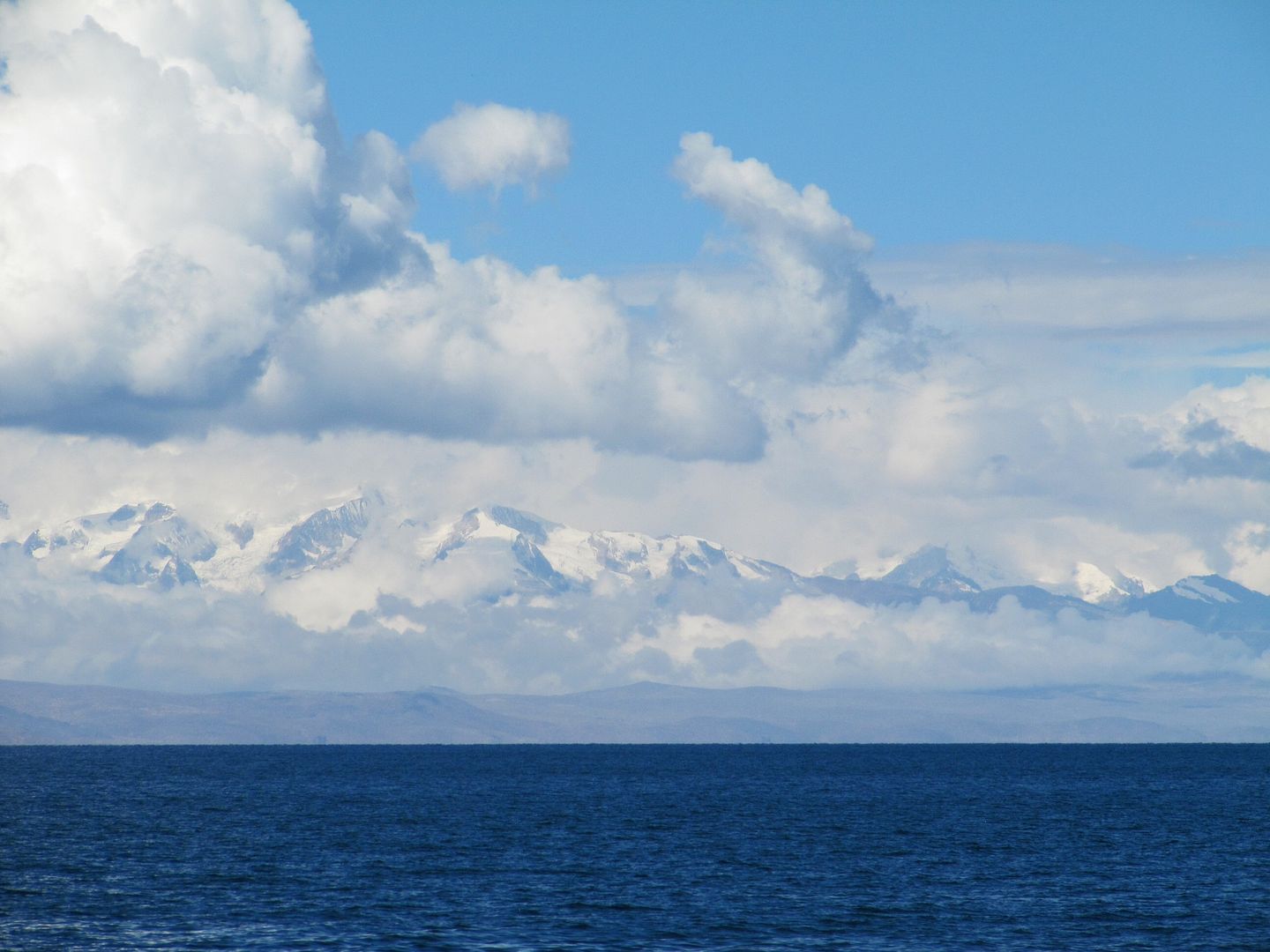
Our next stop after La Paz was Lake Titicaca - which apparently means 'great puma', and our first stop was Copacabana. Inevitably there was much humming of the song by Mr Manilow, although of course that is not where he was singing about. However we were told that the Copacabana beach in Rio was named after the town here because the outline of the coast is similar.
As in most places in South America there are a lot of dogs wandering around. Unfortunately the ones here all decided to congregate close to our hotel for dog wars. Every so often, minor skirmishes would break out with a lot of very loud barking. Nic wasn't impressed and broke out the earplugs.
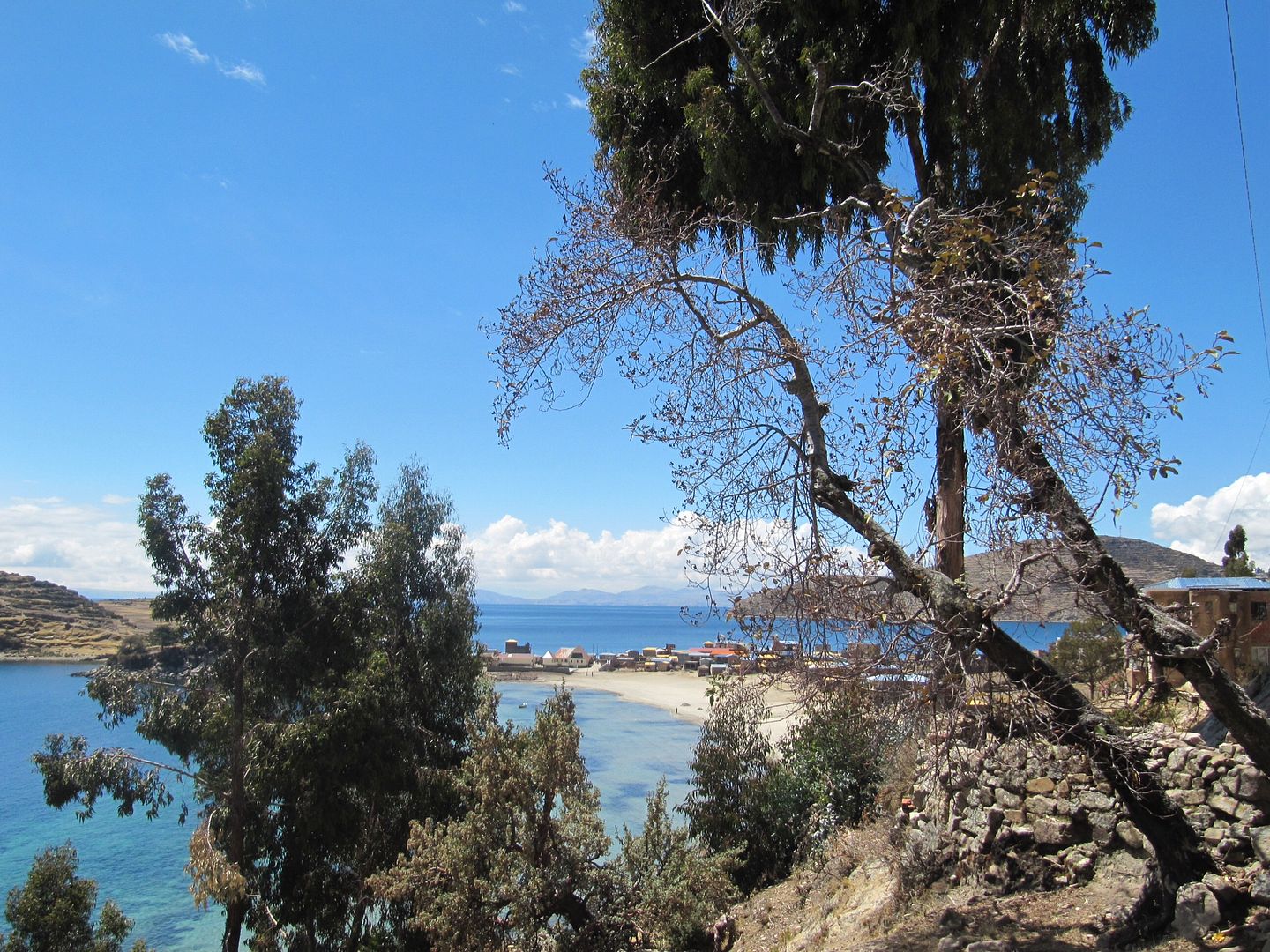
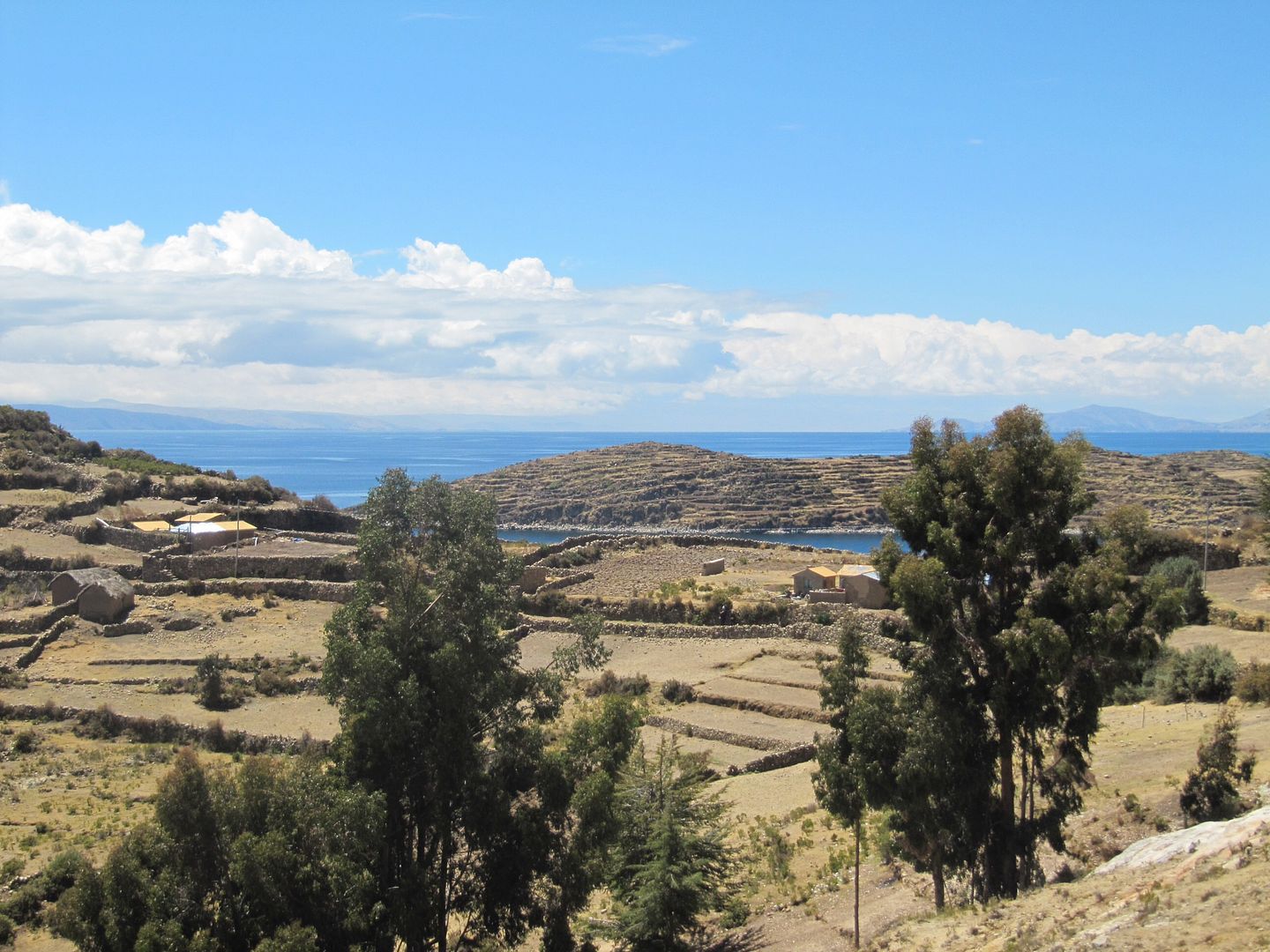
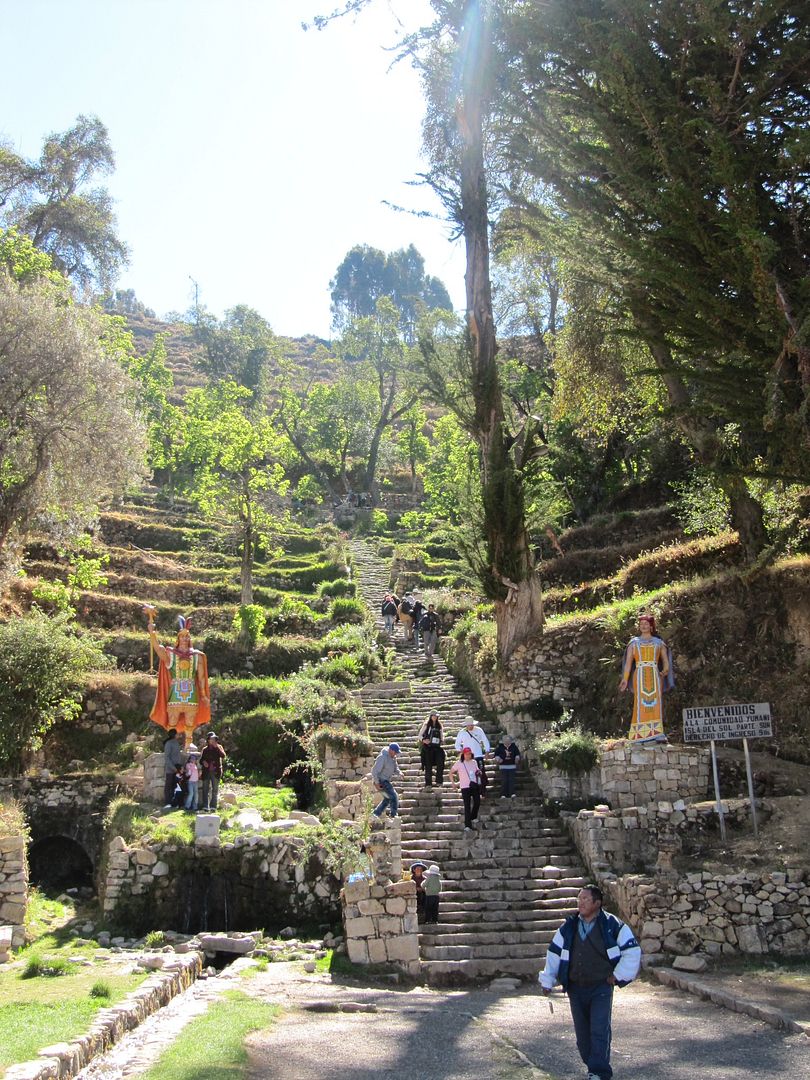
The next day we set off to get a boat to the Isla del Sol, the supposed originating point of some of the local gods, and some suggest the sun itself. No life jackets at all this time, despite it being a two hour journey, but we decided to take that as a sign that this boat was safer - we know that it probably isn't true, but sometimes you just have to tell yourself these lies to make you feel better!
When we got there, our little walk to the inca ruins took us nearly an hour and a half, mostly up hill. I was knackered. After a brief stop for lunch, the plan was either to go on for another three hour walk to the other side of the island, or go back the way we'd come and take a boat to the other side. Either way we had a boat to catch back to Copacabana. As we only had two and a quarter hours to do the three hour walk before the boat was due to go, and I figured that meant going faster than I would cope with, I decided to go back. Trouble was, we only had forty minutes to catch that boat too. Although most of the way back was downhill, there was still quite a steep bit first and so we know this was not long enough. Thankfully, the guide sorted out someone to go on ahead and make the boat wait for us. We rushed back and made it in fifty minutes in the end, and then the boat sat there for another fifteen minutes before it actually left.
The rest of the group was also late back from their walk, but the boat waited for them, so we made it back to Copacabana. Nic and I took a walk around the main square before dinner rather than going back up all the steps to the hotel room, and then found a little place to eat and sample a few cocktails. We had some interesting charades and pictionery with the staff to try to work out what a few of the items on the menu were, but we got there.
| Cindy crossing Lake Titicaca |
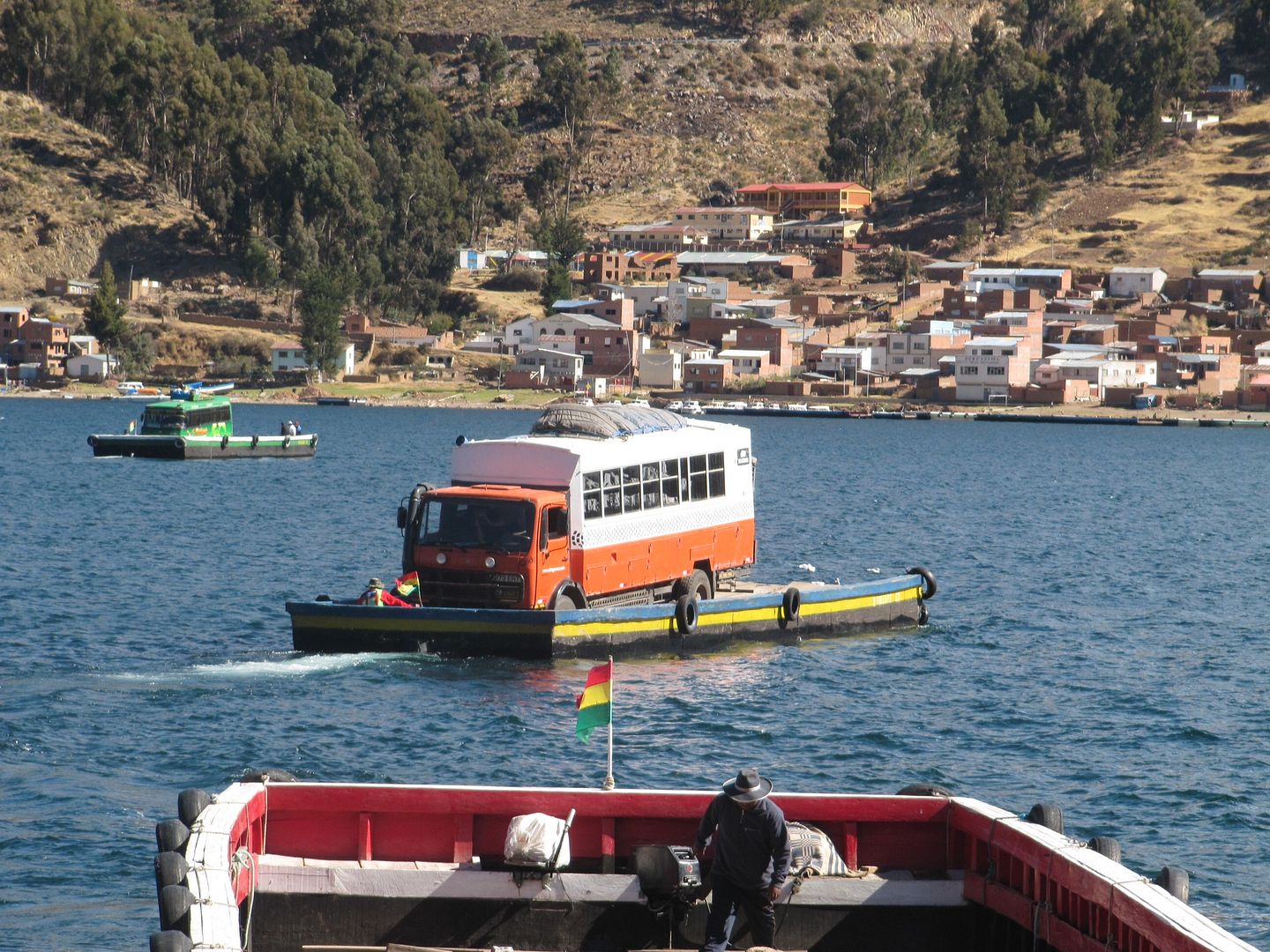
The journey here was OK but got interesting when we had to take a ferry across the lake to where we were staying. There was a ferry for the truck, but we all had to get off and go across separately. This is probably for the best, as apparently one of the other truck operators lost one of their trucks recently when the ferry sank.
But it was a strange sight seeing Cindy float off on a small ferry that was really no more than a floating platform with a small outboard motor. But it made it across OK, and we followed on the passenger boat. I've said before that health and safety isn't a factor in Bolivia, so we were a bit surprised and slightly worried when they started handing out life jackets. And then we were even more concerned when they ran out half way through the group! But still, we made it across without incident.
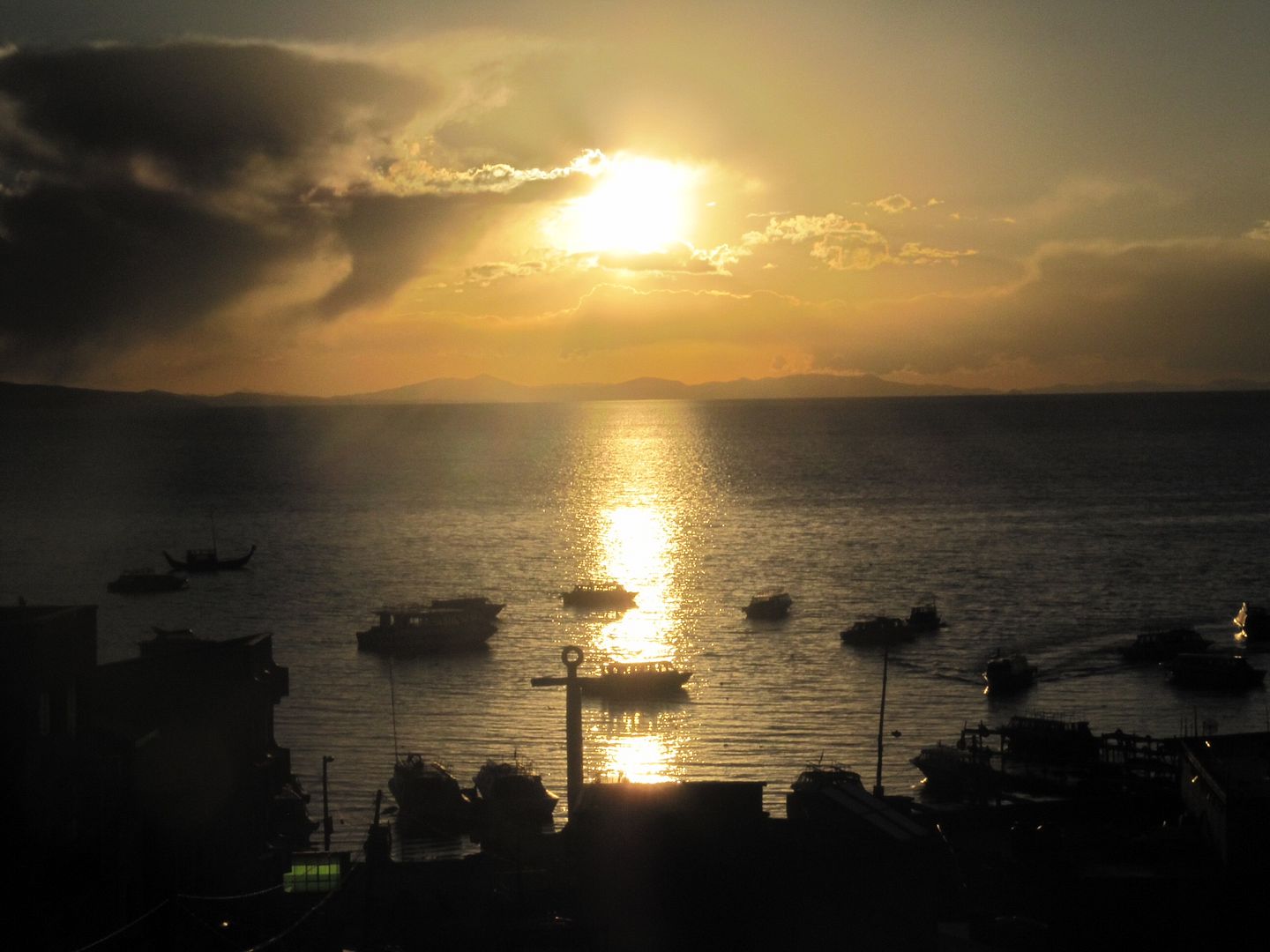
| Sunset at Copacabana, Bolivia |
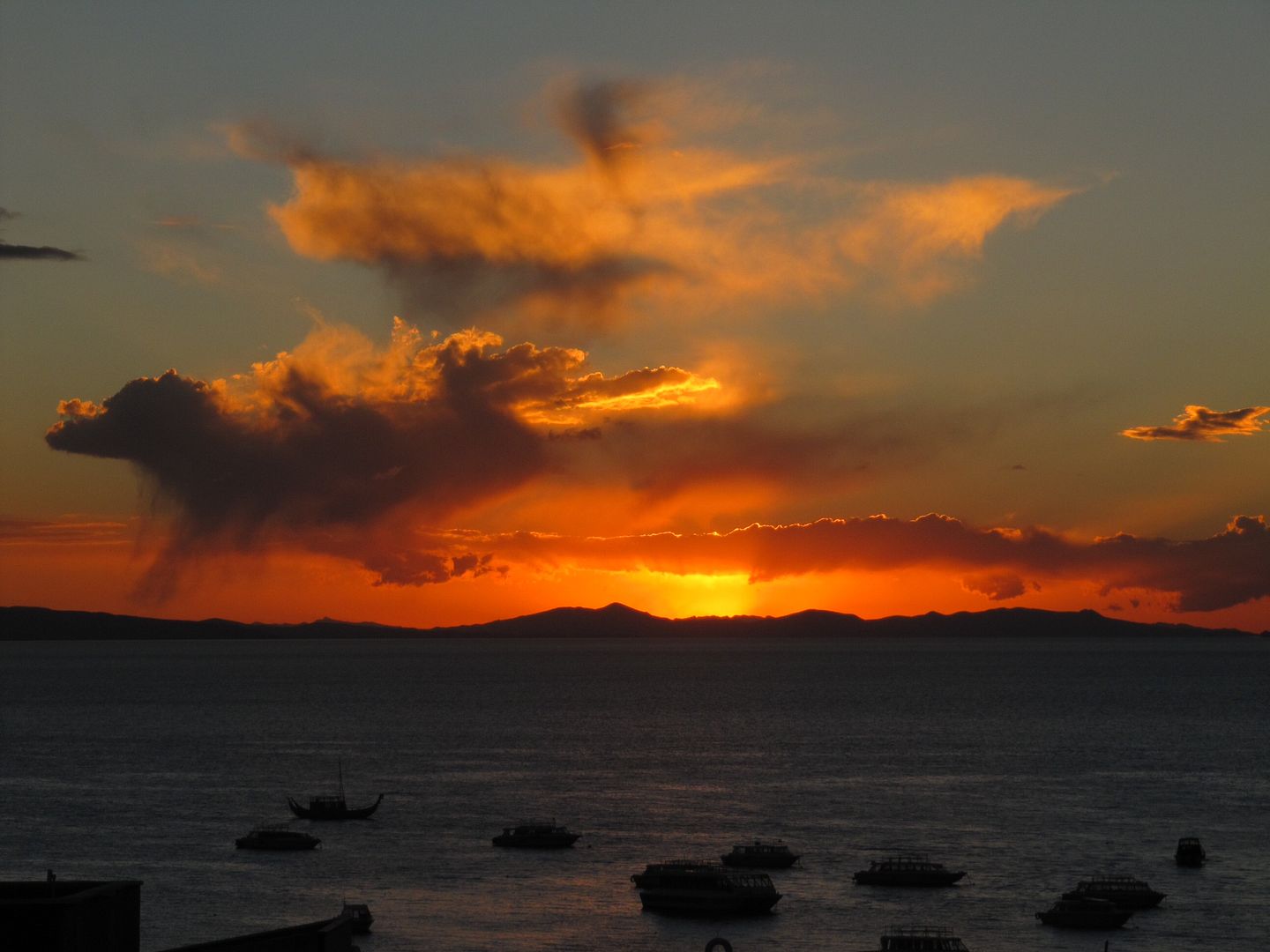
| Sunset in Copacabana, Bolivia |
Copacabana is a small place with a couple of main streets that are focused on the tourist markets and then other streets clearly intended for the locals. Our hotel claimed to have no record of our booking, despite Izzy being able to see the note of it on the counter, and it took repeated attempts to get towels and loo rolls, but generally it was OK. The worst bit was the hike up five flights with the rucksacks.
We headed off almost straight away for a group meal on the roof of a local restaurant. After watching the sun set though, we all gave in to the cold and retreated inside, taking our tables and chairs back down with us.
| Isla del Sol, Bolivia |
| Isla del Sol, Bolivia |
| Isla del Sol, Bolivia |
| Lake Titicaca, Bolivia |
That was our last day in Bolivia, as the next day we were to cross the border into Peru
La Paz
| La Paz, Bolivia |
We arrived in La Paz a day earlier than originally expected so that those people who wanted to cycle the Death Road could do so. We decided not to do it, but quite a few of our group did and they enjoyed it, so if you like that kind of thing and get the opportunity then it is probably worth it.
| La Paz, Bolivia |
| La Paz, Bolivia |
Its called the Death Road because it is a steep descent from over 4000m with a huge drop at one side. It is no longer open to vehicles to use it because it is too dangerous, but you can cycle down it.
There are numerous crosses along the road that mark where people have gone over the edge and been killed. We did have a faller from our group, but thankfully she only came off the bike, so she just had an injured arm and a lot of bruises.
| La Paz, Bolivia |
But back to La Paz. I can't say I was particularly looking forward to the capital of Bolivia. I was expecting it to be overcrowded, busy and a little claustrophobic. I held out little hope for the standards of the hotels and restaurants, and I expected a lot of poverty and hassle on the streets.
| mural on our wall in La Paz |
| La Paz, Bolivia |
And the city was busy yes, but it was really fairly relaxed and friendly. There was poverty, but no more beggars than in most cities, and we weren't hassled by them or by people selling stuff. In fact I quite liked La Paz.
| La Paz, Bolivia |
We wandered around the town and looked at some of the churches squares and buildings, but the best thing was just seeing the markets and street life. Women in their traditional big skirts and bowler hats were selling all sorts of things from little shopfronts or just on the streets. Some were selling spices, pastas and vegetables from huge sacks, including things that looked like pebbles but that we later found out were actually dried potatoes.
| llamas in La Paz, Bolivia |
But the most interesting place was the Witches Market. In these few streets, they sell all of the ingredients you need for medicines and 'potions'. You can buy the various items that make up an offering to Pachamama, or mother earth. People make offerings to bring luck to any aspect of their life, and they normally include sweets, tobacco, alcohol and coca leaves. But an extra item used, especially if you want to bless your new home, if a llama foetus. The stands had many of them strung up. Some were very small and had no fur, so clearly hasn't ever been born, but others were a little larger and had fur, so perhaps were newborns. And strangely the sight of this wasn't nearly as disturbing as it sounds!
| La Paz, Bolivia |
And as La Paz was the end of our first leg, we had our farewell meal with the old group. The place we ate in was fine for food, but was more interesting for its decoration. It was a but like a junk shop, with odd mismatched chairs, some almost throne like, chandeliers, and odds and ends everywhere. I liked it, although those taller than me - which is almost everyone - hit their head on one of the lights when they stood up.
| La Paz, Bolivia |
The two of us tried out a local cafe for lunch one day. The food was fine, but excessive. They have a tendency here to give you rice and chips with a meal, which is a bit of an overload really. We had lomo montado, which was a huge plateful of rice, chips, thinly sliced steak, sausage, fried egg, vegetables and fried banana! I couldn't finish mine but the table next to us had that, and then soup, and seemed to be going on to dessert when we left.
For our last night we all went along to a steakhouse which was very North American. A bit naughty I suppose, but the food was good and it made a nice change.
| Zebra crossing, La Paz, Bolivia |
Goodbye Cameron, Hello Cindy
Being in La Paz meant that we were reaching the end of the first leg of our Dragoman trip, and that meant saying goodbye not only to some of our group, but also to Dave, Ivan and Cameron as they were all going in other directions.
So we had our farewell meal with the old group and then met up with the new. We lost Bert, Vanessa, Carolyn, Alex and Jade, but gained eight new people. Two of Leoni's friends joined her for this next leg, they are Fiona and Drew, also from Australia. In fact we have become overrun with Aussies as we also gained from Australia, Ken and Sue, a retired couple, Stacey and Kas, two young friends, and Shannon, travelling on her own. The last newby is Sander from the Netherlands.
And then there is our new crew. Cindy is fairly similar to Cameron, but the brand new speakers don't work so we hope to get those fixed at Cusco so that we don't have to resort to singalongs! Our new leader is Izzy from UK, and our co driver is TJ from USA.
This next leg is a fairly short one for driving as it takes us to Cusco for the Machu Picchu trek - and I've still not decided whether to do that yet.
So a bit of change, but we expect to settle back in quickly. And on we go.
The Drive to La Paz
The drive to La Paz was an eventful one. It was another long journey, but we made fairly good progress before we stopped for lunch. And lunch started out just like normal.
You've seen the photos of our lunch stops, so you know we bring out the table to prepare lunch on, put out a few chairs, set up the five hand washing and washing up bowls on stools, and get out the plastic plates etc. So we did all that and we were happily eating our lunch, and watching the little dust clouds that were swirling around in the distance.
And then some of the group happily watched as one of the dust clouds got closer. And closer. And closer. As they finally worked out that this mini tornado was about to hit us, the shout went up. Some leapt onto the truck, some took shelter behind it. Others of us, who hadn't been watching and so didn't know what was happening, were caught of guard in the main path.
The mini tornado swept straight over where we were having lunch, spraying dust and sand everywhere and taking our lunch with it. But not just our lunch. We could only watch as the chairs, stools, washing up bowls, cups and plates were picked up by the whirlwind and carried some 200 metres before being dropped back down. Once it passed over, all that was left was the table and the big knives - that thankfully hadn't flown off and hit anyone!
After realising we were all OK - having, only partly in jest, done the buddy check to make sure we were all there - we pretty much collapsed into relieved laughter and set off to collect our stuff.
We got most of it back, but for of the five washing up bowls were beyond salvage, and everything was covered in dust. Needless to say we decided not to bother with the rest of lunch, as sandwich was a bit literal by this time.
There's nothing like a minor natural disaster - with no consequences - to have everyone laughing and joking, but the main source of amusement was at one fellow traveller's expense. And primarily not because he was the only male who made the leap onto the truck, although that was mentioned.
No, our amusement was that, despite being the person who is always taking photos and videos of everything in sight, he didn't manage to get a single picture of our little adventure. And he was devastated about it. As we cleared up, he was scanning the surrounding area, desperately searching for signs of another dustcloud and considering how he could best get us to reenact the original scene so that he could film it. We eventually had to drag him onto the truck to get in with the journey.
So that was our lunch stop, which kept us amused for a good while. Then as we got closer to La Paz, we hit a tailback of lorries and other traffic. On investigation, it was discovered that the town three miles ahead was not happy with it's mayor. Apparently he was not keeping his election promises, so the townspeople had decided to blockade off the road. Nothing was getting through on either direction!
But having an interesting looking truck brings out the best in people, and we were able to get a local guy who lives the other side of the town in question to help us out. He showed us a back way, across country, to get past the town, and we dropped him of at home. Cameron being an off-roading truck came into her own, as we eased through the tracks that other vehicles were getting stuck in, and we soon were back on track to La Paz.
All in all an eventful last drive for the group as it currently is.
| Drive to La Paz |
You've seen the photos of our lunch stops, so you know we bring out the table to prepare lunch on, put out a few chairs, set up the five hand washing and washing up bowls on stools, and get out the plastic plates etc. So we did all that and we were happily eating our lunch, and watching the little dust clouds that were swirling around in the distance.
| Bolivian women |
The mini tornado swept straight over where we were having lunch, spraying dust and sand everywhere and taking our lunch with it. But not just our lunch. We could only watch as the chairs, stools, washing up bowls, cups and plates were picked up by the whirlwind and carried some 200 metres before being dropped back down. Once it passed over, all that was left was the table and the big knives - that thankfully hadn't flown off and hit anyone!
After realising we were all OK - having, only partly in jest, done the buddy check to make sure we were all there - we pretty much collapsed into relieved laughter and set off to collect our stuff.
We got most of it back, but for of the five washing up bowls were beyond salvage, and everything was covered in dust. Needless to say we decided not to bother with the rest of lunch, as sandwich was a bit literal by this time.
There's nothing like a minor natural disaster - with no consequences - to have everyone laughing and joking, but the main source of amusement was at one fellow traveller's expense. And primarily not because he was the only male who made the leap onto the truck, although that was mentioned.
No, our amusement was that, despite being the person who is always taking photos and videos of everything in sight, he didn't manage to get a single picture of our little adventure. And he was devastated about it. As we cleared up, he was scanning the surrounding area, desperately searching for signs of another dustcloud and considering how he could best get us to reenact the original scene so that he could film it. We eventually had to drag him onto the truck to get in with the journey.
| coach get stuck on detour to La Paz |
But having an interesting looking truck brings out the best in people, and we were able to get a local guy who lives the other side of the town in question to help us out. He showed us a back way, across country, to get past the town, and we dropped him of at home. Cameron being an off-roading truck came into her own, as we eased through the tracks that other vehicles were getting stuck in, and we soon were back on track to La Paz.
All in all an eventful last drive for the group as it currently is.
Thursday, September 22, 2011
Potosi
| the drive to Potosi, Bolivia |
On Sunday, after fitting in an early breakfast at Minuteman, we set off for Potosi. We had been truly spoiled for fantastic scenery in our last drives, so the views didn't seem quite as impressive, but they were still very good.
| the drive to Potosi, Bolivia |
| the drive to Potosi, Bolivia |
But it was only to be cut off again when the 'DJ' realised it was repeating and stopped it. Now once was bad enough, but to be cut off in full flow twice was just not on and we complained bitterly. So we started again for a third time, and this time we made it all the way through!
| the drive to Potosi, Bolivia |
| Potosi, Bolivia |
We arrived in Potosi for lunch, which we had in a small car park, watched by some hungry Bolivians. Most of us felt quite uncomfortable about this, as whilst we know that the locals are quite used to the idea that tourists have more than they do, preparing and eating our lunch in the open seemed almost to be flaunting it. But we felt better when, at the end of our lunch, we could hand out the leftovers, which were happily received.
| Potosi, Bolivia |
| Potosi, Bolivia |
Potosi is the highest city in the world at about 4100m above sea level, and it is on a steep hill. This isn't a particularly good combination for tourists as you inevitably end up short of breath walking around. Unfortunately, or perhaps fortunately for my lungs, it being a Sunday most of the sights and shops were closed, so only limited sightseeing could be done.
| Potosi, Bolivia |
Even so, it was interesting to see the city that was once the most important place in South America due to its silver. It was thanks to the silver that much of the infrastructure around here was built, although there is some controversy about the fact that it was the Spanish conquistadors that took most of the benefits from the silver.
| Potosi, Bolivia |
Although we din't do it, there was an opportunity to take a trip down the silver mines. We had heard very negative messages about the conditions in the mines that suggested poor working conditions and equipment, that children were working in them, and that the asbestos and dust gave a life expectancy of about ten years after starting to work there. It may be that this is the case in some mines, but in this one it seems that no-one younger than 18 works there and the conditions are at least reasonable, with the oldest working miner being around 60 years old. Perhaps the conditions are better in this mine, or perhaps their offerings to the mine devils have kept the worst of the problems at bay. That said, there are deaths, but most are apparently caused by the fact that one of the traditions in the mine is drinking 96% alcohol!
Potosi now is a city of faded glory. It has it's charm and some of the buildings are interesting, but it looks a bit down at heel and lacks vitality that it must once have had. Even so, it was good to be in the highest city in the world!
The extreme fun pub
This novelty bar is clearly a popular hangout for all of the Dragoman and other tour trucks that pass through. So what makes it a novelty bar? The drinks. Or rather, the drinking vessels.
You can just order a beer in a glass and there are some relatively normal cocktails available too. Or you can order one of their six shooter drinks. These come in a pottery cup with one large central cup, six smaller cups around the edge and a drinking spout. The smaller cups are all connected to the big cup and spout, so that when you drink from it you get a mix of all of the different drinks put in. They put spirits and liqueurs into the six small cups and either beer or orange juice into the central one. It is an interesting mix, worth trying for the novelty, but generally not the best tasting.
Then you have the drink served in the cup that has a very large penis as the drinking spout, and the cup shaped like the traditional Bolivian figure of a woman, where you have to lift up the skirt and drink from the ‘vagina’.
Needless to say, Dave and Ivan bought one of each of the three and passed them around resulting in some interesting and slightly dubious photos being taken.
Was it extreme fun - probably not, but it was an amusing way to spend a few hours.
Wednesday, September 14, 2011
Uyuni Salt Flats
Despite enjoying our hotel in Uyuni so much, we did at least drag ourselves out of it to spend the day on the salt flats.
The salt flats are 12km2 and we were taken out by locals in their jeeps.
We entered the salt flats at Colchani, which is a mining town, and where we we given the opportunity to look at all of the various alpaca wares and other touristy bits that were on sale.
| Uyuni Salt Flats, Bolivia |
| Uyuni Salt Flats, Bolivia |
| Salt hotel, Uyuni Salt Flats, Bolivia |
| Uyuni Salt Flats, Bolivia |
Our jeep already had a rather large crack through the windscreen, and while we were loading up a wing mirror broke off! But we made it through the trip OK, so it didn't matter.
| ColchaniUyuni Salt Flats, Bolivia |
| Isla Incahuas, Salt Flats, Bolivia |
| Uyuni Salt Flats, Bolivia |
| Uyuni Salt Flats, Bolivia |
The salt flats used to be a lake, but it dried up leaving salt around 7-10 metres deep. Locals mine the salt and export some of it, but they only work on the edges, so much of the salt flats look pristine except for a few tyre tracks. It is a strange sensation, as we often found ourselves referring to it as snow or ice, presumably because that is what a large expanse of white would normally be in our terms of reference.
We entered the salt flats at Colchani, which is a mining town, and where we we given the opportunity to look at all of the various alpaca wares and other touristy bits that were on sale.
| Uyuni Salt Flats, Bolivia |
| Uyuni Salt Flats, Bolivia |
| Uyuni Salt Flats, Bolivia |
| Uyuni Salt Flats, Bolivia |
Our next stop off was the salt hotel, which is made largely of salt, but is disapproved of by many conservationists on the basis that the waste from the hotel can contaminate the salt flats. We then headed to the middle of the salt flats to an 'island' called Isla Incahuas, which was covered in large cactii and was where they gave us a picnic lunch at salt tables.
| Uyuni Salt Flats, Bolivia |
But the main event was in the afternoon, when the jeeps took us out to a very clean area of the flats so that we could take wierd photos. The reason the photos are wierd is that the unchanging background allows you to bend the perspective so that small objects can appear bigger than large ones.
We had brought props from the hotel, so we our photos included Nic fighting with a dinosaur and me lying on top of a wine bottle! But my favourite is the one of mini me standing on Nic's hand.
Train cemetery
| Train cemetery, Uyuni, Bolivia |
| Train cemetery, Uyuni, Bolivia |
On our way to the salt flats, we stopped off at the train cemetery. Bolivia had made much use of trains to transport goods around, but as that because unnecessary, the trains were just left to decay. It is a strange sight, seeing old steam trains rusting and deteriorating.
| Train cemetery, Uyuni, Bolivia |
| Train cemetery, Uyuni, Bolivia |
Somehow it felt wrong. I'm not really sure why - whether it was about the waste of the trains, or the fact that this was effectively a huge dumping ground, but for whatever reason it seemed strange.
| Train cemetery, Uyuni, Bolivia |
| Train cemetery, Uyuni, Bolivia |
That said, it offered the opportunity for some great photos for the photographers in the group, and I had a go at a few too.
Subscribe to:
Posts (Atom)