Welcome to our travel blog. We are Tabitha and Nic. In 2011 we 'retired' in our early 40s and set off to travel the world. We spent our first year in South America and have been lucky enough to make two trips to Antarctica.

Our blog is a record of our travels, thoughts and experiences. It is not a guide book, but we do include some tips and information, so we hope that you may find it useful if you are planning to visit somewhere we have been. Or you may just find it interesting as a bit of armchair travel.


Showing posts with label Argentine Islands. Show all posts

Thursday, March 29, 2012

Argentine Islands - Vernadsky Station


Until 1996 the Vernadsky Station was the working part of the British Faraday station.  When the British decided to move out, rather than absorb the cost of dismantling the station and taking away all of the materials, they sold it to Ukraine for the princely sum of £1.  The original pound coin is actually embedded in between the pumps in the bar upstairs.

The station is now the most senior research station manned all year round and when the ice prevents ships from reaching the station it can be many months before the staff here see another person. So they are quite happy to show visitors around. 


The guy who took us was one of the metereologists, so he talked to us about the work that they have been doing on the weather.


He had various charts recording the extremes of temperature going back to 1947; the lowest recorded temperature here was minus 43.3 degrees centigrade back in August 1958.


Of course the coldest recorded temperature in Antarctica as a whole is somewhat lower.  At Vostock station, much further inland and at a higher altitude, they recorded minus 89.6 degrees centigrade in 1983.  The highest recorded temperature there, in 2002, was still only minus 12.3.  Thirty people live on the station in the summer and eighteen all through winter.


At the South Pole itself it is slightly warmer, but they don't bother to talk about minus temperatures, because it still never goes above zero. The temperature there ranges between minus 14 and minus 82, with the average annual temperature here at minus 49.4 degrees. However even with the relatively gentle wind speeds of only around 20km per hour, the low temperatures can drop down to about minus 110 degrees centigrade.
Back at Vernadsky though, temperatures aren't as low as they used to be and our guide was explaining some of how they measure of the effects of global warming.  That work is pretty important here, as this was where scientists first discovered the hole in the ozone layer.  Indeed the gift shop here sells official bottles of low ozone air!


The station has a variety of other scientists, including biologists, and one of the labs we visited had various bits of penguins and penguin poo that were being analysed. That room was a bit on the smelly side, some didn't spend too long there.

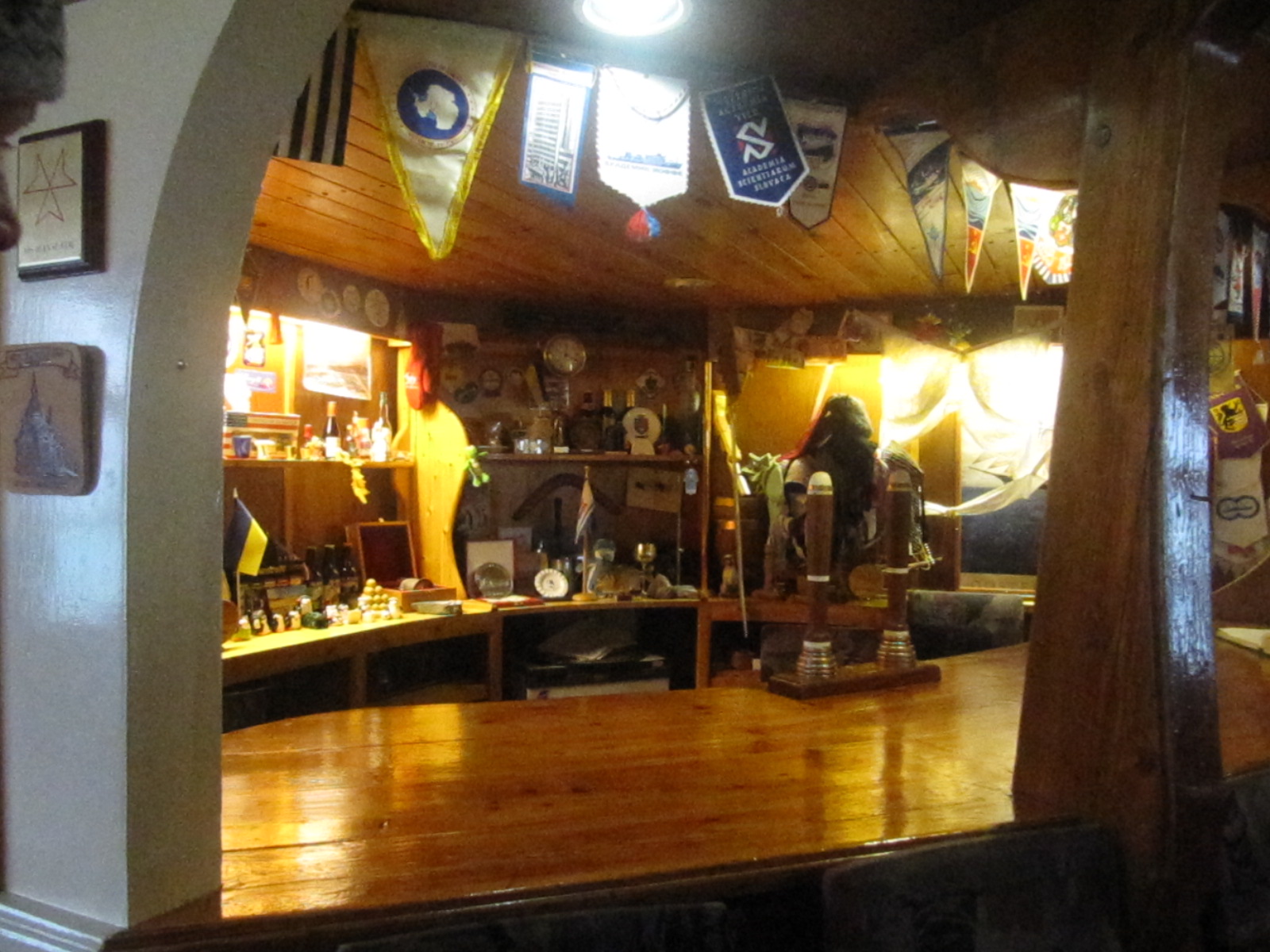

Upstairs they have the kitchen and social areas for the team.  The British heritage is still in evidence her with a bar, billiards table and darts board.  The  wooden bar was made unofficially by carpenters that were supposed to be doing other work.

There is a large collection of bras hanging over the bar, apparently donated by various of the limited female visitors.  One is absolutely huge, and if that belonged to a real woman then I'm guessing she was scary.  I didn't add any of mine to the collection, it took me long enough to find one to replace the one I lost in the fire.

The station also has its own post office where we got another stamp in our passport, and a gift shop.  The guys here use the spare time they have in the winter months to hand make various souvenirs which they sell to visitors.  I liked that and bought myself a little hand painted bell.

This was the furthest south that we were going to reach on our trip, at 65 degrees 15 minutes south, which is about the same distance from the South Pole as just under three times the distance between Land's End and John O'Groats.

Argentine Islands - Wordie House

In the afternoon we anchored around the Argentine Islands for landings at Wordie House and the Vernadsky Station.  Both were originally part of the British Faraday Station.  On the way to shore we spotted fur seals on one of the small islands.  Fur seals are from the same family as sea lions, with the longer front flippers that enable them to sit up and 'walk' on the flippers rather than just moving caterpillar style as the other seals do.  No pictures sadly as it was just too wet for my camera.
 
 
 We also had a go at breaking up a bit of the pack ice with the zodiac, without much success. Not surprising really, the sea ice was so thick and widespread around here that we were only the second ship that had made it to here since the end of their last summer, almost a year ago.


Wordie House was our first stop.  Our photo seems to have disappeared, so I have borrowed one from BAS.  But it was snowier when we were here and the picture doesn't show the huge glacier outside.  The hut, Base F, was built in 1947, one year after the original 1934 base was washed away by a Tsunami.  It is rumoured to be haunted, but we didn't see or hear any ghosts.


Restored in the 1990s by the British Antarctic Survey in the manner that it would have been in the 1950s, it is an important historical site, with many original artifacts of life in an Antarctic station.  It was hard to imagine four or five men spending months here.


I rather liked seeing the old jar of Marmite along with the old anthracite stove and other items. The old Guinness sign amused me, but I'm not sure they would have got a great deal of that here.


One item on the wall was an old document showing how much coal they had used to keep the cold out.  I couldn't make out all of it but they got through quite a bit.  Only to be expected when the information at Vernadsky shows that the average annual temperature out here is just under minus two degrees centigrade now.


The overall trend shows this as increased from just over minus six back in 1947, but the coldest year was 1959 when the average temperature was below minus eight.   I'm guessing that they used a lot of coal that winter.

But of course those temperatures don't take account of the wind chill factor, and I can definitely say that the wind can make it a lot colder even in the Antarctic summer time.
From Wordie House we got back in the zodiacs and made the short trip round to the Vernadsky Station on Galindez Island.