Welcome to our travel blog. We are Tabitha and Nic. In 2011 we 'retired' in our early 40s and set off to travel the world. We spent our first year in South America and have been lucky enough to make two trips to Antarctica.

Our blog is a record of our travels, thoughts and experiences. It is not a guide book, but we do include some tips and information, so we hope that you may find it useful if you are planning to visit somewhere we have been. Or you may just find it interesting as a bit of armchair travel.


Showing posts with label sticky rice. Show all posts

Tuesday, October 25, 2016

Chiang Mai - elephants, temples, and a taste of bee and ant eggs

Chiang Mun Temple, Chiang Mai
From Siem Reap, we flew to Chiang Mai, in Northern Thailand. We only had a few days here, and unfortunately we came a little unstuck with some of the things we would have liked to have done, because we hadn't booked in advance.

One of the things we had thought we might do was an elephant experience, but we were very particular about making sure that it was a totally 'ethical' one. Anything that involved riding them, or elephants doing tricks etc, was out. And of course we wouldn't go to anywhere that captured wild elephants, so we were only interested in places that got their elephants from rescues.

Chang Lom, Chiang Mun Temple, Chiang Mai

That significantly limited the options available. And when I looked into the ones that seemed OK, I found accounts of the staff using electric shocks or something sharp and pointy to control the elephants, and of them being chained up at night.

The only one that we felt absolutely confident in was one called The Elephant Nature Park. Even here, the elephants are still managed to a degree, in that whilst they graze on the grass, they have 'feeding times' and 'bath times' and the visitors are involved in these.

Given the history of these animals, this kind of pattern may even be comforting for them, and in any case it is hugely better than anywhere else - and of course they have to get an income from somewhere. But the elephants are able to wander around freely and all of the feedback that I have seen is suggests that they are properly cared for, including accounts from volunteers that stay for a week, so really get to see what goes on.

Chiang Mun Temple, Chiang Mai
Sadly, they were fully booked up well in advance, so there was no elephant experience for us this time.

We were also too late for the cooking class that we fancied, Thai Farm Cooking School. When you are as awkward with food as I am, and unable to eat spicy food or fish/seafood, cooking classes are tricky, but this one was flexible, and had great reviews. Maybe another time.

So while we had planned a break from temples after all of those at Angkor, we still ended up seeing a few here after all. But we only popped in to a few.

Vaccuum cleaners, Chiang Mun Temple, Chiang Mai
One was the Chiang Mun Temple from 1296. It has a crystal quartz Buddha, and a marble Buddha, that are around 1,800 and 2,500 years old respectively, and the 700 year old Chang Lom stupa that has elephants around the base.

But it was something else entirely that caught our attention. They were celebrating the 720 year anniversary of the temple, and seemed to be making a collection of offerings to the monks. Nothing particularly unusual there, I know, but it was the nature of the offering that was more surprising. We are used to seeing offerings of money, fruits, flowers, but here they were collecting shiny new vacuum cleaners. I don't know why.

Chiang Mun Temple, Chiang Mai
Aside from some temples, we did quite enjoy strolling around the large walking market, which stretches out through the streets. There is a decent mix of food and goods, much of which is obviously quite touristy, but there are some nice and more original things too.

There was a lady here making and selling temari balls - which if you read our Japan posts, you will know about already - so I bought one to go with my one from Matsumoto. There were also some beautifully carved soaps, which we didn't buy, but we much admired. I'm sure I took a nice photo of them, but appear to have lost it somewhere.

We also tried out some of the local food. I took rather a liking to the sticky rice with mango, but we also tried the rather more adventurous ant egg and bee egg omelettes. Just to clarify, the omelettes are still made with hen's eggs, the ant or bee eggs are just additions. The ant eggs didn't taste that much, they just kind of popped in your mouth, but the bee eggs had a definite honey taste to them.


Chiang Mun Temple, Chiang Mai

Walking Market, Chiang Mai

Bee Egg and Ant Egg omelettes, Walking Market, Chiang Mai
Walking Market, Chiang Mai
 
Temple, Chiang Mai
Wat Phan Tao, Chiang Mai


Wat Phan Tao, Chiang Mai
 
Temple, Chiang Mai


Temple, Chiang Mai

Temple, Chiang Mai


Wat Chedi Luang, Chiang Mai

Wat Chedi Luang, Chiang Mai

Temple, Chiang Mai

Chiang Mai


Tan Pra Maha Kajjana, Chiang Mai


Thursday, December 17, 2015

More Yangon

Our afternoon sightseeing was done in one of the little open back truck style taxis. This was quite nice when driving along, as the breeze provided some relief from the heat, but unfortunately, being in Yangon, we spent a lot of time crawling through the traffic jams, so most of the time it was just stiflingly hot.

Once we finally got moving, our first stop was at the National Museum of Myanmar. We only had about an hour, which was a shame because it was actually quite interesting, with various exhibits about the traditions and culture of the country, including music and the clothing worn in the different regions. The star attractions here though are the thrones of King Thibaw Min, the last king of Myanmar, in particular the very impressive Lion Throne.

After another crawl through traffic, we visited the Chaukhtatgyi Paya and its rather large  reclining Buddha, standing - or rather lying - at 65m long and 16m high. The positioning of the feet, which are covered in 108 sacred Buddhist symbols, is slightly staggered, meaning that the Buddha is depicted just before his death; had the feet been fully together, that would show him having just passed away.
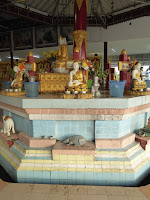

This pagoda also had a round shrine that had eight sections, each representing the day of the week that you were born on, and the animal sign that means you fall under. Why eight rather than seven - Wednesday is split into two parts, the morning and the afternoon. With Nic and I both having been born on a Thursday, we fall under the rat apparently.

The idea is that you give an offering to the sign relevant to you, which generally consists of people pouring a cup of water onto it. Given that they get the water from the shrine itself, it didn't seem like much of an offering to me, but perhaps it's the thought that counts.

After the Buddha, we stopped at Kandawgyi Lake to see the Karaweik. You may remember from an earlier post that the Karaweik is the golden barge that looks a bit like a duck. This one is not only a replica, but it isn't even really a barge as it is concreted in position. It is supposedly quite a nice restaurant, but to us, it just wasn't worth the visit, especially when you spend so much time in traffic to get there.

I was more interested in seeing a group of men busy with the preparation of htamane, a concoction of sticky rice, coconut, peanuts, sesame, oil and ginger, that was being made for the full moon of Tabodwe festival today. Sadly it wasn't ready yet, so we couldn't get a taste. It did however give us an explanation for the strange cylinders that we had seen being given out to children as we passed a school earlier in the day; apparently the bamboo tubes would have contained a gift of htamane.


Our last visit of the day was the famous Shwedagon Pagoda on Singuttara Hill. According to legend, it is over 2500 years old, though experts put it around the 6th to 10th century. Either way, it is certainly an impressive pagoda, and with multiple other structures around it, there is quite a lot to see. It is dedicated to the four Buddhas, Kakusandha, Konasamana, Kassapa, and the one we mostly know about, Gautama. It is said to contain relics from all four, making it the most scared of places of worship in Myanmar.

Of course the usual no shoes rule applies throughout the complex, and that can be a bit of a shock when you first set your bare feet onto the terrace as it can be scorchingly hot after absorbing the sun all day.

The pagoda structure is covered in gold, and the tip has around 5450 diamonds and over 1000 other gems, with the big diamond at the top weighing in at around 76 carats. Just as well it is a long climb up or some non Buddhists might be tempted to help themselves to a few.

It was quite interesting to watch the Buddhist visitors making their offerings at various shrines that are relevant to them in some way. At the shrine which represents children,  expecting couples could be seen making an offering to try to influence what gender their baby would be.

Our guide Myo is from Yangon, and as we were sitting in yet another traffic jam on the way out of the pagoda, he told us that he was going to see his mother to have dinner with her after he had seen us back to the hotel. It was already getting late, and we weren't going anywhere quickly, so we shooed him off to see his mum and leave us to get back to the hotel - once he had given instructions to our driver of course.
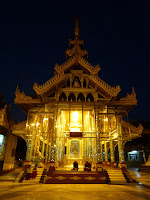

When we finally made it back ourselves, a few of us headed out to a bar and restaurant at the top of the Sakura building, which had a great view of Yangon and the Schwedagon Pagoda. However the prices were as high as the bar was, so we soon moved on to somewhere cheaper.