Welcome to our travel blog. We are Tabitha and Nic. In 2011 we 'retired' in our early 40s and set off to travel the world. We spent our first year in South America and have been lucky enough to make two trips to Antarctica.

Our blog is a record of our travels, thoughts and experiences. It is not a guide book, but we do include some tips and information, so we hope that you may find it useful if you are planning to visit somewhere we have been. Or you may just find it interesting as a bit of armchair travel.


Showing posts with label Hiroshima. Show all posts

Saturday, May 7, 2016

A walk down 'Sake Brewery Street' and a beer festival

Saijo, Hiroshima
Hiroshima isn't only known for its dramatic past and lousy baseball team; the area also has the accolade of being known as Sake Town. There are a couple of towns near to the city that are very well known for their excellent sake, and we took a train out to one of them.

Saijo, Hiroshima
Saijo is only a small town, but it is home to eight sake breweries, seven of which are in one street, Sakagura-dori, or Sake Brewery Street. We visited the breweries that were open, and tried plenty of different sakes. Most weren't really our favourites, (we seem to like those from the Kyoto area best of those we tried,) but they were definitely good quality, and are regular prize winners.

Saijo, Hiroshima
The secret is apparently in the water. The quality of the water is an essential factor for good sake, and you will generally find breweries exist only where the water is good. The water here is known as miracle water, and is called shikomi-mizu, a medium hard type that is perfect for sake.

Saijo, Hiroshima
It varies slightly at the different points along the street where the breweries are, so the sakes are a little different too. The breweries make efforts to preserve the local forests and mountains through which the waters come to develop their sought after qualities.

Saijo, Hiroshima
Some of the breweries have excellent buildings too, and it is lovely to see all of the tall brick chimneys marking the sites. It would be great to be here in October for the sake festival.

Matsuo Shrine, Saijo, Hiroshima
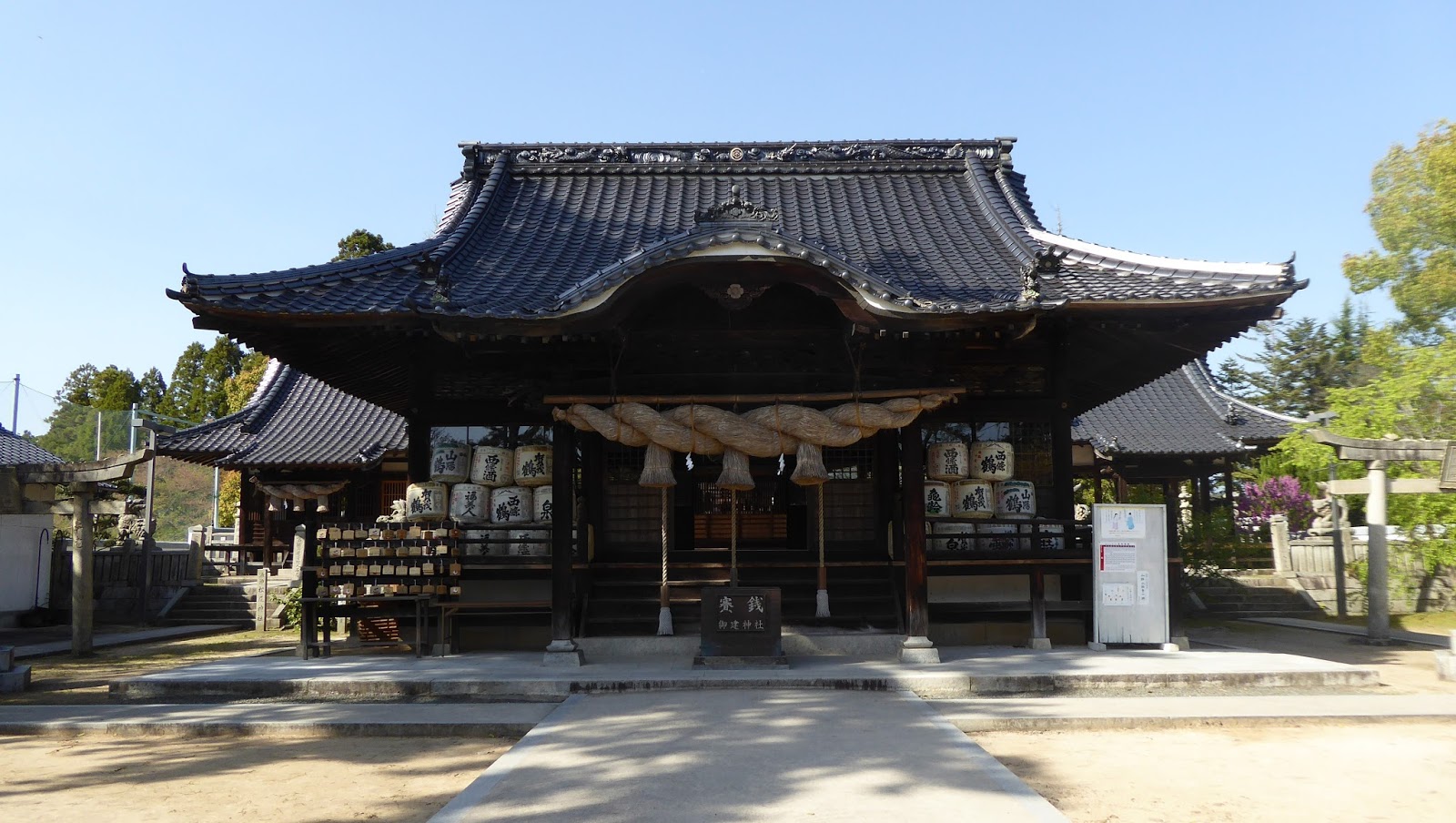
And of course, in a town where sake is so important, there has to be a shrine dedicated to the stuff, the Matsuo Shrine.


Matsuo Shrine, Saijo, Hiroshima

Matsuo Shrine, Saijo, Hiroshima
 
Hiroshima Beer Festival
Back in Hiroshima city, we had an opportunity to partake of alcohol of another kind, as we happened to be in town for the Hiroshima beer festival. We were pretty impressed with some elf the Japanese brews on offer, taking a particular liking to a smoky beer from Fujizakura Heights.


Hiroshima Beer Festival

Hiroshima Beer Festival


Hiroshima Beer Festival


Wednesday, May 4, 2016

Hiroshima Carps

Slyly The Mascot, Hiroshima Carps
Only five years after the devastation of the atomic bomb, one of the things that the city did to try to help with reconstruction was to establish a baseball team. The Hiroshima Toyo Carp got their name from a combination of the city's Rijo, or Carp Castle, and the car company, Toyo Kogyo. The founder of car company Toyo Kogyo, Jujiro Matsuda, owned the controlling interest in the team, having funded its set-up. Whilst the car company was sold on, and is now Mazda, the Matsuda fairly retain their share of the Carps, with the City of Hiroshima owning the rest.


Caroline Kennedy, Hiroshima Carps
The Carps didn't start out too well though and it took them 25 years to start to become successful. But then they did pretty well, winning six pennants up until 1991, but then it all went downhill again, and they are now the only team in the league not to have reached higher than third place since 2000.

Performance isn't helped by the refusal of the management to pay high salaries, so they are unable to buy or retain any top players. But the fans are steadfastly loyal nonetheless and hugely supportive of their team.


Hiroshima Carps
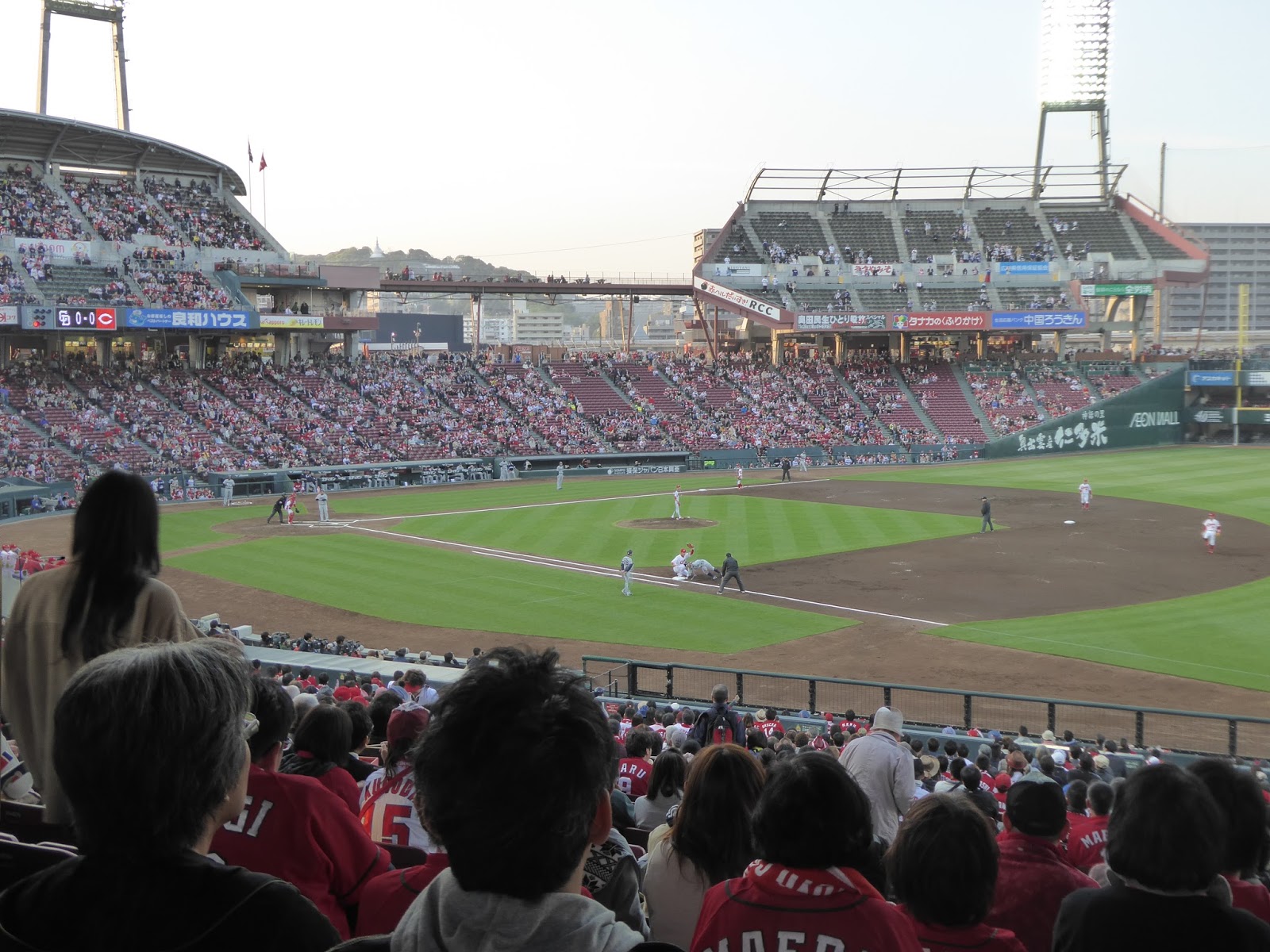
The 32,000 capacity Mazda "Zoom Zoom" Stadium is usually full of enthusiastic, if often disappointed, fans, who are encouraged along by Slyly the mascot. So while we were in Hiroshima, we decided to make like a local, and join them.

After a brief false start in finding where to get the tickets, we managed to get seats for the home match against the Chunichi Dragons. The ceremonial opening pitch was made by the current US Ambassador to Japan, Caroline Kennedy, the only surviving child of the assassinated US President.

Hiroshima Carps
Now, we did a quick look up of rules and so forth beforehand, but Nic and I know nothing about baseball. But even we could see that both teams were pretty awful. We started out fairly optimistic, as the Carps scored an early home run, but that soon faded. As it turned out, that was the only home run of the match.

Hiroshima Carps
It did rather amuse us to watch the crowd during the match, in particular the food choice. There was none of the US style hotdogs, or UK style pies, here it was big bowls of piping hot ramen noodles being slurped through the match. It seemed to us like an accident waiting to happen, but I guess they're well practiced.

Hiroshima Carps
Probably my favourite part of the match was towards the end. We had noticed a number of people buying packets of something red from the vendors, and all of a sudden, everyone started getting out red balloons and blowing them up. One of the guys sitting in front of us handed us a couple of spares, so we duly blew them up, trying to stifle childish giggles at the sight of a stadium filled with people holding rather phallic shaped red balloons!

Red Balloons, Hiroshima Carps
The stadium burst into their team song, and then once it was finished, everyone let go, and thousands of red penis shaped balloons went 'zoom-zooming' around the stadium.

Hiroshima Carps
But crowd enthusiasm notwithstanding, the Carps nearly lost it at the end, when a particularly bad pitcher kept giving away base-on-balls, or 'walks' by delivering four duff pitches. It had reached the point where there all three runners had got to their bases through walks, and one more would give them the run that they needed to draw level, and if they managed a good hit, they could get four runners home.

Hiroshima Carps
Much to the Carps relief, the batter was caught out and they managed to stop any of the runners making it back. So the Carps won. By a rather pathetic 1-0, but still a win. The crowd were thrilled.

Hiroshima Carps


Monday, May 2, 2016

Hiroshima (part 2): A moving and very dignified remembrance

Hiroshima Cenotaph
I split this post into two parts, because it's not a subject that I feel can or should be constrained by the size of a blog posting. The first part was posted yesterday.
 
Just a short distance away from the hypocentre of the bomb, the city has created a permanent reminder of its past. The old centre was devastated by the blast and fire, and they decided not to rebuild there, but to use that area as the focus for remembrance.

A-Bomb Dome, Hiroshima
The Peace Memorial Park is a large and very pleasant area. Close by is the A-Bomb Dome, the skeletal remains of the Prefectural Industrial Promotion Hall, which is the only building that remained standing close to the hypocentre. It is a striking image of the power of the blast, and acts as a permanent link to the past, and to the events of that terrible day.

National Peace Memorial Hall, Hiroshima
The park itself contains the Peace Memorial Museum, the National Peace Memorial Hall and the Cenotaph to the A-bomb victims. All three are important.

The Cenotaph is a beautiful memorial, and contains a chest with a register of the names of all those who died as a result of the bomb; there are over 220,000 names.


National Peace Memorial Hall, Hiroshima
The National Peace Memorial Hall, which was opened in August 2002, is an interesting way to honour those who died. Inside there is a slope taking you down to the Hall of Remembrance, where the walls show a depiction of the city after the bombing, as seen from Shima Hospital, the hypocentre of the blast. The panels are made up of 140,000 tiles, which is the number if people who had died by the end of 1945. The monument in the centre represents the time of the bomb, 8:15am.

Above ground, another memorial depicts the same time, and is surrounded by fountains, which commemorate the way that so many victims died crying out for water.
 
Miyoko's sandal, Hiroshima
But the really impressive place to visit is the Peace Memorial Museum. I was genuinely moved by it, and could see that most other visitors were too. It tells the story of what happened without any hype or blame. A city that could be incredibly bitter and resentful about what happened, is in fact dignified and conciliatory. The only criticism is of their own government for its part in the war; they level no accusation at the USA or its Allies.

There are some very graphic displays, including models of victims who literally had fat dripping from them where it was melting out of their bodies due to the intensity if the heat they were exposed to. But there is nothing sensationalist or gory about any of the exhibits; they are disturbing of course, but shown in a way that is informative and respectful.

Shigeru's lunchbox, Hiroshima
There is a wooden sandal, or geta, that belonged to 13 year old Miyoko, who was 550m from the hypocentre. Her body was never found, but her mother recognised the kimono fabric that she had used to make the sandal. You can sit just make out the imprint of where her foot was.

Schoolboy Shigeru Orimen never got to eat his lunch on that day, and it charred remains were found in his battered lunch box underneath his remains, about 600m away from the hypocentre.

The tricycle and helmet belonged to Shinichi Tetsutani, almost four, who was playing on them outside his home almost a mile away from the hypocentre. He died that night.

Shinichi's tricycle, Hiroshima
A less graphic, but no less emotional exhibit, was the origami cranes. These were folded by Sadako Sasaki, who was two years old when the bomb went off, and by the age of twelve, she was in hospital with terminal leukaemia caused by radiation. She believed that if she could fold a thousand paper cranes, her wish to recover would be granted. She never made it, and died eight months later.

Sadako Sasaki's Origami Cranes. Hiroshima
Probably the most symbolic pieces for me though, was the stone step, which I posted a photo of yesterday, which has a dark mark on it. That is believed to be where someone was sitting at the time of the blast, The mark is all that remained. That is the power and devastation of an atomic weapon.

Origami Cranes. Hiroshima
And what is important to remember is that only a tiny 2% of the payload of this bomb actually went off. And nuclear weapons these days are far more efficient, powerful and destructive. The museum ends with a request to sign a petition for nuclear disarmament.

Origami Cranes. Hiroshima
Now I am not personally convinced about the feasibility of that, so I feel a little conflicted on this issue. I honestly don't know if believe that a full, worldwide disarmament can ever be achieved.

Regardless of my or your views on that, Hiroshima stands as a plea for peace. And I can't, and don't, argue with that; I certainly would never want to see a weapon like this used again.


Sunday, May 1, 2016

Hiroshima (part 1): 220,000 lives lost to a 'Little Boy'

Atomic Blast, Hiroshima
I suspect that if you ask someone to name cities in Japan, then after Tokyo and perhaps Kyoto, many people will find the next city that comes to mind is Hiroshima. Like Chernobyl in the Ukraine, it is one of those places that is infamous rather than famous, and most of us will forever associate the name with the city's past, rather than its present.

I have split this post into two parts, because it's not a subject that I feel can or should be constrained by the size of a blog posting. The second part will be posted tomorrow.

Replica Atomic Bomb, Hiroshima
We really didn't know what to expect of Hiroshima. We knew that there was no ongoing threat from radiation, and that it is a flourishing city, but we didn't know what to expect in terms of the feel of the city, how it deals with its past, and how the people of Hiroshima would feel about visitors.

What we discovered was an amazing city, with great places to eat and drink, and friendly and welcoming locals. In the downtown area, you would have no idea that anything bad had happened here.

The red bomb blast over Hiroshima
But something bad did happen. By the second half of 1945, World War II had ended in Europe, but as a nation famed for the ideal of death before dishonour, the Japanese were showing no sign of surrender. Incendiary bombings in Tokyo had killed over 100,000 people, and it was inevitable that if the war with Japan was to be won, many more thousands would die in the process. If the allies could even win it.


Hiroshima survivors, 2.2 miles away
Reluctant to seek help from the Soviet Union, not wishing to allow a spread of communist influence, and seeing no end in sight through conventional warfare, the USA decided to use its new weapon, the atomic bomb. The aim was to send such a message of strength and superiority to Japan, that it would end the war. As it turned out, it would work.


Clothes and photos of survivors, Hiroshima
I understand the logic of the argument. It may well even be true that the number of deaths in Japan and the surrounding area would have been much higher had the bombs not been dropped. What I'm not so sure about was whether, in this case, the ends really did justify the means.

It isn't a new dilemma in warfare, and it is one we are still facing as we battle against terrorism and the likes of Daesh. It is the kind of decision that is easy to criticise, but must be unbelievably hard to take, and to live with afterwards.


The order to drop the A-bomb, Hiroshima
Right or wrong, the decision was made, and four cities were selected as optimum targets, Hiroshima, Nagasaki, Kokura and Niigata. I have to wonder how the people of Kokura and Niigata felt when it was revealed years later that it could have been them instead of Hiroshima and then Nagasaki. It seems Hiroshima may have been favoured because it did not have an allied prisoner of war camp as the others did, but the final selection was made by the weather conditions.


Black rain on a wall, Hiroshima
On 6 August 1945, at 8:15am, the B29 bomber the Enola Gay, dropped the 'Little Boy' atomic bomb, the first in the world, over Hiroshima. The 3m long, 4 ton bomb, contained 50kg of uranium 235, which was designed to react with plutonium to create nuclear fission. When the bomb exploded, some 600m above the city, less than 1 kg of the uranium actually reacted, but that alone caused the kind of damage that would take over 16,000 tons of high performance explosives.

Turned to dust, Hiroshoma
Within a second, the temperature reached over 1 million degrees Celsius, and caused a fireball with a diameter of 280m. The surface temperature rose to 3000-4000 degrees Celsius. The intense heat and blast from the explosion crushed and burned nearly all buildings in a 2km radius. Some 80,000 people were believed to have been killed instantly, some being literally turned to dust.

That very soot and dust, that was now radioactive, was carried into the air, mixed with water vapour, and fell back to earth, covering a much greater area with black, or acid, rain.


Fused glass bottles, Hiroshima
The heat of the blast can be seen by the way that glass bottles fused together. The ones in the photo were 1800m away from the blast, and the four year old child who lived next door, died the next day.

The heat was also visible in the photo of the water tap, the shadow of which was imprinted onto the wall next to it by the intensity of the heat and light.

Imprinted shadow, Hiroshima
The radiation from the blast severely affected anyone within 1km of the hypocentre, and most died within a few days. Those that didn't, or were further away still suffered the effects of the radiation. There were around 350,000 people living in and around Hiroshima in 1945.


Fingernails that keep growing, Hiroshima
Some 140,00-160,000 were dead by the end of the year, and the register of the dead, contained in the memorial, holds over 220,000 names of victims. Many others suffered horrible effects throughout the rest of their lives.