I said in an earlier posting that both while we were travelling, and since we have been back, we frequently have been asked which was our favourite country or place. I also said that I find it impossible to give a single answer to that question as I don't feel I can reduce such a fabulous year down to just one 'best' thing.
So instead, we have come up with a short-list of our highlights from this first year. In no particular order, it would have to include:
* laid back and gastronomically fabulous Palermo area of Buenos Aires, not least for its cafes, cakes, steak and wine.
* amazing scenery on the Bolivian Altiplano between the Atacama Desert and the Uyuni Salt Flats;
* satisfaction at managing a proper conversation in Spanish with our home stay host in Raqchi, even if our teacher would have been horrified at all of the mistakes;
* exhilaration of adventure activities, such as ziplining, white water rafting and sand boarding;
* relief that we all made it safely out of the fire at Shangri-la
* unconditional friendliness from Colombians who were so pleased to welcome us as tourists to their country;
* seeing the moai left as they were abandoned in the quarry on Easter Island;
* watching - and more particularly hearing - chunks of ice cleaving off the vast and beautiful Perito Moreno glacier;
* grandeur of the fjords, lakes, mountains and volcanoes of southern Chile;
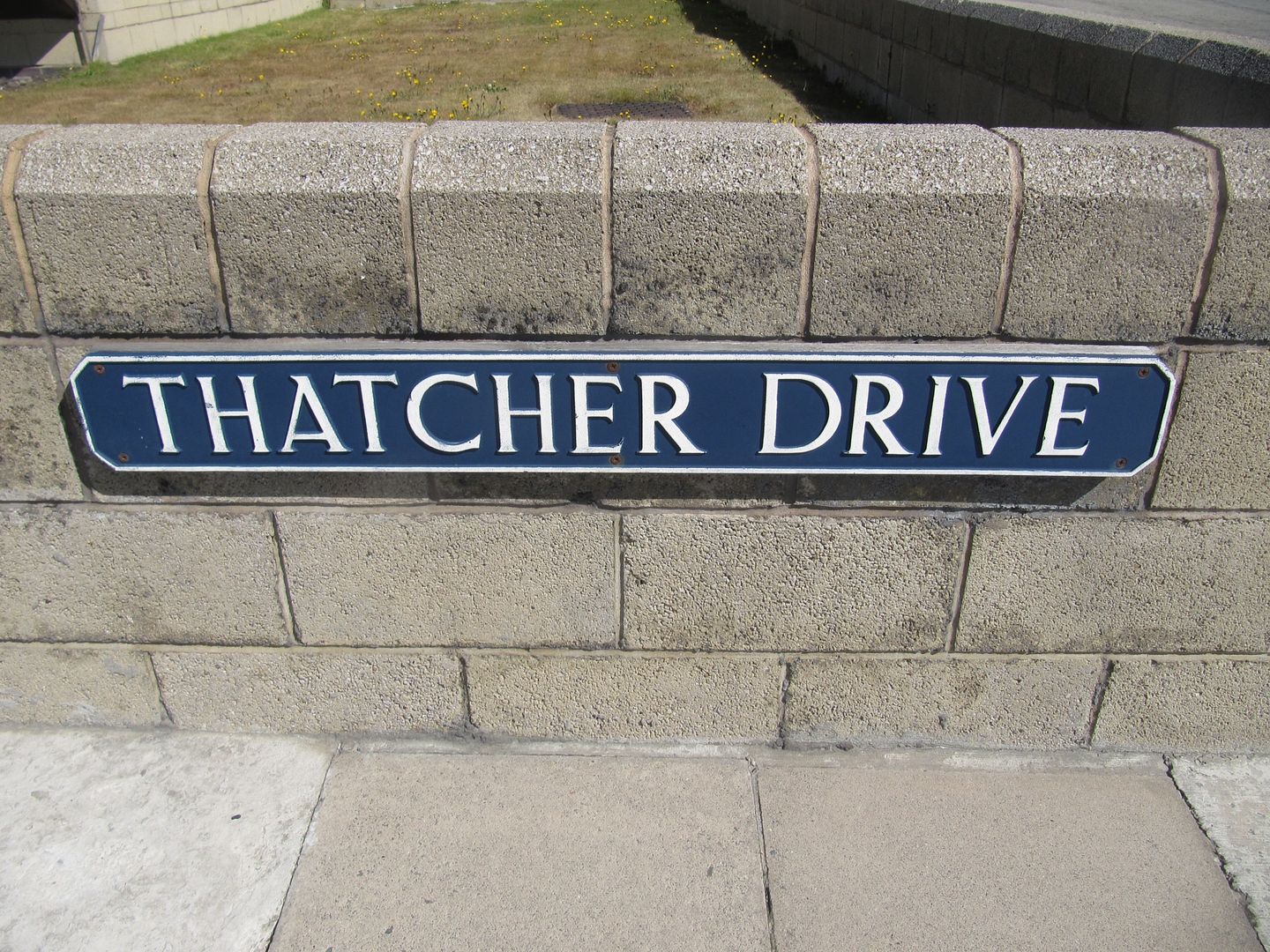
* experiencing the strange feeling of being in a village in England despite being 8000 miles away in the Falkland Islands and having the chance to talk to the islanders first hand about how they feel about the question of their nationality;
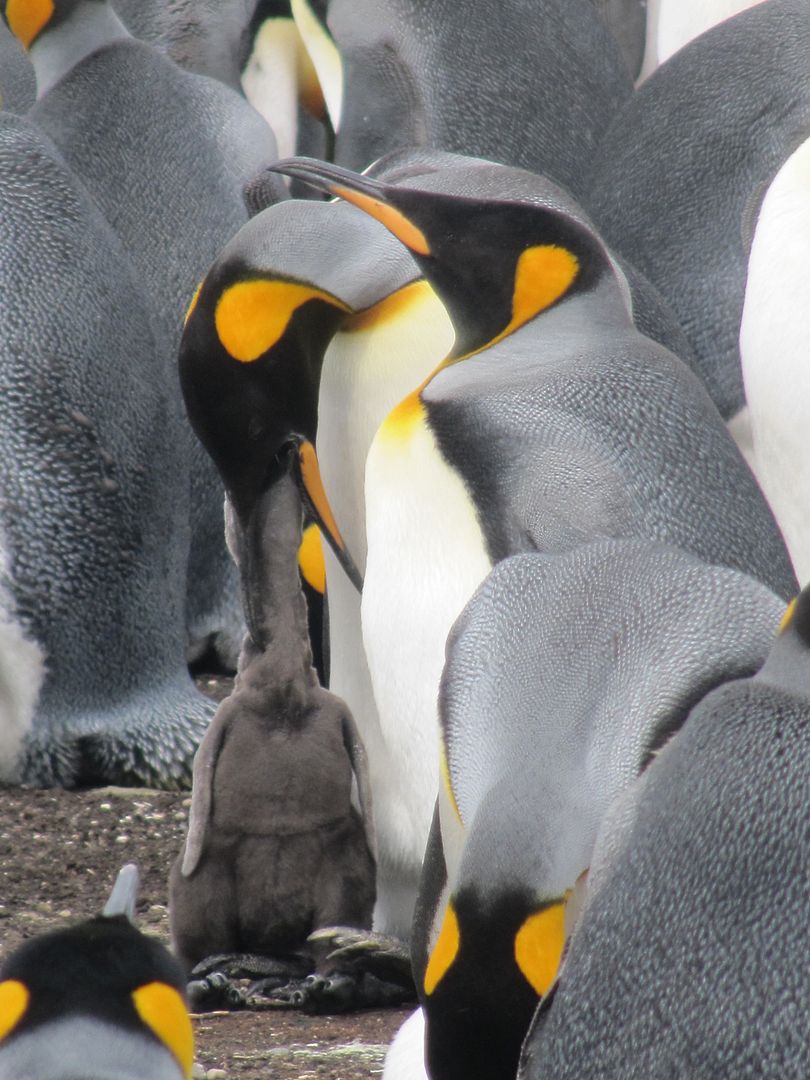
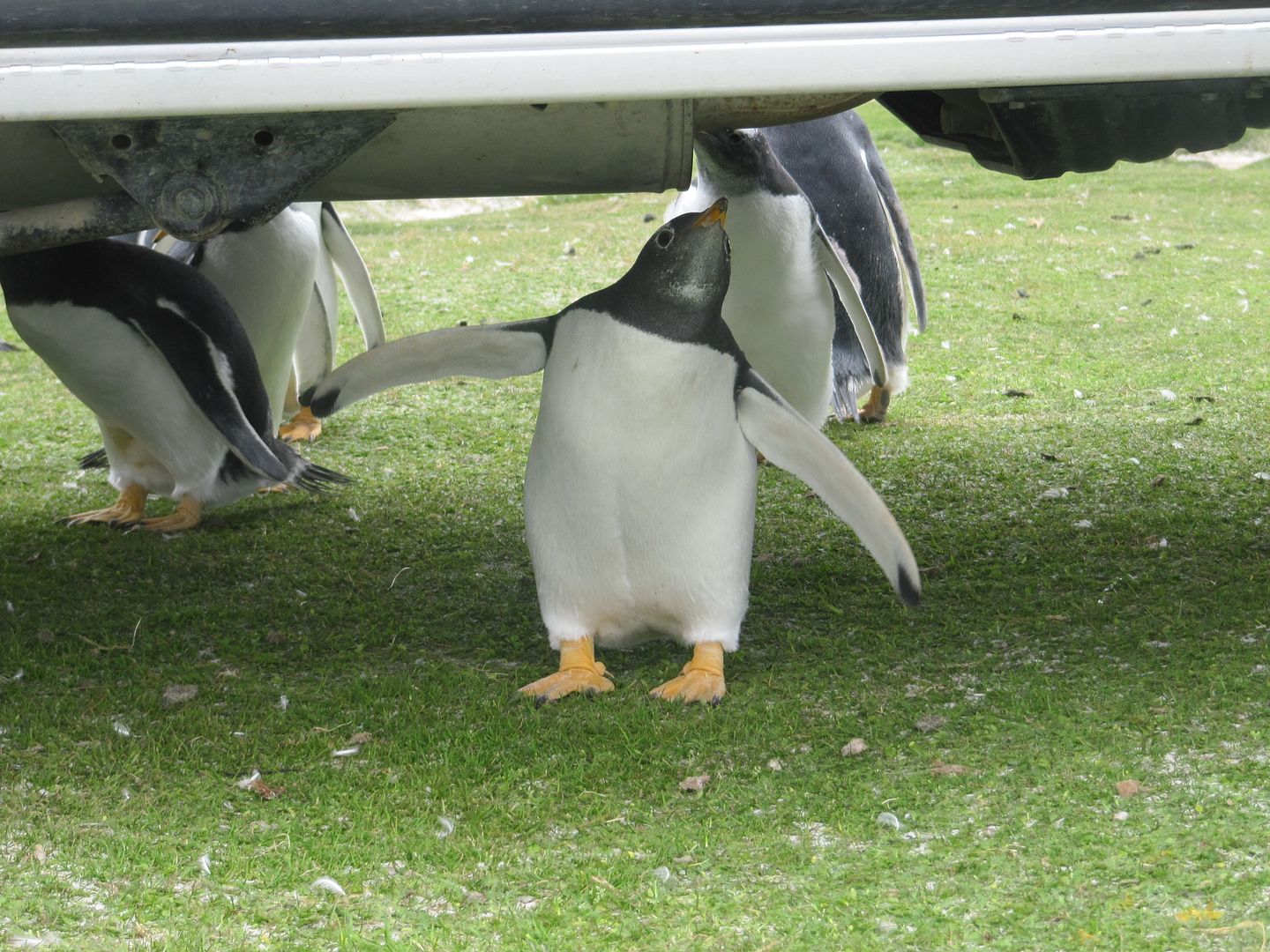
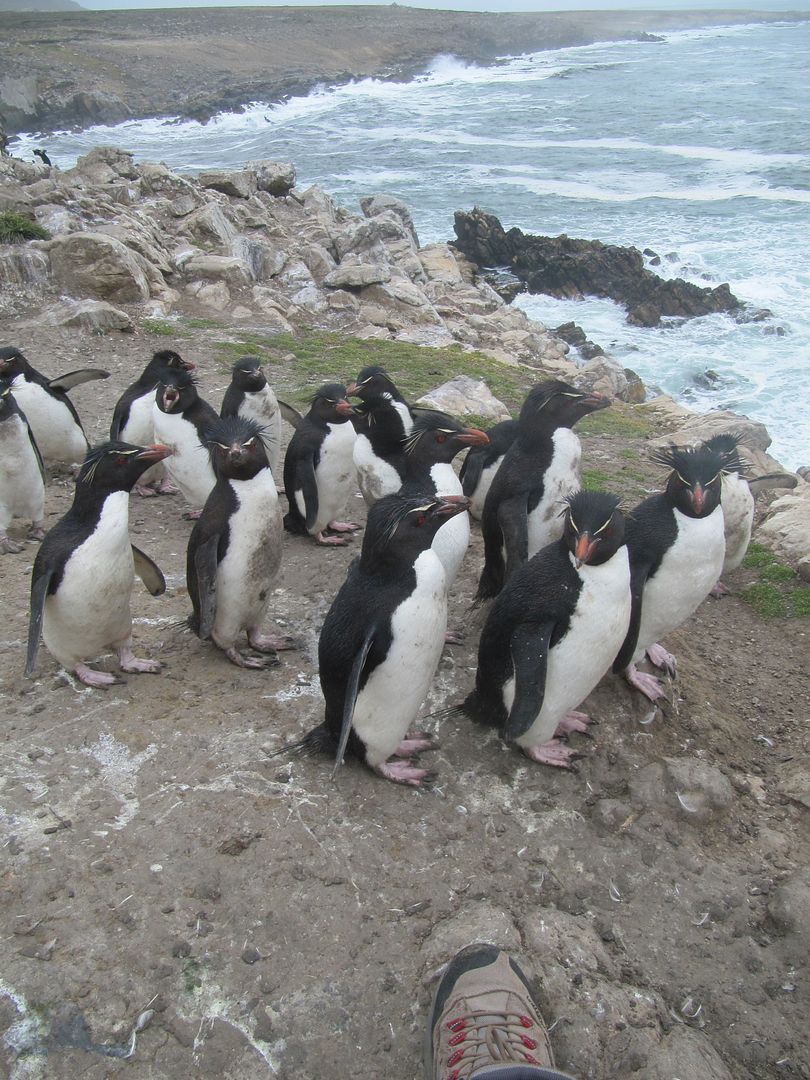
* being pecked by penguins and watching their comical antics in the Falklands and Antarctica;
* simply being in Antarctica, the coldest, windiest, driest, and highest place on earth;
* getting wet at the spectacular Iguassu Falls;
* meeting some fabulous people, some fleetingly, some who have become friends and we will hopefully be seeing again sometime, somewhere in the world!
Over the coming weeks I may add a few posts about some of these highlights and what made each of them so special.
Welcome to our travel blog. We are Tabitha and Nic. In 2011 we 'retired' in our early 40s and set off to travel the world. We spent our first year in South America and have been lucky enough to make two trips to Antarctica.
Our blog is a record of our travels, thoughts and experiences. It is not a guide book, but we do include some tips and information, so we hope that you may find it useful if you are planning to visit somewhere we have been. Or you may just find it interesting as a bit of armchair travel.
Showing posts with label Falkland Islands. Show all posts
Wednesday, August 1, 2012
Wednesday, April 18, 2012
Malvinas Day
| Malvinas memorial in Ushuaia |
I've talked about the reasons why Argentines feel that the Falklands should be theirs before, but I have not talked to any Argentines about what they really think should happen or how strong the feelings are. I would like to, but my feeling is that the opinions here are very strong, having been taught from an early age, but also very complicated.
It seems fairly clear that the original conflict in 1982 was a desperate effort by the ruling military junta to deflect public opinion from their failings and stay in power. Some of the television and news items that we have seen makes it clear that the media at the time actively lied about the progress of the war. I have seen one person write that they were scared that the British would attack Argentina during the conflict. Many Argentines seem to be unhappy with what happened back in 1982, but at the time, it seems there was significant public support for the invasion.
From what I have read and seen, children here are taught that the British stole the islands from Argentina and that they should be given back. They are perceived as the lost little sister. But it is not at all clear to me how how much of what is taught is factual and how much is propaganda. I have no idea how much or how little the average Argentine knows about the islands or the islanders. The story of Las Malvinas is certainly a deep seated one here, and it is a major political issue, but I cannot tell from what I have seen what most people truly believe should happen.
| Malvinas protest in Paza de Mayo |
On Malvinas Day itself, we were heading home in the early hours and saw that the protest outside the Casa Rosada was gearing up. We didn't stop to say hello. They had also changed the usual pink lighting on the Casa Rosada itself to blue.
There were at least six channels dedicated to the issue for the whole day and we looked at some of it. Sadly our Spanish isn't really up to understanding what was being said, but there were former soldiers, academics and various others being interviewed and opinions seemed to vary. There were some debates, which seemed to have some clear support for backing off the issue. And we read about a group of respected Argentines sending a letter to Christina to say that Argentina should reconsider its claim to own the Falklands in light of the islanders right to self determination.
We also caught the tail end of a film about the Conflict, which showed a soldier dying and then his friend and fellow soldier going back to the Falklands afterwards to visit the sites where they fought. Strangely, although the first part was in Spanish, when they got to the Falklands the speech was in English and there were no Spanish subtitles. Not sure why. From the looks of it, this was not a political film, but the story of people involved in it, but the film made no attempt to hide the very British nature of the place or that the islanders seemed happy as they are.
| Casa Rosada in blue |
We had figured that there might be trouble today, and so although we know that most people are very friendly and wouldn't even consider taking this out on us, we also know that it only takes one idiot to take offence at our accents and there could be a problem. So we decided not to take the chance of meeting that idiot and getting into a scrape; instead we took the easy route and holed up in our flat for the day with some nice Argentine wines. The next day we were back out again with people being friendly as usual.
Wednesday, March 14, 2012
The Falklands question
| Stanley rooftop |
Coming to the Falkland Islands, we figured it would be a good opportunity to get to know what the islanders really think about their nationality. From the UK it is impossible to know what the people here are like and what they actually want for their life on these remote islands. Most of us have only even heard of the FIs because of the 1982 conflict and even then all we know is what we have seen in the news, and that is mostly political posturing.
In the UK I have heard views ranging from 'we fought a war and people died so we should never give it back', through 'we only care because of the oil', to 'why should we support some people thousands of miles away, we should give it back to Argentina'. Doubtless most of the people expressing these views actually know very little about it. I make no pretence that a couple of weeks here makes me an expert either, but we have at least learned some facts, have met some islanders and heard what the people that live there really think.Firstly there is the issue of who has a claim to the islands, which I'm afraid requires looking at a bit of the history. And I can't claim to have done lots of research into both sides of the story, so whilst I am trying to put the real picture, I can't guarantee complete accuracy or lack of bias! The first recorded sighting of the FIs was by English Sea Captain John Davis in 1592, and the first recorded landing by English Captain John Strong in 1690 when he named the Falkland Sound. The first settlement was by the French in 1764 followed in 1765 by the English in another part of the islands, each with no knowledge of the other being there.
In 1766 the Spanish objected to the French settlement with the result that the French sold their interest to the Spanish. The Spanish kicked the British out of their settlement in 1770, but after diplomatic negotiations between the British, French and Spanish, the Exchange of Declarations restored the settlement to the British in 1771. Argentina became a country independent of Spain in 1810 and territories passed to Argentina in 1816, but with no specific mention of the FIs. Equally, there was no mention of the FIs in the Treaty of Amity, Trade and Navigation signed by the British and Argentines in 1825.
Argentine Louis Vernet formed a settlement at the old French/Spanish site in 1826, and was appointed commander of the islands by Buenos Aires in 1829. Britain registered a formal protest at that time, asserting its own sovereignty. This doesn't appear to have been resolved formally, but Vernet did obtain British counter signing of any of his land grants, and sought protection for his settlement, which suggests to me an acknowledgement of the British claim.
Then in 1831, Vernet upset the USA and Britain to do with sealing rights, apparently seizing property from an US ship, which prompted the US to send a warship to attack the Vernet's settlement. The USA considered the Argentine claim to the islands to be unjustified, and supposedly declared the islands not to belong to anyone. Argentina sent another interim commander, but he was murdered by his own men, and Britain reasserted it's claim to the settlement.
| Argentine message during the conflict |
In 1833, English captain John Onslow asked the Argentines to reach their flag with the British one and leave the settlement, which they did, but under protest. Since then the Falkland Islands have been under British Sovereignty The issue reemerged when Argentina joined the UN and objected to British sovereignty, but Argentina then refused three offers of discussions. Negotiations were held for about 17 years after the 1965 UN resolution, but with no success. British political support for the islands strengthened after the Argentine military invasion in 1982 and the subsequent war.
I don't claim any expertise in this area, but it seems to me that at the very least, the British do have a legitimate claim as that was confirmed by the only relevant parties in 1771. The Spanish probably did have a claim, which may or may not have legitimately transferred to Argentina. This seems to leave Britain with a definitive claim to at least partial Sovereignty in my reckoning although I can see how the Argentina feels it at least had some claim too. Irrespective of the claims though, the UN has repeatedly urged the end to the ideas of colonialism and has a general principal of self determination of the people.
But before we get to what the people want, there is the argument about proximity. No-one can deny that the FIs are a long way from Britain, but they are also 300 miles from Argentina. Compare that to the Channel Islands which are 14 miles from France and the French Islands of Saint Pierre and Miquelon which are around 12 miles from the coast of Canada. Or how about the British colony of Guyana, French Guiana and the Dutch colony of Suriname, all nestled between Venezuela and Brazil. This list is endless and if you simply said that the biggest and closest country has a right to those smaller ones around it, most countries would eventually end up as Russian or Chinese.
Realistically these arguments are just not feasible. Obviously these acts of history are not the doing of the current people of Argentina, and it is not right to blame them for what happened, just as however much I think it regrettable that it has caused such problems, I refuse to feel guilty for the issues in Northern Ireland. If you start trying to change or reverse history, then where on earth do you stop. Boundaries and claims on countries have changed so many times, how can you say which is the more legitimate claim simply in those terms?
So what about the money. Well in fact, The FIs support themselves entirely. The only thing that they get from the UK is military protection. Of course that does have a cost to the UK, but we do not, as some believe, pay for their hospitals, education or anything else. And the oil? Well that is nothing to do with us either, so the suggestion that we only protect the FIs because of that is wrong too. We are told that the oil would belong to the islanders (though doubtless some would get more from it than others), and it would help them to provide more and better services to the islands. We have been told that the islands may make a payment to the UK, which would be regarded as a kind of thank you for the military protection, but I have no idea if it would actually happen.
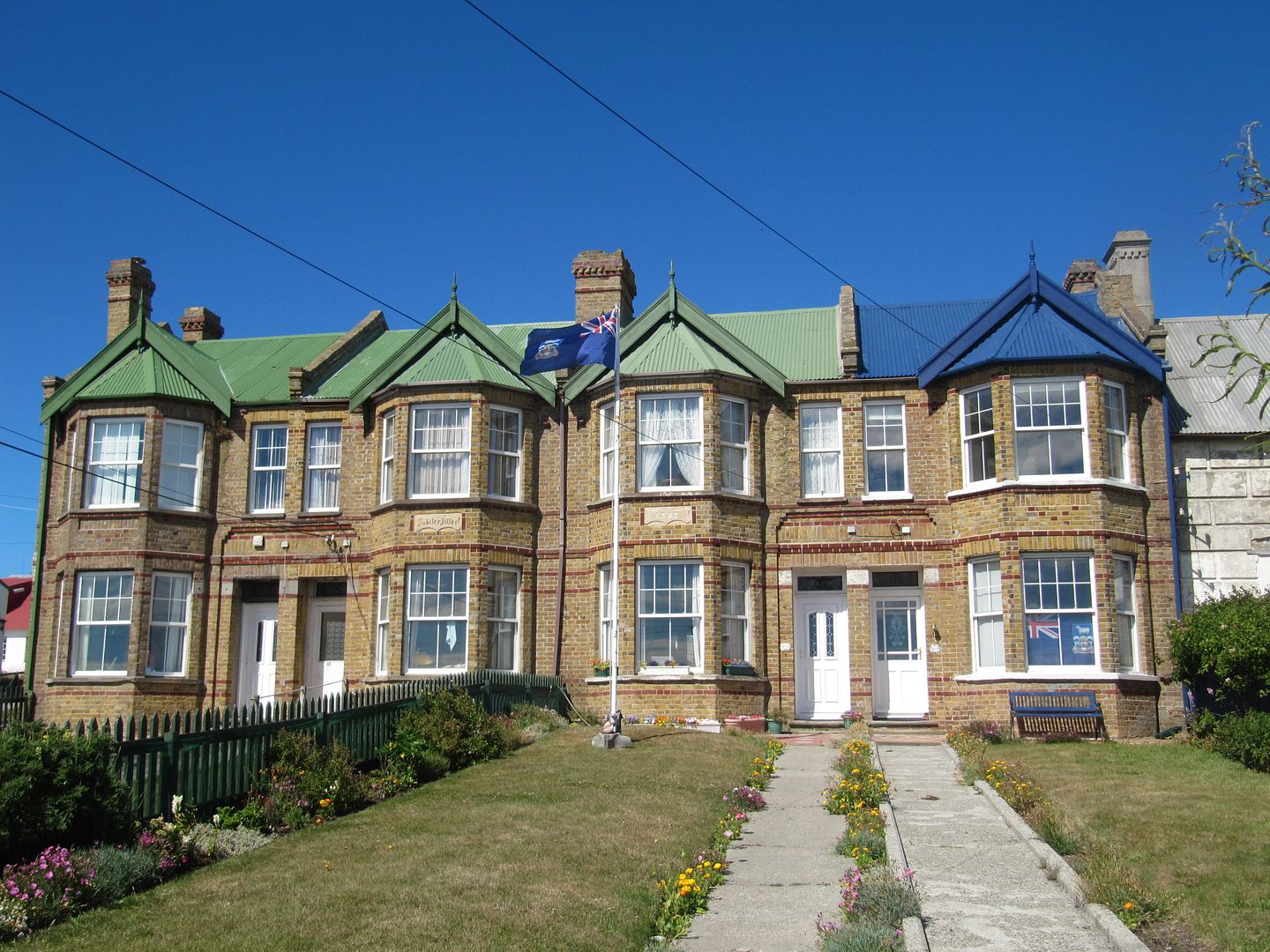
But surely the most important factor here is the people. When we came here we didn't really know what to expect. Are the people really British? Do they look and sound British? Do they have any links at all with the UK? Well the answer is a resounding yes to all three questions. There are some people who have come here mostly from Chile or St Helena, but the majority of the population, the real Falkland Islanders, are as British as they come. If you put them in a pub in London the British drinkers would have no idea that they came from 8000 miles away.
Most of the islanders have relatives in the UK and many of them have lived and worked there at some stage in their lives. And as the education system here can only give opportunities up to GCSE level, if the children show the capability to go on to A levels or university, they are given a grant by the Falkland Islands to get the rest of their education in the UK. They have a British Legion club, they celebrate Poppy Day and the Queen's birthday, and they watch British Forces TV and radio. Visitors to the island have declared Falkland Islanders to be 'more British than the British!'
And for the first time since being away from home, we have managed to have proper sausages and bacon for breakfast, marmite, salt and vinegar crisps, cheddar cheese, fish and chips with real vinegar, and Dairy Milk chocolate. The shops here sell exactly what you would expect to see in the UK, including Sainsburys and Waitrose branded goods. It is just like being in a village in the UK, but windier and with penguins.
| Argentine message during the conflict |
During the 1982 conflict the message to the islanders was that they were being liberated from British power, and welcomed by Argentines as their long lost brethren. And in Argentina we saw numerous signs that remind people that the Malvinas are Argentine and must not be forgotten. I don't know how important an issue it is for most Argentine people, as it is not a conversation that I have felt I could get into so far, and I make no effort here to say that such sentiments are wrong, but the reality for the islanders is that they don't consider themselves to be even remotely connected to Argentina.
The people we have spoken to here regard themselves as Falkland Islanders and are proud of their own heritage and self governance. But equally they are proud to be a part of Britain, celebrating the same traditions and values that we do. They value the protection we give them very highly, as they feel a constant pressure from the politicians in Argentina and live in fear that without British protection they would lose either their nationality and their freedom, or their home. They are already struggling, as a result of the blockading, to get eggs or fresh fruit and vegetables, as well as the flights being threatened.
| Falkland Islands poster |
Goose Green, Darwin and San Carlos
| View over Goose Green battlegrounds |
| British Cemetery at San Carlos |
| Items left at the Blue Beach Cemetery |
| Settlement at Goose Green |
| Village Hall at Goose Green |
| Shearing sheds at Goose Green |
| Darwin settlement |
Our next stop was Darwin, which many years ago was where the settlement gentry lived, rather than with their workers in Goose Green. There is still an old stone corral, complete with its small escape holes in case a person was trapped by an angry animal.
| Memorial to 2 Para |
Close to here is the memorial to the men from 2 Para who died in the battles here, and then a short walk away, overlooking an area that is peaceful now but must have been a horrendous place to have had to try to capture in a battle, is the memorial to Colonel H Jones, the other person awarded the Victoria Cross, who was killed when he stormed a position at a vital point in the battle at Goose Green.
| Memorial to Capt H Jones |
| Argentine Cemetery |
| Unknown Argentine grave |
Volunteer Point and King Penguins
| King penguins |
It was a few hours of driving and on the way Derek our guide also pointed out some of the locations that were in the headlines in 1982, such as Mount Longdon, where Victoria cross winner Sgt McKay was killed, Mount Harriet, and Tumbledown. We didn't take time out to walk around these old battlegrounds, but had we done so, we would still have been able to find the debris of war, such as bullet shells, blankets, boots and even an old shaving kit. Seeing the areas for ourselves, it was clear how difficult the British attack would have been as there was little cover and the terrain was rough going.
| King penguin |
After around three hours of driving over rough roads first and then bumpy tracks across the boggy fields, we arrived at volunteer point. A few of the king penguins were hanging around the white sandy beach, but most of the colony was at the rookery slightly inland. At last count the were around 750 adults and 550 chicks, so this is a large and successful colony.
| King penguin with its egg |
| King feeding its chick |
It was slightly strange watching them feed their chicks though as it almost looks like the adult has swallowed the chicks head entirely as it regurgitates the food for it.
We did also manage to spot one large fluffy brown chick which would have been a straggler from the last breeding season that had not yet developed its sleeker black and white plumage.
| King penguin year old chick |
Because the king penguins can abandon a chick if disturbed, there is a ring of white stones around the main rookery, which people do not cross. This way the penguins are content, but we can still enjoy watching them.
The kings are bigger than the other penguins we have seen, and they emphasize this even more as they generally walk high on their legs, rather than shuffling along as the others tend to. They do have a more imposing stance and their orange markings on their head and chest look most impressive.
| Gentoos playing under the vehicles |
| Gentoo pecking Tabitha |
Of course aside from being pecked a bit too vigorously, the thing that you need to be careful of with the penguins is their projectile pooing. They stand there all innocently, then suddenly lift their tail and squirt out a stream of poo that extends over a foot behind them. Thankfully we were never in the firing line, but we know a person who was, albeit not here. And penguin poo is very smelly.
Sheep Shearing
It surprised us how calm the animals were, and how quick the shearers are. They got through a full grown sheep in less than two minutes, without nicking the sheep or spoiling the fleece.
The fleeces are graded for the quality of the wool - the straighter the wool the better - then packed up and sent off to the buyers. All of the washing and processing is done at the other end.
This was a short but interesting stop, and it reminded me of something that I had heard on the radio when I was listening out for the flight times. Obviously when the sheep are newly sheared, they are more vulnerable to the cold than normal, so as well as the normal weather reports, the local radion station also puts out the 'sheep chill factor' so that farmers know if they need to do anything extra to protect their flock.
Monday, March 12, 2012
Stanley
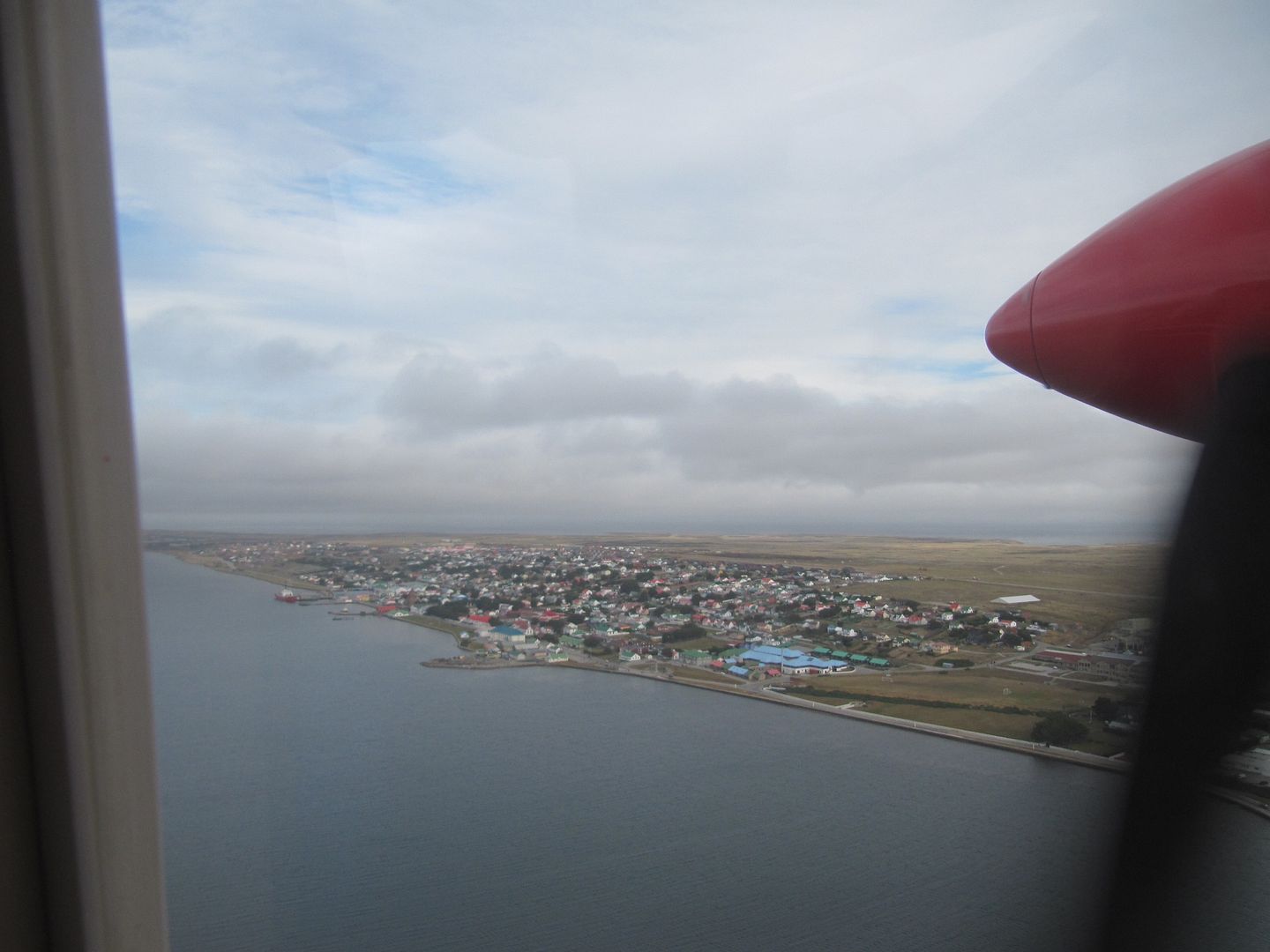
The Falkland Islands are bigger than I had thought they were. They are made up of the two main Islands of East and West Falklands, and 778 smaller islands. Overall they cover around 4700 square miles, which is just over half the size of Wales. Whilst the larger islands are all habitable, and some have farms and small settlements on them, the only town is Stanley on East Falklands. Of the almost 2500 inhabitants (excluding the military base in Mount Pleasant) , 2115 of them live in Stanley.
Everywhere other than Stanley is regarded as Camp. There are a number of other small settlements in Camp, with just under 200 people living elsewhere on East Falkland, about 125 on West Falkland, and just over 40 on the smaller islands.
But even as the only actual town on the islands, Stanley is still very small. Whilst the residential part goes out a bit further. The main centre of the town is only about three streets by seven. There is the all important jetty and visitor centre; a bank, but no cash point; a post office with a philately bureau - apparently collectors stamps are big business here; a police station where you can see about five helmets lined up by the door and three vehicles outside; and a shopping centre, with a supermarket/clothes shop, cafe, electrical shop and a hairdressers in it.
Just off the centre is the hospital, the government buildings and Governor's House and a little further again is the museum. The museum is interesting. It covers a range of stuff from maritime and farming, to how people used to live, and the 1982 conflict. As a person who is not keen on dentists to start with, I was looking with horror at the primitive dentist's chair with foot propelled drill, when a local came up and said she remembered being in that chair and that the dentist often only pedalled the drill very slowly. She was glad when he left; I was glad never to have had that particular experience at all.
The 1982 Conflict section was good as it had a number of pieces of Argentine propaganda and some journals that the locals kept, which gave an fascinating insight into what it was really like during that time. The locals talked about how the Argentine soldiers would come and ask them to buy food because they were hungry, about how one of their friends had gone back to the bottle, and about the distress felt when a civilian house was accidentally hit killing three locals.
On a less serious note was the little exhibit dedicated to the wedding of Prince William and Catherine Middleton. As part of their celebrations they obtained a life size cardboard cut out of their engagement picture and took it on a tour of the islands taking photos of it in all of the different places and with various local people. The resulting album was amusing to see although you have to wonder whether William himself would be able to stifle a laugh if he sees it during his visit here.
Otherwise there are a couple of hotels, a few B&Bs, some gift shops, a couple of cafes, two churches and of course, some pubs. One good solid day of sightseeing and you could have been everywhere there is to go and seen everything there is to see.
But that wouldn't mean that you have got to know Stanley. We chose to spend a bit long here, not just so that we could do a couple of day trips and take advantage of the comforts of home, but also so that we could get an idea of what it is to be a Falkland Islander.
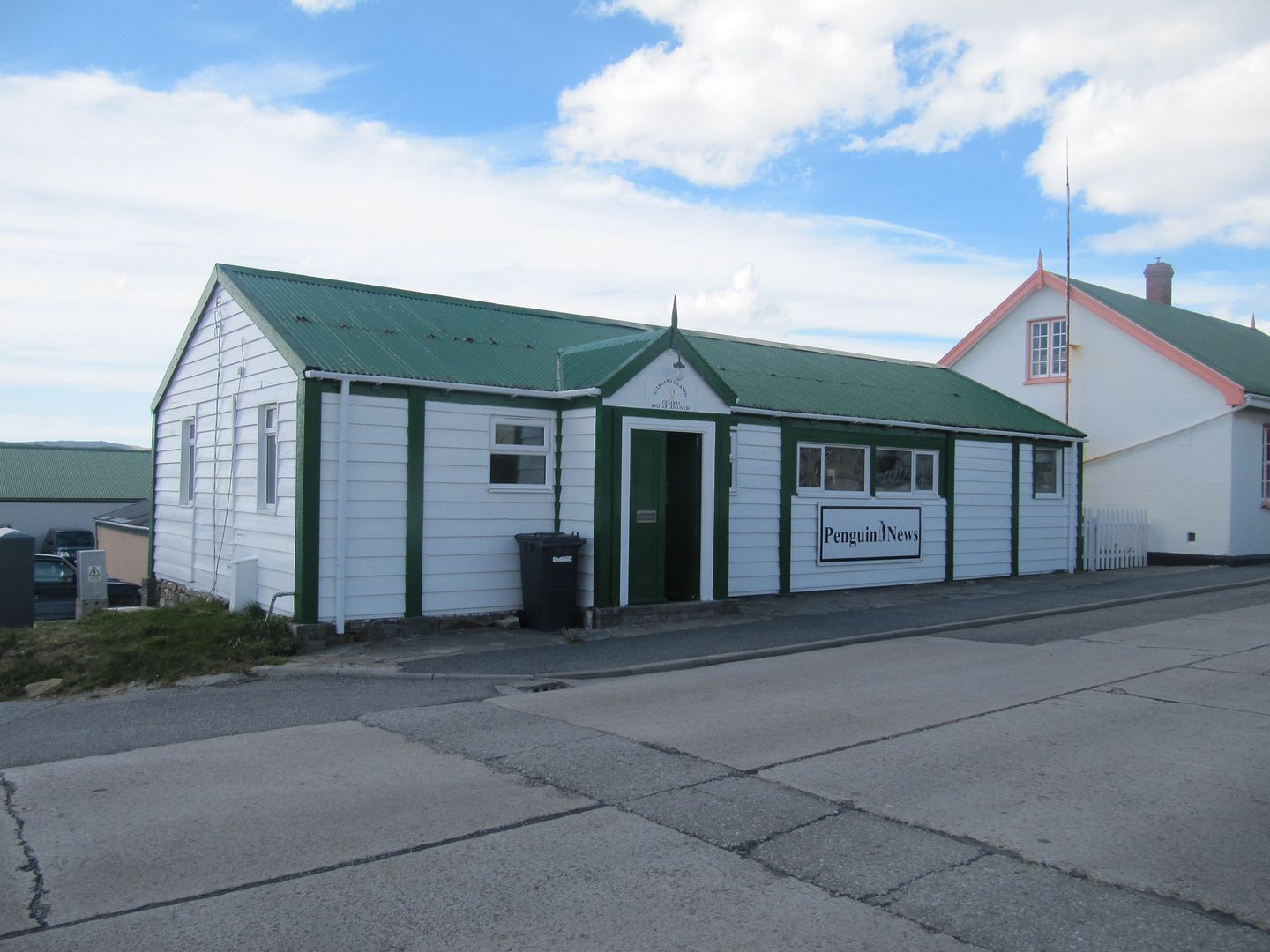
Stanley is a proper little village. Everyone knows everyone, and everything about everyone. The opening hours of some of the shops are short and erratic, revolving around the arrival of the cruise ships. In season, they have about five cruise ships a week, and the schedule is printed in the local newspaper, The Penguin News, so that the pubs, cafes, tour guides and gift shops know when to expect a 'rush' on. We read an article in the Penguin News about the annual raft race and it referred to one of the competing families arriving late 'as usual' for the start. This kind of comment can only work in a place where everyone knows that this family is notorious for being late.
And then there are the vehicles. Now in London, many people drive 4x4s just to do the school run. Here though the fact that just about every vehicle you see is a 4x4 is fully justified, or even essential. Even in the centre of Stanley they only salt a few of the roads when it is icy, and as soon as you get out of the town, the majority of roads are not tarmac, and many are just very uneven grassy tracks.
Of course with such a small population, the number plates are pretty tiny. They all start with an F and end with the appropriate letter for the year, but in the middle, the most they have is three numbers. Nic was very pleased to get a picture of one of the three character plates, F6G.
Talking of the driving, it did seem rather strange that in such a small town, we should find one of the junctions marked up as an accident blackspot. We never saw more that two cars there at any one time, so no idea how they manage to have enough accidents to merit it being a blackspot. And it rather amuses me that there is a Stanley bypass road.
But whatever the size of the town or the facilities available, it is the people that really make a place. The people here were friendly, although I think that some were perhaps getting slightly fed up of all the journalists in town. We stayed at the Waterfront Hotel, where we were made by welcome by Alex, the Chilean owner. He talked to us about the community and the concerns about the situation with Argentina, and explained some of the difficulties that the blockading had created. The main one was that the supply of fresh produce from Chile was very limited; it had become very hard to get enough eggs or fresh fruit and vegetables brought over. And we saw for ourselves that the local garden centre had to put a message into the Penguin News to tell people that they were unable to get cut flowers in for Valentines Day. And one of the editorials said that whilst the islanders would welcome Prince William's visit, their first question to him might well be 'Did you bring any bananas?'
Aside from Alex, we managed to get into quite a few conversations with people, especially once they realised that we weren't just here on a landing from one of the cruises. One of our best evenings was when we went to the pub recommended to us by Jackie, our host on Pebble Island. She sent us to The Rose, and whilst it wasn't very busy, and did have the Sun journalists from our hotel there, people were friendly and we were soon chatting about life on the islands. And when time was called, we were invited back to the owners' place next door to continue the conversation - and drinking - for a bit longer.
To a person from the UK, the Falkland Islands are like a home from home. Small, definitely. A little lacking in facilities and choice, yes. Windy, absolutely. But for all its limitations, it was a great place to visit.
| Stanley from the FIGAS plane |
Everywhere other than Stanley is regarded as Camp. There are a number of other small settlements in Camp, with just under 200 people living elsewhere on East Falkland, about 125 on West Falkland, and just over 40 on the smaller islands.
| Jubilee Villas |
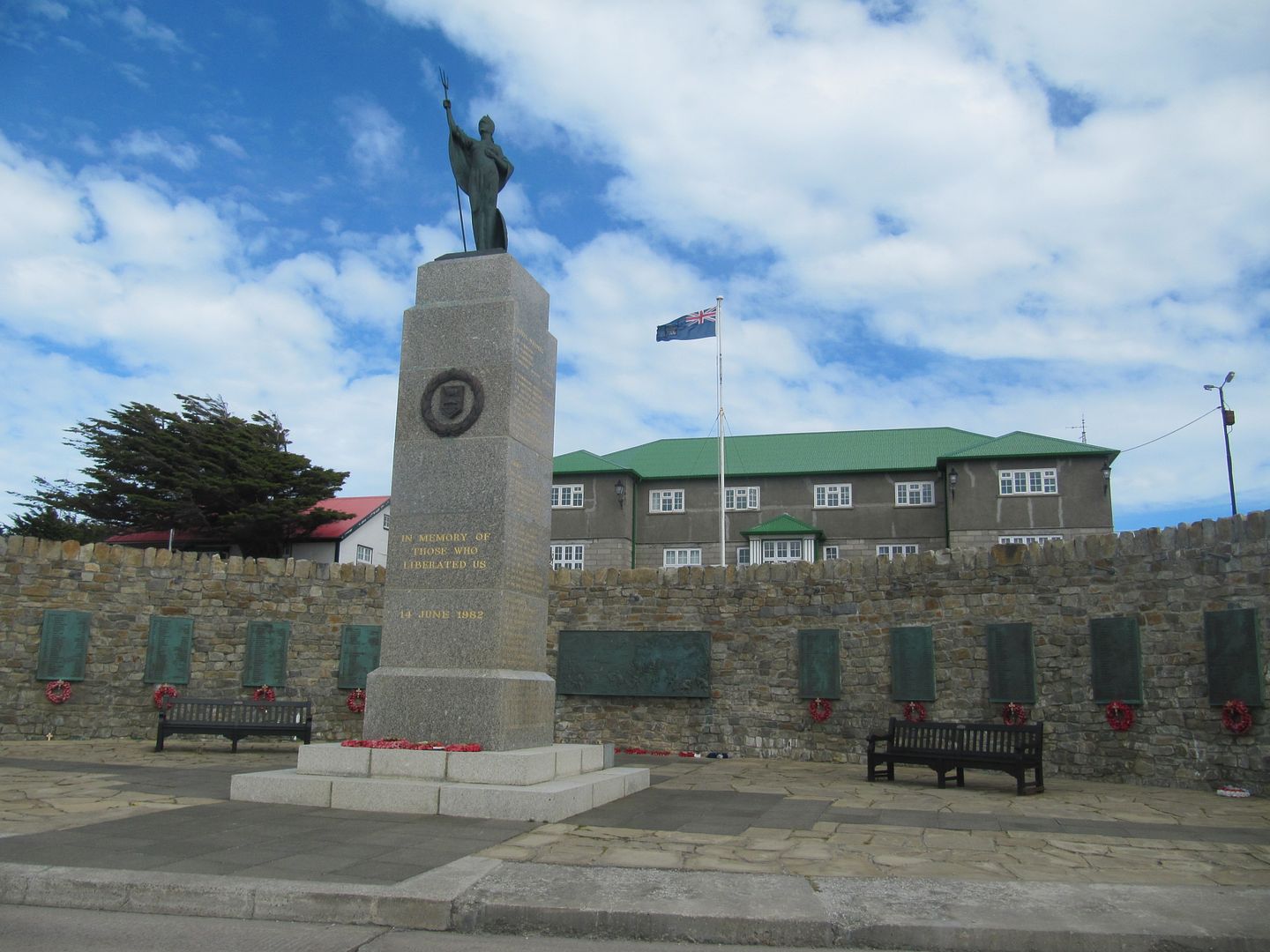
| 1982 Memorial |
The 1982 Conflict section was good as it had a number of pieces of Argentine propaganda and some journals that the locals kept, which gave an fascinating insight into what it was really like during that time. The locals talked about how the Argentine soldiers would come and ask them to buy food because they were hungry, about how one of their friends had gone back to the bottle, and about the distress felt when a civilian house was accidentally hit killing three locals.
| William and Kate 'on tour' |
| Stanley Cathedral |
But that wouldn't mean that you have got to know Stanley. We chose to spend a bit long here, not just so that we could do a couple of day trips and take advantage of the comforts of home, but also so that we could get an idea of what it is to be a Falkland Islander.
| The Penguin News office |
Stanley is a proper little village. Everyone knows everyone, and everything about everyone. The opening hours of some of the shops are short and erratic, revolving around the arrival of the cruise ships. In season, they have about five cruise ships a week, and the schedule is printed in the local newspaper, The Penguin News, so that the pubs, cafes, tour guides and gift shops know when to expect a 'rush' on. We read an article in the Penguin News about the annual raft race and it referred to one of the competing families arriving late 'as usual' for the start. This kind of comment can only work in a place where everyone knows that this family is notorious for being late.
| 4x4 with F6G numberplate |
Of course with such a small population, the number plates are pretty tiny. They all start with an F and end with the appropriate letter for the year, but in the middle, the most they have is three numbers. Nic was very pleased to get a picture of one of the three character plates, F6G.
Talking of the driving, it did seem rather strange that in such a small town, we should find one of the junctions marked up as an accident blackspot. We never saw more that two cars there at any one time, so no idea how they manage to have enough accidents to merit it being a blackspot. And it rather amuses me that there is a Stanley bypass road.
| One of hundreds of wrecks in the islands |
Aside from Alex, we managed to get into quite a few conversations with people, especially once they realised that we weren't just here on a landing from one of the cruises. One of our best evenings was when we went to the pub recommended to us by Jackie, our host on Pebble Island. She sent us to The Rose, and whilst it wasn't very busy, and did have the Sun journalists from our hotel there, people were friendly and we were soon chatting about life on the islands. And when time was called, we were invited back to the owners' place next door to continue the conversation - and drinking - for a bit longer.
To a person from the UK, the Falkland Islands are like a home from home. Small, definitely. A little lacking in facilities and choice, yes. Windy, absolutely. But for all its limitations, it was a great place to visit.
Pebble's Penguins and Petrels
| Fire trailer on Pebble Island |
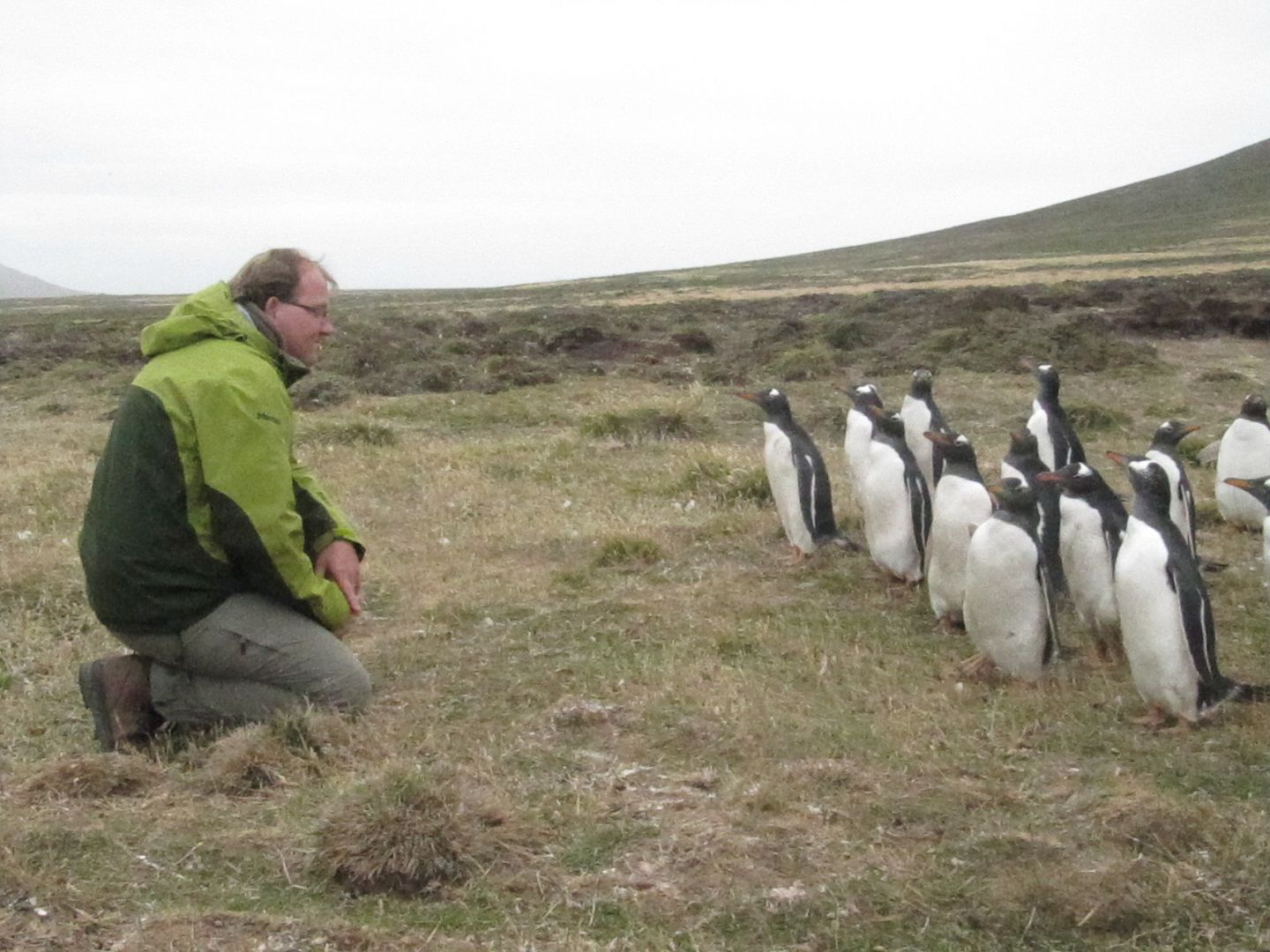
| Nic with the starting line of gentoos |
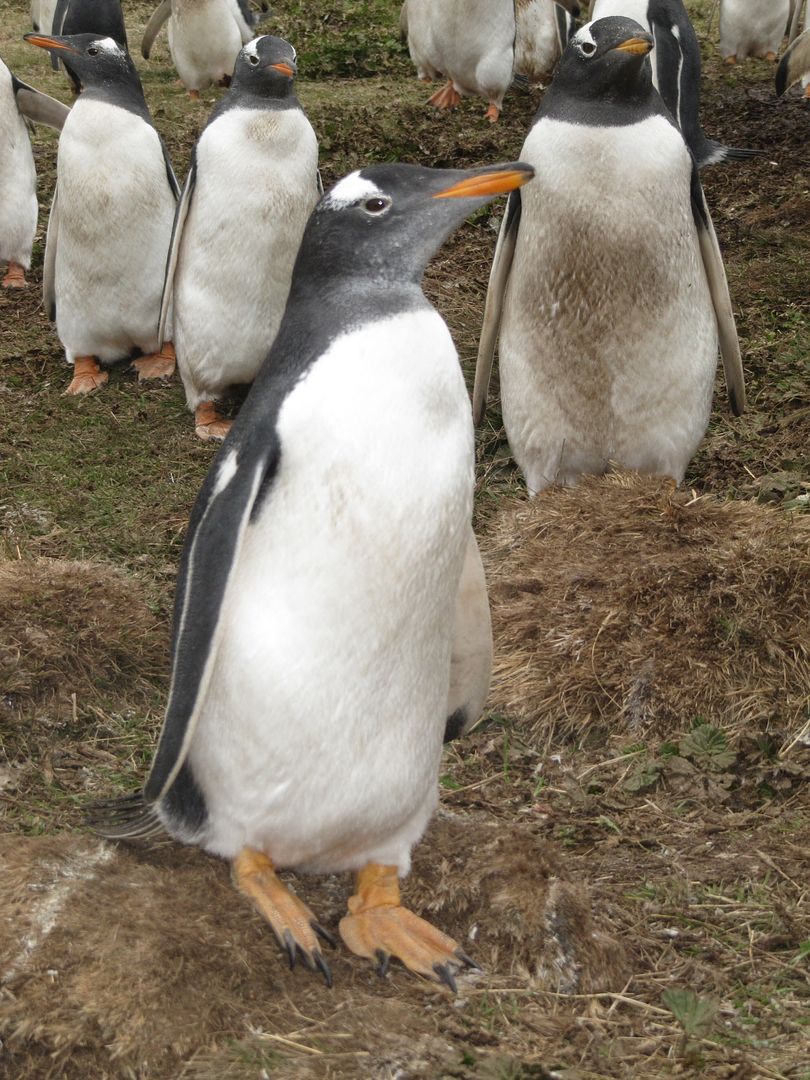
Our first stop today was the Gentoo penguin colony. Their site here is some way inland but they had created themselves a little mud bath to splash around in and many of them were filthy.
| Gentoos on Pebble Island |
They would stop a few metres away, until one would bravely take another step or two, and the others would follow suit. This would continue until they were quite close and then, especially if you had got down to their level, perhaps the boldest would come right up to us and maybe take a little peck to check us out. Thankfully they were usually quite gentle in their pecking, and usually their would go for the boots, trouser legs, or the tabs on the zip of the fleece.
| Moulting rockhopper |
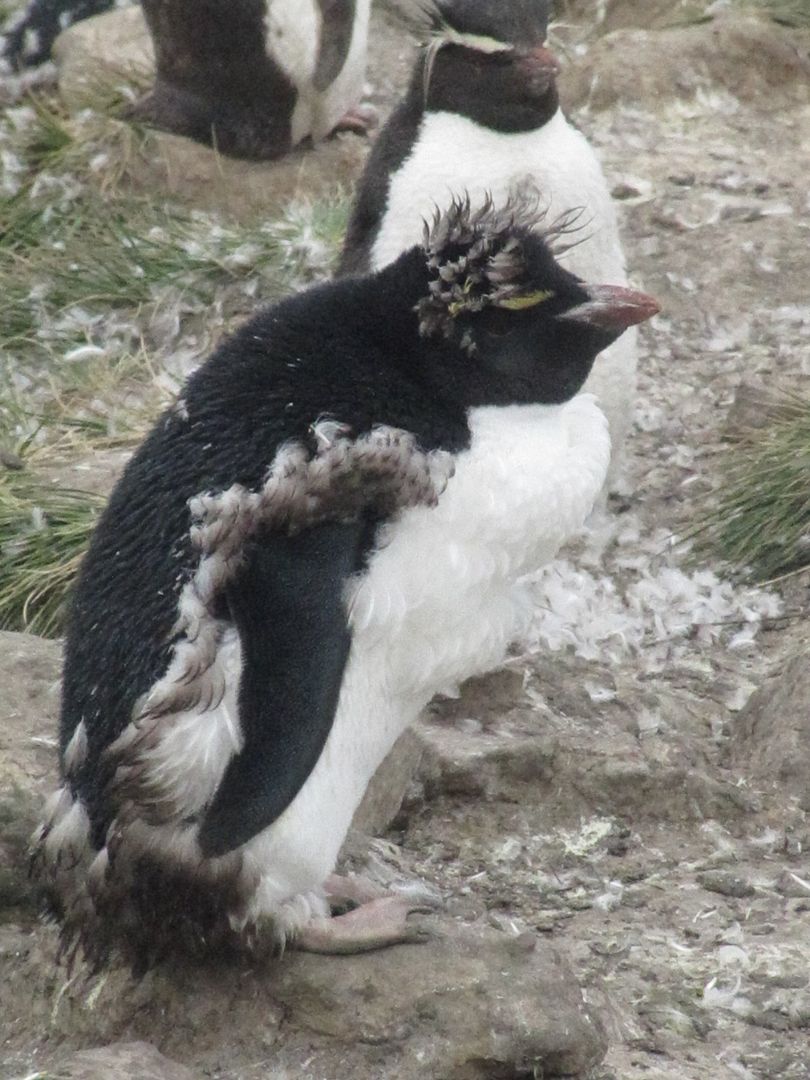
From the Gentoos, we drive on to the huge colony of rockhoppers on Pebble. Their route down to the sea is steep and fairly precarious, but they manage it quite impressively. The even more impressive thing though is that they don’t get smashed on the rocks at the bottom; the waves crash into the coast very strongly, and it is a wonder that the little penguins make it in and out of the sea in one piece. Many of the penguins are still moulting so can't go out to sea yet, and they stay at the nest site. They do look amusing in their various stages of shedding their fluffy feathers, and the ground around them looks like it has been snowing.
| Rockhoppers passing by |
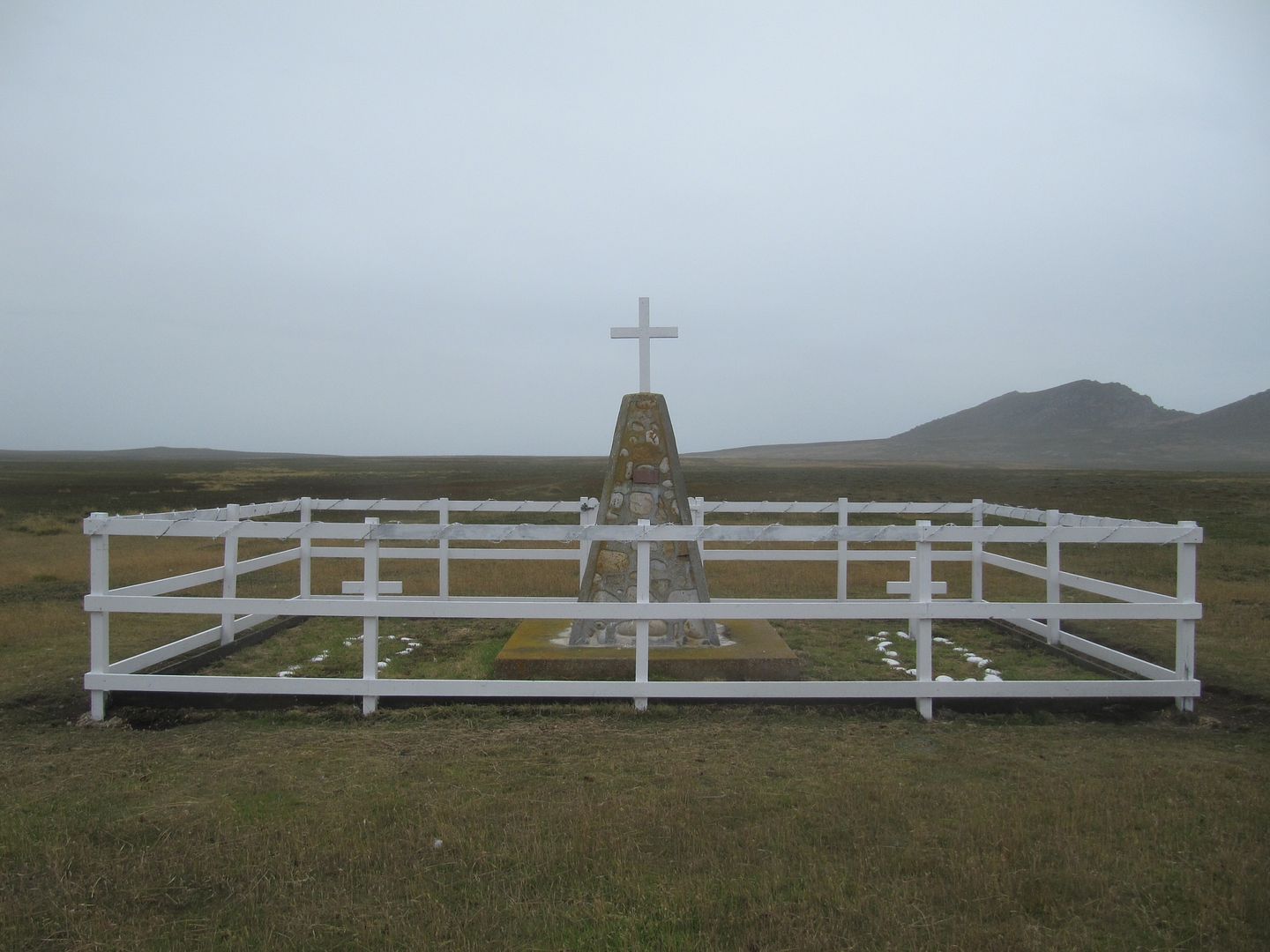
| Argentine Learjet memorial & graves |
| Flightless Steamer Ducks |
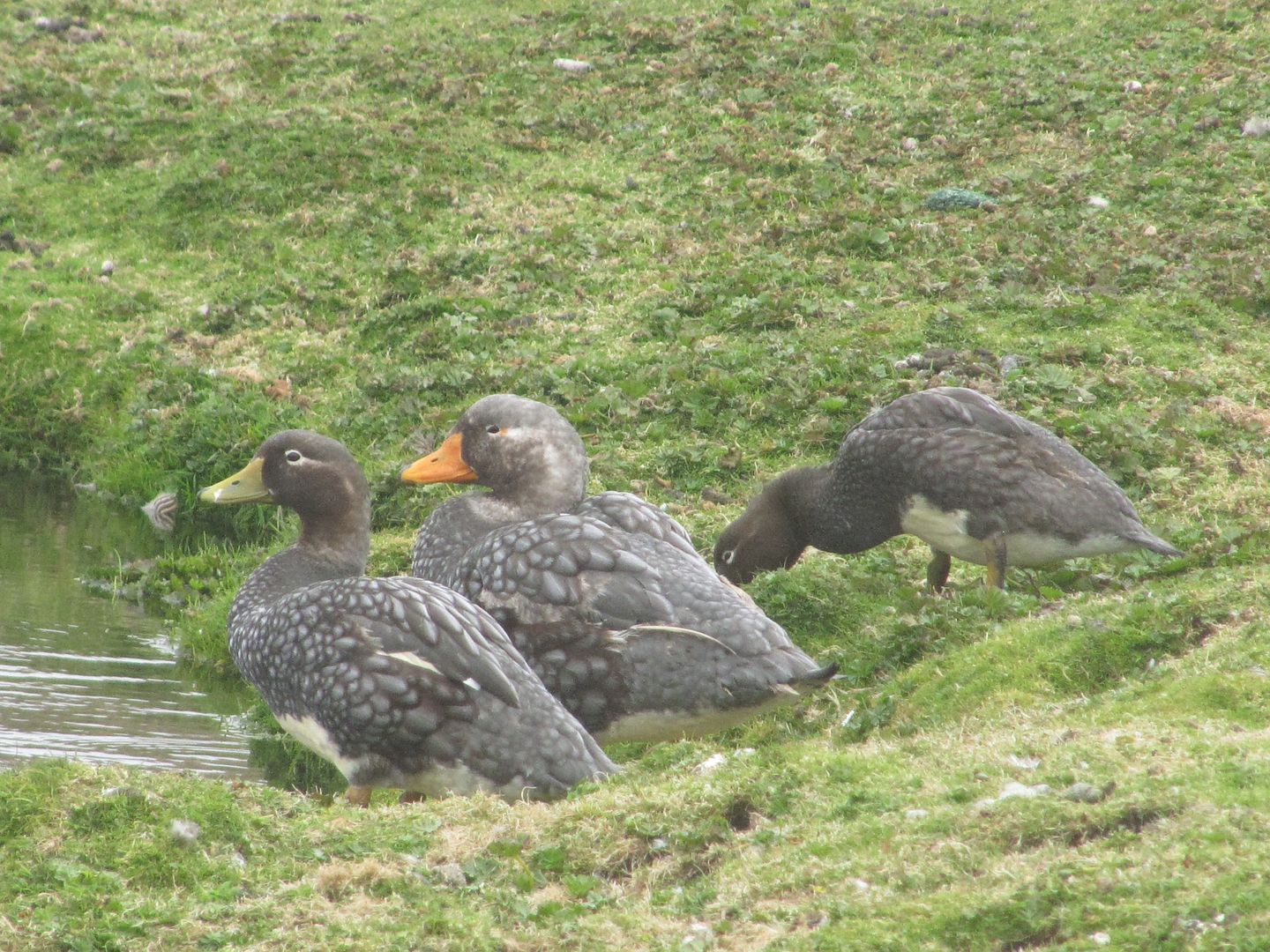
From here we drove down to the shore passing a group of steamer ducks. There are two types of steamer ducks, the flightless ones and ones that can fly. Jackie thought these were the flightless ones but as there is very little difference, the only way to be sure which you are seeing is if it starts to fly. These didn't fly but they may just not have felt like it!
| Great Southern Petrels |
On the beach we found more gentoos, before driving up the steep bank to watch the Great Southern Petrels. These large birds look rather ungainly on the land, especially as they run to take off, but once in the air they move rather more elegantly, even if they do look a bit like a lancaster bomber to me.
| HMS Coventry Memorial |
| Variable Hawk |
Pebble Island
From Sea Lions, we took another FIGAS flight to Pebble Island. The Sea Lion Lodge manager was particularly pleased with the arrival of the plane as it brought with it her new fridge.
Because the planes go around the islands we had a number of stops along the way. We stopped at Bleaker Island to drop off one of our fellow Sea Lion guests, then Port Stephens and Fox Bay, where we picked up one person at each. This was good as we got to see a bit more of the scenery of the islands. Most of the landscape we had seen before was fairly flat and bleak, with grasses and sheep but not much variation. Here we saw some beautiful cliffs and coastlines of the archipelago and some of the hillier parts of the west island. There were still a lot of sheep though. We also got to hear the chat between pilot and the locals manning the airstrip, which in one instance included the important breaking news that they had got the first of their home grown sweetcorn the night before.
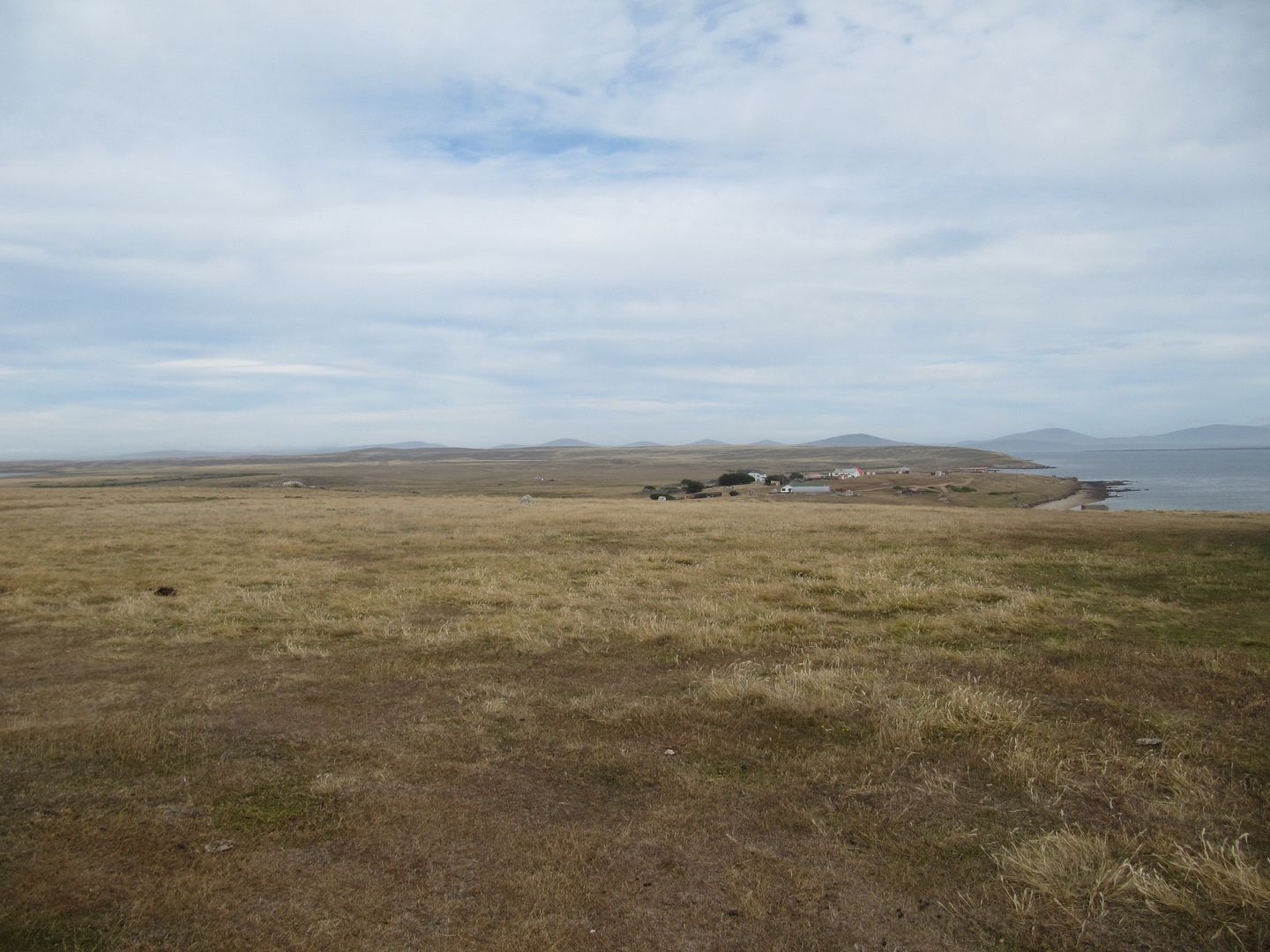
After about an hour and a half, we landed on Pebble Island, which is named after the many semi-precious stones that could be found on the beach here. Sadly they are now only rarely to be seen as they have mostly been collected. We were met by Jackie who owns and runs the lodge with her husband Alan. They are two of the only five people who live on the island all year around, the others being the people who farm it.
Pebble is somewhat larger than Sea Lions, and we had arranged with Jackie that we would
take a full day tour of the west of the island with her the next day, so this afternoon we just took a walk nearby. We decided to make it a fairly short walk as it was incredibly windy. So we set off with our lunch and a map and made for the big ponds and the beach. This wasn’t a wildlife day really, as the only things we could expect to encounter were sheep and birds that we wouldn’t recognize, but we figured we needed to go for a walk if only to exercise off some of the huge English breakfasts we’d been eating.
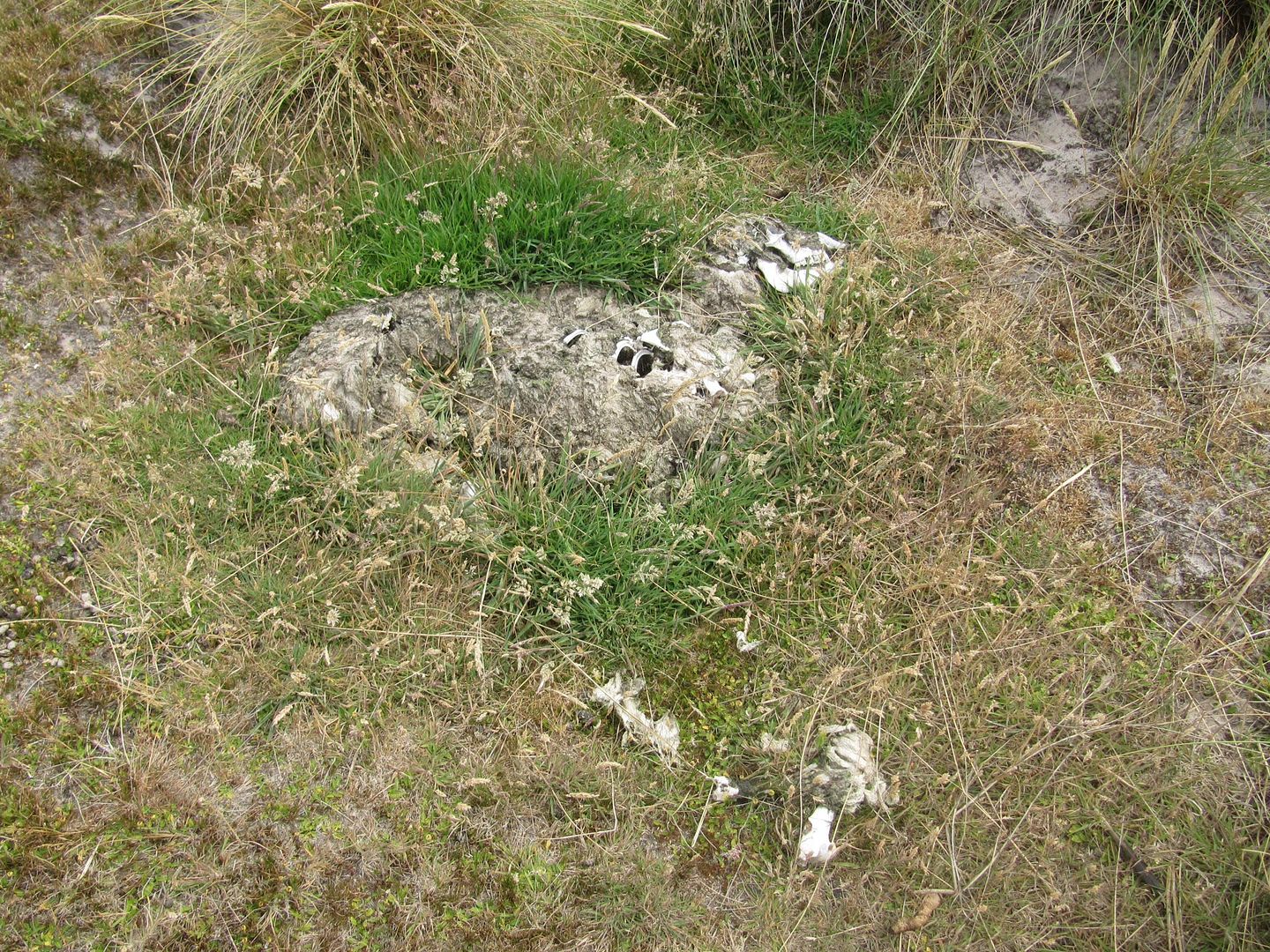
Our first challenges were the gates. It wasn’t so much our having to chase the sheep away from them, as much as they are all different, and so it took a while to work out how some of them worked. But we figured them all out and made sure to close them properly behind us so that we didn’t get into trouble with the farmer. We saw a few dead sheep as we walked around. Occasionally it was hard to spot them until you were nearly standing on them, as they had disintegrated to no more than a flat white outline.
Having eaten our lunch sheltering amongst some huge sand dunes and tussac grass, we walked through the mostly dry bed of an overflow river from the pond to the beach. We had to make a quick dash for it across the dry sand as the wind was blowing it high into our faces. Once we hit the wet shoreline we were safe from the sandblasting, but the wind was even stronger than it had been.
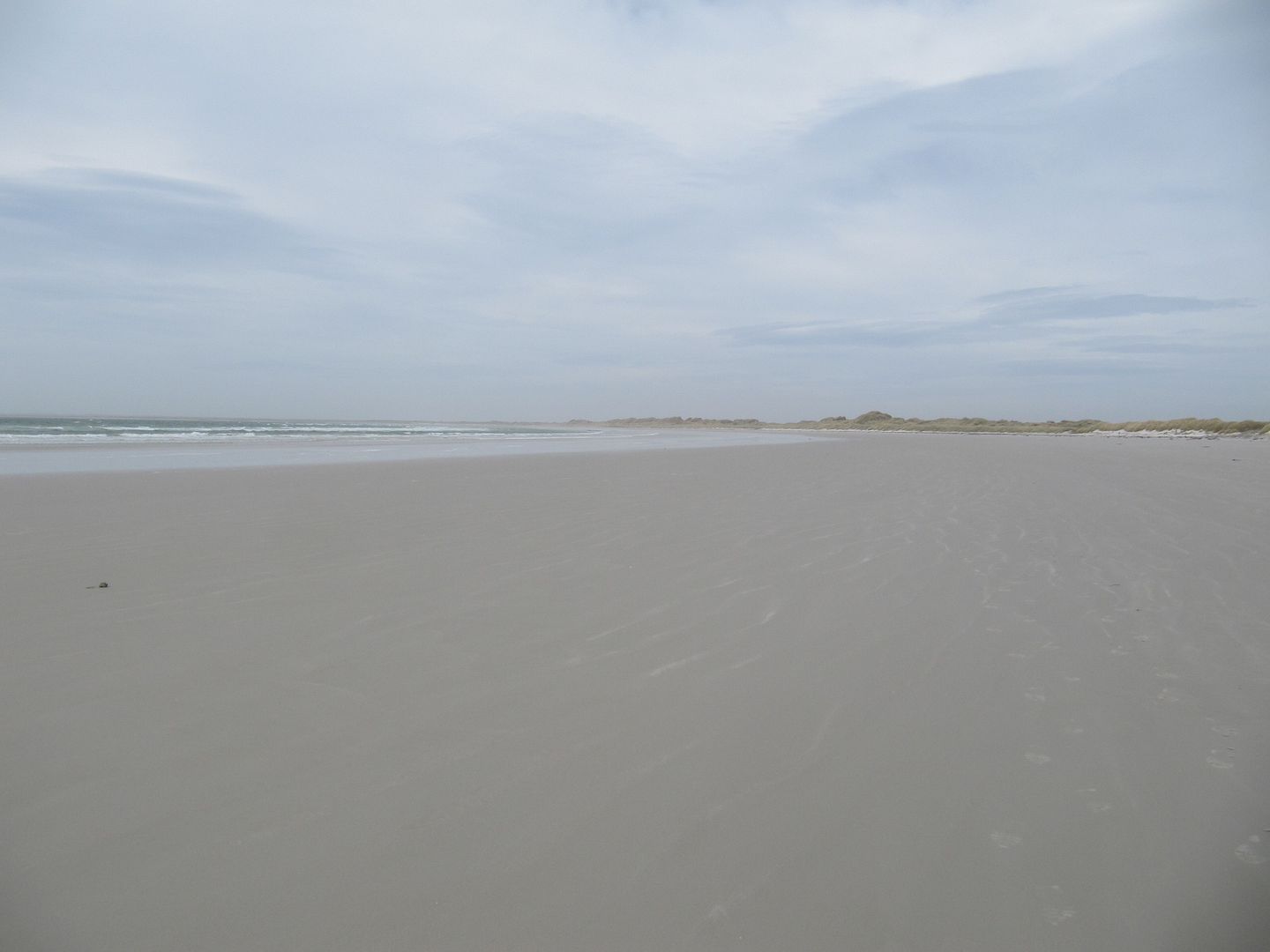
It was hard to appreciate the completely deserted stretch of white beach when we were struggling to breathe against the wind, let alone to fight our way through it. We could have got off the beach part way down, but that would have meant battling our way up and through the sand dunes and tussac grass, which was equally tricky, so we held our hats on our heads and eventually reached the end of the beach.
Of course as soon as we had clambered up the bank to the fields, we found a fence in our way, and no evidence of a gate for some distance. So we cheated and climbed over it. We were soon able to see where we had to go next and that there was a gate we could aim for, but the next problem was that between us and the gate was a stream that was about four foot wide. Definitely too far to just jump across given that there was a bank on either side.
Wandering along the edge, we reached a spot where the stream was covered in a thick surface of some kind of plant. After a bit of hesitant testing, I figured that this grassy stuff was probably just about strong enough to allow us to step across, so I gave it a go. I made it over OK, though I could feel the surface giving way beneath me and knew I was lucky to have stayed dry. Nic was slightly less lucky. He made it over, but got a wet boot on the way. Thankfully we were wearing our hiking boots and they kept his foot from getting an early bath.
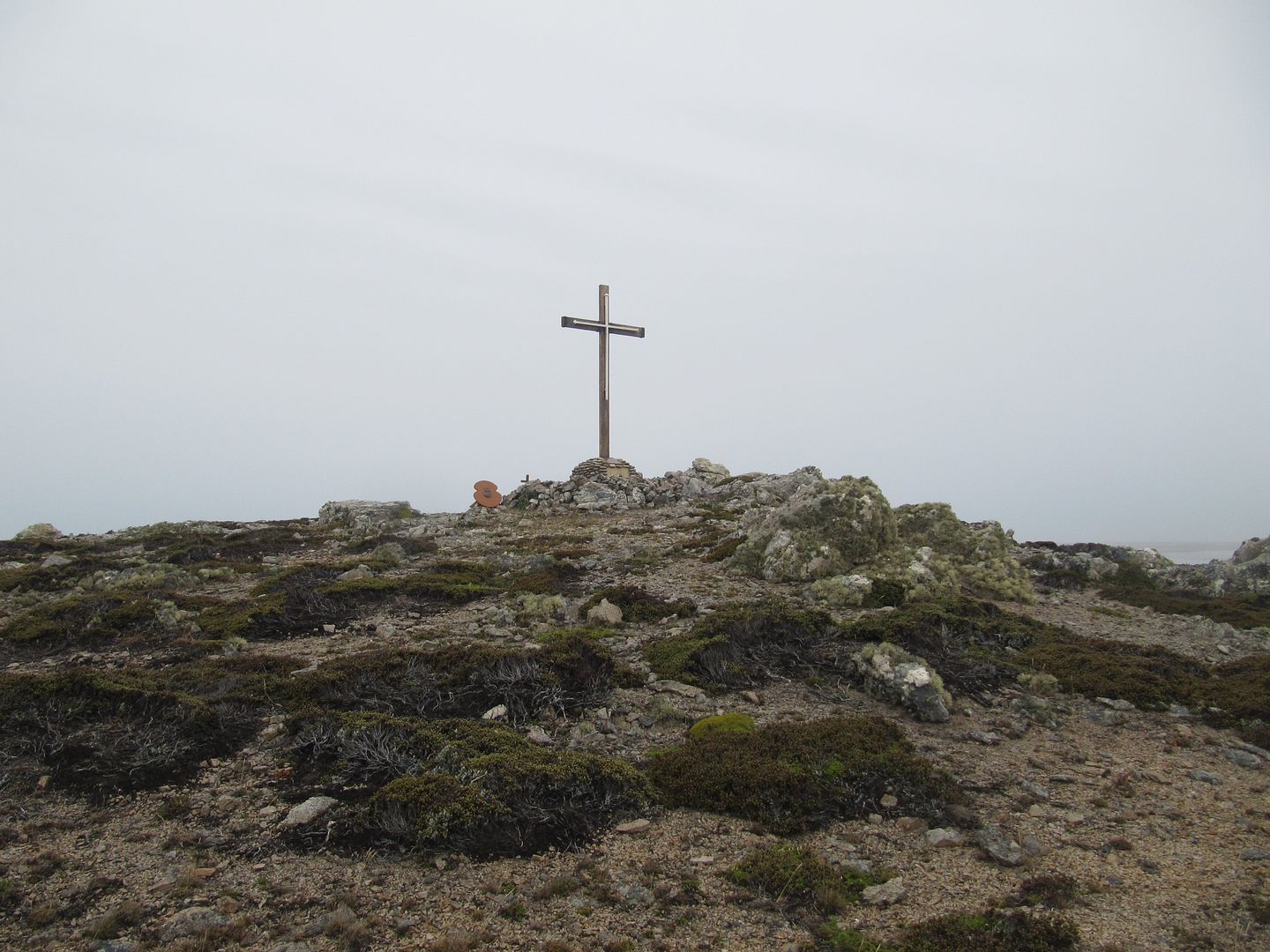
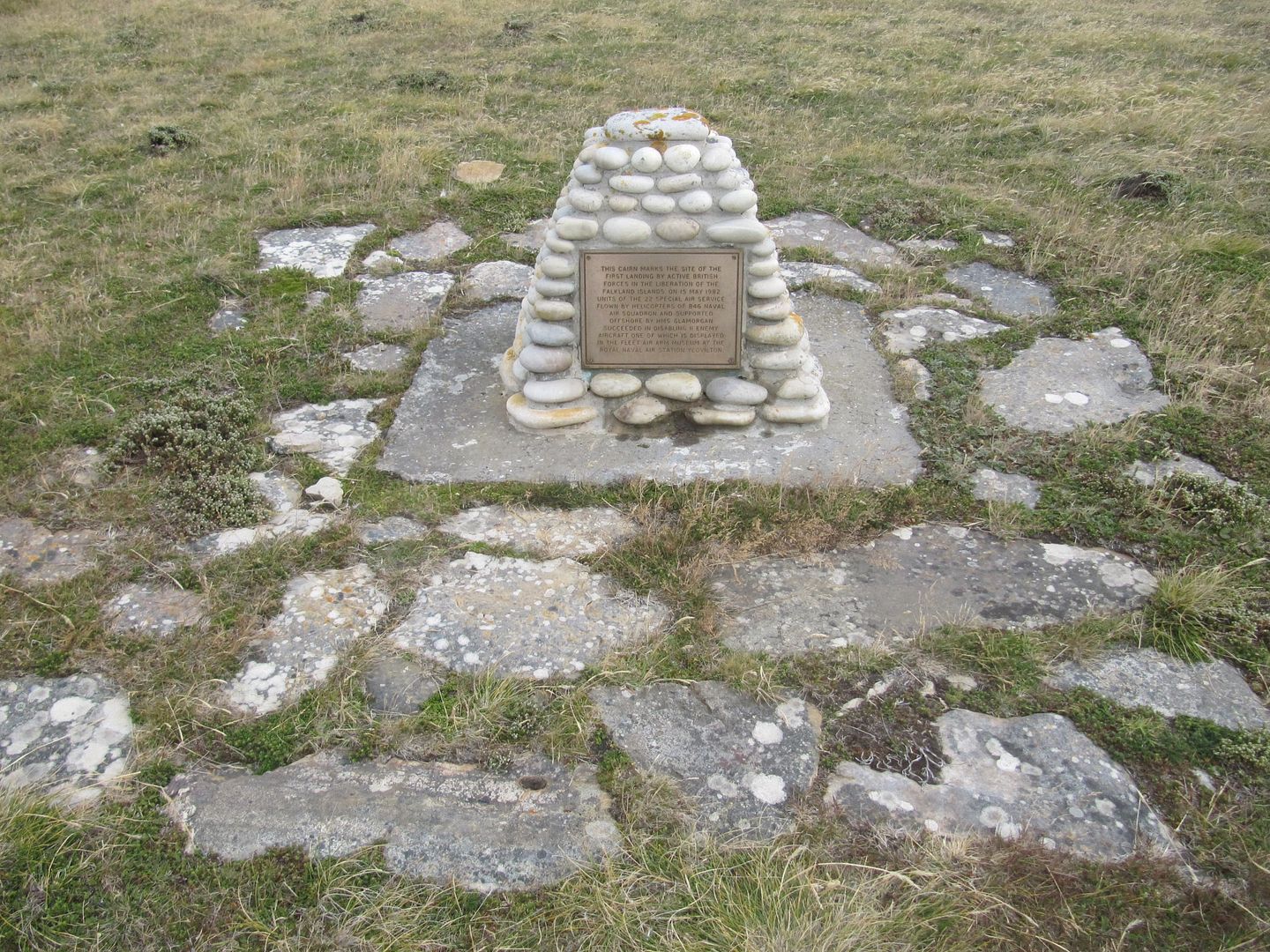
On the home straight now, we got safely through the next gate and over a stile and were out onto the airstrip. We were fairly sure that no more planes were due today, but still kept an eye out as we walked across it. We also passed the cairn that was built to commemorate the landing site of the Special Air Service units that arrived on 15 May 1982 to begin the retaking of the Falklands by taking out the Argentine aircraft on the landing strip here.
Back down at the lodge we were very pleased to be out of the wind and enjoying a cup of tea.
| Pebble Island settlement |
After about an hour and a half, we landed on Pebble Island, which is named after the many semi-precious stones that could be found on the beach here. Sadly they are now only rarely to be seen as they have mostly been collected. We were met by Jackie who owns and runs the lodge with her husband Alan. They are two of the only five people who live on the island all year around, the others being the people who farm it.
Pebble is somewhat larger than Sea Lions, and we had arranged with Jackie that we would
take a full day tour of the west of the island with her the next day, so this afternoon we just took a walk nearby. We decided to make it a fairly short walk as it was incredibly windy. So we set off with our lunch and a map and made for the big ponds and the beach. This wasn’t a wildlife day really, as the only things we could expect to encounter were sheep and birds that we wouldn’t recognize, but we figured we needed to go for a walk if only to exercise off some of the huge English breakfasts we’d been eating.
| Remains of a sheep |
Having eaten our lunch sheltering amongst some huge sand dunes and tussac grass, we walked through the mostly dry bed of an overflow river from the pond to the beach. We had to make a quick dash for it across the dry sand as the wind was blowing it high into our faces. Once we hit the wet shoreline we were safe from the sandblasting, but the wind was even stronger than it had been.
| Long Beach, Pebble Island |
Of course as soon as we had clambered up the bank to the fields, we found a fence in our way, and no evidence of a gate for some distance. So we cheated and climbed over it. We were soon able to see where we had to go next and that there was a gate we could aim for, but the next problem was that between us and the gate was a stream that was about four foot wide. Definitely too far to just jump across given that there was a bank on either side.
Wandering along the edge, we reached a spot where the stream was covered in a thick surface of some kind of plant. After a bit of hesitant testing, I figured that this grassy stuff was probably just about strong enough to allow us to step across, so I gave it a go. I made it over OK, though I could feel the surface giving way beneath me and knew I was lucky to have stayed dry. Nic was slightly less lucky. He made it over, but got a wet boot on the way. Thankfully we were wearing our hiking boots and they kept his foot from getting an early bath.
| SAS memorial cairn, Pebble Island |
Back down at the lodge we were very pleased to be out of the wind and enjoying a cup of tea.
Subscribe to:
Posts (Atom)