So having spent a lot of money, and four days there and back through the Drake Passage, is The White Continent worth it?
Well it is a lot of money, and if you have to choose between going to Antarctica and paying your mortgage or rent, servicing your car, or feeding yourself anything other that bread and water for the next year, then clearly of course not. And the seasickness has certainly put off a few people that we met from considering returning - though not one of them regretted having come this time.
It is probably not the best place for someone who absolutely can't stand being cold, although we found that if you wrapped up really well, it wasn't so bad most of the time. And the ship was always nice and warm to come back to.
But if you can make it past those hurdles, then Antarctica is fantastic. I have already said that we were disappointed not to have gone where we expected to, and that thought was with us all the while we were there, but even that rather large cloud couldn't stop us appreciating what an amazing place it is. And now that we know we will be going back to the part we most wanted, we can appreciate what we did see all the more.
Antarctica is officially the coldest, windiest, highest, driest - and certainly the whitest - continent. It didn't always feel like the driest to us, but we couldn't argue with the rest.
It is hard to imagine how something so devoid of colour can be beautiful, and at times when the day was so grey and cloudy that you couldn't see where the snow covered land finished and the snow filled sky began, some of the panoramic views weren't that great. But when the clouds lifted, or even just when some sunlight broke through, you could see the immensity of even just this very tip of the continent, and it is unbelievable.
And even on the dullest of days, if you let your eye forget the big picture and focus instead on what was close to you, all of the subtle variations and remarkable details jumped out at you. For a start, the monochrome black of the land and white of the snow breaks out into a variety of colours. Much of the ice is a pale blue, with deeper veins of blue running through it. Every so often you get a deep blue, transparent iceberg that is truly stunning to see. In the glaciers there are lines of colour running through that show how the snow has built up year on year, like the rings of a tree. And in both glaciers and icebergs the textures and shapes are constantly different and fascinating to look at.
Then you get the other colours in the snow and rocks, caused by lichens or minerals. Reds, greens, and oranges contrast fabulously against the blocks and whites, and those hits of colour give both a beautiful contrast. Add to this the human elements of science stations and old whaling posts, and you have some amazing features that are incredible just for being there and alo help to give you some perspective about the size of this vast white wilderness.
And it is a wilderness. Our expedition leader reminded us that nature is in control here, not us, and it proved her right. Even at this edge of the continent, in the relatively mild conditions, it was clear that this was not an easy place to exist. We saw reminders of how harsh the environment can be and how easy it could be to die out here as so many experienced and capable people have done in the past. Of course our little expedition was tame and as safe as it could be made, but the captain still has to navigate the icebergs and if you get stuck onshore after a landing because it is too dangerous to use the zodiacs, then you could have a cold night ahead of you. Thankfully we only had to imagine what it would be like to be stranded in the coldest place on earth.
Of course if the sheer beauty of the landscapes aren't enough for you the there is always the wildlife. Many of us have been lucky enough at some time or other to be close to a dolphin swimming alongside a boat in the sea, or to have had some other relatively common, buy nonetheless wonderful encounter with an animal in the wild. It is even more amazing when that animal is a humpback whale, close to the ship, and you get to see firsthand that iconic image of the tail fin rising up out of the water.
Equally the feeling of have the predatory leopard seal circling your zodiac, or letting you get within a few metres while it rests of the ice is awesome. And even for a non bird watcher like me, it was fascinating to see some of the birds here, so someone who can recognize more than just an albatross and a skua would be in their own kind of heaven.
But really, the true icons of Antarctica are the penguins. When you think about a penguin they seem like a strange creature, and it is right, they are. But I defy you not to love them! Even the most indifferent of people we have met have been captivated by the penguins. In the water they are agile, fast and fairly impressive when they porpoise through the water like mini torpedoes, but they aren't quite so interesting.
When you get them on land it is a different matter. It is endlessly fascinating to watch them. They are proud, curious, determined and comical all at once. They aren't exactly built to walk on land, with their tiny legs, but they waddle around and can move pretty fast when they want to. They are frequently faced with obstacles like rocks that are enormous to these little guys, but they are not deterred. Whether going up or down, you can see them concentrating very hard on the jump that have to make, they put their flippers out behind them and arch their bodies in preparation, and then they make their huge two footed leap through the air.
Most of the time they make it. Every so often though, one comes a cropper and falls over. When it does it hurries to right itself in a flurry of flapping wings and scrambling feet, looking around to see if anyone noticed its little mishap. Sometimes, especially when they are trying to get out of a deeper rock pool, it can take them a few goes to clamber over the edge, and it is all you can do not to run over and try to help them.
They are also such curious things. Invariably as I walked around the sites I would get some little visitors. Some would just watch me from a few metres away, but others would have a little peck to check me out. And they are fascinated about any objects around them, from the station buildings or equipment to the whale skeletons that have been there for years, through to the items we had with us like backpacks, or snowshoes. If you don't want to find a penguin standing on it or pecking at it, don't leave anything unattended within their reach. Luckily they don't do much damage so the worst that is likely to happen is that it gets covered in their projectile penguin poo.
So I guess if you don't like snow and ice, have no interest in whales, birds or seals, and are truly convinced that you hate penguins then you shouldn't consider coming here. But otherwise I think Antarctica is an amazing place visit. To experience for yourself what an extreme place it is, to see the beautiful ice, to imagine living in a tiny science station for months on end, and to have close encounters with the penguins and other creatures. I don't know anyone who has been to Antarctica and regretted it, and I am thrilled to be going back in November.
 Whilst landings are great, when the ship is in a good area for ice and wildlife, it can also be fun just to go out and cruise in the zodiacs for a bit. It is fascinating to get up close to the ice in the water when the amazing blues show through, and there is always the chance of a few close encounters with birds, penguins, seals or even whales - though sadly we never found a whale ourselves.
 Over lunch the ship repositioned to a location near to Gourdin Island. During this sailing we passed some spectacular and huge icebergs, though as ever, the photos don't really give you any perspective on their size.
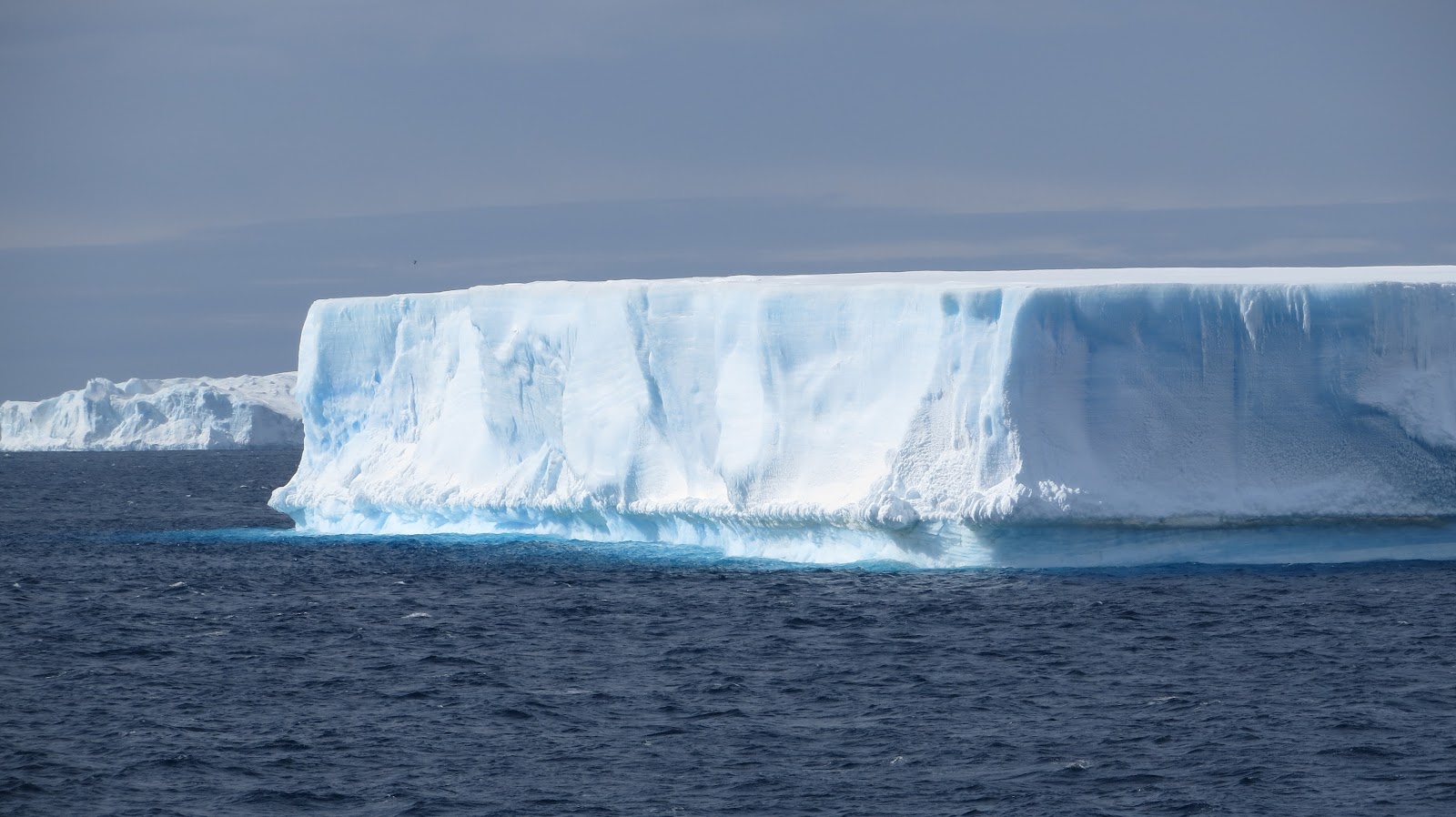 In the afternoon, we started off with a zodiac trip around some of the ice and along the shore of the island, which we were to visit later. There was a huge tabular iceberg that I would have liked to get close to, but it was too far away, so we made do with some of the smaller bergs nearby, in the more sheltered waters.
 It was just as well that we didn't go too far out because whilst this didn't seem at all choppy to us compared to a couple of the trips we made for landings last time, there were a few waves crashing over us once we got speed up, and we did get a bit wet.
 Some people found this icy drenching a bit much; but then that is why you wear all of your waterproof gear in the zodiac. It can rather take your breath away though, especially when you get a good splash in the face.
 Talking of photos, the zodiac cruise was a great opportunity to try out the waterproof camera that we had bought specifically for this kind of thing.
 We watched for a while as three seabirds squabbled over sharing a jellyfish that one of them had caught, then set off for the coastline of the islands, where the water is an amazing blue colour around the base of the icebergs.
 We saw a few crabeater and Weddell seals hauled out on the ice, but we we most excited by our first sightings of the chinstrap penguins. No photos of these here as was having trouble with the camera at the time, but you will certainly see them in the next posting.
 Whilst you wonder sometimes how some types of penguin, such as the gentoo and the adelie get their name, it is pretty obvious why these are called chinstrap. Their predominantly white face and the narrow black band under their chin make them very distinctive.
 Further around, the adelie penguins were in good spirits, darting about in the water, often heading towards the land and then deciding to play in the sea a bit longer. When the time came to get out, they had to swim for the shore line and then propel themselves about a metre and a half upwards to get onto the ledge of the land.
 Most of the time this worked, and they would make it onto the land and slide along on their front until they could make it up on to their feet again. Quite often though, they didn't make it; they would hit the ledge near the top and fall back into the water.


