We really enjoyed Burma for what it was, but at same time, felt that there was so much more that it could be, both as a country and as a tourist destination.
Internally, the country is theoretically a democracy, but in fact the military retains a massive stronghold. Aung San Suu Kyi, aka The Lady, has proven she has the people's vote in the recent election, but as it stands, she cannot be leader due to a piece of government legislation that dictates the president cannot have a foreign spouse or children who have foreign citizenship (her deceased husband was British so her children have British nationality.)
In a recent vote, some softening occurred, but not nearly enough to stop the military from being able to veto her presidency. There is some hope after the outgoing president, Thein Sein, suggested he may support her leadership, but until something concrete changes, it seems that whilst the population would like to have The Lady in power, democracy doesn't extend quite that far.
And then there is the question of the minority groups in Myanmar. The most persecuted is the Rohinga Muslims, who are fleeing from the country in the most awful and dangerous ways, simply because they are not safe in their own homes. We were told accounts of horrific violence, with minor issues being escalated out of all proportion and resulting in terrible persecution and massacres of the Muslim population. And this by Buddhists, who surely we all would expect to be better than that.
But it is not just the Muslims that feel aggrieved. When the British were preparing to leave Burma General Aung San helped negotiate the Panglong Agreement with some of the minority ethnic groups, giving them rights to elements of self governance within the new federal system. However, with the assassination of General Aung San so soon after independence, this treaty was soon disregarded, leading to the formation of a multitude of rebel groups and ongoing tensions between them and the ruling party.
There has been a recent step forward in this, with a peace deal signed with some of the rebel groups, but it is only some, so tensions remain with the remainder, meaning any improvements are likely to be limited, and possibly shortlived.
I would love to see Myanmar become a truly democratic country, and resolve its internal conflicts, but sadly there seems long way to go before that will happen.
If and when it does, perhaps the country can improve its range of attractions for tourists too. Don't get me wrong, I enjoyed our trip, but it really is a lot of temples and Buddhas, with a few visits to crafters workshops along the way. The museum in Yangon was good, but only covered history of the kingdom. It would be nice to have some places that could cover the time since then, dealing with the issue of the British Rule, the war, independence, and the military coup, all the way up to now. There is a fascinating recent history here, but at present it cannot be properly told.
That isn't to say you shouldn't visit now. As long as you are happy to see a lot of temples and Buddhas, which you will, it is a great time because, although visitor numbers are increasing rapidly, the country has yet to have the full influx of tourists that will come in due course, so it is still a place that has a certain amount of innocence in its tourism, especially away from the main hubs. It will certainly change over the coming years, and I am glad to have seen it before that happens..
Showing posts with label Burma. Show all posts
Showing posts with label Burma. Show all posts
Saturday, December 26, 2015


Tuesday, December 22, 2015
Hpa An - Caves and a mushroom rock temple
 Our next overnight destination was Mawlamyine. Myo sang us some Burmese songs during the drive, and we stayed at a nice waterside hotel and watched a lovely sunset drinking cheap rum and coke. We didn't visit the temples here, but the Kyaik Than Lan Paya is where Rudyard Kipling is thought to have written Road to Mandalay.
For me though, today was about the places we visited on the way, around the Hpa An area, which were two of my favourite places in Myanmar, and I would definitely recommend both to future visitors.
 Our first stop was at the Kawgun caves. The monkeys running around may demand your food, but your attention should certainly be on the caves themselves - and perhaps on avoiding treading on the monkey poo with your bare feet!
 There isn't a lot to say about the caves really, so I am just going to post a few photos. In case you can't see them properly, all of those little red figures in rows on the walls are little individual Buddha images.
My photos don't do the place justice at all, but I hope you get an idea at least of how beautiful the decorations in these caves were.


Our second stop was the Kyauk Kalap monastery where, if you are so inclined, you can partake of a free vegetarian meal. But we weren't there for the meal, we were there to see the mushroom rock temple. Although I did finally get around to trying the freshly pressed sugar cane juice, which was tasty and very refreshing in the heat.
 If you do visit here, and do go up to the temple, you might want to allow yourself a little bit longer than you expect to need. We found that here, more than anywhere see we visited, people were fascinated by us and I and a couple of the other women were constantly being stopped by people to have our photos taken with them.
 Some would ask first, other times I would just find that someone was suddenly holding my arm and posing with me. Sometimes it would be just one person, other times there would be a whole group and they would each take a turn for their photo opportunity. It was always friendly, but it did mean that it took a lot longer to get around.
OK, the temple on the rock is nothing special in itself, but the overall sight was pretty impressive. Personally, I would much rather see this than the big gold painted rock at Kyaiktiyo.
 Oh, and I finally got around to getting a bag of the pressed sugar cane juice.
Sunday, December 20, 2015
Kyaiktiyo
 Our next stop was Kyaiktiyo, to see the famous golden rock. This balanced rock is supposedly held in place by a single strand of Buddha's hair, and is one of the most sacred places in Myanmar.
The hotel we were staying at gave us a lift to the starting point for our journey; we travelled in real style this time - in the back of a truck. When it arrived, I did wonder quite how I and some of my companions were going to manage to climb up into it, but I was relieved to see that they had a handy set of steps for us. So we clambered in and made ourselves as comfortable as we could for the short trip.

 The trucks wind their way up the mountainside at a fast pace, so you are in for a bumpy and twisty journey that I enjoyed, but not everyone does. The trucks don't go quite all the way to the top, but they do go further than they used to, so by taking it to the second stop, you can avoid most of the walk. And if you really can't be bothered to walk the last bit yourself, there is always the option of paying to be carried up in a chair.
 Having made it to the top, our first stop was for lunch. As you might expect, this place attracts thousands of visitors, so they is no shortage of shopping and eating opportunities. As we made our way down a large flight of steps - past the shops of course - to the wide street with all of the restaurants in, we could already see and hear the women calling to attract us to their place to eat. It was a huge cacophony of calls, accompanied by the rapid beckoning motion of the hands. Strangely, as soon as we passed a restaurant, the woman for that place would stop, obviously not having any expectation of being able to draw us back, so as we progressed down the street, the sound gradually dwindled.
 After lunch, we went to take a closer look at this big rock. It is quite big, with the rock itself being twenty metres high, with a seven metre temple on top. All covered in gold of course, which you can add to if you buy a bit of gold leaf - and are male!
I know this is a sacred and famous place, but personally I just wasn't that impressed. It felt very commercial and perhaps it has lost something of its prestige as a pilgrimage site now that you can take a truck up the mountain, rather than having to make the journey on foot. I always think of a pilgrimage as having to be hard work. Mind you, given that I wasn't impressed after getting the truck up here, I'm sure I would be even less happy if I'd walked up.
Honestly, whilst I know this place will be a must see for many visitors to Myanmar, I felt that I could happily have given it a miss. To me there are many more interesting and unusual temples and sites to see, not least of which would be two that are coming up in the next posting.rd
Wednesday, March 25, 2015
A Balloon over Bagan
 When I said we had an early morning, I wasn't kidding. We had to be ready in the lobby for a pick-up at 5:45am. But it was all worthwhile, as we had treated ourselves to a hot air balloon ride.
 The company that we were with was Balloons Over Bagan, and they collected us in fabulous old buses, which we instantly decided that we wanted one of to kit out for overlanding. Totally impractical of course, but they looked great.
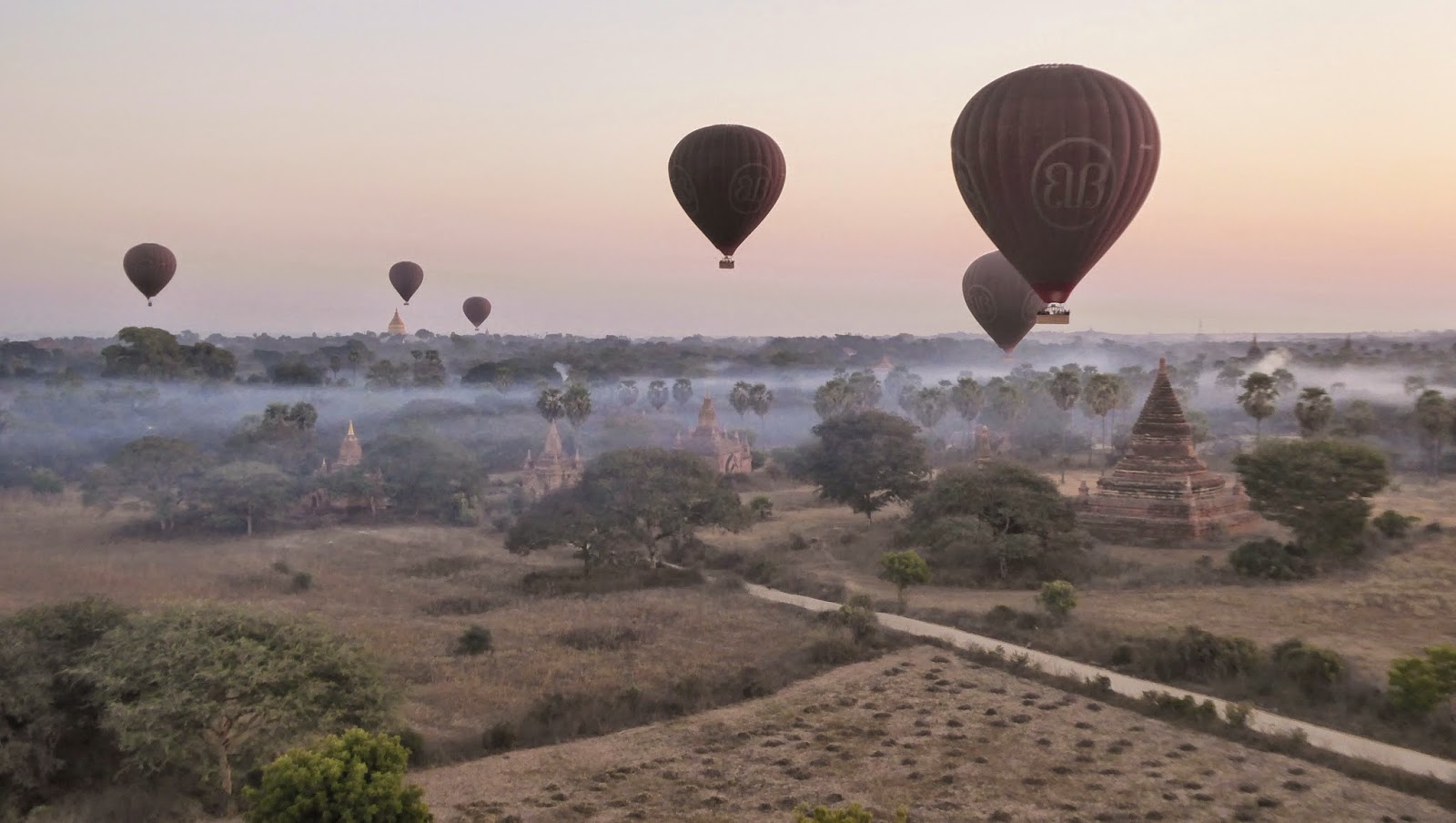 At the launch site, we had teas and biscuits while we watched them get the balloons ready. As sunrise approached, we met our pilot Elly, had our safety briefing, and then piled into the balloon.
 There were sixteen people to a basket. The huge basket had five sections, laid out like an H. The centre section was for Elly and the four gas bottles. The others were for passengers, four in each. Clambering in is a feat in itself, especially trying to avoid kicking anyone, but once you're in, it is fine.
 Elly kept the balloon nice and low for us, so we had a great view of the temples. And there are a lot of temples. Bagan was the royal city from the 10th century up until 1287, when bad diplomacy with the Mongols caused them to flee the city. The various Kings during that period went a bit wild building temples and pagodas. At the city's prime, it would have had over ten thousand of them.
These days, lack of upkeep after the city was abandoned and some devastating earthquakes have reduced their number to around a mere two thousand, many of which are the beautiful old red brick variety, so they look stunning. Little wonder then, that between the three companies based here, there were about seventeen balloons up in the air, and they do that every day.
 As ever, my commitment to taking photos comes a poor third to actually looking at the view and enjoying the experience, and I still only use my little compact, so the photos here do absolutely no justice to the real thing.
 Once we had crossed the city and the temple density had started to dwindle, Elly expertly - and very gently - set us down in an empty plot of land. The crew had us safely moored in no time, so we were quickly out and enjoying our post flight breakfast of champagne, croissants and fresh fruits. Just as well Nic and I were finally feeling better.
 Breakfast over, it was back onto the old buses and back to our hotel, arriving just in time to meet up with the group for a day of sightseeing at ground level.
Monday, March 23, 2015
A boat to Bagan
 It was a bumpy drive on the truck this morning, and as I was still feeling pretty delicate - bucket still to hand but thankfully not used - it was almost a relief to be to told that we were getting on a boat again. And as regular readers will know, I'm not generally too happy about the boats in Myanmar.
As it turned out, the boats were actually OK this time, as they were the bigger ferry boat style rather than the narrow ones. At our boarding point in Pakokku they clearly had experience of western tour groups, indeed they were unloading a small coachload and their baggage onto boats while we were there, but we were a different matter with our truck, and we soon had our usual crowd of watchers.
 The boat trip took us along the Ayeyarwaddy River and into Bagan. There were a few other river users out fishing etc, but in the main, the journey was not especially interesting until we had Bagan and it's temples in sight.
So for some of the trip, our local guide Myo kept us amused by showing us how to wear the longhi, and some other things it can be used for. The longhi is the skirt like piece of clothing worn by most people in Myanmar. Men and women wear different colours and patterns, and the fabrics and designs vary by region and tribal background.

But it was the other uses that we found more amusing. Some were practical, such as the rolling it up and using it as the base for carrying things on your head, for making a hammock to swing your baby in, or even a baby carrier.
 We of course, preferred the ones where he would use it as a cape and pretend to be superman, use it as a ninja outfit, or even to create the ears and trunk of an elephant.
As we got close to Bagan, the scenery finally captured our attention as we saw the first views of just some of the beautiful stone pagodas that have made Bagan such a popular destination.
 Once we made it to our hotel, we a quiet evening to help us get over our remaining sickness, and an early night as Nic and I had an early morning ahead.
Friday, March 13, 2015
Aung San Suu Kyi and democracy in Myanmar
Aung San Suu Kyi - or The Lady as she is known here, is a name that many of us have heard, but perhaps don't know much about. She is an incredibly important figure here in Myanmar, so I figured I'd give some facts about her and drop in a few lines on what is passing for Democracy.
One reason for The Lady's popularity may be attributed to who her father is. General Aung San is the hero of Burmese independence from the British. Always anti British, his first attempt didn't go quite so well, as he decided to accept Japanese help. The Japanese helped him to train a small group of men - the first Burmese army - and then he helped them with the Japanese invasion of Burma in 1942.
However Aung San soon grew skeptical of the Japanese, recognising that the new Burmese ruling party was nothing more than a puppet government, and seeing the terrible treatment of his people. He is quoted as saying ‘I went to Japan to save my people who were struggling like bullocks under the British. But now we are treated like dogs.' Indeed whilst most people are aware of the roughly 12,000 allied forces prisoners of war (around half of whom were British) who died building the Thailand to Burma 'Death Railway', fewer realise that somewhere between 90,000 and 150,000 local Asian workers died too, around a third of whom were Burmese.
So Aung San switched allegiance to the British for the war effort to oust the Japanese.
After the war though, he resumed his aim of Burmese independence, and following a meeting in January 1947 with Clement Attlee, he achieved a promise of independence in one year's time. The independence was indeed granted in 1948, but Aung San never got to see it as he was assassinated by political rivals on 19 July 1947.
After a short period of home rule following independence from the British, General U Ne Win led a military coup and took control of the country in 1962, and military regime continued, officially until 2011, but most would say it still continues and we have heard accounts of corruption and cronyism being rife here, with the military and their allies owning huge government contracts and much of the wealth that there is in Myanmar.
Aung San Suu Kyi was only two at the time of her father's death, and as her mother was appointed ambassador to India in 1960, from when Aung San Suu Kyi spent most of the next three decades in the UK, the USA and India. Whilst in the UK she met and married her British husband and they had two children.
Her political career only began after she returned to Burma in 1988 to care for her sick and dying mother. She returned to a country where the military general Ne Win had officially resigned but still held control behind the scenes. A superstitious man, he had the previous year decided to delete any currency notes not divisible by the lucky number nine, which had the effect of wiping out the savings of many Burmese people. This, together with the general disatisfaction with the military rulers and harsh regime, and then the shooting of a student protester in March 1988, led to major protests. Significantly, the monks joined these protests and a major demonstration took place on what was regarded as an auspicious date of 8 August 1988 - or 8888.
On 26 August 1988, Aung San Suu Kyi made a speech calling for Democracy, which propelled her to be the face of the democracy campaign. But the military junta had no intention of giving up power and on 18 September they responded to the demonstrations with automatic gunfire and the carting off of protesters. Human rights organisations believe that at least 3000 were killed.
Aung San Suu Kyi was placed under house arrest in 1989 with all communication prohibited. She was told she would be permitted to leave as long as she left Myanmar permanently, which she refused to do, despite being separated from her family. There was a free general election in 1990, which was won resoundingly by Aung San Suu Kyi, but the military government refused to cede power. She was given the Nobel Prize for Peace in 1991.
The Lady was released in 1995, the year in which her husband died; they had only seen each other on a few occasions in the past seven years as the military refused to give him visas, hoping she would take up their offer to leave.
Her freedom was short lived. She established a representative committee, which she declared to be the legitimate ruling party, and so was arrested again in 2000. A further release in 2002 lasted only until 2003, when she was imprisoned again.
In 2007, monks again demonstrated against the military junta, in what has confusingly become known as the saffron revolution. I say confusing, because whilst monks wear saffron colour robes in some countries, in Burma their robes are predominantly dark red. The military junta cracked down violently, and many monks were killed or just disappeared.
In 2010, the military held an election which they 'won'. I sat 'won', because both internally and internationally, there were widespread claims that the result was hugely fraudulent and therefore invalid. Nonetheless, they retained power.
Under their new 'democratic' status, Aung San Suu Kyi was finally released again in 2010. The military junta was officially dissolved in 2011, but the military generals became the president and other chief officials, so the same people remain in control. At least now some opponents of the government have been able to take up positions in parliament, including in 2012, Aung San Suu Kyi herself.
New elections will take place at the end of this year, which are expected to result in a significant victory for The Lady and her National League for Democracy (NLD) Party. But even then, the government have sought to ensure that The Lady will not prevail. In 2008, they passed a new constitution which bars anyone from becoming president if their spouse or children are foreign citizens. This may seem like a strange criterion, until you recall that Aung San Suu Kyi is the widow of a British man, and their children were born in Britain, so have British citizenship. Convenient, yes?
This criterion can, in theory, be overcome, if the person concerned gets over 50% of the people's vote and 75% of the government vote. The Lady is almost certain of the public vote, but the government vote is nigh on impossible, given that the ex military government control 52% of the vote, and the military control a further 25%
We did read in a local paper that there is a possibility that the clause will be amended, but there is strong opposition within the government and even if it does go through, presidency would still require a two thirds majority vote in government, which still seems an impossibility. At present it looks like the military led government will be around for a while yet.
This is the same military who recently decided that the rape and murder of two women in the Mu-Se area was not committed by soldiers. Locals - and independent press - are certain that it was them, citing facts such as that it happened very close to where the military were camped, that military issue boot prints and a military belt were found with the bodies.
It is possible that a major public victory for The Lady would result in sufficient worldwide pressure to allow her to govern, but currently that seems unlikely. Whether they could circumvent the issue by appointing someone else that she trusts to be the President, and her acting as an advisor, I don't know, but I hope that something changes soon.
One reason for The Lady's popularity may be attributed to who her father is. General Aung San is the hero of Burmese independence from the British. Always anti British, his first attempt didn't go quite so well, as he decided to accept Japanese help. The Japanese helped him to train a small group of men - the first Burmese army - and then he helped them with the Japanese invasion of Burma in 1942.
However Aung San soon grew skeptical of the Japanese, recognising that the new Burmese ruling party was nothing more than a puppet government, and seeing the terrible treatment of his people. He is quoted as saying ‘I went to Japan to save my people who were struggling like bullocks under the British. But now we are treated like dogs.' Indeed whilst most people are aware of the roughly 12,000 allied forces prisoners of war (around half of whom were British) who died building the Thailand to Burma 'Death Railway', fewer realise that somewhere between 90,000 and 150,000 local Asian workers died too, around a third of whom were Burmese.
So Aung San switched allegiance to the British for the war effort to oust the Japanese.
After the war though, he resumed his aim of Burmese independence, and following a meeting in January 1947 with Clement Attlee, he achieved a promise of independence in one year's time. The independence was indeed granted in 1948, but Aung San never got to see it as he was assassinated by political rivals on 19 July 1947.
After a short period of home rule following independence from the British, General U Ne Win led a military coup and took control of the country in 1962, and military regime continued, officially until 2011, but most would say it still continues and we have heard accounts of corruption and cronyism being rife here, with the military and their allies owning huge government contracts and much of the wealth that there is in Myanmar.
Aung San Suu Kyi was only two at the time of her father's death, and as her mother was appointed ambassador to India in 1960, from when Aung San Suu Kyi spent most of the next three decades in the UK, the USA and India. Whilst in the UK she met and married her British husband and they had two children.
Her political career only began after she returned to Burma in 1988 to care for her sick and dying mother. She returned to a country where the military general Ne Win had officially resigned but still held control behind the scenes. A superstitious man, he had the previous year decided to delete any currency notes not divisible by the lucky number nine, which had the effect of wiping out the savings of many Burmese people. This, together with the general disatisfaction with the military rulers and harsh regime, and then the shooting of a student protester in March 1988, led to major protests. Significantly, the monks joined these protests and a major demonstration took place on what was regarded as an auspicious date of 8 August 1988 - or 8888.
On 26 August 1988, Aung San Suu Kyi made a speech calling for Democracy, which propelled her to be the face of the democracy campaign. But the military junta had no intention of giving up power and on 18 September they responded to the demonstrations with automatic gunfire and the carting off of protesters. Human rights organisations believe that at least 3000 were killed.
Aung San Suu Kyi was placed under house arrest in 1989 with all communication prohibited. She was told she would be permitted to leave as long as she left Myanmar permanently, which she refused to do, despite being separated from her family. There was a free general election in 1990, which was won resoundingly by Aung San Suu Kyi, but the military government refused to cede power. She was given the Nobel Prize for Peace in 1991.
The Lady was released in 1995, the year in which her husband died; they had only seen each other on a few occasions in the past seven years as the military refused to give him visas, hoping she would take up their offer to leave.
Her freedom was short lived. She established a representative committee, which she declared to be the legitimate ruling party, and so was arrested again in 2000. A further release in 2002 lasted only until 2003, when she was imprisoned again.
In 2007, monks again demonstrated against the military junta, in what has confusingly become known as the saffron revolution. I say confusing, because whilst monks wear saffron colour robes in some countries, in Burma their robes are predominantly dark red. The military junta cracked down violently, and many monks were killed or just disappeared.
In 2010, the military held an election which they 'won'. I sat 'won', because both internally and internationally, there were widespread claims that the result was hugely fraudulent and therefore invalid. Nonetheless, they retained power.
Under their new 'democratic' status, Aung San Suu Kyi was finally released again in 2010. The military junta was officially dissolved in 2011, but the military generals became the president and other chief officials, so the same people remain in control. At least now some opponents of the government have been able to take up positions in parliament, including in 2012, Aung San Suu Kyi herself.
New elections will take place at the end of this year, which are expected to result in a significant victory for The Lady and her National League for Democracy (NLD) Party. But even then, the government have sought to ensure that The Lady will not prevail. In 2008, they passed a new constitution which bars anyone from becoming president if their spouse or children are foreign citizens. This may seem like a strange criterion, until you recall that Aung San Suu Kyi is the widow of a British man, and their children were born in Britain, so have British citizenship. Convenient, yes?
This criterion can, in theory, be overcome, if the person concerned gets over 50% of the people's vote and 75% of the government vote. The Lady is almost certain of the public vote, but the government vote is nigh on impossible, given that the ex military government control 52% of the vote, and the military control a further 25%
We did read in a local paper that there is a possibility that the clause will be amended, but there is strong opposition within the government and even if it does go through, presidency would still require a two thirds majority vote in government, which still seems an impossibility. At present it looks like the military led government will be around for a while yet.
This is the same military who recently decided that the rape and murder of two women in the Mu-Se area was not committed by soldiers. Locals - and independent press - are certain that it was them, citing facts such as that it happened very close to where the military were camped, that military issue boot prints and a military belt were found with the bodies.
It is possible that a major public victory for The Lady would result in sufficient worldwide pressure to allow her to govern, but currently that seems unlikely. Whether they could circumvent the issue by appointing someone else that she trusts to be the President, and her acting as an advisor, I don't know, but I hope that something changes soon.
Wednesday, March 11, 2015
Mandalay - U Bein Bridge
 Our final visit on our first day in Mandalay was, in my opinion the most picturesque visit, which was to the U Bein Bridge at Amapapura. At 1300 yards long, it is the world's longest teak footbridge.
Only a few of the 1060 original teak poles have been replaced, but in my opinion it could do with having a few more of the planks on the top changed.

It does feel a little bit rickety in places, and with the number of people on it at this time of day, it wouldn't be all that difficult to end up with someone in the water; thankfully no-one took an unexpected swim today.

In fact at the time of year we were here, the water was pretty low, but in the wet season the water can be literally only just below the walkway, so then a quick dip of the toes would be quite easy. For the sake of the view, I was glad we were here in the dry season.

The reason so many people were here now, was the approaching sunset. This bridge looks stunning against the backdrop of the setting sun. Sadly for me, this means another little boat. We walked halfway across the bridge, to a little island in the middle, and got into little boats to go out on to the lake and wait for the sun to go down.
.JPG)
On this occasion though, having to overcome my dislike of wobbly boats was well worth it. The boatmen here are well practised at this, and they know how to give you the best views.
I had already spotted a great tree that I knew would look good, and sure enough, he paddled straight there. He also made sure to take us under the bridge, going slowly through the teak uprights, before settling into a neat row of boats lined up to watch nature's show.

There isn't much else to say about this really; I didn't much worry about the history of the bridge, I just thought it looked stunning. The only reason it gets a separate posting is that I couldn't bear to only post one photo.

Monday, March 9, 2015
Mandalay - crafting gold, marble and wood
 For part two of the grand tour of Mandalay, I will focus on the crafts that we saw being done. The first of these was making gold leaf, which you will know from the last posting, is likely to end up on a Buddha image. Most places these days use machines to hammer out the gold leaf, but here they do it the old fashioned way.
Before they even start on the gold leaf, they have to make the bamboo paper, which is a very strong waxy paper that they use to separate the sheets of gold leaf. After stripping down and splitting the bamboo into small sticks, they then have to soak it in lime for three years - no, that isn't a mistake, it takes three years to break down.

It then gets broken down to fibres and then pulped. The pulp is then spread over a mesh tray to form a thin film, which is left to dry out to make the paper. The paper is cut into 4.5" and 6" squares, each of which has to be placed on a brass plate and then beaten with sticks for thirty minutes until it get the required waxy finish.
Compared to the bamboo paper, the gold leaf process is quick, but it is much harder work. The gold is measured in ticals, which are 16.3 grams. The molten gold is passed through an extruder to create a thin ribbon of metal. That ribbon is cut into 1" squares, 200 of which are stacked, separated by 4.5" square sheets of bamboo paper, and bound into a small leather wrapped package.
 That package is pounded with a large sledgehammer for about 30 minutes, until each piece of gold has spread to about six times its size. These leaves are then cut into six pieces, and all of the layers are restacked, and beaten for another 30 minutes. The gold leaf is now restacked in 6" square bamboo paper and the bundle beaten for a further 5 hours.
Three men share the hammering, to keep a constant speed and rhythm going, as it is important that the gold leaf keeps the right temperature so that it will spread well. To ensure the thickness is even, there is a strict regime of altering where the hammer hits the package; the number of hits is timed using a coconut shell with a hole drilled in it, which will sink in just over three minutes, during which time they will hit the package 120 times.

The cutting and packaging is done by women in a separate room, where they take care to ensure that there are no drafts to waft away the ultra thin gold leaf. The final product is sold in various sizes and amounts, and used for lacquerware as well as on the religious buildings and images. At the end of our visit, we ladies were all anointed with a small piece of gold leaf on our foreheads.
 The next craft was the somewhat disturbing stonemasonry, where whole families turn lumps of marble into intricately carved Buddha images. I say disturbing because we were all quite horrified to see everyone working with no face masks. Even just walking past, we could taste the stone dust and feel ourselves breathing it, so it must be doing terrible things to their respiratory systems. The guys doing the carving were covered in white dust, and every so often they would hack up a load of gunk.
Health and safety aside, it was quite fascinating to see the amazing work that they do here. The carving of some of the statues was incredibly detailed and quite beautiful. It was slightly strange to see many of the Buddhas with no faces though; apparently it is only the master stoneworkers who are permitted to carve the face of Buddha, so someone else does the rest and in the meantime it leaves these faceless bodies.
 Once the men and older boys have done the carving, it is over to the women and girls to polish up the stone. The whole process seems pretty slick, and the finished products are sold on to temples and businesses to be adored - and possibly garnished with gold leaf!
 Our final craft destination for today was the wood carvers. Unsurprisingly they were making Buddha images too, but they were doing other things as well; elephants featured quite strongly here. There were some really lovely pieces, and we were quite tempted by a large pair of panels with lotus on them, but they were a bit too pricey.
Subscribe to:
Posts (Atom)