Welcome to our travel blog. We are Tabitha and Nic. In 2011 we 'retired' in our early 40s and set off to travel the world. We spent our first year in South America and have been lucky enough to make two trips to Antarctica.

Our blog is a record of our travels, thoughts and experiences. It is not a guide book, but we do include some tips and information, so we hope that you may find it useful if you are planning to visit somewhere we have been. Or you may just find it interesting as a bit of armchair travel.


Showing posts with label Sea ice. Show all posts

Friday, February 22, 2013

Deception Island


When Delphine gave us our briefing about what we would be doing today, we were a bit taken aback to hear that we would be having to get up at the crack of dawn.


We had known that we would be coming to Deception Island in the South Shetland Islands, and that it was worth being on deck to watch the arrival, but we hadn't expected it to be so early.

But she had explained her reasons, and we were all convinced that it would be worth it.

So it was that we were on deck, at 6am in the cold mist of the early morning, to see Ortelius make its cautious way through Neptune's Bellows. Deception Island is in fact a volcano. Not an island with a volcano on it, just the tip of a very large volcano sticking up out of the ocean.

And it is an active volcano that is overdue an eruption. Though we were assured that there are plenty of devices measuring activity so there should be good warning for us to escape to a safe distance.

In a previous eruption, many many years ago, a small section of the wall of the volcano collapsed, allowing the sea to flow into the crater, or caldera.

Ships can sail in through this narrow 255m gap, called Neptune's Bellows, but have to be very careful of Ravn Rock which sits just beneath the water and has claimed ships in the past.

The volcano is huge.  The diameter of the caldera is an enormous 15km.  And it is somewhat surreal to be sailing into the heart of an active volcano, but be surrounded by ice and snow.

The captain navigated his way through the bellows, pushing the ice out of our way as we went, and we were soon safely approaching the old whaling station where there was a pre breakfast landing scheduled.


And for those who were crazy enough, this was also the opportunity to take a polar plunge - not usually so much a swim in the antarctic seas as a quick dash in and out.


We took a look at the weather - snowy, misty and cold - and decided that as we had no intention of getting in the water, there were no penguins here, we had done similar before, and we could get a long range view of the whaling station from the warmth of the ship, we would skip this landing and get in early to a leisurely breakfast instead.

When everyone was back on board having breakfast after the short landing, the ship moved to a different position in the caldera, and pushed its way into some of the sea ice.

From here, Delphine had arranged with the helicopter pilots that we would all be taken up for a short flight around the top of the caldera, to get a birds eye view of this unique island.

This is not something that the trips usually offer, so it was a great opportunity, and why we all forgave Delphine the 5:45am wake up call.  The mist had by this time lifted a bit, so although visibility wasn't amazing, it was good enough to get a fabulous view of the volcano.

As we passed over rim and looked out across the vast expanse of the crater, we could only just about make out the tiny form of our ship, wedged into the ice, which gave us some perspective on just how big the caldera is.  you can just about see it on the very left side of this photo, about half way up. It was a great extra to the trip and we all enjoyed it.

Back on ship, they had lowered the gangways either side, and we were able to get down on to the sea ice and walk around.  With no wildlife to look at and no science stations to visit, this felt a bit like when the schools close due to snow and everyone just goes out to play.

The type of snow doesn't really make good snowballs we discovered, but people were making snow angels and posing for silly photos, and just generally having a bit of fun in the snow.

One of the silly photo opportunities came about when the crew lowered the front mooring line over the side of the ship.  Of course it was ridiculous to think that people would take photos of each other with this huge rope in hand pretending to pull the ship; but we still all did it!  And we also all got together for a big group photo in front of Ortelius.


All in all we had a good morning on Deception Island, and were definitely ready for our lunch.

Thursday, February 7, 2013

Devil's Island and Vega Island

Today's trip was taking the helicopter out to Devil's Island with a walk across the sea ice to Vega Island and the adelie penguin colony.  We were first out today, which was nice because when we arrived the walk was almost pristine.


The helicopter trip was again great with even more fabulous views of different types of sea ice, including parts where initially it looked like open water, but when you got closer you could see that it was still ice, but just very clear, perhaps with a layer of water on top.

We landed next to a huge lump of rock and some icebergs that were frozen into the sea ice.  It was a strange feeling to know that you are walking on sea ice and seeing those trapped bergs.

The expedition team had already set up a tent on the ice as an emergency shelter, just in case we got stuck there for any time, and they had been out to check out a safe route across the ice, marking out any huge crevasses that we might be in danger of falling down.

I'm not sure that some people took that entirely seriously until they realised that the only way the seals that we saw would be this far inland was if they had got up through a hole in the ice.

Being amongst the first to cross, we had the advantage of being almost completely alone in a mostly untouched landscape. We also had the disadvantage of treading the path, which meant that we - or more accurately I - kept managing to tread in the really deep soft snow where you sink in up to your knees. Very glad I had on my waterproofs. 
Aside from being quite a tiring way to walk, there was always that split second when you realise that your foot is going down further and can't help but think of those seal holes and wonder whether you will just be up to your knee in snow, or whether you are about to end up with a very wet leg!

Part of the way across the ice we came across the seals hauled out by a small iceberg.  There were three weddell seals and a crabeater, none of whom seemed the slightest bit concerned to see us.  They had a quick look at us then went back to their dozing.

We just about managed to stay on our feet on the really icy bit, avoided the crevasses, and after about forty five minutes reached the penguin colony.


We clambered up the very slippery edge (we saw one person come a cropper there later) and were face to beak with the adelies.

Last time we were in Antarctica, the chicks were almost grown up and so except for the penguins that were moulting, we could get quite close.


This year though, the penguins were on their eggs, so we had to keep a bit more distance so that they didn't get disturbed and possibly abandon their eggs.

We still were pretty close, and once they could see we weren't a threat, quite often a penguin or two would walk right by us.

We did see quite a few abandoned eggs around the nests.  Most of these were probably from young penguins that weren't ready to breed yet, or inexperienced parents.  But most eggs were safely tucked up under an adelie, protected from the skuas that were flying above looking for a meal.

Mind you the skuas had their own eggs and were highly protective of them.  We must have walked a bit too close for them at one point, as when we stopped, we were buzzed by the skua.  I told Nic to duck and he did so just in time; otherwise I think he may have felt the skuas claws on his head.  We moved away a little and they seemed satisfied with that.

We watched the penguins for a few hours, both the ones in the colony and those that were making the long trek across the sea ice to get to the water and hunt for food.

 
You have to admire the way these little creatures waddle such distances over the ice, often having to leap up to get over a ridge, or toboggan themselves along with their flippers to save a bit of energy.

They are clearly so much better adapted to the water, but they are far more fun to watch on land.
Eventually we made the trek back to the helicopter, pausing again to look at the seals that were still resting.

When we arrived, we discovered that the helicopter flights had had to be suspended due to bad weather.

This was a surprise, as we were having lovely sunshine, but as the expedition staff always said, the weather in Antarctica can change very quickly and be very different only short distances apart.

Ten miles away back at the ship they were have strong cold winds, some snow, and had had to move the ship into a calmer area both to enable the helicopters to fly, and to prevent the ship from getting iced in.

They only had to suspend flying for about an hour, but it reminded us all that Antarctica can be an inhospitable, unpredictable and therefore a dangerous place to get caught out in.

Thankfully, we were stuck in the nice weather area.


Thursday, January 31, 2013

A very icy Weddell Sea

Due to our late start into the Drake, and the slower crossing to avoid the worst of the waves, we only passed through the South Shetland Islands half way through the day we had expected to be our first full day of landings in Antarctica.  But here the seas calmed and we started to see some of the passengers that we 'lost' during the crossing.
With fine weather and only a gentle sailing motion, we took the opportunity to do a practice with the helicopters.  It seems a strange thing to do, but it is very hard to hear what is being said once the helicopter is going, and people do get hit by turning rotor blades, because they can't see them.  And that is in good conditions.  Mind you, I think that part of the reason is just to give us something else to do and get us anticipating the landings.

We sailed on to the Antarctic Sound, passing through to the colder eastern side of the peninsula and, at last, we made it into the Weddell Sea.

And we hit the ice - though not in the Titanic sense I am pleased to say.  We spent some hours pushing our way through the loose ice floes and up on the bridge, I could hear that the captain was getting concerned about how much ice we would find if ahead we were hitting it already.  We carried on through, watching the beautiful scenery around us, and wondering how far we would get.

It is hard to appreciate just how immense Antarctica is.  We are only on the tip of the peninsula, but on a continent that is twice the size of Australia, and when the peninsula is around 1500km long, that makes for a pretty big 'tip'.

After all, it had just taken us nearly three days to sail here and that was only 1000km.  And all we could see stretched ahead of ice was miles and miles of sea ice and ice bergs.  With a few seals and penguins thrown in of course.

When we were here last, we saw some impressive icebergs, but this is where the really big ice lives. The tabular icebergs are freshwater ice that breaks off the vast ice shelves and floats away. Many of the really big ones that we saw were some miles in the distance, locked into the sea ice.

But if you consider that the above water section of our ship Ortelius is about 18m high excluding the masts, then that may help with a perspective in some photos. Bear in mind that a typical height can be 75m, and then you can see from their shape that this makes them very long and wide. Of course 75m is only the visible part; there will easily be seven or eight times as much underneath.

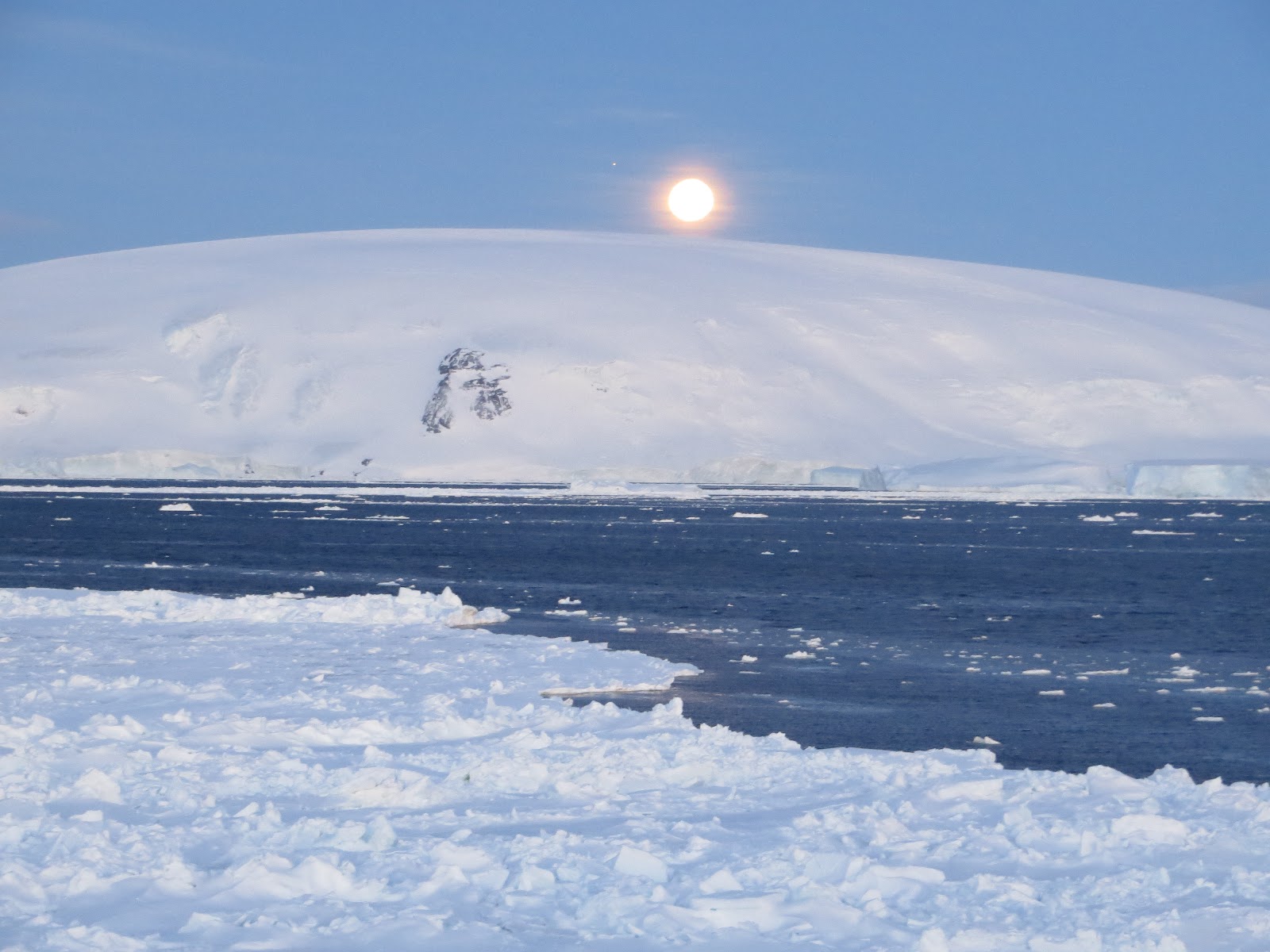
So during the daytime hours, we were looking out onto great swathes of white, with just a few hints of blue. As the sun set at around ten, we were treated to some beautiful reds, oranges and pinks. Then after that, because this far south in the summer it doesn't get fully dark, we still had a lovely hazy, blue tinged landscape to look at.

At around 1am, with most passengers tucked up in bed, I was back up on the bridge watching our progress. The way these ships work is that they break the ice and push it away. That works all the while there is somewhere to push the ice to. But if the ice is solid for too large an expanse, then it has nowhere to go, so the ship can't get through. The ice we were at now was solid for miles ahead of us.

The captain moved the ship into the ice, cracking it up and forcing it along and behind us, but he soon reached a point where the ice had nowhere to go to, and we were in real danger of being trapped in the ice. He had no choice but to pull back into the more open waters.

We were still a long way out from our destination of Snow Hill Island, and so those few of us that were up knew that our plan to see the emperor penguin rookery was already looking decidedly dodgy.

In the morning, the expedition leader Delphine, the Captain and the helicopter crews spent some time discussing what options were open to us. They tried the ice again, but it was not going to be possible safely to get through.


The next step was a helicopter recce.  This showed that while there were a few pockets of open water which the ship would be able to navigate through, there was no way through or around this large expanse we were already at.  

The emperor penguin rookery was expected to be on the sea ice on the other side of Snow Hill Island, which was over thirty miles away from our current position.  This doesn't sound much but in Antarctica, where the weather can suddenly get very bad, very quickly, you just can't safely do a trip that far.  There would be too much risk of getting stuck too far away from the ship.

So our visit to the rookery was not going to be possible, and this far out, we had no idea whether we would get to see any emperors at all.  Clearly everyone was disappointed, especially a few people who had not realised that there was a genuine risk of not being able to get there, but we knew that the Captain and Delphine had not given up without an effort.  And they were soon telling us about some great alternative plans.

In the meantime, what we did have a lot of though, was the ice.  Our purpose in coming to the Weddell Sea was the emperors and the big ice.  We may not have been getting to the rookery, but we were certainly seeing the ice.
As with many occasions, our photos simply cannot capture the real beauty and magnificence, or the sheer size, of the real thing, but I hope that they at least give you an idea of just what an amazing place this is.

Oh, and we did get to see an emperor.  It was way off in the distance, but if you look carefully at my rather blurry zoomed in photo, you can just about make out the way the black markings drop at the side of the neck, and the little flash of yellow.