|
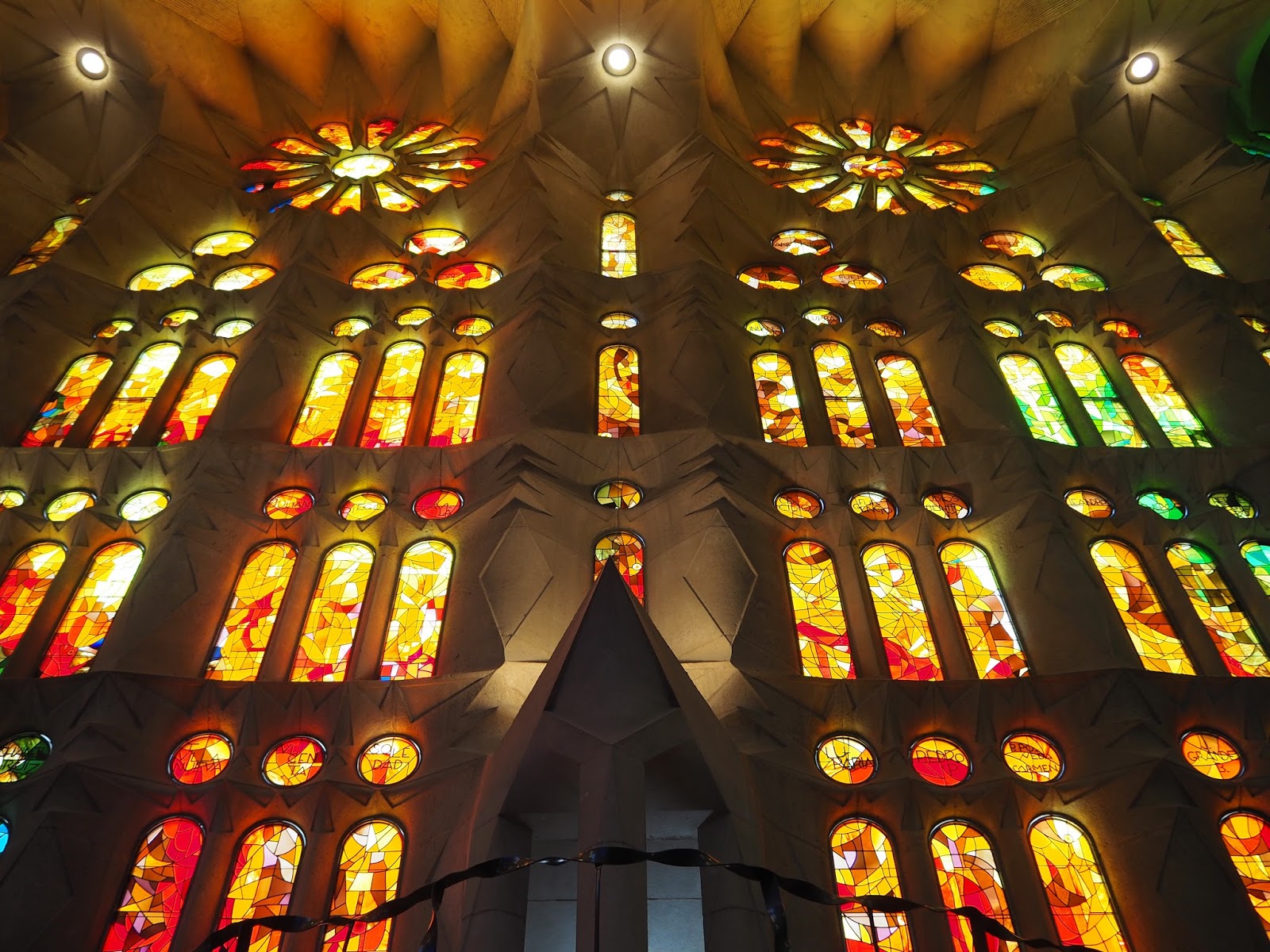
| La Sagrada Familia, Barcelona |
Gaudi’s main customers were the church and the Barcelona middle classes. This post includes his most famous religious building. A separate post covers two excellent residential buildings. In all these designs, it is clear how Gaudi was fascinated by geometry and nature; natural forms were often incorporated in his structural and/or ornamental work.
However, his styles were quite varied, even within one work. We can’t speak with any authority on the architectural influences, features or novelty of his work. Suffice to say, it still feels striking and, well, a bit weird.
 |
| La Sagrada Familia (current the on left, full design on the right), Barcelona |
La Sagrada Familia must be the best-known of Gaudi’s works, albeit that its construction (to his original plans) seems never-ending.
It seems strange, looking at the plans, that it is already so big yet there is so much of the original design to go. In the picture (borrowed from the Gaudi book we bought) you can see that the four huge towers currently standing, are just those four small ones at the front in the full design.
Construction began in 1882, but Gaudi replaced the original architect after a year.
 |
| La Sagrada Familia, Barcelona |
Gaudi lived to see the first bell tower finished in 1925, but a year later suffered a fatal tram accident, with under a quarter of the project finished. Three more bell towers were added by 1930. Reliance on private donations, and interruption by the Spanish Civil War, delayed construction until it began again, intermittently, in the 1950s.
You have to wonder when it will really be finished (especially the largest tower of all), albeit that 2026 is the target date (the centenary of Gaudi’s death).
 |
| La Sagrada Familia, Barcelona |
Grand, impressive, and very strange is how I would describe La Sagrada Familia. Both the inside and outside are striking. The external façade gives the impression that the stone is dripping, rather more suggestive of a gate into Hell. There are a lot of religious and natural details on the outside walls, which apparently have much symbolism but are lost on me.
Inside, the effect of the multi-coloured stained glass (dating only from 1999) is especially striking. We were lucky that the sun was out strongly during our visit, strengthening the impact of this glass. The interior is also notable for its stone columns, up to 21m high, many of which branch off as they reach the vaulted ceilings, like a dense indoor forest reaching its canopy.
The light stone columns and the angles they create scatter the light from the stained glass windows in different directions.
 |
| La Sagrada Familia, Barcelona |
There were also a lot of details a lot to take in internally. The shapes and decoration were typically flowing Gaudi lines, not regular shapes. Some of the internal elements were more surprising to us. The heraldic shields on the columns just looked a bit too much like beer mats. There also seemed to be a paragliding crucifixion. And some of the steps reminded me of Escher. There was also a general lack of symmetry and cohesiveness, which may of course have been exactly the idea.
 |
| La Sagrada Familia, Barcelona |
We bought timed tickets the day before to avoid a longer wait/queue; we heard that the waiting time when we went was 3 hours for those with no booking. The timed ticket process and the scale of the building itself helped it to not feel that overloaded inside, especially for such a tourist mecca. We didn’t appreciate when buying the tickets that audio guides had to be bought at the same time as the tickets, but getting the feel of the place was probably more important than hearing the details.
 |
| Park Guell, Barcelona |
Park Guell, developed especially in 1900-1903 (and more over the next decade), is a bit out of the centre but the tourist bus goes right to the gate. Intended for private residences, Gaudi took a lot of inspiration for Park Guell from the British garden city idea, as an escape from the unhealthy industrial city - hence the English spelling ‘Park’.
 |
| Park Guell, Barcelona |
The development never took off commercially, so in the end, Gaudi bought one of the two houses that had been built, and lived there from 1906-26. The building now contains the Gaudi house Museum, but we didn't go in there.
There are some quite different styles on show in the park, from the ‘classic Gaudi’ flowing lines and curves, such as on the benches around the large public square (which collects rain), to the Greek columns (some of them deliberately but strangely leaning) below the square, which channel the water into a tank to water the extensive gardens, and the Mudejar style from southern Spain.
 |
| Park Guell, Barcelona |
Nature is also a common theme, including the salamander whose mouth serves as the overflow for the tank. Mosaics are common, but on one ceiling collage Gaudi goes beyond that to include bits of glasses, bottles and dolls! In good weather, and for fans of Gaudi, this is a pleasant visit, although there was a huge number of people taking photos of themselves to prove their presence, which made it harder to appreciate the main attractions sometimes.
 |
| La Sagrada Familia, Barcelona |
 |
| La Sagrada Familia, Barcelona |
  |
| La Sagrada Familia, Barcelona |
  |
| La Sagrada Familia, Barcelona |
 |
| La Sagrada Familia, Barcelona |
 |
| La Sagrada Familia, Barcelona |
 |
| La Sagrada Familia, Barcelona |
 |
| La Sagrada Familia, Barcelona |
 |
| La Sagrada Familia, Barcelona |
 |
| Gaudi House Museum, Park Guell, Barcelona |
 |
| Park Guell, Barcelona |
 |
| Park Guell, Barcelona |
 |
| Park Guell, Barcelona |
  |
| Park Guell, Barcelona |
  |
| Park Guell, Barcelona |
 |
| Park Guell, Barcelona |
 |
| Park Guell, Barcelona |