Welcome to our travel blog. We are Tabitha and Nic. In 2011 we 'retired' in our early 40s and set off to travel the world. We spent our first year in South America and have been lucky enough to make two trips to Antarctica.

Our blog is a record of our travels, thoughts and experiences. It is not a guide book, but we do include some tips and information, so we hope that you may find it useful if you are planning to visit somewhere we have been. Or you may just find it interesting as a bit of armchair travel.


Showing posts with label Antarctica. Show all posts

Monday, February 25, 2013

Drake Lake and The House That Cherry Built


All too soon our second Antarctic adventure had come to an end and we were putting our seasickness patches behind our ears, wedging everything securely in pace in our cabins, and preparing for the two and a half days' of rolling waves back to Ushuaia.
But nothing happened. Yes of course there were some waves, but nothing at all like the other three crossings we've made. This was that novel experience that they call Drake Lake. A smooth and easy journey back.

It was quite strange to find that we could walk without holding on, we still had a full complement of passengers in the dining room, and that no glasses, cutlery or chairs went flying during a meal.
We spent some time on deck, watching the birds, and we're lucky enough one day to sail close by some pods of whales. The humpbacks were a bit far away to get a good sighting of, but we got fairly close to some fin whales and spent quite some time watching them alongside us.
We also went along to a few of the talks. I particularly enjoyed Sarah's fantastic rendition of a poem called The House that Cherry Builthind it. It is a silly poem, one of those cumulative ones which adds a line but continually repeats the whole of the story so far each time, but it tells a story of an horrendous journey made by Wilson, Bowers and Cherry-Garrard shortly before the ill fated trip to the South Pole, where the Wilson and Bowers died alongside Scott.
This journey was incredible not so much for its destination, but rather for the fact at it was done in the middle of the Antarctic winter. Back then in 1911, there was a belief that the embryo of the emperor penguin may hold some vital information about an evolutionary link, and so they were eager to get hold of some eggs. The problem with this is that the emperors nest in middle of the winter, so any egg collection would gave to be done then when the weather is at its worst and the sun never rises.
The three of them set off on their trip on 27 June and made their way in the perpetual dark, howling winds and temperatures that froze their clothes solid. They quickly learned that when they first put their head out of the tent in the morning, they had to remember to have it in the right position that they would want it in for the rest of the day because theitr necks froze in that position!
They reached their intended base camp area Mount Terror on 15 July and built a stone igloo with their tent as a roof, but they still had 6.5 treacherous km to go to Cape Crozier where the emperors had their rookery. This journey took them five days because the conditions were so bad and they had to haul themselves over huge ice ridges and dangerous crevasses.
At the rookery, they collected five eggs; two of them got broken on the journey back to the camp at Mount Terror and they pickled the other three embryos in alcohol. But then the blizzard set in so they were going nowhere. Though it turned out that even being in the tent was dangerous, as one night the fat used to fuel their stove spat and hit Wilson in the eye, temporarily blinding him.
On 22 July the blizzard blew away their supply tent, with everything in it. The next night, the tent that was covering their igloo blew away too, so they were left exposed to the wind and snow, huddled in their frozen sleeping bags.
Somehow they managed to survive like this for two days and nights, with nothing to eat and their only liquid coming from sucking the ice on their sleeping bags. Even their teeth were frozen, so much so that when their teeth chattered in the cold, they actually shattered.
Finally the storm relented. They were lucky enough to find their tent and some supplies, and they set off back to the base camp at Cape Evans, arriving exhausted, frost bitten, but alive.
Cherry-Garrard returned to London after the bodies of Scott and the others were found, and in 1913 he delivered the prized embryos to what is now the Natural History Museum. Unfortunately the start of World War I meant that the eggs were not examined until much later. The results were finally published in 1934, by which time they had long realised that the emperor penguin was not the missing link that that had been searching for after all.

Saturday, February 23, 2013

Half Moon Island


In the afternoon, we had our final shore landing on Half Moon Island.  This is a lovely island, with a great colony of chinstraps as well as some adelies and gentoos.

There is a science station, but we decided to spend our time at the other end of the island with the feathered inhabitants.

We landed in a nice spot and trudged up the slope, passing a few stray penguins as we went.  The walk along to the colony was on the side of the slope, and it did feel a bit hairy at times.

The pathway was quite slippery and there was quite a wind blowing at the time, so it did feel that you could lose your footing and end up rolling down the hill.  Thankfully we didn't.


We passed a bit of rock within a gull nesting on it, and stopped to take a few photos there and look out across the sea.  By this time, although the wind was a bit chilly, it was a nice day, and the sea looked a lovely blue against the snowy island scenery.


Further along the way a seal had hauled out onto the beach.  It cast a wary eye our way, but carried on sunning itself.

A couple of penguins came walking along and seemed a bit perturbed to see this enormous creature blocking their way.

They waddled around for a while, but then decided that it wasn't going anywhere, so they would just have to make their way around it.

As we continued to the colony, we found ourselves in a lot of deep snow again, and we were frequently up to our knees.

Thankfully unlike the Devils Island day, here we knew we were on an island, so we weren't going to suddenly drop into freezing seas.  It still made it hard work walking though.  But we got there.

We watched the penguins for a while and then decided to go on to where some other seals had been spotted.  Except here the snow was even worse, with every step landing us knee deep or worse.

We ploughed on for a while before deciding that we were going so slowly that we would probably not make it there and then get back in time for the zodiac, so we turned around and plodded our way back to the landing site instead.


Oh and this is our last landing in Antarctica, so we have to say a fond farewell to the penguins.

Friday, February 22, 2013

Deception Island


When Delphine gave us our briefing about what we would be doing today, we were a bit taken aback to hear that we would be having to get up at the crack of dawn.


We had known that we would be coming to Deception Island in the South Shetland Islands, and that it was worth being on deck to watch the arrival, but we hadn't expected it to be so early.

But she had explained her reasons, and we were all convinced that it would be worth it.

So it was that we were on deck, at 6am in the cold mist of the early morning, to see Ortelius make its cautious way through Neptune's Bellows. Deception Island is in fact a volcano. Not an island with a volcano on it, just the tip of a very large volcano sticking up out of the ocean.

And it is an active volcano that is overdue an eruption. Though we were assured that there are plenty of devices measuring activity so there should be good warning for us to escape to a safe distance.

In a previous eruption, many many years ago, a small section of the wall of the volcano collapsed, allowing the sea to flow into the crater, or caldera.

Ships can sail in through this narrow 255m gap, called Neptune's Bellows, but have to be very careful of Ravn Rock which sits just beneath the water and has claimed ships in the past.

The volcano is huge.  The diameter of the caldera is an enormous 15km.  And it is somewhat surreal to be sailing into the heart of an active volcano, but be surrounded by ice and snow.

The captain navigated his way through the bellows, pushing the ice out of our way as we went, and we were soon safely approaching the old whaling station where there was a pre breakfast landing scheduled.


And for those who were crazy enough, this was also the opportunity to take a polar plunge - not usually so much a swim in the antarctic seas as a quick dash in and out.


We took a look at the weather - snowy, misty and cold - and decided that as we had no intention of getting in the water, there were no penguins here, we had done similar before, and we could get a long range view of the whaling station from the warmth of the ship, we would skip this landing and get in early to a leisurely breakfast instead.

When everyone was back on board having breakfast after the short landing, the ship moved to a different position in the caldera, and pushed its way into some of the sea ice.

From here, Delphine had arranged with the helicopter pilots that we would all be taken up for a short flight around the top of the caldera, to get a birds eye view of this unique island.

This is not something that the trips usually offer, so it was a great opportunity, and why we all forgave Delphine the 5:45am wake up call.  The mist had by this time lifted a bit, so although visibility wasn't amazing, it was good enough to get a fabulous view of the volcano.

As we passed over rim and looked out across the vast expanse of the crater, we could only just about make out the tiny form of our ship, wedged into the ice, which gave us some perspective on just how big the caldera is.  you can just about see it on the very left side of this photo, about half way up. It was a great extra to the trip and we all enjoyed it.

Back on ship, they had lowered the gangways either side, and we were able to get down on to the sea ice and walk around.  With no wildlife to look at and no science stations to visit, this felt a bit like when the schools close due to snow and everyone just goes out to play.

The type of snow doesn't really make good snowballs we discovered, but people were making snow angels and posing for silly photos, and just generally having a bit of fun in the snow.

One of the silly photo opportunities came about when the crew lowered the front mooring line over the side of the ship.  Of course it was ridiculous to think that people would take photos of each other with this huge rope in hand pretending to pull the ship; but we still all did it!  And we also all got together for a big group photo in front of Ortelius.


All in all we had a good morning on Deception Island, and were definitely ready for our lunch.

Thursday, February 21, 2013

Zodiac Cruise

Whilst landings are great, when the ship is in a good area for ice and wildlife, it can also be fun just to go out and cruise in the zodiacs for a bit.  It is fascinating to get up close to the ice in the water when the amazing blues show through, and there is always the chance of a few close encounters with birds, penguins, seals or even whales - though sadly we never found a whale ourselves.

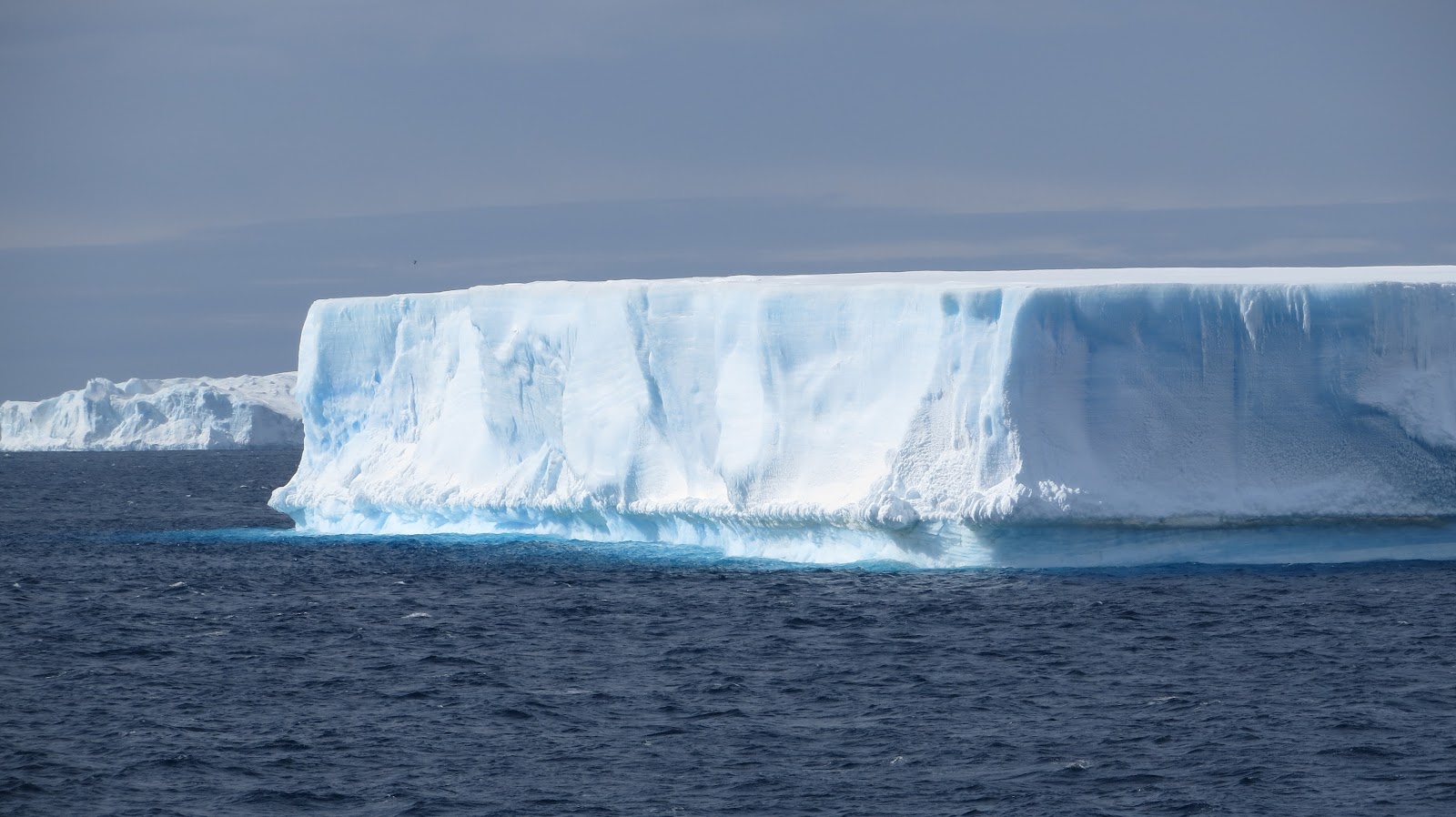
Over lunch the ship repositioned to a location near to Gourdin Island. During this sailing we passed some spectacular and huge icebergs, though as ever, the photos don't really give you any perspective on their size.

In the afternoon, we started off with a zodiac trip around some of the ice and along the shore of the island, which we were to visit later.  There was a huge tabular iceberg that I would have liked to get close to, but it was too far away, so we made do with some of the smaller bergs nearby, in the more sheltered waters.

It was just as well that we didn't go too far out because whilst this didn't seem at all choppy to us compared to a couple of the trips we made for landings last time, there were a few waves crashing over us once we got speed up, and we did get a bit wet.

Some people found this icy drenching a bit much; but then that is why you wear all of your waterproof gear in the zodiac.  It can rather take your breath away though, especially when you get a good splash in the face.


We passed near to one berg that was like a big blue shard pointing up at the sky.  It looked fabulous; sadly my photo of it does not.


Talking of photos, the zodiac cruise was a great opportunity to try out the waterproof camera that we had bought specifically for this kind of thing.

Of course working any camera with gloves on isn't the easiest of things, and I spent quite a while wondering what on earth was going on with my photos before I realised that I had accidentally set the camera onto some kind of create-a-panorama-scene setting. Oops.

We watched for a while as three seabirds squabbled over sharing a jellyfish that one of them had caught, then set off for the coastline of the islands, where the water is an amazing blue colour around the base of the icebergs.


We saw a few crabeater and Weddell seals hauled out on the ice, but we we most excited by our first sightings of the chinstrap penguins.   No photos of these here as was having trouble with the camera at the time, but you will certainly see them in the next posting.

Whilst you wonder sometimes how some types of penguin, such as the gentoo and the adelie get their name, it is pretty obvious why these are called chinstrap. Their predominantly white face and the narrow black band under their chin make them very distinctive.


 Further around, the adelie penguins were in good spirits, darting about in the water, often heading towards the land and then deciding to play in the sea a bit longer. When the time came to get out, they had to swim for the shore line and then propel themselves about a metre and a half upwards to get onto the ledge of the land.

Most of the time this worked, and they would make it onto the land and slide along on their front until they could make it up on to their feet again. Quite often though, they didn't make it; they would hit the ledge near the top and fall back into the water.

Some of them would take three or four attempts to make it onto the land. It did look quite comical, although I suppose it must have been a bit painful for them as they hit the side. They all seemed OK though, so it can't have done them any real harm.