
Over lunch we sailed back to Paradise Harbour and this time as we sailed into it we got a better opportunity to enjoy the scenery. Large swathes of brash ice covered the surface of the water with bergy bits providing convenient platforms for the odd seal or penguin.
We were also lucky enough to spot couple of humpback whales, mother and calf. Even to a novice whale spotter like me, you could tell the distinctive arched motion as they move, and we all waited in hope of seeing the tail coming up.
 |
| Humpback whale tailfin |
We weren't disappointed as they both dived a couple of times giving us a great view of the black and white underside of their tail fins. I was pleased that I just about managed to get a shot of it.
In the afternoon, Nic and I took the zodiac cruise. The general plan for the zodiac cruise is to have a chance to get up closer to the ice, and have a hunt around for any wildlife that might be nearby.

Because the captain keeps a reasonable distance between the ship and any icebergs, not surprising given the reminder of the upcoming 100th anniversary of the sinking of the Titanic, it is easy to be fooled into thinking that they are smaller than they really are.

It is so hard to appreciate the sheer scale of the ocean and islands, let alone the continent itself, and if you can't grasp just how enormous they are, then you can't possibly realise how big the icebergs are. Getting up close to even the little ones, and seeing that they are not little at all, helps you to get a better perspective.

And it is fascinating to look at the different forms that the ice takes. In particular you can see the ones where the ice has turned over, so that the section that was below the water is now on top.
This is when you get to see the fabulous dimpled effect on the ice, or can see the steppes that the water creates. There is more that I could say about the different types, colours and textures of the ice, but as we are now going to the Weddell Sea at the end of the year I'll save it until then.

Much of the water surface in Paradise Harbour is covered in brash ice. The ship ploughs through this easily, but it is a different story in a zodiac. The drivers are all practiced at getting through, but you can see they need to pick the path of least resistance, and even then they get stuck every so often.
 |
| Blue eyed shag |
Generally this is because the motor has got blocked by the ice, and they have to work it free, but sometimes they just reach thicker ice that they can't pass through, so have to back up and go around it. But despite a few problems we got about pretty well.
We passed the Argentine Brown station, where the original buildings were destroyed in April 1984 when the station leader started a fire because he didn't want to stay here for another winter. The people were rescued by a US ship. I assume he had timed the fire for when he knew a shop was scheduled to be nearby, as being left out and exposed once the fire had burned out would almost certainly be deadly.
 |
| Crabeater Seal |
Our first wildlife was the small nesting site of blue eyed shags (keep the smutty comments to yourselves please, we've already done them all!). Their home is a steep multi coloured rock face.
Like the snow, the rock can be turned different colours by various natural elements. They can be blue-green from copper deposits, emerald green from mosses, or orange and yellow from lichens.
 |
| Leopard Seal |
As we were watching the birds, we spotted a couple of crabeater seals. Crabeaters are apparently the most abundant type of seal, but despite their name they don't eat crabs at all, they eat krill. They weren't overly keen on hanging out with us so we watched them for a short while but then left them alone and carried on around the bay.

We soon spotted a leopard seal on some ice and got up fairly close to it. It kept an eye on us but didn't seem bothered by us at all. In fact it was so unimpressed that it proceeded to do an incredibly long and very bright red poo. The bright red was from the krill that it eats. I can only assume that the huge amount of poo meant that a lot of krill had died to satisfy his appetite.
Hearing from another zodiac that a second leopard seal was lounging about on a different bit of ice, we went to check that out. This one didn't stay on the ice for long and for a moment we thought we'd driven it away, but we needn't have worried. It was taking an interest in us, and was swimming nearby to the zodiac, circling around us and popping up regularly.

After a while, a second zodiac turned up, but that didn't bother it either. It just kept on swimming even closer around us, between the zodiacs and underneath them. We had already been told that it is not unknown for the leopard seals to take a bit at a zodiac, so our drivers were keeping a watchful eye to see if the seal turned aggressive and we needed to leave. Happily though, the seal showed no sign of attacking, and just kept swimming around right next to us.

We watched him for a while, and then figured it was time for us to head back. The idea was to leave the second zodiac alone with it. However the leopard seal had other ideas and followed us. It carried on swimming after us for a while, but eventually gave up and went elsewhere. One theory about it following is that it likes the bubbles in the water created by the motor, but we preferred to think that it just taken a liking to us.


 Having spent the morning looking at the ice that was both beautiful and blocking our passage to the emperors, we were looking forward to making a landing this afternoon.
 Delphine had selected a place called View Point, which is a continental landing. There is no wild life in this area, but being high up you get a great view of the surrounding area.
 The flight was only about ten minutes, during which we crossed miles of sea ice.
  It is fabulous to be able to see the circular pancake ice, with their pressure ridges where they knock against each other.
 We landed on View Point and had a few hours to explore the area, with the white snow contrasting against the dark rock, and the odd lichens adding an occasional hint of colour.
 With no penguins to distract us, we focused more on the landscape and the way that the snow had drifted into different formations. Those of you who have travelled on trains in the UK in the winter may recall a wonderful excuse for cancellations that there was the wrong type of snow.
 Well here you really do see different types. You do get the soft and fluffy type, but what you often find is a rather more granular, icy type. We figured that if we added a bit of flavouring then you would have an instant granita.
 At the bottom of the hill, in Duse Bay, we could see an old science station, and close to that were a load of seals hauled out on the ice, but otherwise it was just rock, ice and snow for miles around us.


 Due to our late start into the Drake, and the slower crossing to avoid the worst of the waves, we only passed through the South Shetland Islands half way through the day we had expected to be our first full day of landings in Antarctica. But here the seas calmed and we started to see some of the passengers that we 'lost' during the crossing.
 With fine weather and only a gentle sailing motion, we took the opportunity to do a practice with the helicopters. It seems a strange thing to do, but it is very hard to hear what is being said once the helicopter is going, and people do get hit by turning rotor blades, because they can't see them. And that is in good conditions. Mind you, I think that part of the reason is just to give us something else to do and get us anticipating the landings.
 We sailed on to the Antarctic Sound, passing through to the colder eastern side of the peninsula and, at last, we made it into the Weddell Sea.
 And we hit the ice - though not in the Titanic sense I am pleased to say. We spent some hours pushing our way through the loose ice floes and up on the bridge, I could hear that the captain was getting concerned about how much ice we would find if ahead we were hitting it already. We carried on through, watching the beautiful scenery around us, and wondering how far we would get.
 It is hard to appreciate just how immense Antarctica is. We are only on the tip of the peninsula, but on a continent that is twice the size of Australia, and when the peninsula is around 1500km long, that makes for a pretty big 'tip'.
 After all, it had just taken us nearly three days to sail here and that was only 1000km. And all we could see stretched ahead of ice was miles and miles of sea ice and ice bergs. With a few seals and penguins thrown in of course.
 When we were here last, we saw some impressive icebergs, but this is where the really big ice lives. The tabular icebergs are freshwater ice that breaks off the vast ice shelves and floats away. Many of the really big ones that we saw were some miles in the distance, locked into the sea ice.
 But if you consider that the above water section of our ship Ortelius is about 18m high excluding the masts, then that may help with a perspective in some photos. Bear in mind that a typical height can be 75m, and then you can see from their shape that this makes them very long and wide. Of course 75m is only the visible part; there will easily be seven or eight times as much underneath.
 So during the daytime hours, we were looking out onto great swathes of white, with just a few hints of blue. As the sun set at around ten, we were treated to some beautiful reds, oranges and pinks. Then after that, because this far south in the summer it doesn't get fully dark, we still had a lovely hazy, blue tinged landscape to look at.
 At around 1am, with most passengers tucked up in bed, I was back up on the bridge watching our progress. The way these ships work is that they break the ice and push it away. That works all the while there is somewhere to push the ice to. But if the ice is solid for too large an expanse, then it has nowhere to go, so the ship can't get through. The ice we were at now was solid for miles ahead of us.
  The captain moved the ship into the ice, cracking it up and forcing it along and behind us, but he soon reached a point where the ice had nowhere to go to, and we were in real danger of being trapped in the ice. He had no choice but to pull back into the more open waters.
 We were still a long way out from our destination of Snow Hill Island, and so those few of us that were up knew that our plan to see the emperor penguin rookery was already looking decidedly dodgy.
 In the morning, the expedition leader Delphine, the Captain and the helicopter crews spent some time discussing what options were open to us. They tried the ice again, but it was not going to be possible safely to get through.
 The emperor penguin rookery was expected to be on the sea ice on the other side of Snow Hill Island, which was over thirty miles away from our current position. This doesn't sound much but in Antarctica, where the weather can suddenly get very bad, very quickly, you just can't safely do a trip that far. There would be too much risk of getting stuck too far away from the ship.
 So our visit to the rookery was not going to be possible, and this far out, we had no idea whether we would get to see any emperors at all. Clearly everyone was disappointed, especially a few people who had not realised that there was a genuine risk of not being able to get there, but we knew that the Captain and Delphine had not given up without an effort. And they were soon telling us about some great alternative plans.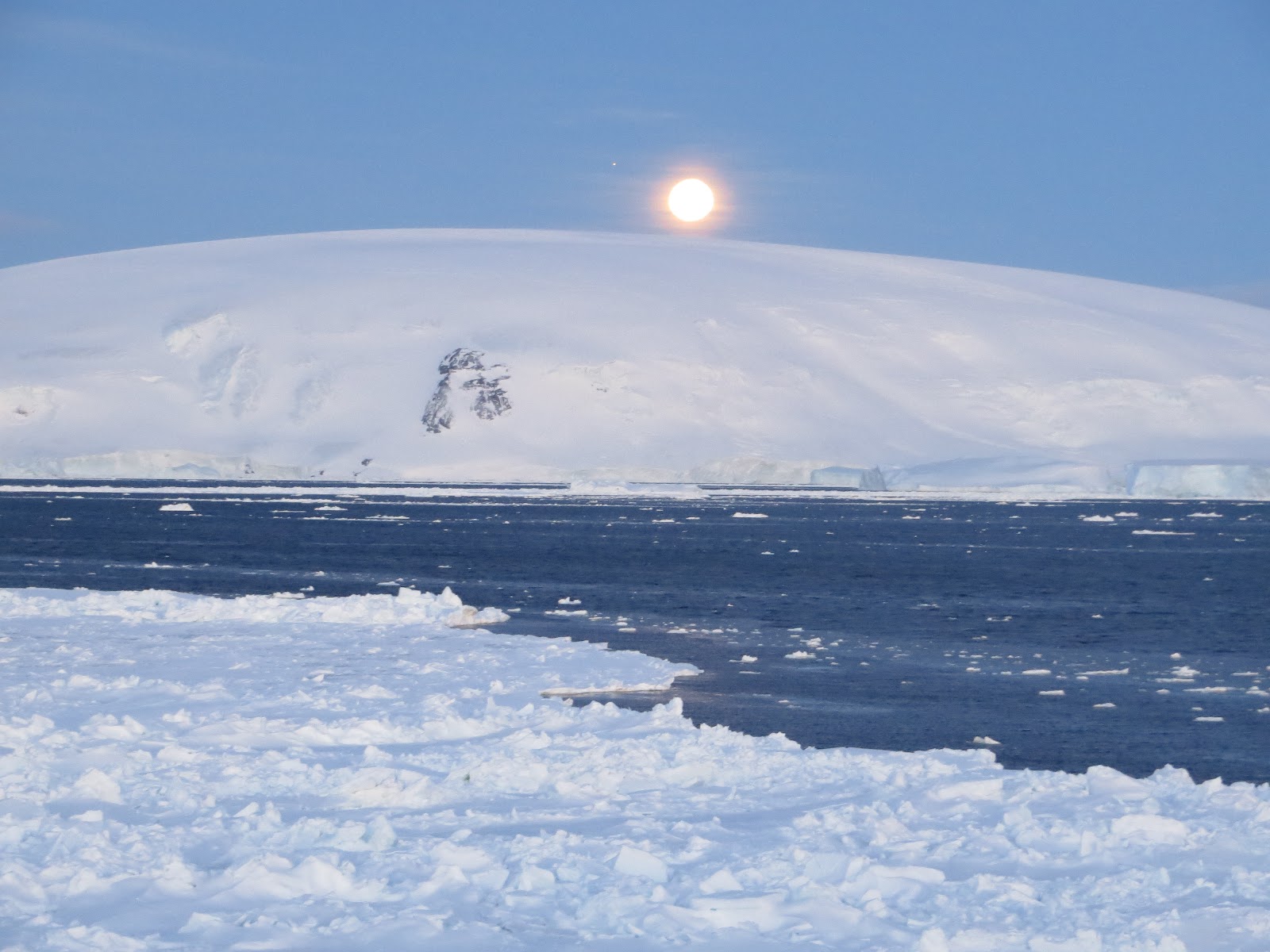

 Oh, and we did get to see an emperor. It was way off in the distance, but if you look carefully at my rather blurry zoomed in photo, you can just about make out the way the black markings drop at the side of the neck, and the little flash of yellow.
 Over lunch we sailed back to Paradise Harbour and this time as we sailed into it we got a better opportunity to enjoy the scenery. Large swathes of brash ice covered the surface of the water with bergy bits providing convenient platforms for the odd seal or penguin.
 Because the captain keeps a reasonable distance between the ship and any icebergs, not surprising given the reminder of the upcoming 100th anniversary of the sinking of the Titanic, it is easy to be fooled into thinking that they are smaller than they really are.
 It is so hard to appreciate the sheer scale of the ocean and islands, let alone the continent itself, and if you can't grasp just how enormous they are, then you can't possibly realise how big the icebergs are. Getting up close to even the little ones, and seeing that they are not little at all, helps you to get a better perspective.
 And it is fascinating to look at the different forms that the ice takes. In particular you can see the ones where the ice has turned over, so that the section that was below the water is now on top.


 We soon spotted a leopard seal on some ice and got up fairly close to it. It kept an eye on us but didn't seem bothered by us at all. In fact it was so unimpressed that it proceeded to do an incredibly long and very bright red poo. The bright red was from the krill that it eats. I can only assume that the huge amount of poo meant that a lot of krill had died to satisfy his appetite.
 After a while, a second zodiac turned up, but that didn't bother it either. It just kept on swimming even closer around us, between the zodiacs and underneath them. We had already been told that it is not unknown for the leopard seals to take a bit at a zodiac, so our drivers were keeping a watchful eye to see if the seal turned aggressive and we needed to leave. Happily though, the seal showed no sign of attacking, and just kept swimming around right next to us.

