Welcome to our travel blog. We are Tabitha and Nic. In 2011 we 'retired' in our early 40s and set off to travel the world. We spent our first year in South America and have been lucky enough to make two trips to Antarctica.

Our blog is a record of our travels, thoughts and experiences. It is not a guide book, but we do include some tips and information, so we hope that you may find it useful if you are planning to visit somewhere we have been. Or you may just find it interesting as a bit of armchair travel.


Showing posts with label Lithuania. Show all posts

Saturday, March 25, 2017

Vilnius - the darker side

Genocide Victims' Museum, Vilnius
Whilst we love visiting the nice parts of a city, and Vilnius does have a lot of those, we are firmly of the view that, to even begin to properly understand a place, you also have to see some of the darker side.

By that, I don't mean seeking out neighbourhoods where you're likely to get mugged, or such like, but rather I mean taking the time to find out about the less pleasant aspects of their past.

In Lithuania, that involved discovering more about the various occupations of the country, and in particular, a visit to the Genocide Victims' Museum.

By it's nature, this is obviously not the most pleasant of posts, and it has some disturbing photos, but it is an important part of Lithuania's still relatively recent past.


Genocide Victims' Museum, Vilnius

Lithuania has had a rough time of it over the centuries, with repeated invasions and occupations, and the last century was no exception to that.

After years of Russian occupation, it seemed during the years of 1918-20, that Lithuania was finally regaining its independence as a sovereign state, but even then, Poland had laid claim to Vilnius, and the national leadership was far from being a democracy.


Ring worn by Partisans as ID at meetings, Genocide Victims' Museum, Vilnius

As the century developed, the Soviet Union and Germany both started claiming parts of Lithuania. Hitler and Stalin agreed their Molotov-Ribbentrop non-aggression pact, and in the process divided up Eastern Europe between them, with Lithuania being allocated to the USSR. After the Soviet Union invaded Eastern Poland, they freed Vilnius from that occupation, but insisted on having tens of thousands of troops stationed in Lithuania as part the enforced 'treaty of mutual assistance'.

Act of Independence, Genocide Victims' Museum, Vilnius

With Russian troops already in the country, Lithuania was effectively powerless to resist, when on 14 June 1940, the Soviet Union issued an ultimatum to cede power once again. The next day, the Soviet Union annexed Lithuania. The people did resist, and a year later the radio announced that the People's Revolt, with the aim of re-establishing an Independent Republic of Lithuania, partisan troops fought the Russians, who retreated, and a provisional government was formed. During the five day revolt, from 23-28 June 194, some 700 or so rebels were killed.

Unfortunately, whilst they managed to dislodge the Russians, their place was quickly taken by the Germans. The Third Reich abolished the provisional government, and on 5 August, a three year period of German occupation began, which would include the persecution and murder of the country's Jews.

Genocide Victims' Museum, Vilnius


When that occupation came to a end in 1944, it still did not bring about freedom, as Lithuania was once again occupied by Russia, and remained part of the USSR until the Act of Re-establishment of Independent Lithuania was signed on 11 March 1990.


During those fifty years of occupation, a grand looking building on the very normal looking Auku Gatve, was used by the Gestapo and KGB for the imprisonment, torture and execution of mostly Lithuanians but also a sizeable number of Poles, and anyone else who didn't suit the regime of the day.


Genocide Victims' Museum, Vilnius


The Third Reich, during the three years they were in Lithuania, killed over 240,000 people, around 200,000 of those being Jews. Only around 8,000 Lithuanian Jews survived Hitler's persecution.

A further 29,500 people were imprisoned and deported to concentration camps, and another 60,000 deported to Germany for forced labour.


During the Soviet occupation, some 200,000 were arrested, interrogated and imprisoned. 132,000 were deported, with 28,000 dying during deportation. Around 21,500 Partisans and their supporters were killed, and a further 20-25,000 prisoners.


Interrogation Room stamp, Genocide Victims' Museum, Vilnius

Over 1,000 are believed to have been killed here in this building on Auku Gatve between 1944 and the early 1960s. The building is now the Genocide Victims' Museum.

It isn't the only place that sits as testament to some of the atrocities that took place in Vilnius, and I'm not sure that I would call it a Genocide Victim's Museum, as that is probably not the main focus, but it is definitely worth a visit.

Genocide Victims' Museum, Vilnius


The upstairs rooms have been given over to information about the occupations, the deportations, and the way that this building was used over the years.


Some of the exhibits about the administrations and individuals involved in the occupations are a little heavy on the facts, but you don't have to read everything, and many of the displays are really well done. It was interesting to read about the life of deportees, and how they found it difficult to return even after Stalin's death.


There is some interesting information about how the KGB would spy on people, including a set up of the Eavesdropping Room.


The Boxes, Genocide Victims' Museum, Vilnius

Passing down into the basement levels, the atmosphere turns from museum into something more like a memorial. This was the prison, and a lot of what is down here has been left exactly as it was when the Russians moved out, including a number of different types of cells.


The first cells that a prisoner would have encountered were The Boxes. They were placed in isolation in these tiny spaces for hours on arrival.


The ones pictured are the nicer ones that were installed after Stalin died, where they can at least perch on a small ledge; prior to that, they were so small that they would have had to stand.


The Padded Cell, Genocide Victims' Museum, Vilnius


The Padded Cell has padded and soundproofed walls. Whilst one might associate padded cells with protection in outdated hospitals for the mentally ill, these are more likely to have been use for torture, and perhaps those driven to a state of madness by that torture.


The Water Cell, Genocide Victims' Museum, Vilnius


The Solitary Confinement In Water Cells had a tiny plinth that the individual was forced to stand on, while the floor around them was filled with icy water - or likely just ice in the winter - which they would fall into should they lose their balance or fall asleep.


The Execution Chamber, Genocide Victims' Museum, Vilnius


But the really exceptional room here is one floor further below ground. The Execution Chamber.


The treatment this part of the visit was, in my opinion, excellent. The floor and part of the wall have been covered in glass to protect them, and a few items of belongings found in a mass grave have been added.


The Execution Chamber, Genocide Victims' Museum, Vilnius


But of course the point of this place isn't what was in it, but rather what happened here. As I said above, over 1,000 are believed to have been led down to this chamber and executed. The bullet holes remain clearly visible.

A slightly macabre, but even so still tastefully done aspect, is the video reconstruction of a person being brought in for execution. It does bring into sharp reality what this place was.


Many of the victims were buried in mass graves, some of which have been discovered in Tuskulenai. They undertook research on 724 of the bodies recovered, and the following is an excerpt from that report, as taken from the Museum's website:


"Most of the executed, that is 685, or 97 per cent, died from various injuries to the scull: 492 sculls had one bullet hole, 110 two holes, 31 three, 13 had four shots, four had five holes, and two sculls had six. Various sizes of ammunition were used (5.6–9mm,) with the bullet usually entering through the back of the scull and exiting through the top of the head or the face. …

“Apart from evidence of shooting, other forms of injury were found: 118 instances of wounds inflicted by a blunt object, 106 instances of piercing, and four of deep cuts or splitting.
“Blunt, indeterminate objects caused shallow injuries. There is evidence that in some cases the head was squeezed between two flat, hard surfaces.

“Four-sided daggers caused the most piercing injuries. … They show that the victim was struck while lying down and the dagger penetrated the head. Cut and (or) split scull injuries were caused by small axes."

Memorial, Genocide Victims' Museum, Vilnius


Visiting places like this is not an enjoyable experience - we're not 'dark tourists' who go to sites specifically for the purposes of seeing where terrible things occurred. But I do believe that, in order to understand what has made a place, and people, what they are, it is necessary to look at events like those that occurred here.


Names of some of those who died, Genocide Victims' Museum, Vilnius


And equally, how are we ever supposed to learn from the awful things that people have done in the past, and make sure that they never happen again, if we don't take the trouble to learn about them.

This place certainly makes you stop and think, and I believe that is a good thing.
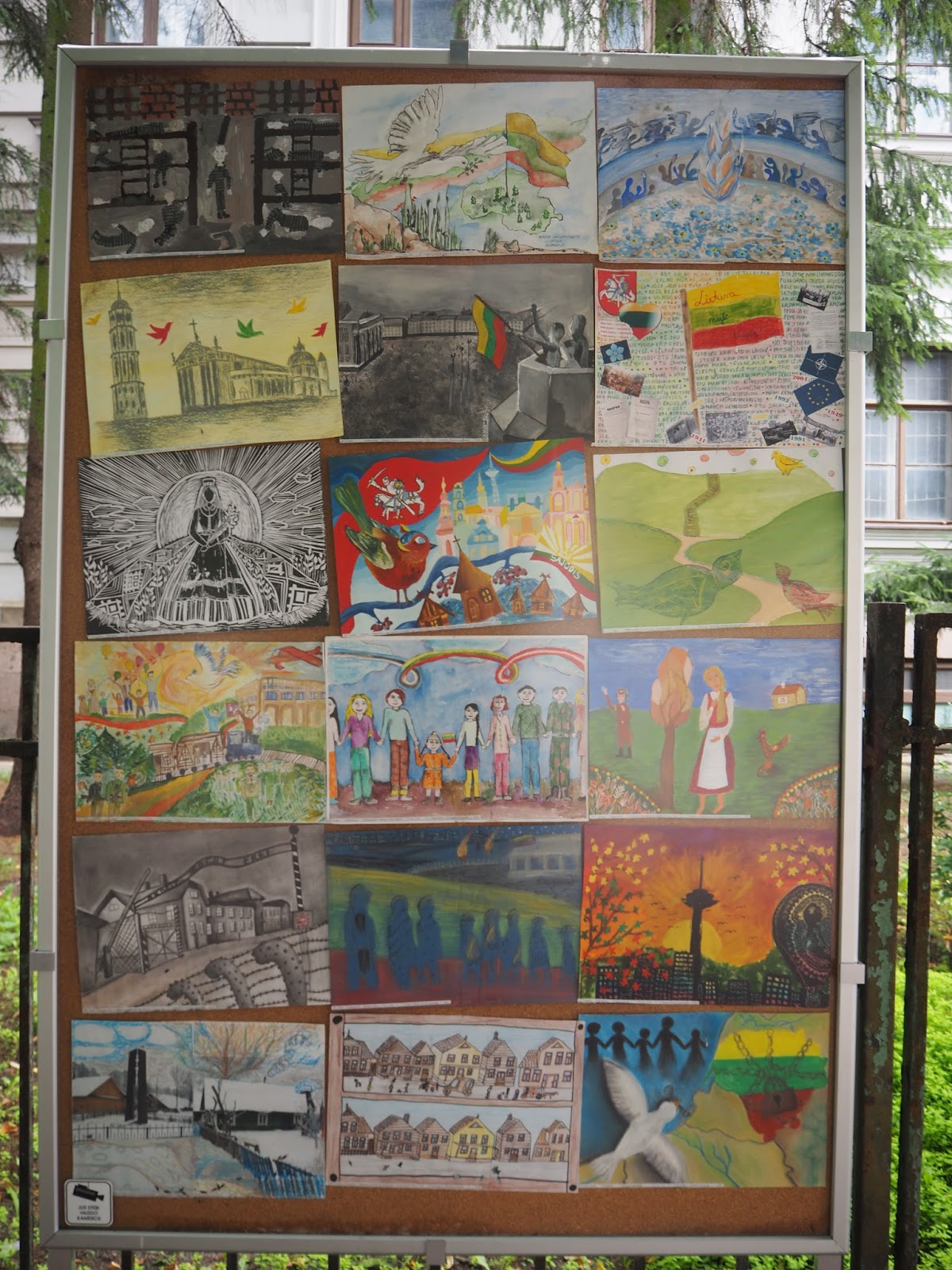


Memorial Art, Genocide Victims' Museum, Vilnius


Nic commented that in many ways, he wonders if Stalin may have been worse than Hitler. Perhaps not in terms of numbers, or in the outrageousness of his plans for domination and genocide, but in the calculating and cruel way that he sought to achieve his own ideals, and dealt with anyone who resisted him.

1990 Protest Rally against USSR occupation, Genocide Victims' Museum, Vilnius
Memorial to the deported, Genocide Victims' Museum, Vilnius
 
Images of killed Partisans and those who sheltered them (left) Items made by Partisans (right)
Genocide Victims' Museum, Vilnius

Items made by Partisans, Genocide Victims' Museum, Vilnius
 
Genocide Victims' Museum, Vilnius
 
The Eavesdropping Room, Genocide Victims' Museum, Vilnius

Genocide Victims' Museum, Vilnius

Genocide Victims' Museum, Vilnius


Genocide Victims' Museum, Vilnius

Prison Cell, Genocide Victims' Museum, Vilnius

The Execution Chamber, Genocide Victims' Museum, Vilnius

Image of Vilnius Jewish Ghetto, Genocide Victims' Museum, Vilnius

Image of Women lined up to be shot, Genocide Victims' Museum, Vilnius
 
Image of killed Partisans, Genocide Victims' Museum, Vilnius
Art by Partisans, Genocide Victims' Museum, Vilnius
 
Art by Partisans, Genocide Victims' Museum, Vilnius

Memorial Art, Genocide Victims' Museum, Vilnius


Thursday, March 23, 2017

Vilnius - the churches and the cakes

St Catherine's Church, Vilnius
Our last stop in the Baltics was Vilnius. We were going to be flying home from here, and didn't expect to need the car in the city, so we dropped it off at the airport and got the bus the rest of the way. This was good for me of course, as not driving meant that I could have a drink when I wanted one.


Having settled in to the tiny attic room in our guesthouse, where needless to say, Nic managed to bang his head at least twice a day, we set off for a little wander around the city. It was a hot afternoon, so it wasn't long before we found ourselves enticed towards the shady seats of a cafe, where we had yet another strawberry pavlova.

Strawberry pavlovas are definitely popular in the Baltics, and we enjoyed sampling quite a few during our stay.


Vilnius


We wandered around a little more but soon ended up in a little wine bar, just around the corner from the café we had been in, where we tried some of their limited selection of wines, until it was time to go for dinner.


We decided to try out a place called Forto Dvaras, which serves up traditional Lithuanian food. The place is a little touristy, but not tackily so.

Church of St Paraskeviya, Vilnius


The menu was extensive, and there were lots of things that we fancied trying, so we ended up ordering a range of plates to share.


The food was definitely tasty, but of course quite a lot of it is potato based and heavy, so we were completely stuffed by the end of the meal, and rolled our way back to the guesthouse.


St Casimir's Church, Vilnius


Even just by the end of the first day, we knew we were going to like Vilnius. It reminded us a lot of what Riga was like when we first went there - touristy, yes, but not heaving with visitors, and a great place for wandering around and relaxing in quiet corners.


The next day it rained. And rained and rained. We had stayed in during the morning, but ventured out for lunch, and then did a bit of dashing in and out of shops, before eventually taking shelter in another café.


Dinner in Bistro 18, was flavoursome and good value with some more interesting dishes to choose from.


Church of the Holy Mother of God, Vilnius

Thankfully, by the morning, the rain had stopped, and we got out and about in town again. We had lunch - if you can call tea and cakes lunch - at a café that quickly became a firm favourite, and that I would definitely recommend. Skonis ir Kvapas has an extensive selection of worldwide teas and coffees, with unusually accurate and helpful descriptions of them and staff who are able to make good suggestions if you're not sure.


Entering the 'Republic' of Uzupis, Vilnius


They had some nice savoury choices, which had been our intention when we went in, but we were instead tempted by the excellent cakes, especially the delicious matcha cake. This would definitely be a regular haunt if we lived here.

We made some effort to walk off our cakes, making our way into the tiny self-proclaimed 'Republic' of Uzupis. The area is one of the oldest parts of Vilnius, and like so many areas that have now become popular and 'bohemian', it was one of the poorest areas and home to the red light district.


Constitution of the 'Republic' of Uzupis, Vilnius


After Lithuania obtained it's independence again in 1991,the cheap accommodation here was taken up by artists, and the place began to take on a Bohemian air.

This is where you will find gigs and festivals, as well as art exhibitions and poetry evenings. Outside of the events though, I'm not sure that there is anything overly Bohemian these days, and I suspect that like many such places, its very popularity will  eventually be its downfall.
Bronze Angel of the 'Republic' of Uzupis, Vilnius


In the meantime though, Uzupis has its own anthem, president, bishop and constitution, the last of which is engraved on tablets on a wall, in multiple languages.


The 'Republic' also has a guardian angel, in the form of The Bronze Angel of Uzupis, a large angel sculpture that was put up in 2002. Apparently they also have a mermaid, who lives on the embankment, and it is said that those who give in to her charms will remain here forever. We must have missed her though.


St Anne's Church (left) and the Bernardine Church (right), Vilnius
Having passed back into the rest of Vilnius, we passed the large white Church of the Holy Mother of God, which was originally fourteenth century, but as reconstructed in 1522, and has been used as a university building and a military barracks.

The university building at least felt like a more respectable function for a church; in most cases it seems like the soviets intentionally used them for very mundane and functional purposes, presumably to underline their view that religion was unimportant. St Casimir's Church, originally a Jesuit church, was even used as a museum about atheism at one stage.
St Anne's Church & the Bernardine Church, Vilnius


Anyhow, Vilnius certainly has a lot of churches, and we continued our stroll up to the Bernadine Church and St Anne's Church, both of which were quite impressive.


The Bernardine - or Franciscan - Monks arrived in Lithuania in the fifteenth century, and built their first church, a little wooden one, here in 1475. That burned down, and the Bernardine Church, or to give it its proper name The Church of Saint Francis from Assisi, that stands here now was built between 1506-16.


St Anne's Church & the Bernardine Church, Vilnius


Fires in the sixteenth century meant that parts were later rebuilt, and new sections were added in the seventeenth century. The crucifix sculpture at the alter dates from 1614, and is believed to be the oldest in Lithuania. It was used as a warehouse during the Soviet occupation, but the Franciscan Monks returned in 1994, after Independence.


Next door, St Anne's has some beautiful gothic brickwork on the outside, which is said to use 33 different types of brick. It is over 500 years old, but the bell tower alongside is a later addition, from the nineteenth century.


The Castle, Vinius


A short walk through the park then brought us to the rather unimpressive castle on the hill, and the rather more impressive, though not really to our taste, Cathedral of St Stanislav and St Vladislav.


Cathedral of St Stanislav and St Vladislav, Vilnius


The cathedral is huge, and dates to around 1419, although has had considerable alteration since then.


The three statues on top, of Saints Stanislav, Helena and Casimir, are recent copies, as the eighteenth century originals were destroyed by the Soviets in 1950.


Grand Duke Gediminas, Vilnius


In 1922, the place was granted the title of Basilica, but like most religious buildings here, it has seen some other uses, including the rather diverse functions of an art gallery and a car repair workshop.

The separate, 57m tall bell tower, was originally part of one of the gates in the city wall.

In the square outside, there is an impressive statue of the Grand Duke Gediminas and his horse, and if you are feeling in need of some extra help, then if you stand on the tile marked STEBUKLAS, you can make a wish; don't forget to turn 360 degrees after making the wish though, if you want to have a chance of it being granted.


Literatu Gatve, Vilnius


We walked back into the main part of town via Literatu Gatve, a street that has been named Literati Street, in recognition of past resident, poet Adam Mickiewitz.

In 2008, students decided to honour him and other literary figures, but creating a wall of literature, featuring plaques and art pieces commemorating them. It was interesting to take a look at.


Church of Saints Johns, University Courtyards, Vilnius


After all that sightseeing, we were ready for dinner, and went to a place called Forest, which was OK but nothing special, especially as the service was very slow. We finished off the evening in a nice cafe and bakery on same square, where we valiantly resisted having more cake, but the choice was good and looked very tasty.


Church of Saints Johns, University Courtyards, Vilnius
The next day, we visited the Museum of Genocide Victims, but I will write about that in the next post. For now lets go on to yet more tea and cakes, this time in the very decent and popular Pinavija.

We broke up our café time for a while in the University courtyards. They are worth a look round, and whilst they were a bit empty when we were there, some of the courtyards could be a good place just to sit out and enjoy a sandwich and a book.

University Courtyards, Vilnius


We also met a lovely big grey cat in one of them, who was sufficiently friendly that, despite clearly having a bit of trouble walking, it came tottering slowly over to us to say hello.


The Church of Saints Johns - or officially The Church of Saint John The Baptist and Saint John The Evangelist - was impressive, with a 68m bell tower, and was yet another Soviet warehouse for a while. It was built in 1426, but has a baroque façade dating from the eighteenth century, designed by Johann Christoph Glaubitz.


University Courtyards, Vilnius


The inside is very ornate, as are the painted ceilings in one of the other buildings and in the bookshop, where they seem quite content that people come in just to look at the painting.


Vilnius


The rest of Vilnius was all about chilling out in cafes etc. We tried the Meat Lover's Pub for dinner, which wasn't a pub, but a restaurant with a bit of bar space. It was busy, and the atmosphere was ok but a name like that implies a high standard to me, and it was just okay; perhaps I am just a more discerning meat lover than they expect.


Restaurant in the air, Vilnius


Our last day here we spent catching up with a bit of a practical stuff in various eateries. WE spent a good while back in the excellent Skonis ir Kvapas, and then went to a place called Kitchen for dinner, which was generally very good, and Nic especially liked his beetroot, pear and goat cheese salad, with crunchy sunflower seeds.

Sadly, we didn't partake of the pop-up restaurant in the town square. Up being the operative word here, as the table and chairs were raised way up into the air, on what was basically just a big crane. I thought it might be fun, but Nic wasn't too keen on the idea!

'Republic' of Uzupis, Vilnius

'Republic' of Uzupis, Vilnius

'Republic' of Uzupis, Vilnius

'Republic' of Uzupis, Vilnius

'Republic' of Uzupis, Vilnius

'Republic' of Uzupis, Vilnius

'Republic' of Uzupis, Vilnius

St Anne's Church, Vilnius

The Bernardine Church, Vilnius

The Bernardine Church, Vilnius

The Bernardine Church, Vilnius

St Anne's Church, Vilnius

Vilnius

Cathedral of St Stanislav and St Vladislav, Vilnius

Cathedral of St Stanislav and St Vladislav, Vilnius

Literatu Gatve, Vilnius

Literatu Gatve, Vilnius

Literatu Gatve, Vilnius

Literatu Gatve, Vilnius

Vilnius

Church of Saints Johns, University Courtyards, Vilnius

Church of Saints Johns, University Courtyards, Vilnius

Church of Saints Johns, University Courtyards, Vilnius

Bookshop, University Courtyards, Vilnius

Cat, University Courtyards, Vilnius

University Courtyards, Vilnius

Vilnius